zenpundit.com » iraq

Archive for the ‘iraq’ Category

Counter-messaging by violin, cello and cigarette

Sunday, May 7th, 2017

[ by Charles Cameron — long a chain smoker, painful on the ear when he attempted the violin, never tried the cello ]
.

No, I don’t smoke any more, haven’t for more than a decade. But I still think of cigarettes as potential sacraments, as when a soldier in the trenches at the Somme passes one to his dying mate.. sacramentals, to be precise. So I can take pleasure in this conjunction of violin and cigarette in defiance of the Islamic State:

and:

**

The potential for grace is more easily seen in music than in smoking, to be sure — Ameen Mokdad with his violin in Mosul surely found it, as did Karim Wasfi with his cello in Baghdad. In these times in which the President scatters bombs around the place with one hand while planning to cut funding to the National Endowment for the Arts with the other, you might like to visit the Facebook page of Karim Wasfi Center For Creativity – Peace Through Arts, or listen to one or more of these videos..

Karim Wasfi — Interviewed by NPR’s Renne Montagne:

Iraqi cellist Karim Wasfi plays music on bomb explosion site:

Karim Wasfi, cello sonata and lecture at Geneva Centre for Security Policy during Geneva Peace Week 2016:

Iraqi Violinist Ameen Mokdad Plays Concert In Defiance Of ISIS | NBC News:

Ameen Mokdad, Viaggio:

**

Music as sacrament is nicely illustrated by John Eliot Gardiner‘s quoting Bach immediately after Sara Mingardo sings O selger Tag! in the DVD of Bach Cantata BWV 63, “Christen, ätzet diesen Tag”:

Wherever there’s devotional music, God with his grace is present.

Recitatives — O selger Tag! is an example — are by definition “musical declamation of the kind usual in the narrative and dialogue parts of opera and oratorio, sung in the rhythm of ordinary speech with many words on the same note”. Arias are the stellar “diva” vocal parts for solo, duet etc, and recitatives the mere handmaidens that carry us from one aria or chorus via narrative to another. How extraordinary, then, the devotion Sara Mingardo‘s musicianship manages to pour into this recitative as performed in rehearsal above!

Mosul drone footage DoubleQuote

Sunday, May 7th, 2017

[ by Charles Cameron — grief and chills ]
.

Horrific CNN drone footage of the destruction in Mosul:

Weaponized ISIS drone footage, source confirmed as ISIS propaganda footage by Joby Warwick here:

Footnoted readings 03 – Violence, theirs and ours

Sunday, April 2nd, 2017

[ by Charles Cameron — on analysis by symmetry, asymmetry, comparison, form ]
.


Vijay Prashad

**

Vijay Prashad writes in Jadaliyya under the title Violence: Theirs and Ours and sub-head Binaries:

I have spent decades thinking about the asymmetry of reactions to these sorts of incidents in places such as Iraq and Afghanistan. I have written about them, indignation as the mood of these essays. But this is spitting into the wind. It is futile on Facebook, for instance, to make the suggestion that the 2016 Karrada bombings in Baghdad (Iraq), which killed over 300 people, should have driven people to turn their profile pictures into Iraqi flags (as the world had done after the 2015 Paris attacks, when 137 people were killed). “Je Suis Charlie” is easy to write, but not #AmiAvijit. Eyes roll when these gestures are urged, whether through bewilderment at their meaning or exhaustion at their sanctimoniousness. After all, the eye-roll suggests, how could one compare a satirical French magazine with obscure Bangladeshi bloggers who have been hacked to death? It takes an immense act of will to push editors to run stories on tragedies that seem distant even from the places where they occur. All eyes focus on the latest attack in Molenbeek, but few turn with the same intensity to look at the tragedies in Beirut or in Cairo.

Okay, what interests me here is his mode of analysis by form: Prashad pays specific and repeated attention to binaries — symmetries and asymmetries. I think that’s a key move in analytic terms, and you can see it in play, again, in the way he phrases his concluding paragraph:

From Lord Baring’s Violent Shock to George W. Bush’s Shock and Awe: this cannot be terrorism. It is the business of rational states. Terrorism is what the others do. Always.

Violent Shock :: Shock and Awe.

**

Agree or disagree with Prashad’s analyses as you will, his method is one that I too have been focusing on here at ZP for a while now — that of emphasis on form as a clue to analytic significance.

Binocular (camera) vision, Mosul

Sunday, March 19th, 2017

[ by Charles Cameron — ISIS vs journo, fighter vs reporter ]
.

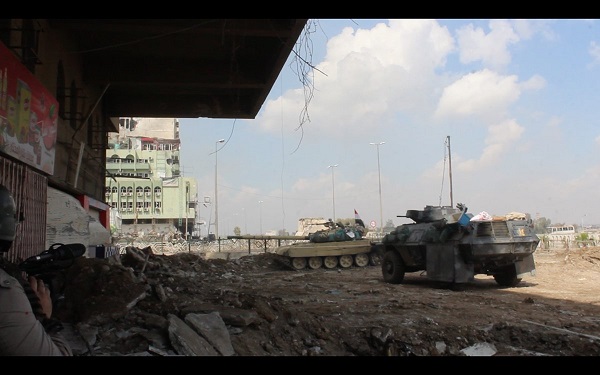
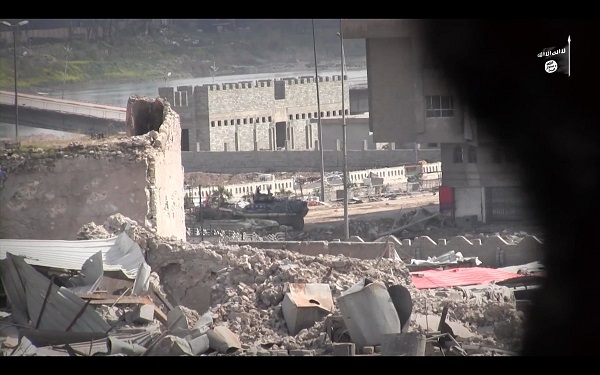
An intriguing use of DoubleQuote thinking — from opposite sides of a conflict moment:

**

These images are even more striking when seen in full:

ISIS pov:

Raineri pov:

Kudos, Daniele Raineri.

A striking image from Scott Atran, Davos

Saturday, February 25th, 2017

[ by Charles Cameron — on the importance of spiritual commitment ]
.

**

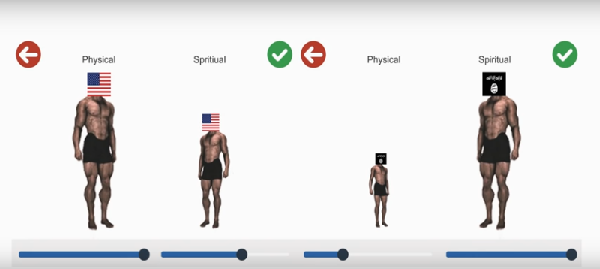
Scott Atran, author of Talking to the Enemy: Violent Extremism, Sacred Values, and What It Means to Be Human, speaking at the World Economic Forum, offered this slide with the following comment:

Our research with fighters shows that the US Government’s judgement is fairly mistaken about underestimating ISIS and overestimating the armies against it, because it denies th4e spiritual dimension of human conflict. Three critical factors are involved: sacred values and devotion to the groupz people are fused with; willing to sacrifice family for values; and perceived spiritual formidability. For example, among fighters on both sides in Iraq and Syria, they rate America’s physical force maximum but spiritual force minimum, and ISIS’ physical force minimum but spiritual force maximum. But – they also think material interests drive America but that spiritual commitment drives ISIS. The spiritual trumps physical force when all things are equal.

Here’s the short clip from which that slide & comment are taken — Friday 24th February 2017, WEF Davos, Scott Atran analyses the limits of rational choice in political and cultural conflict


Switch to our mobile site