zenpundit.com » iraq

Archive for the ‘iraq’ Category

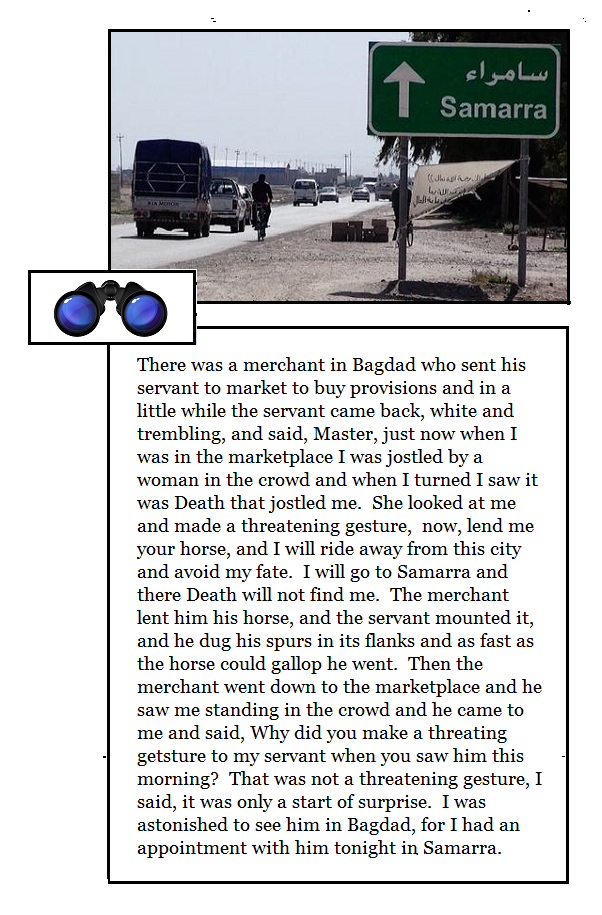
The road to Samarra

Friday, March 6th, 2015

[ by Charles Cameron — parroting Somerset Maugham in the context of suicide ops ]
.

SPEC-Samarra1

The story [lower panel] is Somerset Maugham‘s version of the tale..

**

No news from Samarra since Feb 28th, when Radio Free Europe reported:

IS Militants Attack Samarra

Militants from the radical group Islamic State (IS) have launched an attack on the northern Iraq city of Samarra, where security forces and Shi’ite militia groups have been assembling ahead of an anticipated offensive against IS positions.

Suicide bombers detonated their explosives-laden vehicles in the northern part of Samarra early February 28 and a man in a Humvee also packed with explosives blew up his vehicle in the southern part of the city.

Those who actually volunteer for these suicide missions, however, will find their path to Death in Samarra way more direct.

Mad Dog Mattis – Blogger

Friday, March 6th, 2015

[by Mark Safranski, a.k.a. “zen“]
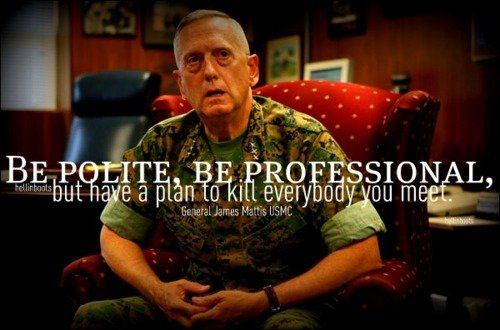
General James N. “Mad Dog ” Mattis, USMC (ret.), the semi-legendary, no-nonsense, fighting general of our recent wars, beloved by his Marines, has accepted a Distinguished Visiting Fellowship at the highly regarded Hoover Institution, where he has been writing an online column. A fancy way of saying that General Mattis has become a blogger.

In fact, he’s quite good at it.

His most recent post can be found here:

Using Military Force Against ISIS

….Following more than a decade of fighting for poorly articulated political goals, the Congress needs to restore clarity to our policy if we are to gain the American people’s confidence and enlist the assistance of potential allies, while sending a chilling note that we mean business to our enemies. With enemy influence expanding rapidly, patience or half-measures cannot replace a coherent strategy for taking measured steps, aligned with allies, to counter the mutating Islamist threat in the Middle East. The AUMF that Congress passes should be constructed as one building block in a coherent, integrated strategy for dealing with a region erupting in crises. Thus the AUMF needs to serve an enabling role for defeating this enemy, and not a restrictive function. Congress’ voice in the AUMF must not reassure our adversary in advance about what we will not do:

  1. We do not enter wars to withdraw; when we must fight, we fight to win. We should not set arbitrary deadlines which would only reveal that our hearts are not really in the game and would unintentionally embolden our enemies with the recognizable goal of outlasting us.
  2. We should not establish geographic limits in a fight against a franchising, trans-national terrorist group and its associates.  Our AUMF must be fit for the purpose of defeating this specific enemy (a non-state entity) and whoever stands with them, but not be hidebound by the rules for how we fought previous wars against nation states.  We must adapt to our time and the threat and not try to fight as we did in the past using rules no longer effective or applicable.
  3. The AUMF should put the enemy on notice that we will deploy all our military capabilities, as well as our diplomatic and economic tools.  If employing our ground forces will help build the international coalition against ISIS, will hasten the enemy’s defeat, will help to suffocate ISIS’ recruiting through humiliating them on the battlefield, or negatively impact their fundraising cachet, then our Commander-in-Chief should have that option immediately available to achieve our war aims.  When fighting a barbaric enemy who strikes fear into the hearts of many, especially those living in close proximity to this foe, we must not reassure that enemy in advance that it will not face the fiercest, most skillful and ethical combat force in the world. 

While I am not enthused about the idea of a large ground deployment back to Iraq – mainly because our national leadership has no idea on how to assemble a constructive political end that a decisive military victory would buy them, nor a willingness to entertain realistic, stabilizing outcomes (like Kurdish statehood) that would mean changing longstanding US policies – I’m very much in tune with Mattis that any warfare should be waged without a set of needless, self-hobbling, anti-strategic restraints. Note what he writes here:

The AUMF must also make clear that prisoners taken from forces declared hostile will be held until hostilities cease. There is no earthly reason for the Congress to acquiesce to funding a war in which we do not hold prisoners until the fight is over, as is our legitimate right under international law. The AUMF should make clear that the same standards that applied to prisoners in Lincoln’s or FDR’s day will be imposed today. This will ensure that we have a sustainable detainee policy instead of the self-inflicted legal quandary we face today, with released detainees returning to the battlefield to fight us.

“Catch and release” by the Bush and Obama administrations – and the latter tightening ROE in Afghanistan into the gray, blurry zone between military force and law enforcement, was self-defeating and probably is responsible for a sizable number of American casualties.

Mattis writes with admirable clarity and focus. More importantly, his military reputation lends invaluable credence toward educating the public and civilian officials about the nature of strategy and the uses and (more importantly) limitations of military force. Hopefully he will gain an even larger platform in time, but for readers at ZP, here are previous posts by the “Mad Dog” :

A New American Grand Strategy

“The Enemy Is Not Waiting”  

The Worsening Situation in the Middle East–and America’s Role   

Pruning the U.S. Military: We Will Do Less But Must Not Do It Less Well
Two new “must read” books

Monday, March 2nd, 2015

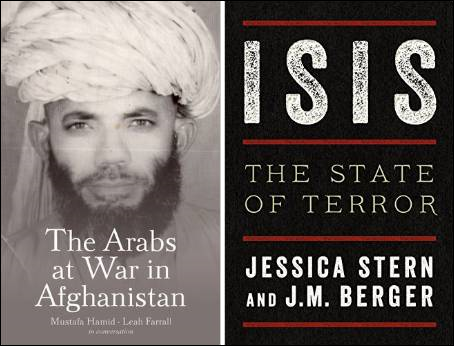
[ by Charles Cameron — Hamid & Farrall, Stern & Berger, full reviews coming up shortly ]
.

Farrall & Berger

**

I recently received a review copy of Mustafa Hamid & Leah Farrall‘s breakthrough book, The Arabs at War in Afghanistan, courtesy of the publisher, Michael Dwyer of Hurst, and will be writing it up once I’ve finished devouring it:

A former senior mujahidin figure and an ex-counter-terrorism analyst cooperating to write a book on the history and legacy of Arab-Afghan fighters in Afghanistan is a remarkable and improbable undertaking. Yet this is what Mustafa Hamid, aka Abu Walid al-Masri, and Leah Farrall have achieved with the publication of their ground-breaking work.

The result of thousands of hours of discussions over several years, The Arabs at War in Afghanistan offers significant new insights into the history of many of today’s militant Salafi groups and movements.

Huzzah!

An almost unbelievable and very welcome collaboration.

**

And:

Huzzah!

Jessica Stern is terrific, while JM Berger is not only one of our ablest analysts, but also a good friend. This book will be an eye-opener.

Mosul Museum: then the good news, perhaps

Saturday, February 28th, 2015

[ by Charles Cameron — second of three posts, this one more hopeful ]
.

Does ISIS really have SEVEN-FOOT tall executioners? Parts of grisly film showing beheading of 21 Christians were faked, claim experts

Veryan Khan, of the Florida-based Terrorism Research and Analysis Consortium, told Fox News that there are several technical mistakes in the video that show it was manipulated.

She said that in the shot of the terrorists marching their prisoners along the beach, the jihadis appear to be 7ft tall – towering as much as two feet above their victims.

This observation was supported by Hollywood director Mary Lambert who described it as the shot with the ‘really tall Jihadists and the dwarf Christians.’

**

Analysis: Mosul Museum video from Islamic State could be a staged drama

Britain’s Channel 4 television gave the Islamic State propaganda video to archaeologists to examine. Mark Altaweel, an American scholar at the Institute of Archaeology at University College London, noted the modern iron rebar protruding from inside some of the smashed statues. It disproves their authenticity.

Nonetheless, the vandalism’s cultural insult strikes deep. The Iraqi people, Altaweel said, “are taking the destruction of their cultural heritage – their identity, essentially – just as seriously as the beheadings.”

**

The above ties in with the notion expressed in the LA Times article — where else? — Islamic State and its increasingly sophisticated cinema of terror:

The cinematography is as crisp and chilling as a horror movie. Men in orange jumpsuits kneel on a beach beneath a sky of broken clouds. Executioners hover over them, dressed in black, knives aglint. A masked militant reads the death sentence. The camera pans across praying faces. Knives are raised, and 21 men are beheaded, blood spilling into the sand and mixing with the waves.

This and other recent execution videos released by Islamic State are slickly produced narratives of multiple camera angles, eerie tension and polished editing that suggest the filmmakers are versed in Hollywood aesthetics. Brutal and perverse, the clips, some infused with music and subtitles, carry a primeval message stylized for a world wired to social media and hypnotized by an endless pulse of competing images.

The beheadings and other killings, including the burning alive of a captured Jordanian fighter pilot, represent an increasingly sophisticated cinema of terror.

For more on the media side of things, see the third and last post in this series.

Mosul Museum: first the bad news, perhaps

Saturday, February 28th, 2015

[ by Charles Cameron — there’s some question as to the authenticity of the footage of destruction in the Mosul Museum, hence the triple post of which this is part 1 ]
.

First the grief, the terrible wailings:

The reason for the grief:

I have to say, I too was moved to tears by the video.

The symbolic impact:

An individual’s response ties the destruction of statuary in with the destruction of lives:

A communal response as reported by the same individual:

**

Two useful articles:

  • from the Editor of the Middle East Journal, More on the Destruction in the Mosul Museum:

    Following up on those videos of ISIS smashing Assyrian antiquities in the Mosul Museum, here’s a roundup of commentary and detail from several websites around the preservationist community. And let me emphasize that I am not giving more weight to the destruction of antiquities than to the slaughter of human beings, but that barbarity is already well known.

  • and from The Atlantic, Erased: ISIS and the Destruction of Ancient Artifacts

    But another way to think about it is as squarely in a tradition of iconoclasm. Abraham, the patriarch of Judaism, Christianity, and Islam, himself destroyed idols, according to tradition. There’s a strong tradition of icon-destruction in Christianity. And in pre-Islamic Mecca, the Kaaba was the site of multiple idols, which Muhammad cleared out before rededicating the site to God. This is certainly the tradition to which ISIS wishes to claim a connection. The Taliban, another group that claimed fidelity to the principles of early Islam, also spent a great deal of time destroying images of people—most notably the massive Buddhas at Bamiyan in Afghanistan. The tomb of Muhammad in Mecca was itself destroyed by Ibn Saud, the first monarch of Saudi Arabia, early in the 20th century.

    The fog of war makes it tough to tell when genuine artifacts are missing or in danger.
    In reality, the relationship with icons in all three Abrahamic religions is rather more elaborate than Abu Bakr al-Baghdadi would want us to believe—but the tradition is there. Destroying traces of forebears, and even robbing and destroying tombs, has perhaps a longer tradition in civilization than preservation.

    ISIS can’t claim total purity on the matter itself, either. The group has widely been reported to be profiting by selling plundered artifacts on the black market.

  • **

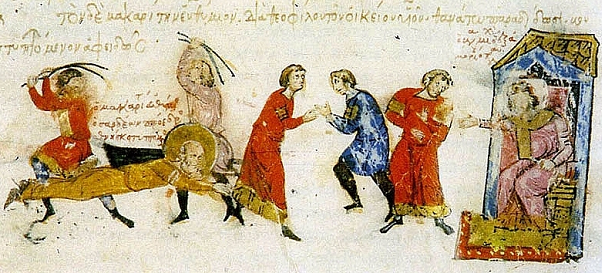
    And let’s not forget the Christian tradition of iconoclasm, both Orthodox and Protestant, either:

    The torture and martyrdom of the iconophile Bishop Euthymius of Sardeis by the iconoclast Byzantine Emperor Michael II in 824, in a 13th-century manuscript

    The torture and martyrdom of the iconophile Bishop Euthymius of Sardeis by the iconoclast Byzantine Emperor Michael II in 824, in a 13th-century manuscript


    Switch to our mobile site