zenpundit.com » bin laden

Archive for the ‘bin laden’ Category

Close reading, Synoptic- and Sembl-style, for parallels, patterns

Monday, March 25th, 2013

[ by Charles Cameron — if we omit all mention of the Qur’an, will the jihad perhaps disappear, you think? ]
.

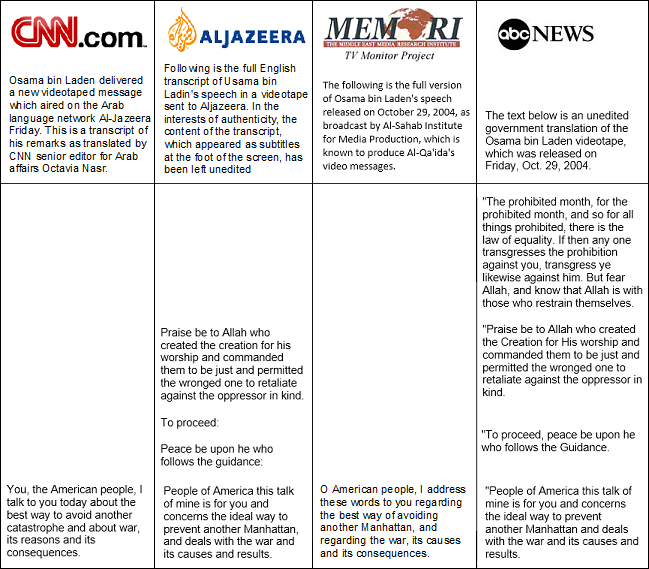
On Friday, Oct. 29, 2004, just before the 2004 US Presidential Election, a videotaped speech by Osama bin Laden was released online and variously reported:
.

.

Being a theologian at heart, I’ve formatted these versions in the style used in comparisons of the Synoptic Gospels, to give you an immediate sense of the differences I’ll be discussing…

**

Just how important was this particular speech by bin Laden?

It was important to bin Laden himself, as it was his first statement after his invitation to the US to convert to Islam. As I have noted before — quoting Michael Scheuer‘s Al-Qaeda’s Completed Warning Cycle – Ready to attack? — bin Laden had been criticized for failing to issue such an invitation:

After 9/11, bin Laden received sharp criticisms from Islamist scholars that dealt with the al-Qaeda chief’s failure to satisfy several religious requirements pertinent to waging war. The critique focused on three items: (1) insufficient warning; (2) failure to offer Americans a chance to convert to Islam; and (3) inadequate religious authorization to kill so many people. Bin Laden accepted these criticisms and in mid-2002 began a series of speeches and actions to remedy the shortcomings and satisfy his Islamist critics before again attacking in the United States.

MEMRI picks up the story here:

The Islamist website Al-Islah explains: “Some people ask ‘what’s new in this tape?’ [The answer is that] this tape is the second of its kind, after the previous tape of the Sheikh [Osama bin Laden], in which he offered a truce to the Europeans a few months ago, and it is a completion of this move, and it brings together the complementary elements of politics and religion, political savvy and force, the sword and justice. The Sheikh reminds the West in this tape of the great Islamic civilization and pure Islamic religion, and of Islamic justice…”

This video is also a significant “first” for bin Laden. In Raymond Ibrahim‘s words in his The Al Qaeda Reader:

This message also marks the first time bin Laden publicly acknowledged his role in the 9/11 strikes; previously he had insisted that he was merely an “inciter” and that it was the Muslim umma in general who had retaliated in defense of their faith.

It was important to the US because of the election four days later. The following exchange occurred on NBCNews’ Meet the Press, Jan 30th, 2005:

MR. RUSSERT: At the Clinton Library dedication on November 18, a few weeks after the election, you were quoted as saying, “It was the Osama bin Laden tape. It scared the voters,” the tape that appeared just a day before the election here. Do you believe that tape is the reason you lost the race?

SEN. KERRY: I believe that 9/11 was the central deciding issue in this race. And the tape–we were rising in the polls up until the last day when the tape appeared. We flat-lined the day the tape appeared and went down on Monday. I think it had an impact

The speech was important, in sum, both to bin Laden himself and to the US electorate: it deserves a close reading.

**

Sadly, however…

Posted, translated transcripts of Al Qaida and other jihadist materials often leave out the salutation and envoi (or other choice bits such as quotes from the Qur’an or Hadith) because they’re too religious or perhaps too Muslim — but when these same pieces of the puzzle are added back into the text, the whole document may cohere to a degree that is otherwise unapparent.

We tend not to “get” religious language. What do Daniel Benjamin and Steven Simon tell us in their book The Age of Sacred Terror?

So much of what was heard from al-Qaeda after the attacks sounded to Americans like gibberish that many chords of the apocalypse were missed.

Our prejudice against alien religious sentiment, or the assumption that it is ritualistic and hence irrelevant, or even worse, “babble” — the term FBI agents used to describe David Koresh‘s religious interpretation of events during the Waco siege — can blindside us to its very real discursive and exegetical power.

That’s the reason I’m offering you this post — years later — as a counter-example of the power of “Sembl thinking” — essentially, the power of pattern recognition as a key to understanding.

**

I read three versions of bin Laden’s videotaped speech of Oct. 29, 2004 at the time: those provided by CNN, MEMRI, and Al Jazeera — one “western secular” source, one with some degree of Israeli association, and one with roots in the Arabic cultures.

CNN cited al-Jazeera as having aired the video, and posted “a transcript of his remarks as translated by CNN senior editor for Arab affairs Octavia Nasr” which, as you can see above or at the link, began, “You, the American people, I talk to you today… “ MEMRI offered The Full Version of Osama bin Laden’s Speech followed by a transcript which began, “O American people, I address these words to you…” And Al Jazeera posted “the full English transcript of Usama bin Ladin’s speech in a videotape sent to Aljazeera” and noted, “In the interests of authenticity, the content of the transcript, which appeared as subtitles at the foot of the screen, has been left unedited” – above a transcript that began:

Praise be to Allah who created the creation for his worship and commanded them to be just and permitted the wronged one to retaliate against the oppressor in kind. To proceed: Peace be upon he who follows the guidance: People of America this talk of mine is for you…

That in itself is interesting — Al-Jazeera has two sentences with religious significance, one of them saying that God “permitted the wronged one to retaliate against the oppressor in kind” — with no mention of them in the MEMRI and CNN accounts.

**

As I read the Al Jazeera version, which seemed to me to be the one most likely to be accurate to bin Laden’s meaning, I came across the phrase:

We want to restore freedom to our Nation and just as you lay waste to our Nation, so shall we lay waste to yours.

There were several other parts of the speech which seemed to make (rhetorical) use of symmetry. There were the comments about “punishing the oppressor in kind” by destroying towers in the US, since towers in the Lebanon had been destroyed (which seems a pretty literal-minded reading of “in like manner”):

And as I looked at those demolished towers in Lebanon, it entered my mind that we should punish the oppressor in kind and that we should destroy towers in America in order that they taste some of what we tasted and so that they be deterred from killing our women and children.

There was a passage pointing up analogies between the Bush dynastic presidencies and similar dynastic rulerships in “our countries”:

… we have found it difficult to deal with the Bush administration in light of the resemblance it bears to the regimes in our countries, half of which are ruled by the military and the other half which are ruled by the sons of kings and presidents. Our experience with them in lengthy and both types are replete with those who are characterized by pride, arrogance, greed and a misappropriation of wealth.

And there was the comment translated in the CNN version:

Your security is not in the hands of [Democratic presidential nominee John] Kerry or Bush or al Qaeda. Your security is in your own hands. Any nation that does not attack us will not be attacked.

Each of these excerpts is couched in an analogical, symmetrical format, but it was the first one that really rang a bell for me — that phrase “just as you lay waste to our Nation, so shall we lay waste to yours” reminded me very strongly of one verse from the Qur’an, which contains the phrase, “And one who attacketh you, attack him in like manner as he attacked you” — the whole verse, Qur’an 2.194, has also been translated thus:

For the prohibited month, and so for all things prohibited, there is the law of equality. If then any one transgresses the prohibition against you, transgress ye likewise against him. But fear Allah, and know that Allah is with those who restrain themselves.

**

Okay, I’d read three versions of bin Laden’s text, and made a mental leap to a Quranic verse — and then I finally ran across ABC’s transcript, which opens with the very verse from the Quran my mind had leaped to.

Here’s where you can find the entire text, which ABC describes as “an unedited government translation of the Osama bin Laden videotape” – presumably from the Foreign Broadcast Information Service (then the FBIS, now the Open Source Center). It is certainly the most complete version I’ve seen:

Full Transcript of Bin Laden Video: ABC News Obtains Complete Text of Bin Laden’s Oct. 29 Video.

I don’t know for sure whether bin Laden used that verse himself (although I’d bet on it), or whether it was “framing matter” added by in the studio by Al-Jazeera (I very much doubt it) — either way, it confirmed my association, and reading the whole speech as a sermonette on that scriptural text gives it, in my view, notable added coherence.

**

Here’s what I wrote after I read the ABC transcript:

I’m particularly interested to note that bin Laden “opens” with the Qur’anic verse which says “for the prohibited month, and so for all things prohibited, there is the law of equality. If then any one transgresses the prohibition against you, transgress ye likewise against him. But fear Allah, and know that Allah is with those who restrain themselves” [Baqara 194].

That’s the central statement of the Islamic view of symmetrical morality in warfare, and prior to reading your full text, I thought I’d detected echoes of it in the OBL text in question — my own analytic process leans heavily on analogy and symmetry — and specifically in the passages I’ve quoted above…

The analogical, symmetrical format is present in each of these excerpts, and indicates how deeply the Qur’anic process runs in bin Laden, even here in a speech which attempts to present that very Qur’anic insight in secular terms to a western audience — explaining the first of the four excerpts above, for instance, with these following words:

No one except a dumb thief plays with the security of others and then makes himself believe he will be secure whereas thinking people when disaster strikes make it their priority to look for its causes in order to prevent it happening again.

and saying again, towards the end of the speech:

you may recall that for every action, there is a reaction.

We do indeed recall that phrase: in its complete form, as given in Isaac Newton‘s memorable Third Law of Motion:

For every action, there is an equal and opposite reaction.

**

For what it’s worth, the Qur’anic verse in question is not present in either Ibrahim’s Al Qaeda Reader, nor in Bruce Lawrence, Messages to the World: the Statements of Osama bin Laden. Ibrahim opens his version with the words, “Praise be to Allah, who created the worlds for his worship…” and Lawrence with, “Peace be upon those who are rightly guided. People of America…”

But no mention of Qur’an 2.194. It has just vanished. Gone. It has been ignored.

Isn’t that pretty much the definition of ignorance?

Words fail me.

Stereocognition, intelligence and the movies

Wednesday, February 20th, 2013

[ by Charles Cameron — Zero Dark Thirty & Manhunt, fact and fiction, that old saw about who it is that gets to write history, thence onwards to theology & the arts, von Balthasar & Tolkien, winding up watching UK & US versions of House of Cards with son David ]
.

How’s this for stereoscopy?

**

You may know I’m preoccupied with the notion of extending the stereo concept — using twin sources to add a depth dimension to one’s perception — from stereophonic audition and stereoscopic vision to stereocognition more generally.

Nada Bakos‘ image above shows a cinema in which documentary and fictional versions of the story of the hunt for bin Laden are playing simultaneously. The fiction, Kathryn Bigelow‘s Zero Dark Thirty, I saw a couple of days ago, and neither I nor son Emlyn, 17, were terribly enthused: the Camp Chapman scene was the one that touched me most deeply.

I’ll no doubt want to see both films, but it’s Greg Barker’s documentary, Manhunter, that will interest me the most, the more factual of the two. And yet that’s curious in and of itself, because as a poet I’m usually interested in the mythic and imaginative as much as or more than the “merely” factual, and I tend to think of the movies as providing a mythology for our times.

Okay, let me give you the two quotes that get to the heart of my sensibilities about fact and fiction at the movies.

What, after all, happens in a movie theater after the lights dim and the curtain rises? F Scott Fitzgerald tells us what happens in the mogul’s screening room, but it’s the same with us peons, isn’t it?

Dreams hung in fragments at the far end of the room, suffered analysis, passed — to be dreamed in crowds or else discarded.

And I’m also with the poet Kathleen Raine, who said:

Myth, when a real event may be the enactment of a myth, is the truth of the fact and not the other way around…

So where does that leave me?

Right now, it leaves me feeling that in the case of these two filmic treatments of the same “true story” — and no doubt many others — history will likely be “written” by the entertainment makers, not the documentarists. Paradoxically, a sad thought.

But let’s go beyond that.

**

I said I’m preoccupied with the notion of using twin sources to add a depth dimension to perception — from stereophonic audition and stereoscopic vision to stereocognition more generally. Another way to say that is that I’m interested in figuring out how to think contrapuntally, and how to score contrapuntal thought — thought which holds two or more potentially conflicting concepts in mind simultaneously, so as to arrive at a deeper understanding than one perspective alone can provide…

I’ve talked about these modes of stereoscopic / contrapuntal cognition before, in posts such as Form is insight: a musical experiment and Silent reading, silent thinking, bifocal glasses, and I’m always delighted when I run across a new very bright thinker (Glenn Gould, Edward Said [Power, Politics, and Culture p. 447}, Wm Blake) playing with these ideas — today it’s the late theologian Hans Urs von Balthasar in his book Truth Is Symphonic: Aspects of Christian Pluralism, who speaks of “the entire polyphony of revelation”, suggests that:

In his revelation, God performs a symphony, and it is impossible to say which is richer: the seamless genius of his composition or the polyphonous orchestra of Creation that he has prepared to play it

and states that “Even eternal Truth itself is symphonic.” The only stronger statement I know of concerning the contrapuntal nature of the world from within the Catholic tradition is JRR Tolkien‘s extraordinary short masterpiece of a creation myth, The Music of the Ainur [scroll down at link], with which he begins the Silmarillion.

So the contrapuntal idea is present in theology, as well as the arts…

**

Stereoscopy, counterpoint.

I’ve been watching the TV series, House of Cards, with my fourteen-year old, David — we’ve now seen the whole first series of the UK version together, and the beginning of the US version, and it’s fascinating to notice the differences.

Frank Underwood (Kevin Spacey):

Francis Urquhart (Ian Richardson):

See both shows, form your own conclusions…

And their source?

Now I shall have to watch Richard III with David, too.

Seal Team Six: asymmetries and symmetries

Thursday, November 22nd, 2012

[ by Charles Cameron — we just might want to understand the Quranic ROE — or at least its OBL and SK Malik versions ]
.

.

I was watching Seal Team Six: The Raid on Osama Bin Laden, the TV movie aka Code Name: Geronimo last night [okay, okay], and one phrase early on caught my attention and sent me, first to the OBL Letters from Abbottabad and Nelly Lahoud‘s commentary, and then to the always useful Brig. SK Malik‘s Quranic Concept of Power.

**

Here then, from Prof: (Brig: Retd.) S.K. Malik’s The Quranic Concept of Power, published in an edition of 500 by Progressive Publishers, Lahore, in 1991, pp. 303-04, is a brief outline of the Rules of Engagement for jihad as presented in the Quran and Sunna, and understood by the late Pakistani Brigadier and professor in the Defence & Strategic Studies department of Quaid-i-Azam University, Islamabad:

The Holy Quran also directs us to observe its ethics during the application of the military instrument. The divine ethics are gracious, liberal and generous. With regards to fighting in the Prohibited Months and in the Sacred Area, our Lord has prescribed for us a law based on quality and reciprocity, We are forbidden from fighting in this period and place for as long as the enemy also observes these limits. If the enemy transgresses these limits, we are permitted to transgress the limits to the extent he does. Even I such situations, our Mighty Lord has commanded us to prefer patience and restraint. Under no circumstances, however, can we transgress the clear and well-defined limits set forth for us by our Lord.

According to the studies carried out by the Muslim jurists on the subject, we are prohibited from cruel and torturous ways of killing the enemy during war. The killing of women, minor, servants and slaves is also forbidden. We are also to spare the blind, the monks, the hermits, the old, the physically-deformed and the insane or mentally-deficient. For bidden for us also is the decapacitation of the prisoners; the mutilation of the men and the beasts; devastation and destruction of harvests; excesses and wickedness; and adultery or fornification with captive women. We are also forbidden to kill hostages and taking to massacre to vanquish the enemy. Muslim soldiers are not permitted to kill their parents in the enemy forces except in absolute self-defence. Prohibited similarly is the killing of peasants, traders, merchants, contractors and the like who accompany the enemy forces to the battle field but do not take part in actual fighting.

The checks and controls imposed by the Holy Quran on the use of force have no parallel in the annals of human history In practice, there were very few occasions on which the Faithful transgressed these limits and they were duly reprimanded for it. It must, however, be understood that the exercise of restraint in the use of force in inter-state relations is essentially a two-way affair. It is not possible that one side goes on exercising restraint while the other goes on committing excesses. Nor doe the Holy Quran approve of such a restraint. In such situations, the very injunction of preserving peace demands the use of limited force. The Holy Quran commands us to use force for just such a purpose.

**

I am sure Brig. Malik’s work [most accessible: his Qur’anic Concept of War] is only the tip of the iceberg here, and I’d certainly advise reading western analysts (eg Cook, Firestone, and Bonner) on the topic, too — but it would surely be helpful to know what ROE jihadists are in fact supposedly following.

Three from the avatar… Aaron Zelin

Friday, November 16th, 2012

[ by Charles Cameron — keeping up with Aaron Zelin on a good day can be quite a feat — this post has taken me a few days to write! ]
.

Let’s start with this avatar business. I picked it up from Gregory Johnsen, who applied the term in a tweet a few days ago to Aaron Zelin:

I chuckled at the description and RT’d Johnsen’s tweet at the time — but a day later the full force of the words “more than just a high producing avatar” came back to me, when I took a look at the things I wanted to pass along here on Zenpundit from that day’s haul, and found that three of them came via Aaron.

**

First up on the 14th: Aaron’s own post on Foreign Policy‘s Middle East Channel, Maqdisi’s disciples in Libya and Tunisia.

This featured the Benghazi and Tunisian groups that share the name Ansar al-Sharia (ASB and AST), and points to the idea that:

much of the scope of their activities lies outside violence. A large-portion of the activities of these groups is local social service provision under their particular dawa (missionary) offices. This broader picture is crucial to better understanding emerging trends in societies transitioning from authoritarian to democratic rule.

This emphasis, Aaron suggests, derives from the writings of Sheikh Abu Muhammad al-Maqdisi:

One of the main critiques Maqdisi presents, and hopes to create a course correction within the jihadi movement, is his differentiation between the idea of qital al-nikayya (fighting to hurt or damage the enemy) and qital al-tamkin (fighting to consolidate ones power), which he expounds upon in his book Waqafat ma’ Thamrat al-Jihad (Stances on the Fruit of Jihad) in 2004. Maqdisi argues the former provides only short-term tactical victories that in many cases do not amount to much in the long-term whereas the latter provides a framework for consolidating an Islamic state. In this way, Maqdisi highlights the importance of planning, organization, education, as well as dawa (calling individuals to Islam) activities.

Finally, Aaron places ASB (Benghazi) and AST (Tunisia) in the wider context of Islamist movements, both Sunni and Shia, writing:

By providing charity, care, and aid ASB and AST are acting similarly in their operations (though should not be confused for allies with or having ideological connections) to the Muslim Brotherhood, Hamas, and Hezbollah. Providing social services has provided leverage for these groups to gain wider popularity and support within the local community.

For more detailed discussion of Maqdisi, Aaron points us to Joas Wagemaker‘s essay, Protecting Jihad: The Sharia Council of the Minbar al-Tawhid wa-l-Jihad.

By my count, therefore, we now have at least five tendencies to think about: (i) politically engaged Islamists, such as the Brotherhood and the Ennahda movement, (ii) jihadists who hope to topple the “near” enemy, ie local despotic rulers of Muslim-majority states, (iii) jihadists who hope first to cripple the “far” enemy, following bin Laden‘s doctrine, (iv) jihadists in the wake of Abu Musab al-Suri‘s nizam, la tanzim (system, not organization), with its implication of decentralized jihad and leaderless resistance, and (v) the distinctive approach to jihad that Aaron discusses, in which al-Maqdisi’s theories are implemented:

ASB and AST do not buy into the democratic process and in spite of it are attempting to consolidate their future Islamic State one small act of charity at a time.

**

Second, Aaron’s Jihadology blog the same day hosted a fascinating piece by Jack Roche, a former member of Jama’ah Islamiyyah, titled The Indonesian Jama’ah Islamiyyah’s Constitution (PUPJI).

One point of interest to me here was a version of the well-known “saved sect” hadith, which has been specifically viewed as referring to al-Qaida on occasion:

It was narrated from ‘Awf bin Malik that the Messenger of Allah said: “The Jews split into seventy-one sects, one of which will be in Paradise and seventy in Hell. The Christians split into seventy-two sects, seventy-one of which will be in Hell and one in Paradise. I swear by the One in Whose Hand is the soul of Muhammad, my nation will split into seventy-three sects, one of which will be in Paradise and seventy-two in Hell.” It was said: “O Messenger of Allah who are they?” He said: “Al Jama‘ah – The main body.” (Sunan Ibnu Majah 3992).

I’d seen versions of the hadith in which it is promised that one Islamic sect will endure to the end and be worthy of paradise, but I’m not sure I’d ever seen this version, with one Jewish and one Christian sect similarly treated.

I imagine the “three” sects are in fact the “one” sect of those who, in the different Abrahamic traditions, have remained faithful to the one truth taught by all the prophets from Moses via Jesus to Muhammad — but might there be some Christians faithful to this day, as is perhaps suggested by Qur’an 5.82 —

The nearest to the faithful are those who say “We are Christians.” That is because there are priests and monks among them and because they are free of pride.

The first part of that verse, be it noted, is less than flattering regarding the Jews…

Again, this post of Roche’s lead me to another source, in this case Nasir Abas‘ book, Exposing Jama’ah Islamiyah. This presumably belongs on the mental shelkf next to Muhammad Haniff Hassan‘s Unlicensed to Kill: Countering Imam Samudra’s Justification for the Bali Bombing [both links are to free, downloadable e-books].

There is much reading to be done…

**

Last, to return to the matter of Twitter, there was Aaron’s response to an FBI announcement —

The FBI tweet actually came after they had made the announcement Aaron was responding to, but his critique still stands…

**

There may be some flattery in this post, but if so, it’s not Aaron’s fault; there’s certainly a sincere compliment intended from my side. But what this post really is — and the length of time it’s taken me to write this has made the timing right — is a “Follow Friday” #FF for @azelin on Twitter, and the articles and resources his twitter feed will lead you to.

consider Aaron a friend in the digital way of things, but my point here is point you towards him if you do not already follow him, and to raise just a few of the issues that struck me in reading just one day’s worth of his output.

Quick update / pointer: GR & AZ on prisoner release

Friday, October 12th, 2012

[ by Charles Cameron — prisoner releases in Arab springtime, abu Musab and Dr Fadl; Daveed G-R and Aaron Z; two major rules of expertise: detail and humility ]
.

video edit-bay photo credit http://www.cdmastercopy.com

.

When you watch a well edited movie, the experience is seamless — despite the fact that the film itself was made with hundreds of cuts and splices. Film critics, mavens and the director’s fellow auteurs who make close readings and detailed studies of the film will see and appreciate the juxtapositions and graphic matches, the fine-tuned timing of the edits and the rhythm they give the film — but for the regular viewer, one continuous fabric of story unspools from opening to final credits. The editor’s skill lies in getting the splices right to a degree beyond the perceptual acuity of the audience.

Similarly, a fine carpenter will often want to make joints that are imperceptible to the client, seeking a sensitivity to changes in height that is an order of magnitude greater than that required for the quick, cheap performance of the same task.

True expertise is at least one order of magnitude deeper and more self-critical than it needs to be to satisfy a cursory examination.

**

Thus when Daveed Gartenstein-Ross and Aaron Zelin tackle the important — and easily overlooked — question of How the Arab Spring’s Prisoner Releases Have Helped the Jihadi Cause in the Atlantic, they offer us both far more than we knew we needed to know, and yet less than they themselves know about the topic, let alone the broader current of jihadist movements of which this particular topic is a single strand.

It’s a significant topic, though, as their opening paragraphs neatly show:

The investigation of the devastating Sept. 11 attack on the U.S. consulate in Benghazi, Libya, that killed American ambassador Christopher Stevens — limited as it is by security concerns that hampered the FBI’s access to the site –has begun to focus on a Libya-based Egyptian, Muhammad Jamal (a.k.a. Abu Ahmad al Masri). As a detailed Wall Street Journal report explains, Jamal is notable not only for having fighters under his command and operating militant training camps in the Libyan desert, but also for having recently gotten out of Egyptian prison.

This latter fact makes Jamal part of a trend that has gone largely unremarked upon in the public sphere since the beginning of the “Arab Spring” uprisings: prisons in affected countries have been emptied, inmates scattering after being released or breaking free. In many cases, it is a good thing that prisoners have gone free: the Arab dictatorships were notorious for unjustly incarcerating political prisoners, and abusing them in captivity. But jihadists have also been part of this wave of releases, and we are now beginning to see the fruits of the talent pool that is back on the streets.

I recommend it highly, as does at least one other more knowledgeable than I.

**

A short piece in the Atlantic is just right for an overview, but not the place to lay out the next level of detail, though — and there are three people in particular whose names I am always on the lookout for, names of people who vanished from public view into some form of imprisonment, and who are of considerable interest to me personally — primarily for their theological significance.

The first of these is the Imam Musa al-Sadr, whose “disappearance” in Gaddafi’s Libya at the age of 50 in 1978 deprived the Lebanon of an inspiring leader — in a manner that eerily paralleled the ghayba or “occultation” of the Twelfth Imam of the Ithna ‘ashariyah.

The second would be Sayyed Imam Al-Sharif, aka Dr. Fadl, whose book The Essentials was one of the major works of AQ ideology and the #2 jihadist manual downloaded from the net according to the CTC Atlas (p.10), and who recanted it from Egyptian prison, writing his Rationalizing Jihad in Egypt and the World which so severely critiqued AQ-style jihad that al-Zawahiri felt obliged to pen a 200-page counter-argument. In Dr Fadl’s case, the interest would be to see what he would say if liberated now.

And my third “person of interest”? That would be Mustafa Setmariam Nasar aka Abu Musab al-Suri, whose massive Call to Global Islamic Resistance is a key document that chides bin Laden for “leading them to the abyss”, says “Al Qaeda is not an organization, it is not a group, nor do we want it to be. It is a call, a reference, a methodology”, and calls for “terrorism created by individuals or small autonomous groups (see Lawrence Wright, The Master Plan). Abu Musab, who may have been released from prison in Syria recently, is of interest to others as potentially the jihadi’s foremost strategist — and to me chiefly because of his use of apocalyptic forecasting in his Call.

**

Since their Atlantic piece was a short context-setter rather than a longer analytic paper, I asked Gartenstein-Ross and Zelin — Daveed and Aaron — net acquaintance and friendship is a funny thing, we haven’t worked out the etiquette as yet — about Dr Fadl and Abu Musab, not mentioned in the piece itself but surely not far from their thoughts.

Twitter, of course, is even more drastically reduced than a piece in the Atlantic, so you can think of their tweeted responses as something along the lines of snapshots of footnotes. Nevertheless, they give me, as an inquiring mind, a quick glimpse of what a couple of those at least an order of magnitude deeper into these things know or conjecture about two people whose names and potential activities we should all keep stashed quietly away on some easily accessible mental shelf.

Three things emerge from these tweets — how little we actually know, how important what we don’t know may be, and how honest the best analysts are about the limits of their knowledge. I’d tweeted, congratulating them on their piece and saying:

hipbonegamer: i note no mention of Musab a-S – any idea what’s up with Dr Fadl? Dead? Released? Still held?

And they responded:

Aaron Y. Zelin: Details still too murky on Abu Mus’ab and no info on Dr. Fadl.

D. Gartenstein-Ross: However, I think the question “where is Dr. Fadl, and why haven’t we heard from him?” is important for many reasons.

D. Gartenstein-Ross: But Aaron is right: I haven’t seen any open source info that speaks to his fate.

That’s two things at once: not very much, and a great deal.

**

So if lesson #1 of this post is that True expertise is at least one order of magnitude deeper and more self-critical than it needs to be to satisfy a cursory examination, lesson #2 must be…

True expertise never claims knowledge that is one order of magnitude deeper or more exact than is actually known.

Putting that in other terms: having an accurate mapping of one’s archipelago of knowledges within one’s oceanic ignorance is a highly significant form of meta-knowledge, lacking which one’s knowledges have blurred edges and little definitional value.

And that in turns means — especially in terms of human intelligence — humility.

**

It’s Follow Friday (#FF) on Twitter: @DaveedGR and @azelin are two folks you can follow and trust.


Switch to our mobile site