zenpundit.com » analytic

Archive for the ‘analytic’ Category

Brezhnev in the Hejaz?

Friday, August 26th, 2011

Bruce Reidl makes the case for the al-Saud as a decaying gerontocracy:

Brezhnev in the Hejaz

….The biggest unknown is how the Kingdom’s youth will act. They have watched the drama in Tahrir Square, Benghazi, Sanaa and Dara’a on Al Jazeera just like everyone else. And the Kingdom has the same demographics as its Arab brothers: a large youth bulge that is chasing too few jobs. With 80 percent of Saudis under thirty years of age and 47 percent under eighteen, unemployment is officially at 10 percent but could be as high as 25 percent (only men are counted since few women seek jobs outside the home). The underemployed young Saudi man may have more money in his pocket than his Egyptian counterpart, but he too is frustrated by a system that is completely opaque and closed to the nonelite.

While the Kingdom can and does appease many of their demands-Abdullah announced over $100 billion in new bonuses, mosque building and other payoffs-it offers them little or nothing in the way of political change. Absolute monarchies are not usually accommodating to transparency and devolution of authority; by definition absolutists do not compromise with nonroyals.

….In fact the Hejaz, with its young, urbane, religiously varied population, has never fully accommodated to Saudi and Wahhabi rule. It has always seen itself as more cosmopolitan than the Nejd, looking across the Red Sea to Egypt and north to Syria rather than to the harsh interior. For centuries it was part of the broader Islamic world, a part of the great empires of Islam from the Umayyads to the Ottomans. The Nejd, in contrast-remote and barren as it is-stayed outside of those empires. Moreover, the Hejaz is home to the holy cities of Mecca and Medina, the center for the hajj every year, visited by Muslims from all corners of the ummah, thus exposing Hejazis to views and peoples of all caste and creed. Many of them are critical of the ugly remodeling of the holy cities to allow for plush apartment blocks and designer stores, and a few even long for the return of the Hashemites.

Color me skeptical that there is any deep longing among Saudis of any region to have the great-great- grandson of the Sherif of Mecca “return” as the lord of the Hejaz.

Alice’s Wonderland Battlespace

Tuesday, August 23rd, 2011

[ by Charles Cameron — terrain, IDF, inverse geometry, Necker cube, apocalyptic signs ]

.
wonderland-battlespace.jpg

I’ve just read one of those astounding paragraphs that leaves the mind reeling. Some of you will no doubt already be aware of the work of Israeli architect Eyal Weizman, but for me, his paper Lethal Territory is new ground:

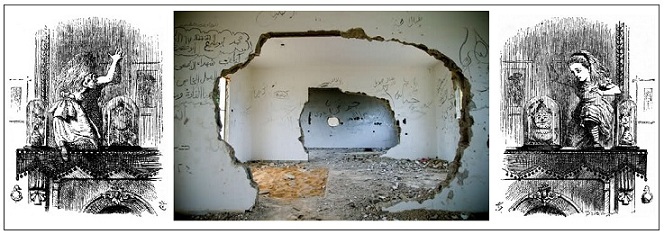
The maneuver conducted by units of the Israeli Defense Forces (IDF) in Nablus in April 2002 was described by its commander, Brigadier General Aviv Kokhavi, as inverse geometry, the reorganization of the urban syntax by means of a series of microtactical actions. During the battle, soldiers moved within the city across hundred-meter-long “overground-tunnels” carved through a dense and contiguous urban fabric. Although several thousand soldiers and several hundred Palestinian guerrilla fighters were maneuvering simultaneously in the city, they were so “saturated” within its fabric that very few would have been visible from an aerial perspective at any given moment. Furthermore, soldiers used none of the streets, roads, alleys, or courtyards that constitute the syntax of the city, and none of the external doors, internal stairwells, and windows that constitute the order of buildings, but rather moved horizontally through party walls, and vertically through holes blasted in ceilings and floors. This form of movement, described by the military as “infestation”, sought to redefine inside as outside, and domestic interiors as thoroughfares. Rather than submit to the authority of conventional spatial boundaries and logic, movement became constitutive of space. The three-dimensional progression through walls, ceilings, and floors across the urban balk reinterpreted, short-circuited, and recomposed both architectural and urban syntax. The IDF’s strategy of “walking through walls” involved a conception of the city as not just the site, but the very medium of warfare — a flexible, almost liquid medium that is forever contingent and in flux.

Where do I begin?

* * *

1. For sheer creativity, this reversal of our normal understanding of space is both audacious and brilliant.

2. In terms of the way the humans living in that space experience the tactic, it must have been – must be – extraordinary – shock and awe on the scale of the individual family and its dwelling. Weizman quotes a Palestinian woman’s response:

Imagine it – you’re sitting in your living room, which you know so well; this is the room where the family watches television together after the evening meal. .. And, suddenly, that wall disappears with a deafening roar, the room fills with dust and debris, and through the wall pours one soldier after the other, screaming orders. You have no idea if they’re after you, if they’ve come to take over your home, or if your house just lies on their route to somewhere else. The children are screaming, panicking. . Is it possible to even begin to imagine the horror experienced by a five-year-old child as four, six, eight, twelve soldiers, their faces painted black, submachine guns pointed everywhere, antennas protruding from their backpacks, making them look like giant alien bugs, blast their way through that wall?

3. It has a past, there’s nothing entirely new under the sun:

Similarly, the strategy of walking through walls, as Israeli architect Sharon Rotbard reminds us, is reinvented for every urban battle in response to local conditions. It was first described in Marshal Thomas Bugeaud’s 1849 draft of La Guerre des Rues et des Maisons, in the context of anti-insurgency tactics used in the class-based urban battles of 19th-century Paris. Instead of storming the barricades from the front, Bugeaud recommended entering the barricaded block at a different location and “mouse-holing” along “over-ground tunnels” that cut across party walls, then taking the barricade by surprise from the flank. On the other side of the barricades and a decade later, Louis-August Blanqui wrote this microtactical maneuver into his Instructions pour une prise d’armes.

* * *

4. Quite apart from the notion of “inverse geometry” there’s a thread here that concerns mapping and deserves investigation. First, there’s this quote in Weizman’s essay from Walter Benjamin:

I have long, indeed for years, played with the idea of setting out the sphere of life — bios — graphically on a map. First I envisaged an ordinary map, but now I would incline to a general staff’s map of a city center, if such a thing existed. Doubtless it does not, because of the ignorance of the theatre of future wars.

Then, in a paper on forming a “coherent mental map of the Israeli-Palestinian conflict”, Weizman writes

A new understanding of territory had to be developed to govern the West Bank. The Occupied Territories were no longer seen as a two-dimensional surface, but as a large three-dimensional volume, layered with strategic, religious and political strata.

Later in the same piece, we can find Weizman’s description of a “politics of verticality” along with its vivid quote from Benveniste:

New and intricate frontiers were invented, like the temporary borders later drawn up in the Oslo Interim Accord, under which the Palestinian Authority was given control over isolated territorial ‘islands’, but Israel retained control over the airspace above them and the sub-terrain beneath.

This process might be described as the ‘politics of verticality’. It began as a set of ideas, policies, projects and regulations proposed by Israeli state-technocrats, generals, archaeologists, planners and road engineers since the occupation of the West Bank, severing the territory into different, discontinuous layers.

The writer Meron Benvenisti described the process as crashing “three-dimensional space into six dimensions – three Jewish and three Arab”. Former US president Bill Clinton sincerely believed in a vertical solution to the problem of partitioning the Temple Mount. Settlement Masterplanners like Matityahu Drobless aimed to generate control from high points.

* * *

Upside down, inside out, and topsy-turvy? Apart from Alice, of course — what does this remind me of?

Why, religion, naturally.

Take the Gospel of Thomas, logion 22 (Barnstone & Meyer, p. 51):

Yeshua said to them,
When you make the two into one,
and when you make the inner like the outer
and the outer like the inner
and the upper like the lower,
and when you make male and female into a single one,
so that the male will not be male nor female be female,
when you make eyes in place of an eye,
a hand in place of a hand,
a foot in place of a foot,
an image in place of an image,
then you will enter the kingdom.

Similar sayings are found in the poetry of Kabir, the great Indian mystic-poet, and described thus by Linda Hess (The Bijak of Kabir, p.135):

A particularly intriguing category of Kabir’s poems is the type known as ulatbamsi, poems in “upside down language”. They intrigue because they are absurd, paradoxical, crazy, impenetrable, and yet they purport to be meaningful.

In Japan, they might be given the name of koan — Hess quotes (p. 145) an early Mahayana sutra describing the world as “like a desert mirage, a celestial city, a mirror-reflection, a stone made from water hardened by a whirlwind”.
.

Here is one of the signs of the end times quote in Islamic sources:

After the night of three nights, the following morning the sun will rise in the west. People’s repentance will not be accepted after this incident.

* * *

And so perhaps the saying with which Eihei Dogen described Master Dogo‘s friend in his Shinji Shobogenzo best encapsulates both the state of mind that a sudden reality-reversal accomplishes in those who are not prepared for it — and paradoxically, the state of mind in which it can be accepted as part of the natural order of things:

He does not have a roof above his head, nor any ground under him.
Historical footnotes to game theory

Sunday, August 21st, 2011

[ by Charles Cameron — philosophy, psychology, history, game theory, dilemma, commons cooperation, analogy, 9/11 ]

.

I have an interest in game theory that is much like my interest in music: I can’t play, but I can whistle. And so it is that I’ve substituted curiosity about the history of the thing, and whatever analogical patterns I can discern there, for any actual ability at the thing itself.

Somewhere in my analogy-collector’s mind, then, I have these two quotes, cut from the living tissue of their writer’s thoughts, and prepped fpor contemplation. I find them, in retrospect, quite remarkable.

Jean-Jacques Rousseau, in On the Inequality among Mankind, wrote:

Such was the manner in which men might have insensibly acquired some gross idea of their mutual engagements and the advantage of fulfilling them, but this only as far as their present and sensible interest required; for as to foresight they were utter strangers to it, and far from troubling their heads about a distant futurity, they scarce thought of the day following. Was a deer to be taken? Every one saw that to succeed he must faithfully stand to his post; but suppose a hare to have slipped by within reach of any one of them, it is not to be doubted but he pursued it without scruple, and when he had seized his prey never reproached himself with having made his companions miss theirs.

And David Hume, in A Treatise of Human Nature:

Your corn is ripe today; mine will be so tomorrow. ‘Tis profitable for us both that I shou’d labour with you today, and that you shou’d aid me tomorrow. I have no kindness for you, and know that you have as little for me. I will not, therefore, take any pains on your account; and should I labour with you on my account, I know I shou’d be disappointed, and that I shou’d in vain depend upon your gratitude. Here then I leave you to labour alone: You treat me in the same manner. The seasons change; and both of us lose our harvests for want of mutual confidence and security.

*

Those two, I believe, are fairly well known – I was delighted the other day to run across a third sample for my collection. William James, in The Will to Believe, writes:

Wherever a desired result is achieved by the co-operation of many independent persons, its existence as a fact is a pure consequence of the precursive faith in one another of those immediately concerned. A government, an army, a commercial system, a ship, a college, an athletic team, all exist on this condition, without which not only is nothing achieved, but nothing is even attempted. A whole train of passengers (individually brave enough) will be looted by a few highwaymen, simply because the latter can count on one another, while each passenger fears that if he makes a movement of resistance, he will be shot before any one else backs him up. If we believed that the whole car-full would rise at once with us, we should each severally rise, and train-robbing would never even be attempted.

*

The first two quotes are of interest as showing the forms that an idea which will later be mathematized can take.  They are, if you like, precursors of game theoretic constructs, although neither Hume nor Rousseau appears to be mentioned in von Neumann and Morgenstern‘s Theory of Games and Economic Behavior.

The third, I think, is even more interesting..  Consider the eerie and heroic “fulfillment” of that third paragraph if read “as prophecy” – in this account from the 9/11 Commission Report of the events on United Flight 93:

During at least five of the passengers’ phone calls, information was shared about the attacks that had occurred earlier that morning at the World Trade Center. Five calls described the intent of passengers and surviving crew members to revolt against the hijackers. According to one call, they voted on whether to rush the terrorists in an attempt to retake the plane. They decided, and acted. At 9:57, the passenger assault began. Several passengers had terminated phone calls with loved ones in order to join the revolt. One of the callers ended her message as follows:

“Everyone’s running up to first class. I’ve got to go. Bye.” The cockpit voice recorder captured the sounds of the passenger assault muffled by the intervening cockpit door.

Yesterday’s highwayman is today’s hijacker, yesterday’s train is today’s plane…

*

If there’s anything to be learned here, it’s not a novel way of protecting trains or aircraft from passengers of malicious intent —

It’s that there’s a subtle thread running from something akin to instinct that’s also close to unspoken common sense, surfacing for a moment in the writings of thoughtful individuals, leading on occasion to the formulation of exact mathematical principles — but also (i) available, (ii) in the human repertoire, (iii) to be acted upon, (iv) cooperatively, (v) as required, (vi) via the medium of human common interest, (vii) which provides the resultant trust.

Which may in turn offer some reason for hope — for a humanity in various forms of communal distress…

New Book: The Five Percent by Coleman

Saturday, August 20th, 2011

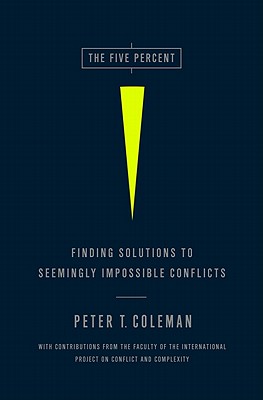
The Five Percent: Finding Solutions to Seemingly Impossible Conflicts  by Peter T. Coleman

A courtesy review copy just arrived. Intriguing, because the study here is about intractable or seemingly “wicked” socio-political conflicts. Coleman is an academic, researcher and activist in conflict resolution studies. Perhaps it will have some nuggets of wisdom for “de-escalating” 4GW or Hybrid wars.

Two Links on Political Economy

Friday, August 19th, 2011

That are complementary:

Fabius MaximusOur fears are unwarranted. America is in fact well-governed.

….America is in better shape than Europe and Japan.  We have good demographics, sound fundamentals, relatively easily solved problems, and no powerful enemies.  Why the constant sense of crisis?  QE2, hyperinflation, climate armageddon, Obama the socialist, AIDS, alar on apples, jihadists, debt, swine flu – a constant drumroll of doom, explained by Peter Moore in “The Crisis Crisis” (Playboy, March 1987).   Answer:  elites govern a weak people by exploiting their fears.  For example, look at the “government is broke” panic.

  • The Federal government’s net debt is only 2/3 of GDP, well below the 100% of GDP “red line” (that Italy reached many years ago).
  • The short-term deficit is mostly the result of the recession.  The medium-term deficit results from the Bush tax cuts.
  • Social security’s funding gap is small vs. GDP and easily fixed.
  • The massive funding gap is mostly Medicare, easily fixed by adopting features from the mixed public-private systems in Europe.

Panic pushes Americans to allow cuts to popular social services plus increased and highly regressive taxes.  No matter who wins, after the 2012 election our representatives will implement the necessary policy changes:  raising taxes, cutting expenditures, rebuilding our infrastructure, and beginning the long process of reforming health care.  It will be another morning in America.  There is no crippling polarization, just distracting noise masking a consensus between both parties about the key points of economic and foreign policy.

We do not see this long-standing pattern (see the previous post for details) because our collective OODA loop is broken (see section 6 here).  That makes us easier to lead.  Relying on wealth-based elites to run the country has a cost.  They take a large share of the pie; we take a small slice….

Global Guerrillas –JOURNAL: Global Financial Cancer

….A couple of years ago, I wrote that the underlying structure of the global financial system was a “bow-tie.”  Here’s what I said (it’s worth going back and reading the entire article and this paper on bow-ties from John Doyle at Caltech):

If we look at this new global system from a distance, its architecture is something called a bow-tie. This is a universal control system architecture that underlies complex systems from the Internet to cell metabolism.

Bowtie

What is a Bow Tie?

The bow-tie is a very powerful approach to organizing a complex system (it’s a system design that is used by controls engineers.)  Visually, it starts with complex inputs (the left side of the bow-tie), boils them down into simple build blocks (the knot), which then allows the construction of complex outputs (the right side of the bow-tie….

….Unfortunately, as I mentioned in the earlier article, bow-ties are vulnerable to organisms that attach themselves to the knot at their center (like the way cancer uses the body’s metabolism system).  These organisms relentlessly use the bow-tie’s knot to for selfish ends (rapid growth).  The end result is typically death for the system.  My suggestion was that the instability we were seeing in the financial system was an indication that it had been co-opted by a malicious, self-serving organism.

Of course, at the time there wasn’t much data to support this systemic analysis.  That has been rectified with a new paper, The Network of Global Corporate Control by Vitali et. al. from ETH in Zurich.  This paper finds, through extensive network analysis, that a small group of tightly intertwined financial institutions control the bow of the global financial system.  It is in effect, the world’s first super-organism….

They are both right. Probably not perfectly, the American economy, even more the world’s, is too complex a subject, but right enough.

FM is right that the emerging class of people I have been calling “the Oligarchy” the past couple of years do not intend to deliberately implode the system that is working outrageously to their benefit. They are currently in the stage of trying to come up with an arsenal of tax-farming schemes that will pass political muster (i.e. – not provoke uncontrollable, “Arab Spring” street demonstrations or a successful populist electoral revolt  that would eject their sycophants from government en masse in a single election) and are quietly, methodically and strategically neutering the capacity of the populace to resist their rule over the long term. It is there that we see seemingly unrelated measures as the coordinated political attack on public education and university education, restrictions on the ability of citizens to get courts to review arbitrary actions of Federal agencies, imposition of laws to permit total surveillance of US citizens and acquisition of their personal information and so on.

The elite, who are not completely cohesive or formally organized, are supremely confident in their ability to manage the technocratic economy they are putting into place, or if bumps in the road appear, to squeeze sufficient new leverage from the populace through inflation, devaluation and other forms of expropriation. Unfortunately, I am not confident that these folks are nearly as competent as they imagine themselves to be. Nor am I sure that the global system that they have built, a high-performance, deeply complex, ultra-leveraged, financial sector dominant political economy isn’t as fragile and dangerously unstable as people like John Robb and Nassim Nicholas Taleb have maintained it is. The system might not just crash, it could crash to extreme depths with unprecedented speed with unforseen consequences (financial systems also ensure the reliable and continuous logistical flow of *food* and *power* to population centers).


Switch to our mobile site