[ by Charles Cameron — the second holiest site in Islam disrespected by the editors of Azan? ]
.
I’ve taken out the surrounding matter, but here’s the section on “decorated mosques” as a sign of the time of the Dajjal or Islamic antichrist, from Maulana Asim Umar‘s Third World War and Dajjal in the second issue of Azan:
.
.
**
There’s no doubt that the photo that has been dropped in there is of the interior of the Mosque of the Prophet in Medina — compare, for instance here and specifically the larger image here — and the accompanying hadith are less than flattering of “decorated” mosques — suggesting they signal the time of the Dajjal:
Anas ibn Malik narrates that the Prophet of Allah said that the Hour would not arrive until the people show off to each other in (the construction and going to) of mosques. [Saheeh Ibn Khuzaima Vol. 2 Pg. 282, Saheeh Ibn Hibban Vol. 4 Pg. 493]
Abu Darda said that when you start decorating your mosques and beautifying your Mushaf (i.e. The Quran – adorning it with jewellery etc.), then upon you will be destruction. [Kashf-ul-Khifa’ Vol. 1 Pg. 95]
Abdullah ibn Abbas narrated that the Prophet said that when the sins of a nation increase, then their mosques become greatly decorated. And decorated mosques will only be constructed at the time of the emergence of the Dajjal. [Al Sunnan Al-Waridah Fil Fitn: Vol. 4 Pg. 819]
**
What exactly do the Pakistani brothers intend to signal to their readers with this juxtaposition? As Mr Orange has reminded me, they are Deobandis, and consider devotions at the tombs of saints to be a form of shirk — but would they bring bulldozers to the Prophet’s mosque on that account, as their Wahhabi brothers in jihad did to a small shrine commemorating Abraham in Ayn al-Arous, Syria, recently?
I’d like to get a better sense of whether the juxtaposition is as unexpected in Pakistani context as it was to me, thousands of miles away, and would appreciate further clarification…
[ by Charles Cameron — on end-times rhetoric and having no need of sun or moon ]
.
Detail from a Commentary on the Apocalypse by Beatus of Liebana
**
On the whole, the “signs of the end times” described in the installment of Maulana Asim Umar‘s Third World War and Dajjal, pp. 23-31, and now posted in the second issue of Azan on pp 83-89 are standard fare of the “wars and rumors of wars” type that could fit pretty much any time n history, including our own — “When the most despicable person of a nation would be its leader” would fit an astounding number of rulers across recorded history, depending on your point of view, including Nero and Diocletian, George III and Abe Lincoln, and a slew of Saddams, Mubaraks and Assads…
There was one section, however, that struck me as a powerful piece of visionary apocalyptic, and I wanted to bring it to the attention of those interested in such things.
The Maulana writes [I’ve omitted the Arabic honorifics since I lack Arabic, and corrected one typo in Enlish]:
“Hazrat Abu Hurayrah narrates that the Prophet of Allah said that the Day of Judgment would not occur before a fire erupts from Hijaz and lights up the necks of the camels of Basra.” [Bukhari, Muslim]
The incident mentioned in this Hadith has already occurred according to Hafiz Ibn Kathir (RA) and other historians. This fire appeared in 650 H on the Day of Jumu’ah in some valleys of Madinah Munawwarah and remained for about a month. The narrators have said that the fire suddenly erupted from the direction of Hijaz. The scene looked like a whole city of fire – containing a whole castle, tower or battlement etc. Its height was 4 “farsakh” (around 12 miles) and its width was 4 miles. The fire would melt any mountain it reached as if the mountain was made out of wax or glass. Its flames had the sound of thunder and the energy of river waves. Blue and red-colored rivers looked to be coming out of the fire. In such a (horrible) state, the fire reached Madinah Munawwarah. But the curious thing was that the wind that was emanating from the direction of the flames felt cool in Madinah. The scholars have written that the fire had encompassed all the jungles of Madinah such that in the Haram-e-Nabwi and in Madinah, all the houses were lit up as if from the sun. The people would do all their work in the night from the light (of the fire); in fact, the light of the sun and the moon would became faded because of the light of the fire.
Some people of Makkah (at the time of the fire) bore witness that they saw the fire while they were in Yamama and Basra.
A strange quality of the fire was that it used to burn the stones to coal but it would not have any effect on the trees. It is said that there was a large stone in a jungle – half of it was in the limits of Haram-e-Madina and half of it was outside the limits. The fire burnt to coal the half of the stone that was outside the limits of the Haram-e-Madina. However, it cooled when it reached to the other half and hence, this half remained safe.
The people of Basrah bore witness that they saw the necks of camels light up from the light of the fire…
[The Beginning and the End: Ibn Kathir (RA)]
**
You know my interest in semblances and parallelisms. Compare:
in fact, the light of the sun and the moon would became faded because of the light of the fire
in that narrative with:
the city had no need of the sun, neither of the moon to shine in it, for the glory of God did lighten it
in Revelation 21:23.
I am not arguing that there is an echo between the two accounts, nor that they describe the same phenomenon — simply that the rhetoric of each has a similar poetic intensity. This just happens to be one of those occasions when there are more things in heaven than are dreamed of in your natural sciences.
[ by Charles Cameron — not good branding, not Islamic, dumbstruck? — not a whole lot else to say ]
.
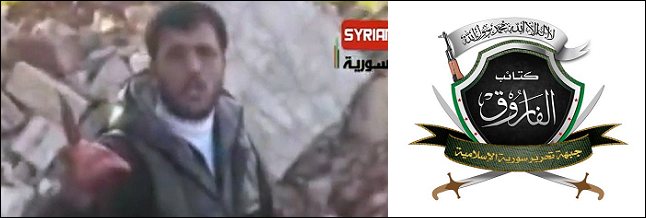
Commander Abu Sakkar / the Farouq Brigades logo
Let’s take the bald facts first:
Commander Abu Sakkar of the Farouq Brigades, Free Syrian Army, had himself videotaped this month cutting open and seeming to eat the flesh of a just-killed Syrian soldier loyal to President Assad — to send a message. According to a New York Times “Lede” blog-post, he preceded this act with the words:
I swear to God, soldiers of Bashar, you dogs — we will eat your heart and livers! … God is great! Oh, my heroes of Baba Amr, you slaughter the Alawites and take their hearts out to eat them!
His rhetoric as reported speaks of eating the heart: in the event, it is a portion of lungs that he eats, or mimics eating.
**
This has to be seen in many contexts — one of them, the branding of the Syrian rebels in general and the Farouq Brigades in particular.
Twelve activists in an office in Reyhanli, Turkey near the border run Farouk’s Facebook page, web site, and Twitter account. They’re working on the TV channel, which Mr. Awad says they’ve envisioned as a tool to resocialize fighters off the battlefield.
“The regime will fall one day,” he says. “We have 20,000 fighters–they all won’t stay fighters. They will put down their weapons, and need to integrate into the world. TV, radio, these things will help.”
The media office’s latest brand offering? A three-dimensional version of the Farouk logo, which will be used in videos and other online material.
“The guys complained the logo wasn’t nice enough,” Mr. Awad said, laughing. “They wanted a 3D one.”
**
Moralizing about someone eating the flesh of a deceased enemy is pretty easy to pull off — unless one still thinks it’s a potent way to acquire one’s enemy’s courage, which is now something of a curiosity in the anthropologist’s cabinet of concepts. Here, dug up from the section on Homeopathic Magic of a Flesh Diet in Sir JG Frazer‘s 1922 edition of The Golden Bough, now long out-dated, is the picture as it used to be seen:
When Basutos of the mountains have killed a very brave foe, they immediately cut out his heart and eat it, because this is supposed to give them his courage and strength in battle. When Sir Charles M’Carthy was killed by the Ashantees in 1824, it is said that his heart was devoured by the chiefs of the Ashantee army, who hoped by this means to imbibe his courage. His flesh was dried and parcelled out among the lower officers for the same purpose, and his bones were long kept at Coomassie as national fetishes. The Nauras Indians of New Granada ate the hearts of Spaniards when they had the opportunity, hoping thereby to make themselves as dauntless as the dreaded Castilian chivalry.
Even as a cannibal delicacy, the white man’s heart seemed to have special virtue! As I say, though — that’s all a little out of date.
**
Eating one’s enemy, however, is a distinctly un-Islamic behavior, whatever century we’re in. One early Islamic narrative concerns Hind bint ‘Utbah avenging deaths in her own family by eating the heart of a great Muslim warrior, dear to the Prophet — far from being an example of what is permitted in Islam, she’s an example of what Muhammad was up against by way of enemies in the early days of his preaching:
Hind Bint `Utbah, the wife of Abu Sufyaan, ordered Wahshiy to bring her Hamzah’s liver, and he responded to her savage desire. When he returned to her, he delivered the liver to her with his right hand, while taking the necklaces with the left as a reward for the accomplished task. Hind, whose father had been killed in the Battle of Badr and whose husband was the leader of the polytheist army, chewed Hamzah’s liver hoping to relieve her heart, but the liver was too tough for her teeth so she spat it out and stood up shouting her poem:
For Badr we’ve paid you better
In a war more flaring than the other.
I was not patient to revenge the murder of
`Utbah, my son, and my brother.
My vow’s fulfilled, my heart’s relieved forever.
Hind did eventually become a Muslim — but on account of this very event, was never fully included among “the Companions of the Prophet”.
**
I don’t want to moralize over Commander Abu Sakkar‘s act, not having been in his shoes — but it is vile under pretty much any moral standard you might choose. A problem arises, though, when one attempts to use it to justify one side or another, in a conflict in which brutality of one kind or another seems to be present on both sides. As Sakkar himself told a Time correspondent:
You are not seeing what we are seeing, and you are not living what we are living. Where are my brothers, my friends, the girls of my neighborhood who were raped?
Abu Sakkar is just one man, and there are many other armed fighters in Syria who reject such sectarian actions and would be horrified by the mutilation and desecration of a corpse — let alone an act of cannibalism. But he is a commander in a decisive battle in Syria — hardly a marginal figure.
**
Not without reason did Kurtz whisper at the end of Joseph Conrad‘s Heart of Darkness, as in Francis Ford Coppola‘s Apocalypse Now:
[ by Charles Cameron — Khorasan, black banners, the Ghazwa-e-Hind — when will the updating ever stop? ]
.
**
It looks as though I first realized that “the black banners of Khorasan” was a meme I should be “eyes out” for was in July 2007, when John Robbpointed us to a piece by Syed Saleem Shahzad on events at the Red Mosque
For the al-Qaeda leadership sitting in the tribal areas, the situation is fast evolving into the promised battle of Khorasan. This includes parts of Iran, Pakistan, Afghanistan and Tajikistan from where the Prophet Mohammed promised the “end of time” battle would start.
That reference to Khorasan in turn led me back to a slightly earlier Washington Post piece where the Khorasan / black banners motif was clearly set forth, along with a pointed comment from Andrew Black, co-founder of Thistle Intelligence Group:
The battles today, like those against the Soviet occupiers, are also fought with religious verve. The Taliban and al-Qaida fight under a black flag connoting the participation of Islam’s prophet in their battle for Khorasan, the ancient name for the region centered around Afghanistan.
Khorasan increasingly features in the militants’ videos and the name was taped to the leg of a suicide bomber who killed 24 people in Pakistan’s Northwest Province this spring.
“One should not underestimate the theological importance of Khorasan to aspiring mujahedeen; particularly those who are only able to initially view the conflict through the Internet,” said Black.
Hamid Gul was in Shahzad’s piece too, talking about the Red Mosque and the Red Fort — and here, too, I likely made my first acquaintance with the motif of the Ghazwa-e-Hind, symbolized by the wish to plant Pakistan’s flag on Delhi’s Red Fort:
It is a pity that our army was preparing youths to seize Lal Qala [the Red Fort of Delhi] and they ended up seizing the Lal Masjid,” Gul said.
Both these memes have been around longer than I have, but back then they didn’t seem to be attracting much attention in the west.
Now they’re cropping up all over — and I’m (to switch metaphors in mid-stream) paddling hard to keep up.
**
The black flags are alive and well this week, as shown in this video of the graduation of a new batch of the Free Army fighters in Syria:
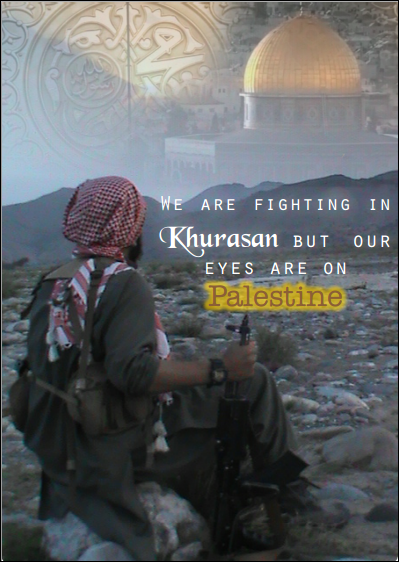
Khorasan too, as seen in the image from the new magazine Azan at the top of this post — but where does Azan itself come from?
B Raman writes:
It is not yet clear who has started “Azan”. One suspect is the Tehrik-e-Taliban Pakistan (TTP), which is the Pakistani Taliban. The other suspect is Al Qaeda headquarters in the South Waziristan area of Pakistan.
I’m interested in this question, because Azan had an overview of the various fronts of contemporary jihad, and an image that invokes both Khorasan and Jerusalem isn’t exactly “local” in focus. And that brings me to that other meme of interest here — the Ghazwa-e-Hind — which as I pointed out recently ius also mentioned in Azan, though not a huge focus there.
But if Azan is indeed a TTP product, then this info from Mr Orange:
would indicate they find the Ghazwa of more than passing interest…
This wasn’t like the training camps of propaganda videos, with the black flag of al-Qaeda flying free in the wind. There were no racks of weapons waiting for recruits. And all the trainers had left for the religious festival of Eid.
They came home to the UK, where their families “berated” them, they were arrested, tried, found guilty and sentenced to 40 month terms in prison.
With jihad, as with so much else, you can’t always count on truth in advertising.
**
And then there’s Omar Hammami.
Even Rusty Shackleford from My Pet Jawa — “a weblog comparing Muslims to Jawas and containing criticism and satire of Islamic traditions and beliefs” — can’t help but like Omar Hammami, aka Abu Mansoor Al-Amriki, the American jihadist from Alabama who, as Wired puts it, “shoots the breeze” on Twitter “with the people whose job it is to study and even hunt people like him.” He does it with verve, even when ridiculing al-Shabab, the group he was put on the the FBI’s Most Wanted Terrorist List with a $5 million bounty for joining:
Shackleford commented, “I’ve actually become kinda fond of the guy — if that’s possible”.
Al-Shabab, however, appears to dislike him enough to have tried to assassinate him a couple of days ago, following up their failure with a major attack, results as yet unknown.
With jihad in foreign lands, apparently, you can’t even trust your fellow mujahidin to treat you better than your avowed enemies.
Zenpundit is a blog dedicated to exploring the intersections of foreign policy, history, military theory, national security,strategic thinking, futurism, cognition and a number of other esoteric pursuits.