Lucky 13th Sunday surprise!
Sunday, January 12th, 2014[ by Charles Cameron — from Russia with apocalypse? ]
.
.
… or is this just a case of old enemies Bonding with one another?
[ by Charles Cameron — from Russia with apocalypse? ]
.
.
… or is this just a case of old enemies Bonding with one another?
[ by Charles Cameron — it still takes a live human to see what the human eye cannot see but the machine can ]
.
This would appear to be (one version of) the state of the art in facial recognition:
#PLOSONE: Identifiable Images of Bystanders Extracted from Corneal Reflections http://t.co/CJOiQ1klAS pic.twitter.com/ZT45t1SUqN
— SebMln (@SebMln) December 29, 2013
Image within image within image — the gentleman on the right is more or less recognizable as a reflection in the eye of the gentleman on the left — thus giving new potential meaning to the phrase “you are the apple of my eye” (cf Zechariah 2:8, also Oberon in Midsummer Night’s Dream III.ii.102 ff., and Stevie Wonder, You Are The Sunshine Of My Life).
**
Or — to switch disciplines while remaining with the matrioshka form, because such patterns are of interest to the inquiring mind — as Gary Snyder puts it in his marvelous poem, One Should Not Speak to a Skilled Hunter:
The secret.
and the secret hidden deep in that.
**
For another version of the state of the art in facial recognition, see: Where’s Ms. Waldo?. Aloha!
[ by Charles Cameron — I got caught in a cascade of images, swept away — and then, Mao ]
.
This gesture seems to me to have the quality of a caress…
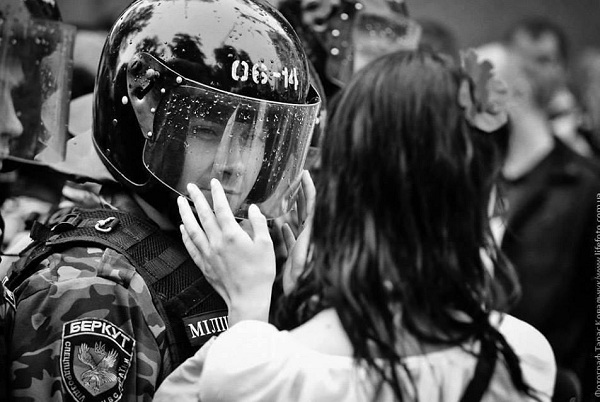
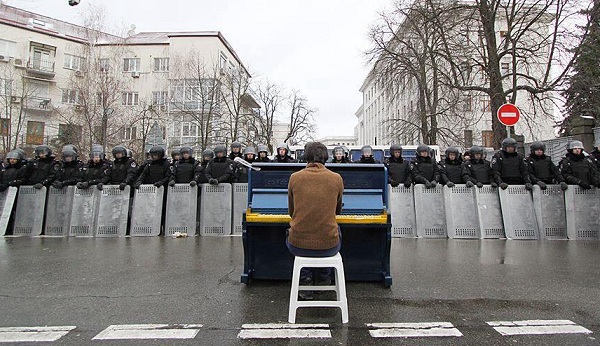
in which case a caress in Kyiv is not so different from piano music in that same city…
or, as it might be, cello music in Sarajevo…
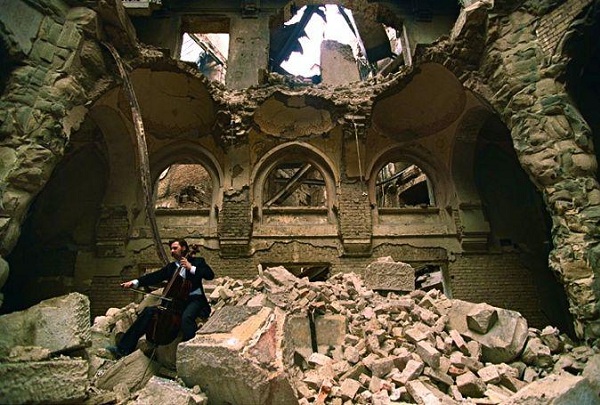
or for that matter, simply standing motionless in Tienanmen Square…

or planting flowers in Washington, DC…

Caresses, music, stillness, flowers… there’s a kinship there.
**
But then again, maybe these gestures are too idealistic for the realist’s “real world” — and to quote Chairman Mao in refutation of that last image:
Every Communist must grasp the truth, “Political power grows out of the barrel of a gun.”
**
I keep coming back to that first image — stunning!
The thing about it — to my eye — the humanity is clearly visible on both sides…
[ by Charles Cameron — Slovenian electronic-industrial group Laibach tackles pone of Bach’s late, greatest works ]
.
Here’s Glenn Gould playing Contrapunctus XIV from Johann Sebastian Bach‘s Art of Fugue, complete with the hum that seems to generate itself from his immersion in the music:
And here by way of comparison and contrast, is the Laibach — “music wing of the Neue Slowenische Kunst (NSK) art collective” — interpretation of that same piece:
For my money, Laibach does a far more interesting job of “electronicizing” Bach than Wendy Carlos ever did, all those many years ago.
For my money too, there’s the complete Laibach Art of Fugue on CD on its way to me courtesy of Amazon.
[ by Charles Cameron — in which jihadis utilize the graphical technique known as kinetic typography for what may be the first time — follow on to part 1: interfaith hatred ]
.
**
Today the Combating Terrorism Center at West Point notified their mailing list of the launch of their Militant Imagery Project online. It’s a very helpful resource, covering much of the same issues as Artur Beifuss & Francesco Trivini Bellini, Branding Terror: The Logotypes and Iconography of Insurgent Groups and Terrorist Organizations and Asiem El Difraoui, The Jihad of Images — which I discussed briefly in Jottings 7: Two for the iconography of terror a while back.
The CTC explains:
The use of propaganda and imagery by terrorist groups has long been an understudied dimension of the broader field of political violence. This project explores the use of imagery and visual themes by militant groups, focusing largely on jihadist media production. Jihadist organizations and individuals inspired by their message are prolific producers and distributors of visual propaganda, and their efforts have expanded exponentially online. However, these images frequently utilize themes which can be inscrutable to those not familiar with the sub-culture. It is our hope that this project will provide academics, practitioners, and students with a basic contextual understanding of the ideas these images convey before they turn to the larger questions of why they are employed, how they work, and what responses they may elicit.
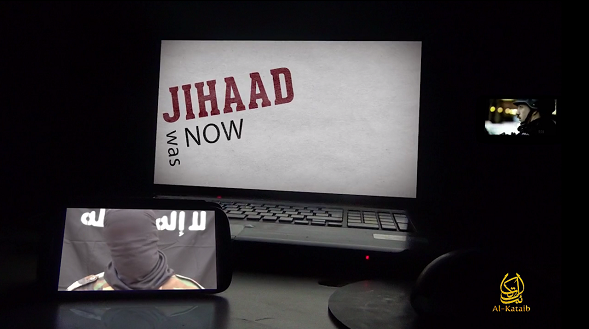
It is in that spirit that I would point you to the following three screengrabs from the Al-Shabaab video I discussed in my previous post…
**
Imagine the images tilting and changing, as the words spoken on the soundtrack are gradually spelled out typographically on screen in this sequence:
Jihad was now global. Jihad in the West — Madrid — London — Paris — Boston — Jihad was now coming home to the West, And it was making a dramatic entrance… WOOLWICH ATTACK
Here are the screengrabs:
**
These three screengrabs illustrate what may well be the first use of the technology called “kinetic typography” or more simply “moving text” in jihadist propaganda. Somali news outlet Harar24‘s Editorials team claim it’s a first, writing:
It is not unusual for jihadi videos to be laden with high graphics and effects. However Al-Shabaab this time used a never technique never adopted before in any jihadi videos, kinetic typography.
The best way to investigate kinetic typography in depth is via Marco Papale‘s video site, the Kinetic typography Channel on Vimeo.
**
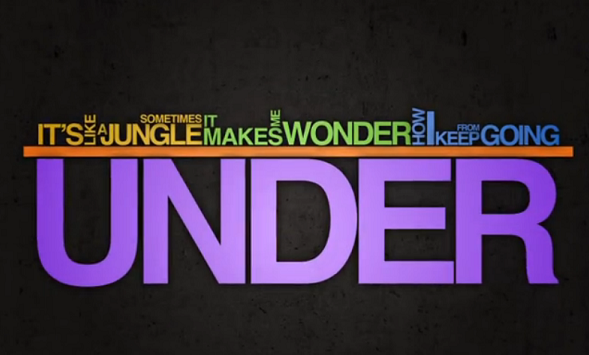
I don’t intend to embed the Shabaab piece itself, but here for your further illumination is the Grandmaster Flash sample rom which the screengrab at the top of this post was taken, in full:
That’s kinetic typography!

Zenpundit is a blog dedicated to exploring the intersections of foreign policy, history, military theory, national security,strategic thinking, futurism, cognition and a number of other esoteric pursuits.
Customized Web Site & Blog Design