zenpundit.com » music

Archive for the ‘music’ Category

When does music become noise?

Tuesday, July 17th, 2012

[ by Charles Cameron — a little rock criticism with military, political and theological overtones ]
.


.

When does music become noise?

  • When it annoys you.
  • Even when it’s Nancy Sinatra.
  • And FWIW, much the same can be said of prayer.

I say this, because there’s currently a battle of the noises in Jerusalem. Or should I call that a battle of rock music vs the call to prayer?

Noise, in any case. That’s what the people who don’t like it call it.

**

It may be that you’ve sought out events with “strobe lights and screamingly loud rock and rap music” — they’re called concerts when you volunteer for them, but torture when you have no choice…

**

The New York Times piece quoted above brings us a legal opinion that the practice at Gitmo constituted torture, and a hint of the playlist:

David Sheffer, a senior State Department human rights official in the Clinton administration who teaches law at George Washington University, said the procedure of shackling prisoners to the floor in a state of undress while playing loud music – the Guantánamo sources said it included the bands Limp Bizkit and Rage Against the Machine, and the rapper Eminem – and lights clearly constituted torture. “I don’t think there’s any question that treatment of that character satisfies the severe pain and suffering requirement, be it physical or mental, that is provided for in the Convention Against Torture,” Mr. Sheffer said.

It also tells us what impact of the “strobe lights and screamingly loud rock and rap music” had on the Gitmo prisoners, who had to put up with it for fourteen hour stretches:

Another person familiar with the procedure who was contacted by The Times said: “They were very wobbly. They came back to their cells and were just completely out of it.”

How does being shackled to the floor compare with being in a compound inside an FBI cordon — how does “Nancy Sinatra songs, shrieks of dying rabbits, Christmas carols and Tibetan monk chants” compare with “strobe lights and screamingly loud rock and rap music”?

I’d say there are significant similarities and significant differences.

**

For one thing, David Koresh, the “sinful messiah” of Waco, was a guitarist-songwriter himself:

How shall I put this? That’s not what I expected…

**

But hey, Manuel Noriega.

You remember him? It is perhaps worth recalling that when Gen. Noriega was holed up at the Panama City residence of the Papal Nuncio — a place where one can imagine the Angelus bell modestly calling the faithful to prayer thrice daily, but I digress — “American troops directed loudspeakers his way in an attempt to blast him out“.

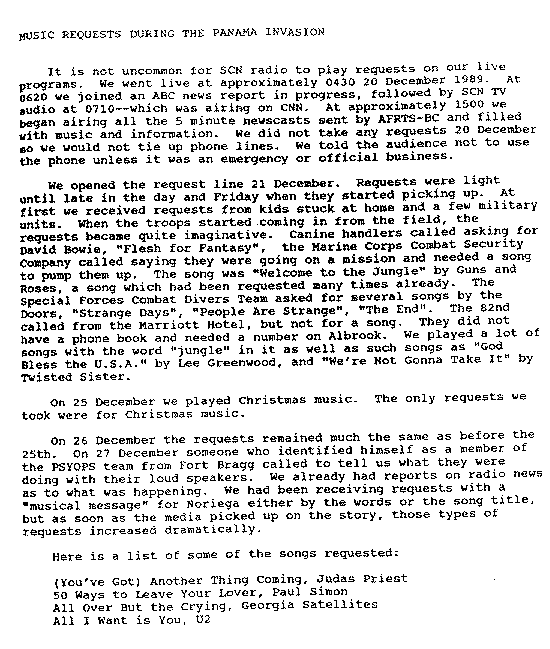
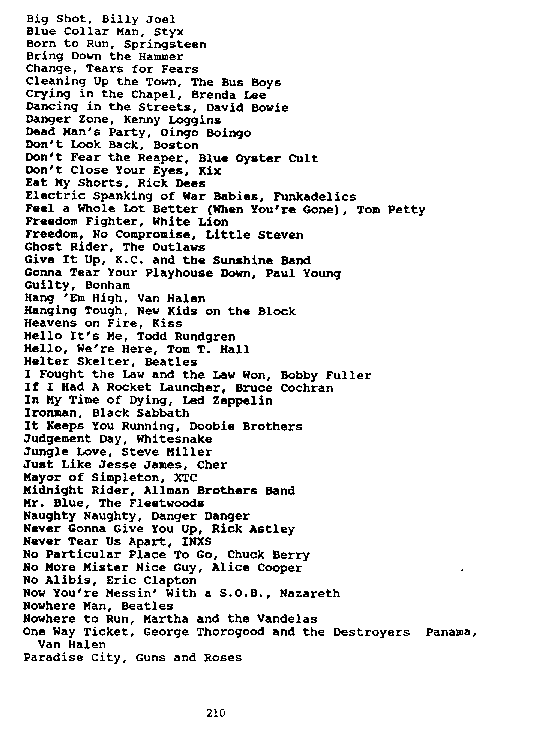
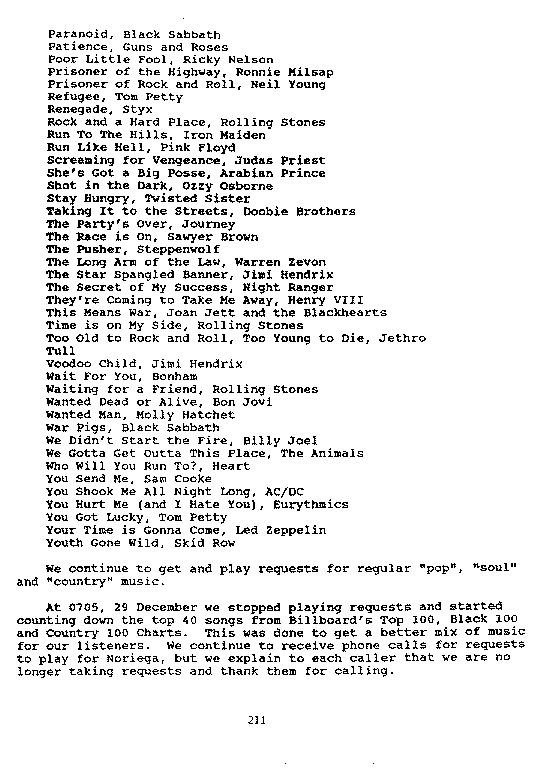
Happily for those of us interested in the musics of siege and torture, the National Security Archive associated with George Washington University has posted a copy of the playlist of songs requested by US troops to regale the General.

One can only imagine how much a man of his discerning taste must have enjoyed listening to Jimi Hendrix’ high-tweakin’ guitar on one of Rolling Stone‘s top 500 songs evah — Voodoo Child:

Oh, and so much more besides. For the full playlist, see here and here and here. Those selections are drawn from USSOUTHCOM’s After Action report on Operation Just Cause.

The Papal Nuncio’s residence would in essence be a diplomatic extension of the Vatican, wouldn’t it? Can you imagine the berobed monsignori tapping their feet to Electric Spanking of War Babies by the Funkadelics — or, with subtle religious overtones, War Pigs by Black Sabbath?

**

So, onwards to Jerusalem.

Today’s adhan or call to prayer in Jerusalem / al-Quds would have been sung out by the muezzin at 4:11am (Fajr) and again at 12:47pm, 4:27pm, 7:47pm and 9:17pm.

**

Under the title Mosque’s Loud Prayer Generates Mega-Decibel ‘Battle of the Bands’, the Jewish Press reports:

After the French Hill neighborhood of Jerusalem has decided to play very loud music, in defiance of the volume and disturbance of the sound of the muezzin at the mosque in nearby Al-Issawiya, two additional Jewish neighborhoods, Pisgat Ze’ev and Har Choma, have announced that they, too, will take up a similar approach. French Hill also decided to go with hard rock, and not Mediterranean tunes, as had originally been planned, because, as they put it, hard rock is more likely to deliver the message.

According to Yediot Jerusalem, the French Hill neighborhood has recently approached an amplification company with an order for four huge speakers to be directed at Al-Isawiya. As soon as the village muezzin will start his exceedingly loud prayer, it will be responded to with ear shattering Rock n’ Roll, letting local Arabs understand how disturbing the loud prayers have been to their Jewish neighbors.

French Hill, according to Wikipedia:

French Hill (Hebrew: HaGiv’a HaTzarfatit, Arabic: at-tel al-faransiya), also Giv’at Shapira is a neighborhood in northeastern Jerusalem. It is located on territory occupied during the Six-Day War in 1967, later annexed to Israel under the Jerusalem Law in 1980. The United Nations Security Council declared this law a violation of international law, and states that the Council will not recognize this law, and calls on member states to accept the decision of the council. The International Court of Justice stated in its 2004 Advisory Opinion that the Israeli settlements in the Occupied Palestinian Territory (including East Jerusalem and therefore also in French Hill) have been established in breach of international law. The European Union considers French Hill to be an illegal settlement in East Jerusalem.

**

Noise is in the hearts and minds of the hearers and beholders.

Or beauty, as the case may be.

Numbers by the numbers: two

Thursday, July 12th, 2012

[ by Charles Cameron — numbers as analytic categories, two, the duel and the duet ]
.

Charles Darwin once said of his fellow species biologists:

Those who make many species are the “splitters,” and those who make few are the “lumpers”.

**

The diagram above represents a card-game I’ve played on occasion in my mind, asking myself the question: what is the opposite of one?

Two is the usual answer — and it’s interesting, you can get there from one two ways: by adding, or by dividing.

**

The human mind very often thinks in binaries, we talk about us and them, friend and foe, the Allies and the Axis Powers, and even an eye for an eye and a tooth for a tooth – our ideas of warfare, contest and justice alike are predicated on the number two.

As I said in my intro post, one is a single data point, perhaps an anomaly: two is a duel or a duet, an opposition or a trend.

So we don’t always have to think of us and them — we could also think about me and mine, you and yours, two heads are better than one…

And what if you can “turn” your enemy? Then the duel turns into a duet.

**

The duel is all about two competing, contending, fighting, agonizing to see who shall be the one. It is arguably the most basic form of combat, the simplest, and possibly the most profound. It can be close to symmetric — “they were perfectly matched” — or the very essence of asymmetric — David and Goliath.

The duet is about two collaborating, counterpointing, harmonizing — seeing how, together, they are one…

War-fighting and music-making, war and peace, regiment and free form, the march and the dance…

*****

I am eager to know what sorts of insights you can derive from or find echoed in this series of posts.

Bureau of Continuing Education

Monday, July 2nd, 2012

[ by Charles Cameron — Anabaptists, Amish, Mennonites and Robespierre, rock’n’roll, gaming ]
.


.

I knew the Amish and Mennonites tended towards a pacifist interpretation of Christianity, but I had no idea until this evening that Robespierre had granted them special recognition on that account:

The matter was referred for a decision to the Committee of Public Safety. And on 19 August 1793 this body issued what was indeed not formally a decree, but simply a recommendation, in effect brief guidelines directed to local authorities, concerning the proper procedure to be adopted in dealing with drafted Mennonites. Among those signing, or confirming, this document we find the names of such prominent Jacobins as Robespierre, Carnot, Couthon, Hérault de Séchelles, and St Just. ‘We have observed the simple hearts of these people,’ states their arrêté, ‘and believing a good government ought to employ all kinds of virtue for the public good we ask you to treat the Anabaptists with a mildness that matches their character, to prevent them from being harrassed in any way, and finally to allow them to serve in such branches of the armed forces as they may agree to, like the pioneers or the teamsters, or even to allow them to pay money in lieu of serving personally.’

Peter Brock, Against the Draft: Essays on Conscientious Objection from the Radical Reformation to the Second World War, University of Toronto Press, 2006, p. 76.

Amish Warfare, on the other hand, is either a rock band, or a playlist of YouTube videos “designed for various Call of Duty related topics”, or both.

Quite a name for a band.

Quite a stand to take, right at the start of the Reign of Terror.

Tree series, I: This is how nature thinks

Saturday, June 23rd, 2012

[ by Charles Cameron — this one’s a companion piece for One bead for a rosary and the first of three more or less contemplative / creative posts on trees. ]

.


.

This is how nature thinks: this is one of nature’s thoughts, and it’s the kind of thought that comes late, after much else has been worn away and only essence remains, the kind we find in our elders and call by the name wisdom.

We don’t think of trees as thoughts, but perhaps we should: our idea of mind might broaden.

*

And rivers.

We spend a great deal of our time thinking and speaking in straight lines. One of the straight lines I tent to think along and speak about is the idea that we might want to think differently, to braid our linear ideas perhaps, to listen to the voices of others and join ours to theirs, making somehow a thought that is many-voiced, a thought stream that reflects on itself, echoes itself, has eddies of questioning, rapids, calm stretches, still ponds… “pondering”, my friend Derek suggests.

There are certain people who, I trust you’ll agree, are deliciously frank and frankly strange: we call them by affectionate negative names – he or she’s “an ornery old cuss” we say, perhaps – I suppose I may be one myself, and my language old-fangled, but I trust again that you get my drift.

Gnarly.

Now there’s another word for them. It comes from the gnarls in wood, and the poet Hopkins applies it to the nails that tear the hands of Christ: With the gnarl of the nails in thee, niche of the lance…

A gnarly character has come to conclusions you probably don’t share, but you feel a grudging admiration for the forthrightness with which this character has pursued some intricate and personal logic to its unordinary conclusion.

I have presented various images for a kind of thinking that is many-braided, communal yet irrepressibly individualistic, including a railway marshaling yards after a bombing raid and the multiple complex paths of the Mississippi.

*

Please consider the tree above – seen in a photo by Rick Goldwasser of a Bristlecone Pine from the White Mountains in California – as exemplifying the gnarly, intensely personal, complexly braided thought of a Beethoven in the late quartets and sonatas, the Hammerklavier and Grosse Fuge – or the unfinished late masterworks of a Michelangelo.

A tree, a way of thinking – and appreciation for that which is bone-weary yet resolute, difficult yet rewarding, which swirls like water yet is almost as still as stone.

* * *

The Grosse Fuge, performed by the Takács Quartet:

The Hammerklavier, performed by Mitsuko Uchida:

These, also, are among nature’s thoughts.

Another magnificent example of which is GM Hopkins’ poem, The Wreck of the Deutschland, from which that line about “the gnarl of the nails in thee” is drawn…

Between the warrior and the monk (ii): Fr Trevor Huddleston

Friday, May 25th, 2012

[ by Charles Cameron — a warrior, a monk, and where that leaves me ]
.

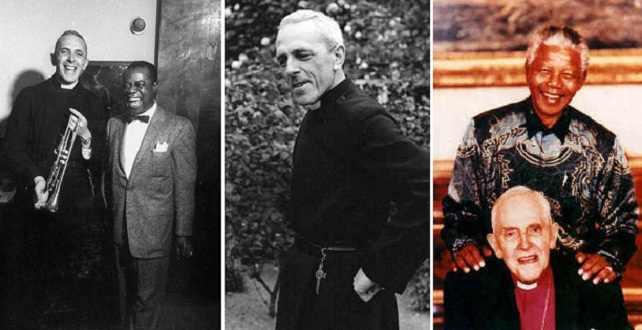
In the first part of this post I introduced you to my father, Captain OG Cameron DSC, RN, the man who fueled my keen interest in gallantry and the martial side of things. The other great influence in my early life was Fr. Trevor Huddleston CR, pictured below:


.

Trevor Huddleston CR:

Archbishop the Most Reverend Sir Ernest Urban Trevor Huddleston CR, KCMG – it’s hard even to know how to string his titles together, this monk, priest, schoolteacher, activist, archbishop, finally knighted by Her Majesty towards the end of his long and eventful life was the man who became a second father, guardian, mentor and spiritual guide to me shortly after my father died when I was nine.

That’s the man as I knew him, Father Trevor — simple, caring, intelligent, perhaps a little austere even — in the middle image above.

Austerity, simplicity: two more words to set beside gallantry in the lexicon of admiration and gratitude.
.

Satchmo:

To the left in the same image, he’s shown with Louis Armstrong — Satchmo — who has just presented him with a trumpet.

The story goes like this: as a monk in an Anglican monastic order, the Community of the Resurrection popularly known as the Mirfield Fathers, Father Trevor was sent to South Africa while still a young man, and worked in Sophiatown, just outside Johannesberg, as a priest and teacher.

A young black kid in one of his classes, Hugh, aged 12 or 13, fell ill and was taken to hospital, where Trevor Huddleston visited him. Trevor asked him what he would like more than anything in this world, what would so thrill and please him that he would have the greatest possible motive for getting better, getting out of the hospital and back to school. Hugh said, “a trumpet, Father” — so Trevor got hold of a trumpet which he then presented to the boy: now known the world over as the great jazz trumpeter, Hugh Masekela.

That wasn’t quite enough, though. A year or three later, Trevor was in the United States, and met Satchmo, who asked if there was anything he could do to help… Trevor told Satchmo he’d started a jazz band for the kids in his school, and knew a boy who would just love a trumpet…

Trevor was a hard man to refuse.
.

Hugh Masekela:

Here’s Hugh Masekela, just a little older, with the trumpet Trevor brought him from Louis Armstrong:

And here’s the sound…

When I was maybe 15, and Trevor had returned from South Africa to England, he gave me a 7″ “45” record of the Huddleston Jazz Band — now long lost. Imagine my amazed delight to be able to hear that sound again, fifty years later, through the good graces of the internet —

Hugh Masekela and the Huddleston Jazz Band play Ndenzeni na?


.

Desmond Tutu:

Another story I like to tell about Trevor and his time in South Africa has to do with a lady…

It seems this young black kid aged about 8 or 9 was sitting with his mother on the “stoop” outside his house in a South African shanty-town when a white priest walked by and doffed his hat to the boy’s mother.

The boy could hardly grasp how this had happened — his mother was a black woman, as one might say, “of no special acount”. But the priest in question was Trevor Huddleston, and it was a natural courtesy for him to lift his hat in greeting a lady…

The young boy never quite recovered from this encounter. We know him now as the Nobel Peace laureate, Archbishop Desmond Tutu.

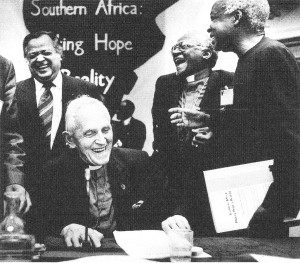
Here’s a photo of four old friends — Huddleston, Tutu, Julius Nyerere of Tanzania, and former Commonwealth Secretary General Shridath Ramphal.
.

From individuals to the world:

These are two simple stories of how Fr Trevor simply and straightforwardly loved whomever was before him, regardless of the enormous pressure at the time to discriminate between “real” and “insignificant” people — a love which made an indelible mark on those whose lives it touched.

And when Father Trevor touched you, as Lord Buckley might say, you stayed touched.

Thus far I’ve been focusing on individuals that Trevor touched. I do not think he in fact saw more than one person at a time, and his responses to situations were geared directly to the service of his love.

It was because of this that while he was in South Africa, Trevor repeatedly and quite literally put his life on the line in defence of the very simple proposition that the color of a person’s skin was immaterial in view of the love that was possible between any two people — so perhaps here’s where I should mention some of that history and some of the honors it brought him. After all, Trevor did pretty much take on the government of the South Africa he so loved, and lived to see it change.
.

Bishop Trevor of Sophiatown

Trevor Huddleston was a founding member of the African National Congress, the author of the first non-fiction work (Naught for Your Comfort, more on that later) to critique his beloved South Africa’s apartheid policy, reviled publically for meddling in politics by an Archbishop of Canterbury who later declared he had been in error and that Fr Trevor was about as close to a saint as one could find.

In 1955, Father Trevor, along with Yusuf Dadoo and Chief Albert Luthuli, was awarded the Isitwalandwe, the highest award given by the African National Congress. He was awarded the United Nations Gold Medal in recognition of his contribution to the international campaign against apartheid, the highest awards from both Zambia and Nigeria, the Dag Hammerskjold Award for Peace, the Indira Gandhi Memorial Prize, and ten honorary doctorates, including that of his alma mater, Oxford.

Archbishop Huddleston initiated the “International Declaration for the Release of Nelson Mandela and all Political Prisoners” in 1982, took part in the televised “International Tribute for a Free South Africa” held at Wembley Stadium, London in 1990 during which he introduced the address by Nelson Mandela (see below), entered South Africa House, Trafalgar Square, London in 1994 to vote in the first South African democratic election, and was a guest at President Mandela’s inauguration in Pretoria that year.

He received the KCMG (Knight Commander of the Order of St. Michael and St. George) in the 1998 New Year Honours list, for “Services to UK-South African Relations”, and attended an Investiture at Buckingham Palace on March 24th, 1998, to receive this honour from HM the Queen.

He chose the designation, “Bishop Trevor of Sophiatown”.
.

Nelson Mandela:

But let’s go back to individuals, and to Nelson Mandela in particular.

Mandela and Trevor were comrades in the fight against apartheid from the beginning — and the richness of their friendship is visible in the photo of Mandela with his arms on Trevor’s shoulders in the right hand panel at the top of this page.

In his autobiography, Long Walk to Freedom, Mandela tells the story of a time when he and Walter Sisulu were approached by a group of South African police who had been ordered to arrest them. Trevor, who was talking with with the two of them, called out to the cops, “No, you must arrest me instead, my dears.”

It’s that “my dears” that gives the game away. I can hear those words in Trevor’s voice. Even the cops were dear to Trevor: he might be utterly opposed to what they were doing, and risk his life to oppose them – but they were children of God.

Here’s a video of Trevor’s speech introducing Mandela at Wembley — a political speech, to be sure, but one powered by religious conviction:


.

Mandela’s tribute:

I’m saving the best of what Fr. Trevor taught me for the third post in this series, and hope to wrap the series up with some of my own reflections in a fourth; here I’d like to close with the words Mandela wrote about his friend after Trevor’s death in 1998:

It is humbling for an ordinary mortal like myself to express the deep sense of loss one feels at the death of so great and venerable figure as Father Trevor Huddleston.

Father Huddleston was a pillar of wisdom, humility and sacrifice to the legions of freedom fighters in the darkest moments of the struggle against apartheid. At a time when identifying with the cause of equality for all South Africans was seen as the height of betrayal by the privileged, Father Huddleston embraced the downtrodden. He forsook all that apartheid South Africa offered the privileged minority. And he did so at great risk to his personal safety and well-being.

On behalf of the people of South Africa and anti-apartheid campaigners across the world, I convey my deepest condolences to his Church, his friends and his colleagues. Isithwalandwe Trevor Huddleston belonged to that category of men and women who make the world the theatre of their operation in pursuit of freedom and justice.

He brought hope, sunshine and comfort to the poorest of the poor. Not only was he a leader in the fight against oppression. He was also father and mentor to many leaders of the liberation movement, most of whom now occupy leading positions in all spheres of public life in our country. His memory will live in the hearts of our people.


Switch to our mobile site