zenpundit.com » music

Archive for the ‘music’ Category

Osama and the flute of the devil

Wednesday, May 9th, 2012

[ by Charles Cameron — curiosity and classical music leads me on a merry chase from Bach and bin Laden via LastFM and Chorus Angelus to the heraldry of the Afridi, a Forsane Alizza video and the death of Superman ]
.

I’m grateful to JM Berger (@intelwire) and Chris Anzalone (@ibnsiqilli) for their encouragement and help with this post. JM provided the screengrab above, which shows a title card from a recent al-Zawahiri video — I suspect it may have been the one he mentioned here [text now mildly updated]:

Back in the day, when Adam Gadahn was just getting started as guru to Al Qaeda’s media operations, he released a couple of fairly slick videos designed to appeal to Western audiences by mimicking Western documentaries — up to and including the presence of a musical soundtrack.

It is therefore interesting to note that the latest release from As-Sahab (which Gadahn basically runs at this point) opens with a short disclaimer. “ATTENTION: We do not permit musical accompaniment with our productions.” One second later, a nasheed (religious song) fired up, but I guess that doesn’t count.

I’m guessing this is due to input from one of Gadahn’s Al Qaeda overseers. It’s interesting that these guys can rationalize away visits to strip clubs but they can’t handle a light orchestral score.

Chris tells me that Tehrik-i Taliban Pakistan has included similar notes in some of its videos. Indeed as JM put it in a tweet yesterday, “The odd thing is most of these guys would not be cool with music” — while as Chris noted, “Opposition to music with instruments, it should be said, isn’t unique to jihadis.”

So that’s the context: here’s the thing that interests me.

*

I can appreciate using the Old Master’s portrait of Christ that’s on the album cover to accompany a YouTube video of Bach’s B Minor Mass performed by Philippe Herreweghe (left), I can understand using a series of “nature scenes” for the Diego Fasolis performance (middle), I can even bite my lip and remain silent when someone lays a cute graphic of a wide-eyed young thing with a white rabbit (right) on top of Ton Koopman‘s version —

But my eyes simply bug out when I find someone has posted not one but four versions of Bach’s great Mass on YouTube, on not four but 42 separate videos, with bin Laden talking — silently, his lips moving — on each one.
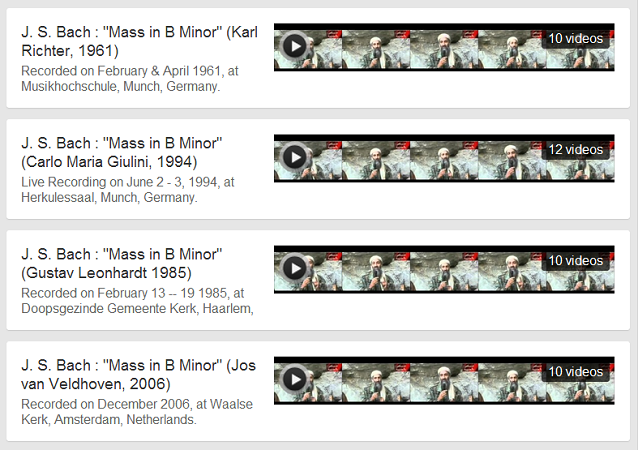
Amazingly enough, that’s what someone calling themselves SOMALIAAFGHANISTAN has done.

*

Look, people, this is strange.

Lawrence Wright quotes Osama bin Laden [link, at p 167] as saying “Music is the flute of the devil”.

I was doing some research for this post on Google, and ran across this:

Fair enough, I thought, and went to Last.FM, where I found this artist featured:

Bullet for my bloody valentine.

I kid you not.

*

See, this all started because I was looking to play myself some Bach organ music and ran across a video of Marie-Claire Alain performing Bach’s BWV 767, which is pretty terrific — Alain is a great organist, it’s a remarkable work, etc etc — and found myself staring at this:

I mean, that’s not from the Bach part of my life, that’s from the part of my life that tracks jihadist utterances and theology…

*

As my friend Chris Anzalone, whose posts on jihadist graphics I always read with interest, pointed out to me, this particular video has an extensive explanation of its heraldic significance attached:

Coat of Arms Of The Famous Afridi Pashtun Afghan Pathan Tribe

Flag of the Afghan Tribe – The Afridi.

Made from historical Texts & references.

Main Circle/Islam Symbolism:

White circle: Unified, unbroken & Islam 4 stars: 4 sons of Qis/Kesh/Qais Abdur Rashid Crown: Representation of Qis/Kesh/Qais Abdur Rashid & his Bani Israel lineage which is from the Ancient Royal House of Israel Lion with Flag: The Lion of Judah/The Bravery of the Afghans & the emblem of many Afghan Kingdoms Olive Tree: Descent from the House of Israel/Bani Israel Black Background: The world in troment, pain & ignorance, showing the messianic dedication of Afghans that spread Islam through kings and Sufis throughout India.

Tribal Symbolism on Coat of Arms:

Babe Khyber/Fort: Defending the borders of Afghanistan for centuries and masters of siege warfare. They successfully held the mountain passess of Afghanistan against the counter attack of many Indian Armies. Bolt Rifle: One of the first among Afghans to master the art of local Rifle and small arms making. They were famous for their sniper marksmen skills with the 3 not 3 or .303. Camel Caravan: Afridis are skilled businessmen. AK 47: Every Afridi child is given one before passing into adulthood.
Red Background: The Traditional color of the Afridis.

Reference Material:

* The Pathans 55O B.C.-A.D. 1957 By Sir Olaf Caroe
* History of the Afghans by Bernhard Dorn
* History of the Afghans Original by Neamet Ullah (active 1613-30) in the court of the Mughal emperor Jahangir (1569-1627)
* Tareekh i Farishta
* History of the Afghans edition X by Fut’h Khan in 1718
* The Works of the Pashto Academy Peshawar University and The Pashto Dept. Islamia College Peshawar through countless publications, both online and offline, and may writers including Dr. Yusafzai, much of which you can find at Khyber.org
* History of Kohat -Gazetteer of the Kohat District
* History of Peshawar -Gazetteer of the Peshawar District
* Afghan Poetry: Selections from the poems of Khush Hal Khan Khattak., Biddulph, C.D., Saeed Book Bank, Peshawar, 1983 (reprint of 1890 ed.)
* A Grammer Of The Pukhto, Pushto: Or Language Of The Afghans, Raverty, H.G., London, 1860
* Poems from the Diwan of Khushâl Khân Khattak, MacKenzie, D.N, London, Allen & Unwin, 1965
* Notes on the Tarikh-e-Murassa, Plowden, Maj.
* Settlement Report of Bannu, Thorburn

This text, in turn, comes from a Wikipedi page on the Afridi Tribal Flag posted by a user named Afghan Historian. Who has an enviable library.

Sadly enough, Wikipedia notes “The factual accuracy of this description is disputed” — although it’s not clear by whom.

*

There are interesting references in the scholarly footnotes to the Afridi flag to “Qais Abdur Rashid & his Bani Israel lineage which is from the Ancient Royal House of Israel” and to “the messianic dedication of Afghans that spread Islam through kings and Sufis throughout India”…

The idea that the Afghans are descendants of the “lost tribes” of Israel is explored in the Jewish Virtual Library here. As to the Afghans’ “messianic dedication” — I’m not clear exactly what the word messianic means in this context, but it’s an interesting word choice in any case.

*

When I first looked up this image on TinEye, my image-search engine of choice, the only version it reported was from the site of Forsane Alizza, a now-disbanded group in France whose leader claims to preach only non-violence:

Je vous préviens dès maintenant que je n’ai ni armes, ni explosifs, ni drogues, ni même quoi que ce soit d’illégal. Si cela venait à arriver, soyez intelligent réfléchissez et souvenez vous que depuis sa création et jusqu’à la fin, Forsane Alizza use et n’usera, que de sa liberté d’expression et son droit à manifester contre des lois injustes et illégal au vu des droits de l’homme. D’ailleurs toutes nos actions sont non violentes et elles le resteront.

while the security police claim to have found weapons in his house.

The Forsane Alizza video, from which the snazzy image directly above was taken, shows members practicing martial arts and painball games…

*

And how’s this for an illustration of Bach’s BWV 566, the C Major Toccata and Fugue — and the death of American pop culture?

To sum up: what’s all this about? Why pair Bach with bin Laden, the Afridi, the demise of superman and all the rest?

*

I don’t want to leave you with a bad taste in your mouth.

If you want to see what it’s like to hear Gustav Leonhardt conducting the Kyrie from the B Minor Mass juxtaposed with images of bin Laden, you’ll find that here. You may, of course, prefer the Herreweghe version, with another variant of his album cover with the face of Christ as the accompanying visual…

And for Marie-Claire Alain performing Bach, sans the Afridi, may I recommend this hour long recital, which I just happened upon myself thanks to this post?
Crucifixion and Resurrection, ancient and modern

Wednesday, April 18th, 2012

[ by Charles Cameron — religious resonances of the Tupac video, from the Drachenloch cave bears to today ]
.

1.

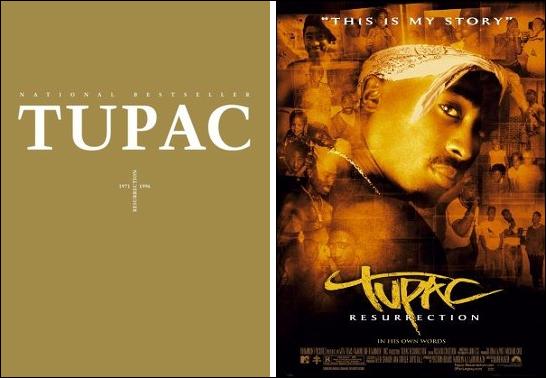
As the 2006 book and DVD covers above suggest, the themes of crucifixion and resurrection have been associated with Tupac Shakur for a while.

R.N. Bradley blogs at Red Clay Scholar and is a doctoral candidate in African American Literature and Culture at Florida State University. She makes the same connection clear in a post titled Smilin’ Serpent: the Violent Passion of Tupac Shakur on September 13, 2010:

Projects revealed Shakur’s pseudo-schizophrenic obsession with death and resurrection. These tropes manifested in videos like “I Ain’t Mad Atcha” or the collabo featuring Scarface “Smile,” and the coverart of The Don Illuminati: the 7 Day Theory(1996).

2.

Death comes before resurrection: Tupac Shakur died of gunshot wounds in 1996, after completing his final album, Makaveli — which was posthumously released:

3.

What may be more surprising is that he was brought back to something approximating life — in a holographic performance that included a duet with a decidedly non-holographic Snoop Dogg— just this week…

4.

But then, that’s religion.

Time-bound, mortal and frankly disintegrating as we are, we’d like there to be more to the story after death, and that yearning is something that religion addresses.

Perhaps to get the point across in an interesting way you’ll allow me to quote from a move in a game I played some years back:

Exploring the Drachenloch cave in Switzerland, Emil Bachler found cave bear skulls arranged in wall niches in one part of the cave, and stone tombs in another chamber containing cave bear skulls and bones. Ursus spelaeus, the cave bear, has now been extinct 10,000 years, while the Neanderthal inhabitants of the caves appear to have ceased as a species themselves about 40,000 years ago.

In Shepard and Sanders’ book, The Sacred Paw, which deals with both the natural history of the bear and its appearances in myth and ritual, Bachler surmises that his finds provide “the first evidence in man of an already awakened higher spiritual life.”

But why the bear in particular? What could we learn from the bear that we couldn’t learn anywhere else? Shepard and Sanders’ answer is that the bear seemed able to teach us how to survive bodily death. Hibernation isn’t just a “natural” phenomenon — it’s also a “spiritual” revelation… I’ll let them explain in their own words:

The bear, more than any other teacher, gave an answer to the ultimate question… an astonishing, astounding, improbable answer, enacted rather than revealed. Its passage into the earth, winter’s death, and burial under the snow was like a punctuation in the round of life that would begin again with its emergence in the spring…

The miracle was double, for the bear burst out with young — birth and rebirth. Somehow the bear knew when to reenter the world again, emerging just ahead of the snowmelt, as though its very heat set the new year in motion… Clearly the bear was master of renewal and the wheel of the seasons.

The bear ‘knows’ about death and how to survive it… She is therefore seen by traditional peoples as a guide to the movement between worlds.

So the bear is not only the first shaman, s/he’s also the first dying and rising God, and the first divine “Mother and Child” — teaching us two things that are still at the heart of religion 40,000 years later: nativity and resurrection!

5.

Death and resurrection certainly date back quite a ways. Attis, Osiris and Odin are only a few of those thought to have died and been resurrected — and indeed the early Christian writer Justin Martyr confirms (In his First Apologia XXI), the similarities between Christian and pagan teachings when he writes:

In saying that the Word, who is the first offspring of God, was born for us without sexual union, as Jesus Christ our Teacher, and that he was crucified and died and after rising again ascended into heaven we introduce nothing new beyond those whom you call sons of Zeus. You know how many sons of Zeus the writers whom you honor speak of — Hermes, the hermeneutic Word and teacher of all; Asclepius, who was also a healer and after being struck by lightning ascended into heaven –as did Dionysus who was torn in pieces; Heracles, who to escape his torments threw himself into the fire; the Dioscuri born of Leda and Perseus of Danae; and Bellerophon…

6.

Here’s the video:

7.

Max Eddy, blogging at The Geeoksystem today, not only describes the technology used to bring Tupac back to artificial life, but gives us a feel for the event:

The Tupac Hologram put on an eerie performance. When it appeared, the crowd became noticeably quiet while the show continued so achingly aware of its strangeness. The CG simulacrum even declared “I’m a ghost” during a rendition of “Hail Mary.” The ghostly, semi-transparent image went on to do two more numbers – one opposite a likely perturbed Snoop Dogg – before, no kidding, dissolving into triangles in a blaze of otherworldly light.

He also gives us an overview of the endurance of the resurrection motif within the music biz. He writes:

While I must confess ignorance to the life and body of work of Tupac, the resurrection obsession is part and parcel of the music industry. We can get specific: Back in 1995, the surviving Beatles recorded two new tracks along with unreleased demos recorded by John Lennon in 1977. Lennon had been dead since 1980. For his 75th birthday in 2010, Elvis Presley netted $60 million despite having been dead since 1977. Deceased in 2004, Ol’ Dirty Bastard still managed to appear on 2009?s “Blackroc,” a rap album put together by the Black Keys.

Though resurrections are a phenomenon that is particularly common in the music industry, it’s notable that CG recreations of dead actors haven’t broken into mainstream film. Perhaps it’s because fooling the ear is easier than fooling the eye.

Posthumous musical careers are clearly not unique to Tupac, but Shakur’s has been particularly lively. Since his death, seven albums have been released under the rapper’s name. For Forbes’ 2002 edition of the magazine’s annual list of top-earning dead celebrities, Shakur came in at number ten. A 2003 documentary about Shakur’s life, titled Tupac: Resurrection, was narrated entirely by Shakur. From 1997 on, Shakur has made 49 guest “appearances” on the tracks of other recording artists.

All of this is not to mention the rumors held by some ardent fans that Shakur is, in fact, still alive and in hiding somewhere.

8.

I don’t know whether this image is taken from an early archaeological report on the Drachenloch caves, or is just a reconstruction of what those first bear-altars with their carefully arrange skulls and bones might have looked like. I don’t really know if the dying-and-rising-god meme has been overblown or not — or the circumpolar bear cult for that matter.

But bears hibernating and coming back to life, Attis and Adonis, Christ, Arthur, the Once and Future King, more recently, Elvis sightings — and now Tupac coming back, as a hologram — it makes me wonder.

9.

I’ll give Max Eddy the final word:

When a singer is on stage, he or she is mostly their celebrity, with their humanity tucked safely away for later. At home, they are someone else, but on stage they fill a role assigned to them by their fans and perhaps by themselves. Some take it to an extreme – Ozzy bit the head off a bat. For others, it’s subtle – Roy Orbison’s dark glasses, for instance.

Unlike them, the Tupac Hologram has no humanity; it is only celebrity. The Tupac Hologram will not go home and read Shakespeare, as Shakur did. The Tupac Hologram will not make controversial political statements. The Tupac Hologram will not visit Tupac’s mother, Afeni Shakur Davis. The Tupac Hologram is empty, and we made it.

[ … ]

When we look into the Tupac Hologram, we see ourselves reflected brightly on a thin Mylar screen.

_________________________________________________________________________________________________________
A hat tip to Doug Breitbart, for suggesting I check out the Tupac video and nudging me along the way. The details of Crucifixion and Resurrection are from the superlative Isenheim Altarpiece by Matthias Grunewald (ca. 1510).

Vivaldi, veiling and revelation…

Wednesday, March 14th, 2012

[ by Charles Cameron — some glorious music, Venice, Kandahar ]
.

I was listening to Pergolesi‘s Stabat Mater the other day, and talk came around to the question of whether women would have sung the two solo parts – whether they were written for soprano and contralto, in other words, or for treble and counter-tenor – all of which reminded me that the “red priest” Vivaldi was, for over thirty years, maestro of the Ospedale della Pietà orphanage in Venice.

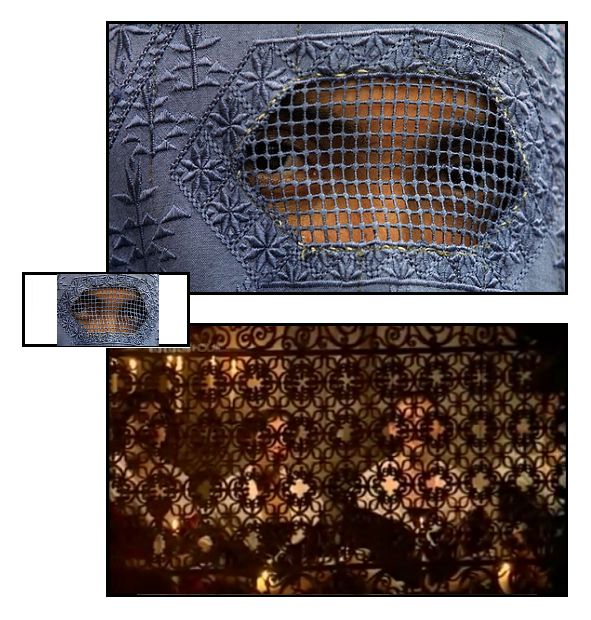
The Ospedale’s all-woman choir performed many of his sacred choral works in church, hidden from view if not speculation in a high balcony behind an iron grille…

The BBC has an hour-long documentary on the subject of Vivaldi’s Women, which features the Ospedale but also the contemporary choir and orchestra, Vivaldi’s Women, more properly known as the Schola Pietatis Antonio Vivaldi.

The (lower) image of the present-day women’s choir singing behind one of those grilles – accompanied by a voice-over reading from a fashionable “grand tour” diary of the day which reports that the “grilles conceal the angels of loveliness” (the writer was perhaps aware, perhaps not, that many of the orphans in Vivaldi’s day would have been scarred or deformed by the pox or their parents’ syphilis) reminded me of another contested icon of “women behind a grille” – this time, the traditional Afghan chadari (upper image)…

*

I have exchanged greetings through a grille with Carmelite nuns in California, and they clearly appreciated the sanctuary that their enclosure offered them…

My point is not to argue the superiority of bikini over burqa or vice versa: it is to offer you a chance to hear some Vivaldi or Pergolesi, and to consider the issue of veiling and revealing — intimacy’s equivalent of secrecy and transparency — from what was for me at least an unexpected and fresh angle.

Questions — Letting John out of his Cage?

Thursday, March 1st, 2012

[ by Charles Cameron — creative, automotive, drone? whither music? classical, pop, film? — & other questions ]
.

Mozart on skates with ski sticks:

I’m posting three videos here that have quite a bit in common, each of which has gone viral at some point recently, and each of which features music making.

OK Go’s Needing/Getting on Chevy Sonic:

Three styles of music, three kinds of instrumental set-up… there’s something admirable about each of them, and also something I find faintly disturbing — a different something disturbing in each case

Quadrotor Drones play the James Bond theme:

So what do you make of them? I’ll be back with a John Cage video and my own comments in a follow-up post a few days hence.

*

h/t +Jason Wells

Another fine voice gone, a fiery liquid, and a Lorca quote or two

Wednesday, February 15th, 2012

[ by Charles Cameron — Whitney Houston, RIP, Rumi, a broken reed, Federico Garcia Lorca, the duende ]
.
.
Live performance — Whitney Houston singing Amazing Grace.

*

Blog-friend Peter J Munson just recently tweeted this quote:

“Through the empty archway a wind of the spirit enters, blowing insistently over the heads of the dead”

That’s from the Spanish poet Federico Garcia Lorca, from an essay of his that I remembered vividly when I heard the other day that Whitney Houston had died. I wrote, then:

So Whitney Houston has died, far earlier than one might have wished, and the question comes up again whether some gifts essentially “demand” a life that breaks one — as though there’s a liquid inside the anger, the pain, the hurt, that must be set free for the voice to sing.

I didn’t post that here, because it felt at the time a little too private — but Peter Munson’s quote from Lorca reminds me that I followed up that observation about the “liquid” with this:

My sense that there might be “a liquid inside the anger, the pain, the hurt, that must be set free for the voice to sing” comes from the way her voice breaks, and breaks again, as she’s singing “a wretch like me” — from about 1’45” with the liquid finally spilling at 1’51″….

in the Amazing Grace video above…

*

If you’re interested in the background to that idea of mine about the liquid, I’ll admit to two sources here — the first is Jalaluddin Rumi, who compares himself in the opening of his Masnavi with a reed, severed from its roots in the marshes to become a flute:

“Ever since I was cut off from my reed-bed, men and women all have lamented my bewailing. I want a breast torn asunder by severance, that I may fully declare the agony of yearning. Every one who is sundered far from his origin longs to recapture the time when he was united with it. In every company I have poured forth my lament, I have consorted alike with the miserable and the happy: each became my friend out of his own surmise, none sought to discover the secret in my heart. My secret indeed is not remote from my lament, but eye and ear lack the light to perceive it. Body is not veiled from soul, nor soul from body, yet to no many is leave given to see the soul.

As Rumi himself comments:

This cry of the reed is fire, it is not wind; whoever possesses not this fire, let him be naught!

My second source, echoing to us perhaps from the Cordoba of the Sufis, is Garcia Lorca, in his astounding essay, Theory and Play of the Duende — from which these paragraphs, like Peter Munson’s quote, are torn:

Once, the Andalusian ‘Flamenco singer’ Pastora Pavon, La Niña de Los Peines, sombre Spanish genius, equal in power of fancy to Goya or Rafael el Gallo, was singing in a little tavern in Cadiz. She played with her voice of shadows, with her voice of beaten tin, with her mossy voice, she tangled it in her hair, or soaked it in manzanilla or abandoned it to dark distant briars. But, there was nothing there: it was useless. The audience remained silent.

In the room was Ignacio Espeleta, handsome as a Roman tortoise, who was once asked: ‘Why don’t you work?’ and who replied with a smile worthy of Argantonius: ‘How should I work, if I’m from Cadiz?’

In the room was Elvira, fiery aristocrat, whore from Seville, descended in line from Soledad Vargos, who in ’30 didn’t wish to marry with a Rothschild, because he wasn’t her equal in blood. In the room were the Floridas, whom people think are butchers, but who in reality are millennial priests who still sacrifice bulls to Geryon, and in the corner was that formidable breeder of bulls, Don Pablo Murube, with the look of a Cretan mask. Pastora Pavon finished her song in silence. Only, a little man, one of those dancing midgets who leap up suddenly from behind brandy bottles, sarcastically, in a very soft voice, said: ‘Viva, Paris!’ as if to say: ‘Here ability is not important, nor technique, nor skill. What matters here is something other.’

Then La Niña de Los Peines got up like a madwoman, trembling like a medieval mourner, and drank, in one gulp, a huge glass of fiery spirits, and began to sing with a scorched throat, without voice, breath, colour, but…with duende. She managed to tear down the scaffolding of the song, but allow through a furious, burning duende, friend to those winds heavy with sand, that make listeners tear at their clothes with the same rhythm as the Negroes of the Antilles in their rite, huddled before the statue of Santa Bárbara.

La Niña de Los Peines had to tear apart her voice, because she knew experts were listening, who demanded not form but the marrow of form, pure music with a body lean enough to float on air. She had to rob herself of skill and safety: that is to say, banish her Muse, and be helpless, so her duende might come, and deign to struggle with her at close quarters. And how she sang! Her voice no longer at play, her voice a jet of blood, worthy of her pain and her sincerity, opened like a ten-fingered hand as in the feet, nailed there but storm-filled, of a Christ by Juan de Juni.

Perhaps we could say that Houston’s inspiration was a duende-haunted angel…

*

Another live performance a few years later… the solo:

*

Pondering these things, and thinking of that “liquid” I mentioned, my friend William Benzon quoted Lena Horne to me, as reported by David Craig in On Performing:

And then when they killed [Robert] Kennedy and Martin Luther King, it seemed like a floodgate had opened. There had been a lot of deaths in my own family. … and when I say, I was different. I began to “listen” to what I was doing and thinking. I listened to the audience. Even to the quiet. I had never listened to it before. … I was different because I was letting something in. The tone was developing differently. I could do what I wanted with it. I could soften it. I wasn’t afraid to show the emotion. I went straight for what I thought the songwriter had felt at a particular moment because he must have felt what I’d been feeling or else I couldn’t have read that lyric, I couldn’t have understood what he was saying. And I used my regretfulness and my cynicism. But even my cynicism had become not so much that as … logic. Yes, life is shit. Yes, people listen in different ways. some nights they’re unhappy at something that has happened to them. OK. I can feel that knot of resistance. OK. That’s where I’m going to work to. … And the second “eight” would be different than the first because the first was feeling it out and the second would change because I could come in “to my mood.” … It developed out of this relaxation … a tone that was softer, more liquid.

*

My life had no troubles while I was listening to those tracks.


Switch to our mobile site