Wicked problems, multiple stakeholders, multiple voices, polyphony, counterpoint – there’s a whole nexus here that needs exploring.
My post on The speeds of thought, complexities of problems addresses the “thought-speed” that best addresses this kind of issue. There are ways to educate that particular style of thinking, and I hope to address them in a future post – but the other issue that’s of importance here is how to notate such problems, how to map them, or …
model them? No.
*
The question we should be asking is not how to code a machine (via stocks and flows, agent based models) to model them, but how to sketch them in such a way that the human mind, working at that slowest and most profound of speeds, can model them using its own natural complexity and capacity for emergent (“aha!”) insights.
That’s a topic I have discussed here before (e.g.: i, ii, iii) and shall take up again, and my preferred term for the activity is the one used in music: scoring.
The other issue that’s of importance here, then, is how to notate such problems, how to map them, how to score them — so that the tortoise mind can read them the way a musician reads a score…
[ by Charles Cameron – pop irony for Yemen, requiem for Etta James ]
.
.
There’s a lot of doubling up here: for starters, the lyrics each of the two songs have a significant amount of double entendre, and there’s a terrific parallelism between them – as well as some real differences between the two singers and genres…
But that’s just the beginning. The linkage between these two songs on the level of their lyrics – up down, stay go – has nothing to do with the fact that I was playing them today.
I ran across one of these songs today because I’m fascinated by the ways pop culture can model, influence, and even on occasion drive events in the global seriousphere – and the other simply because I had a vague blog-acquaintance at one time with someone who played with Etta James, and wanted to note her passing with sadness, gratitude, and a few minutes appreciative listening.
1.
So the Middle East Channel over at Foreign Policy featured a mash of Katy Perry’s Hot n’ Cold along with some quotes from Ali Abdullah Saleh today, in which he too doesn’t seem to know whether he’s coming or going — video below.
I also heard Clay Shirky‘s TED presentation Why SOPA Is a Bad Idea today as it happens, and he was saying that every times new recreational tools came along – analog tools like the photocopier, tape recorder and VCR as well as digital tools and technologies like the internet, file-sharing, laptops and tablets – industrial concerns like the publishing, movie and music industries fought them. Why?
Because it turned out we’re not really couch potatoes. We don’t really like to only consume. We do like to consume, but every time one of these new tools came along, it turned out we also like to produce and we like to share. And this freaked the media businesses out — it freaked them out every time.
So yeah, someone serious enough about Yemen to mock President Saleh and savvy enough to make a YouTube video of Katy Perry intercut with choice selections from Saleh’s speeches – that’s just what Shirky’s talking about, it’s human nature, it’s creative…
And sometimes stuff like that can go viral – so it’s not just pop music, it’s more than that, as Bob Dylan said, it’s “life, and life only”.
2.
And Etta’s song? — again, video below…
To me, Etta’s song, voice and life between them bring up a whole different set of issues. Here’s where “love” trumps “morality”.
Etta James’ obituary in The Guardian contains this paragraph:
Her approach to both singing and life was throughout one of wild, often desperate engagement that included violence, drug addiction, armed robbery and highly capricious behaviour. James sang with unmatched emotional hunger and a pain that can chill the listener. The ferocity of her voice documents a neglected child, a woman constantly entering into bad relationships and an artist raging against an industry and a society that had routinely discriminated against her.
Is that “immoral” – as one part of my brain would like to conclude? Or is it glorious — is a voice soaked in whiskey and wreathed in smoke the only voice that can chill us like that, that can bring us to our senses, to our knees, to compassion?
Is this — “and armed robbery’ — the price we sometimes have to pay for artistry?
One way of dealing with this recurring business of those who bless us with extraordinary gifts despite their own lives seeming at times wretched and accursed is – to tweak a well-worn phrase slightly – to hate the sin but love the singer.
I think that’s cheap. I think Etta – and many others – was hollowed out, and that it’s that hollowing, precisely, that gave her the depth and the voice to reach us so profoundly. So I lament Etta’s passing today, and have taken time out to let her sing to me.
[ by Charles Cameron — Turkey, Perry, Cheney, also Havel, Dylan and the Stones ]
.
.
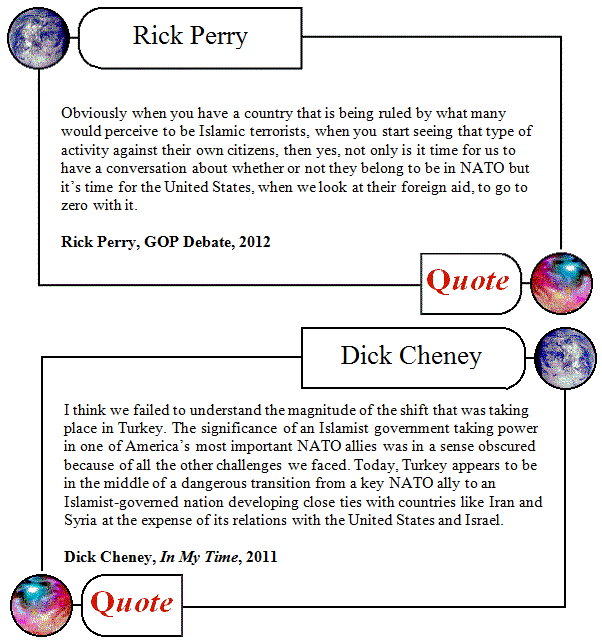
I’m always interested when someone, left or right, uses a juxtaposition of quotes or soundbites to show parallelisms or oppositions between opinions, and today the blogger at Emptywheeldid just that with a quote from Rick Perry at last night’s Republican debate and another one from Dick Cheney‘s memoir.
Here’s the result, presented in my own characteristic DoubleQuote format:
I guess my questions here would be about the specific phrasings, “ruled by what many would perceive to be Islamic terrorists” (Perry) and “an Islamist government” (Cheney). Are the two statements virtually identical, somewhat similar – or are there significant nuances separating them?
*
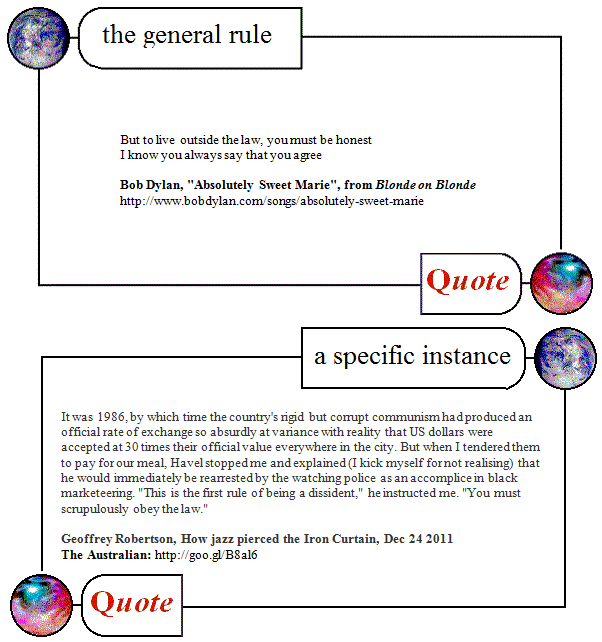
While we’re at it, here’s another DQ — this one struck me while reading a piece about Vaclav Havel today.
[ by Charles Cameron — a carol for the faithful, a paean to the Bonnie Prince for the unbelievers — and a Happy Christmas to Zen, Scott and all our readers ]
.
First the carol, because I think it’s only fitting at Christmas, with Bonnie Prince Charlie to follow for those who’d like to enjoy the music without subscribing to the belief…
1.
Okay, that was the Latin which, being something of a cultural snob, I prefer — the English version goes as follows:
O come, all ye faithful, joyful and triumphant, O come ye, O come ye, to Bethlehem. Come and behold Him, born the King of angels; O come, let us adore Him, O come, let us adore Him, O come, let us adore Him, Christ the Lord.
2.
And for disbelievers, agnostic and otherwise, here’s an alternative interpretation of the carol that doesn’t require a credal affirmation…
Adeste Fideles, the song which became O Come All Ye Faithful, is recognised as being the work of the 18th century music scribe, John Francis Wade, but there’s far more to this beloved song than meets the eye. The lyrics written by John Wade have clear Jacobite references to the restoration to the British throne of Charles Edward Stuart – the exiled King also known as ‘Bonnie Prince Charlie’.
In its earliest forms, from the 1740s to 70s, Adeste Fideles is often found in English Roman Catholic liturgical books next to, or physically very near, prayers for the exiled monarch. In John Francis Wade’s books it and other liturgical texts with ‘hidden’ Jacobite meaning are often strewn – even laden – with Jacobite floral imagery.
One important book including Adeste Fideles, to be shown on The Truth About Carols, reveals a wealth of Jacobite imagery. Amongst other things, it portrays a colourful image of Bonnie Prince Charlie, set over the image of a diagonal cross, imitating the text on the opposite page, the great Battle Hymn, Vexilla Regis Prodeunt – ‘Behold the Royal Ensigns Fly, Now Shines the Cross’s Mystery! The same book has a Jacobite cryptogram in Latin on its title page, which when deciphered gives a very clear sense of its Jacobite connections.
The meaning of the Christmas carol is clear: ‘Come and Behold Him, Born the King of Angels’ really means, Come and Behold Him, Born the King of the English – Bonnie Prince Charlie! “Fideles is Faithful Catholic Jacobites. Bethlehem is a common Jacobite cipher for England, and Regem Angelorum is a well-known pun on Angelorum (angels)/Anglorum (English).
Adeste Fideles seems to have lost its Jacobite meanings not long after Wade’s last published book in 1773, perhaps as Jacobitism ebbed in popular consciousness and as Roman Catholics neared religious freedom in the late 1770s. The real meaning of the Carol, remains, however, although whose birth we choose to celebrate in it remains a matter of personal decision.
[ by Charles Cameron – Iraq war, beginning and ending, analytic power of similarity ]
.
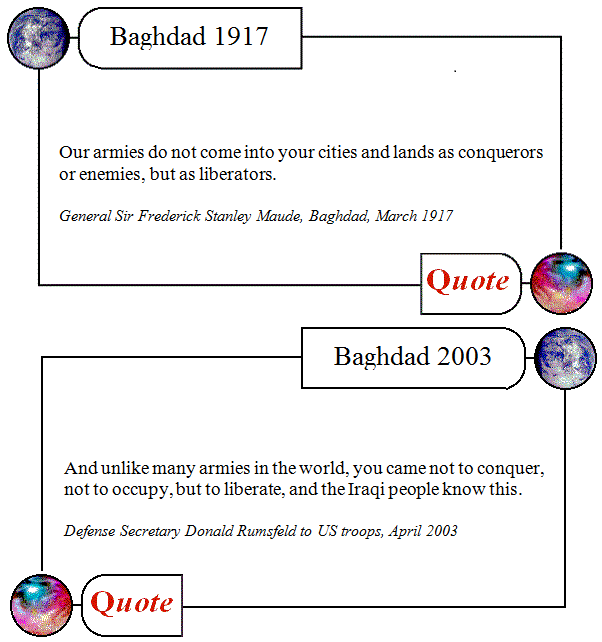
I’ve thanked Zen for his Iconic Compare and Contrast post already, but I’d like to run with his juxtaposition of images from the end of the Iraq war, and book-end it with an early DoubleQuote of mine from the beginning, thus:
That’s the beginning of the war, as I saw it “binocularly” — and here’s its ending, as Zen captured it:
Different though they are — one verbal, one visual — I think they go well together. I think they belong together.
But that’s essentially an aesthetic intuition.
*
And — apart from thanking Zen — that’s the thing I want to talk about.
The two quotes, eighty-six years apart, about an (anglophone) army in Baghdad coming there to liberate, not to conquer, are similar enough that they should give us pause for thought. They challenge us to think long and hard about the similarities between the two situations — and they challenge us to think no less hard and long about their differences.
Likewise, it’s the similarities between the two images Zen chose — of the Soviet withdrawal from Afghanistan and the US exit from Iraq — that give that juxtaposition its power. And Zen has chosen very carefully:
Not only are there two lines of vehicles stretching back from the foreground away into the distance in each image, but the angle from which the two columns are seen is about the same — and there are even two “tracks” in each photo reinforcing the vanishing point — two tracks to the right of the vehicles in the Afghan photo, the edge of the road and a what looks like the shadow of an overhead cable in the photo from Iraq.
*
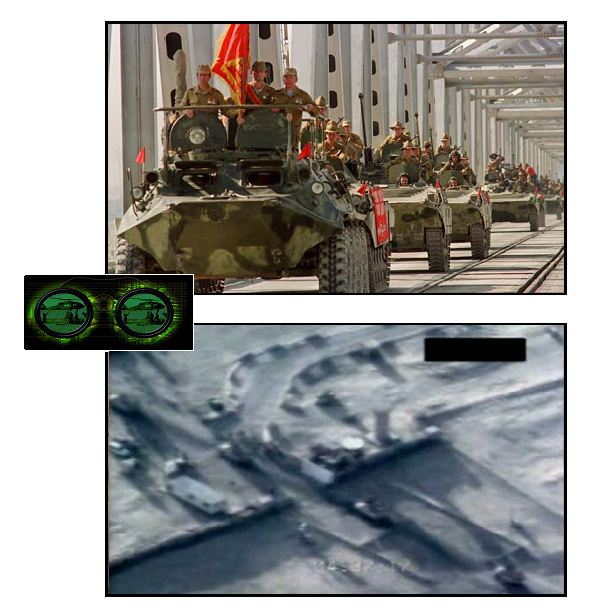
But let’s take this a bit further. The following juxtaposition is every bit as much a juxtaposition of the Soviet and American withdrawals as the pair of images Zen picked, but this time we have an aerial view of the US convoy — so the visual “rhyme” between the two images is no longer there — and even though the aerial shot is an intriguing one, what a difference that makes!
There’s nothing in that juxtaposition to make you go, yes!
On the level of what’s being referred to, the troop withdrawals from Afghanistan and Iraq, this pair of images has the same properties as the two images that Zen selected. But it doesn’t capture our attention in nearly the same way.
And the same would have been true if I’d picked a different sentence from Rumsfeld‘s speech to juxtapose with General Maude‘s “not as conquerors or enemies but as liberators” — such as, “You’ve unleashed events that will unquestionably shape the course of this country, the fate of the people, and very likely affect the future of this entire region.” I’d still be comparing and contrasting two speeches from the beginnings of two occupations of Baghdad. But there’d be no oomph to the comparison.
*
Because — and this is what I am trying to get at, the basic principle of HipBone analysis and what distinguishes it from otherwise similar modes of brainstorming and mind-mapping — the recognition of pattern, of salient sameness, of close parallelism or opposition is the criterion for success or failure in a HipBone-style juxtaposition.
Zen’s graphic example has that closeness — even down to those two parallel tracks beside and to the right of the vehicles. My two quotes from Maude and Rumsfeld have that. And it’s that closeness of match that makes a juxtaposition powerful.
Analogy works this way, rhyme works this way, fugue works this way, graphicmatch (in cinematography) works this way — it’s basic to the arts, basic to rhetoric, and basic to the way our analogically-disposed minds think.
It is not a method for arriving at conclusions, it’s a method for posing questions. And it sits right at the juncture where analysis admits it is not a science but an art.
Zenpundit is a blog dedicated to exploring the intersections of foreign policy, history, military theory, national security,strategic thinking, futurism, cognition and a number of other esoteric pursuits.