zenpundit.com » pakistan

Archive for the ‘pakistan’ Category

Ashura: the Passion of Husayn

Sunday, November 25th, 2012

[ by Charles Cameron — today’s solemn commemorations in Iraq, Afghanistan, Pakistan and India in comparative religious perspective ]
.

I was listening to Mozart‘s Requiem last night, and it is rich in grief shot through with glory. That’s the thing about mourning celebrations in which death is accompanied by the “sure and certain hope of the Resurrection into eternal life”.
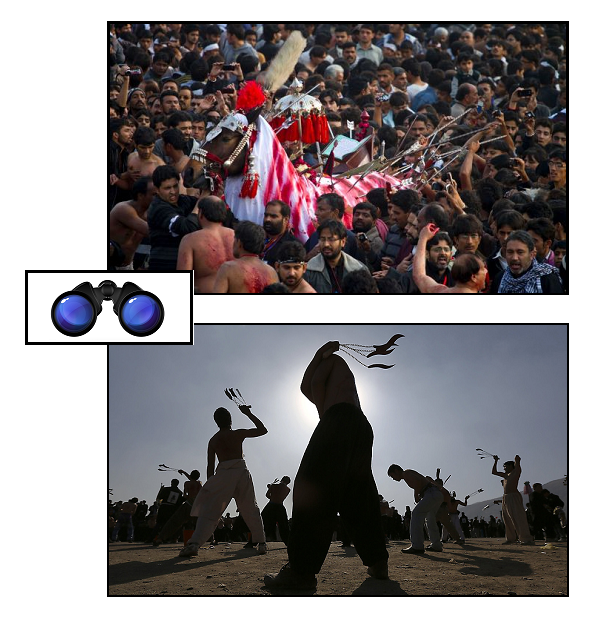
One such observance is found in Shia Islam, and falls this year on the 25th of November — today. It is the day of Ashura, the 10th day of Muharram in the Islamic calendar, and its epicenter is at Karbala in Iraq. As the saying goes:

Every day is Ashura and every land is Karbala.

For the Shia, Ashura commemorates the martyrdom of Husayn, grandson of the Prophet, at the Battle of Karbala, when he refused to give allegiance to the Umayyad caliph Yazid. Husayn’s martyrdom is dramatized in Ta’zieh, passion plays, giving us a hint that the martyrdom of Husayn at Ashura figures in the devotional life of the Shia much as the passion and death of Christ figures within Christianity, both in passion plays such as that at Oberammergau and in Catholic rituals such as the Stations of the Cross. This may seem a far-fetched analogy to some of my readers, but both deaths are viewed as redemptive. As another saying has it:

A single tear shed for Husayn washes away a hundred sins.

**

As you can see depicted in the lower panel above, Shiite mourning can include flagellation with chained blades, not something that sits easily with most westerners — yet as Roy Mottahedeh has said (quoted in SA Hayder, Reliving Karbala: Martyrdom in South Asian Memory):

Self-mutilation in emulation of the “passion” of heroes who are human yet divine is no stranger to the West: flagellants who whipped themselves both in penance and in remembrance of the scourging and crucifixion of Jesus appeared in almost every western European country in the Middle Ages…

The upper panel above depicts Husayn’s horse, riderless and bloody, and can perhaps give us some sense of the dark ceremonial beauty of the occasion for those whose grief transcends time and unites them in aspiration with Husayn himself — their flagellation attesting to their wish that they themselves could have stood beside him on that day so long ago, standing for truth against an army of injustice.

**

Their grief may be trans-temporal, but the possibility of dying for their faith persists to this day, for Sunni militants of the jihadist sort view Ashura differently — primarily as a day of fasting first performed by Moses and continued by Muhammad — and detest the breakaway sect of the Shia as rafidun, heretics.

In Iraq, Ashura there has seen millions of pilgrims visiting Karbala this year, with comparatively little violence:

Millions of Shiites flooded the Iraqi shrine city of Karbala on Sunday for the peak of Ashura rituals, which have been largely spared the attacks that struck pilgrims in past years. A bomb wounded 10 pilgrims in Diyala province, north of Baghdad, but it was the first such attack since a car bomb against pilgrims killed three people on November 17.

Farther afield, what the Pakstani police describe as a “major terror plot to attack the Muharram processions in Karachi” was avoided this year when “large amounts of explosive material, two suicide jackets and grenades” were confiscated during a raid, with the Minister for Religious Affairs declaring that the Tehreek-e-Taliban were behind the plots. Elsewhere in Pakistan:

At least five persons were killed and over 70 others injured on Sunday when a Shia procession was targeted with a bomb at Dera Ismail Khan in Pakistan’s restive northwest, the second such attack in the city in as many days.

Meanwhile in Kabul:

For the past week, the Afghan capital has been draped with black cloth arches and festooned with huge colored banners. Mournful, pounding chants pour from loudspeakers across the city, filling the air with slow martial intensity.

The dramatic display is all part of Muharram and the 10-day Shiite festival that commemorates the slaying of Imam Hussein, a 7th-century holy figure and early champion of Islam. But it is also a symbol of the growing religious and political freedom that Afghanistan’s long-ostracized Shiites have had in the past decade.

That’s from a Washington Post piece yesterday titled Afghan’s Shiite minority fears a return to old ostracism — and the next two paragraphs bear out the title:

Now, as Western military forces prepare to leave the country by 2014, Afghan Shiites, most of whom are from the Hazara ethnic minority, fear that their window of opportunity may slam shut again, leaving larger rival ethnic groups as well as Taliban insurgents, who are radical Sunni Muslims, dominating power.

“Everything we have achieved, our ability to come out and participate in society, has been in the shade of the international community and forces,” said Mohammed Alizada, a Hazara Shiite who was elected to parliament in 2009. “We are very concerned that once they leave, the fundamentalists will reemerge, ethnic issues will return, and we will lose what we have gained.”

Tribal politics, sectarian issues, the impending departure of US forces, the Taliban, cross-border alliances — and the sheer power of devotion — all these are intricately intertwined in today’s Afghanistan and its future. We may do well to understand something of the meaning of this day of Ashura, in our own calendar, 25th November 2012.

**

Annemarie Schimmel, the great Harvard scholar of Islamic mysticism, has a fine essay on the poetry of Ashura, encompassing both Sunni and (strongly Shia-influenced) Sufi traditions, Karbala and the Imam Husayn in Persian and Indo-Muslim literature. The mindset is very different from contemporary secular westernism, seeing death itself — and the grief that accompanies it — as a prelude to resurrection, and thus part of the timeless love-play of God with those who love him:

In having his beloved suffer, the divine Beloved seems to show his coquetry, trying and examining their faith and love, and thus even the most cruel manifestations of the battle in which the ‘youthful heroes’, as Shah Latif calls them, are enmeshed, are signs of divine love.

The earth trembles, shakes; the skies are in uproar;
This is not a war, this is the manifestation of Love.

The poet knows that affliction is a special gift for the friends of God, Those who are afflicted most are the prophets, then the saints, then the others in degrees’, and so he continues:

The Friend kills the darlings, the lovers are slain,
For the elect friends He prepares difficulties.
God, the Eternal, without need what He wants, He does.

**

The spirit here is not too far from that of the Greek philosopher Plotinus, who wrote in his Enneads [III.ii.15]:

Men directing their weapons against each other- under doom of death yet neatly lined up to fight as in the pyrrhic sword-dances of their sport- this is enough to tell us that all human intentions are but play, that death is nothing terrible, that to die in a war or in a fight is but to taste a little beforehand what old age has in store, to go away earlier and come back the sooner.

together with that of the early Christian Father, Origen, who wrote [De Martyrio, 39]:

And let each of us remember how many times we have been in danger of an ordinary death, and then let us ask ourselves whether we have not been preserved for something better, for the baptism in blood which washes away our sins and allows us to take our place at the heavenly altar together with all the companions of our warfare.

**

In India, indeed, the martyrdom of Husayn takes on an interfaith character in some places, as Hindus and Christians join Muslims in Ashura commemorations, as Naim Naqvi relates:

One can observe the richness and beauty of the diversity of Indian Culture at the occasion of Muharram. Since the martyrdom of Imam Hussain, Muharram ceremonies are observed all over the world including India. Hindus take part in them with great reverence and devotion. The tragedy of Karbala has become the harbinger for interfaith understanding in the Indian sub-continent. Participation of Hindus in the mourning rituals of Imam Hussain has been a feature of Hinduism for centuries in large parts of India. Hindus, Sikhs, Jains and even Christians observe Muharram. In the city of Varanasi which is the holiest city for Hindus many Hindu families participate in Muharram processions.

Describing the participation of one such Hindu family in Orissa, we read:

District police chief Lalit Das said Padhihary family has been doing this every year for the last 338 years, adding other local Hindu families also participate in the procession.

Muslims said it reflected the perfect harmony between the two communities in the area.

Thanksgiving and Kasab: pardon and penalty

Thursday, November 22nd, 2012

[ by Charles Cameron — i suppose this is about the state’s claim to a monopoly of violence, seen from both ends ]
.

I don’t want to go too far with this one, and I’ll start with the turkey and pardon, because pardon and forgiveness and thanksgiving all fit together and might as well be celebrated at this season — but as you’ll see, pardon has its dark side, even if it takes an anthropologist named Magnus Fiskesjö and his pamphlet titled The Thanksgiving Turkey Pardon, the Death of Teddy’s Bear, and the Sovereign Exception of Guantánamo to point it out:
.

But around the same time a turkey gets a reprieve in the US, a terrorist in India gets the death penalty.

I think it’s important to remember the Mumbai atrocities of 2008,and of which Ajmal Kasab (depicted below, and recently deceased) was the sole surviving perpetrator — if for no other reason than because he’s considered a martyr by some, and will be avenged.

But first, let me wish a Happy Thanksgiving! to all Zenpundit’s American readers, and good wishes to all others.

**

The problem with martyrdom… is that it’s a force-multiplier. Okay when the force is purely spiritual, not so much when it runs to violence and terror…

photo credit: Outlook India

Retired Indian intelligence chief Bahukutumbi Raman, whose tweets I often follow to articles on his Raman’s strategic analysis blog, warned us all:

Before the execution of Ajmal Kasab, the Pakistani terrorist of the Lashkar-e-Toiba (LET), who had participated in the 26/11 terrorist strikes in Mumbai, at Pune on the morning of November 21, 2012, our security agencies must have examined the likelihood of retaliation by jihadi terrorists in Pakistan and India and strengthened security precautions to prevent retaliatory attacks.

The LET and the organisations associated with it would want a quick retaliation.

And then he went into detail

Sure enough, Reuters then tells us:

Pakistan’s Taliban movement threatened on Thursday to attack Indian targets to avenge the country’s execution of Mohammad Ajmal Kasab, the lone survivor of the militant squad responsible for a rampage through Mumbai that killed 166 people in 2008. Kasab was hanged on Wednesday amid great secrecy, underscoring the political sensitivity of the November 26, 2008, massacre, which still casts a pall over relations between nuclear-armed rivals Pakistan and India.

“We have decided to target Indians to avenge the killing of Ajmal Kasab,” said Taliban spokesman Ehsanullah Ehsan by telephone from an undisclosed location.

**

In the course of the coronation liturgy for Queen Elizabeth II, the words justice and mercy crop up quite often — justly and justice 8 times, and merciful and mercy 28. It appears to be a sovereign’s right and obligation to administer both, and during the ceremonial they are brought together as a symbolic pair.

The Sceptre with the Cross is given into her right hand, with the words:

Receive the Royal Sceptre, the ensign of kingly power and justice

while the Rod with the Dove is given into her left hand, with the words:

Receive the Rod of equity and mercy.
Be so merciful that you be not too remiss,
so execute justice that you forget not mercy.
Punish the wicked, protect and cherish the just,
and lead your people in the way wherein they should go.

Justice is only fair: it seems, however, that it should be tempered with mercy.

**

Let me simply add that my own preference would be to have remitted the death penalty in Kasab’s case, and given him a life term in which to think about the lives he took. As for the turkey — happy stuffings!

I remember too, today, my friend and mentor Wallace Black Elk, and his wife, Grace Spotted Eagle. It was Wallace who — at least once — said:

They called us “Indians” when they came, so we have a nickname. But we are Earth people, we are original. When they come here, I welcome them with open arms, give them a turkey dinner, corn, and all the vegetables, all the greens.

Because this is a land of abundance…

Speaking of Pundita….

Wednesday, October 24th, 2012

She has a post up that skillfully weaves the case of Colonel Tunnell into a much larger, demoralizing, political and policy context:

On the perversion of nonviolence and religious tolerance in service of politics and war 

Two recently published essays, one by Belmont Club’s Richard Fernandez, one by Zenpundit’s Mark Safranski, when taken together reveal a portrait of human evil so horrific that young people and the severely depressed should not be allowed to see it. The rest of us need to contemplate what we have wrought by looking the other way as NATO military commands ordered soldiers in Afghanistan to act like saints in the face of ruthless armed militias and democratic governments promoted the lie that nonviolent resistance could topple dictators.  

In The Limits of Myth, Richard Fernandez amplifies on the theme I presented in On the Taliban shooting of Malala Yousafza: Pakistani human rights activists need to step believing in American fairy tales:

Pundita argues the notion of bloodless resistance has been oversold by the advocates of Mahatma Gandhi and Martin Luther King. It was a convenient alternative narrative to that perennial problem-solving algorithm, war.  By skipping over the War of Independence and the Civil War and emphasizing the Salt March and Selma, Alabama they gave the mistaken impression that resistance was all about speeches and heroic poses.
[…]
But nonviolence is a useful myth she argues, because it gives diplomats an excuse not to act. It makes a virtue of doing nothing by characterizing it as actively breaking the cycle of violence and counseling that eventually the tyrant will die of shame. But not before you die of a bullet.
[…]
The truth is that every resistance movement — even largely nonviolent ones — carries with it the implicit threat of force. The police and army of the regime often switch sides when they see that the cost of dealing with impending storm of popular violence exceeds the cost of turning on the tyrant. They fear force and therefore decline to exercise it.

The idea of consequences was once deeply rooted in the public consciousness. Yahweh thundered. And even Christ came to save us from the fires of hell. But hell there was. The opportunity for nonviolent change was always understood to be the ‘last chance’ prelude to violent consequences.  …  This kind of reasoning is now out of fashion…..

Read the rest here.

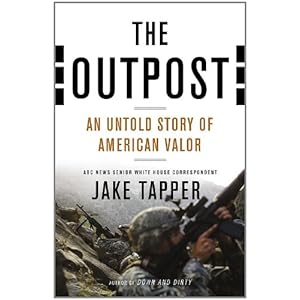
New Book: The Outpost by Jake Tapper

Thursday, October 18th, 2012

The Outpost: An Untold Story of American Valor by Jake Tapper

Influential ABC News Senior White House correspondent Jake Tapper has a new book coming out in November entitled The Outpost, about the battle of Outpost Keating in 2009 that the Taliban lost but inflicted high casualties on American troops and led to an ignominious withdrawal. Tapper’s PR folks have sent me an advance review copy, and at first glance, the book uncomfortably reminded me of Sebastian Junger’s WAR.

Sure enough, the site of Combat Outpost Keating in Nuristan is compared by Tapper to Junger’s deadly Korengal valley by page 6.  The xenophobic and remote Nuristanis were the last Afghans to convert to Islam, only by force, in the 1890’s. Their distant kin, the Kalash, are polytheists still.  Great place for an American outpost.

Looks like a gripping story. Will review in the near future.

Form is insight: the funnel, part 2

Thursday, October 11th, 2012

[ by Charles Cameron — a post in my importance of form in intelligence series — following up on part 1 with a series of quotes zeroing in from context via analysis to decision — Pakistan, Afghanistan, OBL ]
.

The 2nd funnel is from Duke's Structural Biology & Biophysics Program "folding funnels" page

.

In Part 1 of this post, I introduced the form of the funnel. I want to use this form, this recognizable and repeating pattern in nature, mathematics, and the transfer of oil into car engines, to illustrate a movement in time, an imperative in intelligence, and a loss in nuance. With regard to Obama and Osama.

I shall do this by offering a series of quotes that, in various voices, take us through the zeroing in process, by which an unimaginably complex world gets sorted into a complex analytic understanding and reduced from there to a yes/no decision and a single, definitive (fatal) command.

**

Let’s start here:

The universe is a complex system in which countless causal chains are acting and interacting independently and simultaneously (the ultimate nature of some of them unknown to science even today). There are in fact so many causal sequences and forces at work, all of them running in parallel, and each of them often affecting the course of the others, that it is hopeless to try to specify in advance what’s going to happen as they jointly work themselves out. In the face of that complexity, it becomes difficult if not impossible to know with any assurance the future state of the system except in those comparatively few cases in which the system is governed by ironclad laws of nature such as those that allow us to predict the phases of the moon, the tides, or the position of Jupiter in tomorrow night’s sky. Otherwise, forget it.

Further, it’s an illusion to think that supercomputer modeling is up to the task of truly reliable crystal-ball gazing. It isn’t. … Certain systems in nature, it seems, are computationally irreducible phenomena, meaning that there is no way of knowing the outcome short of waiting for it to happen.

That’s Ed Regis, responding to the Edge Question for 2008, What Have You Changed Your Mind About?

**

What do we do about it? The great (one might say visionary) biologist Francisco Varela has something important to say about that:

Let me try and be clear in the terminology here: for every system there is an environment which can (if we so decide) be looked at as a larger whole where the initial system participates. Since it would be impractical to do this at all times, we often chop out our system of interest, and put all the rest in the background as “environment.” To do this on purpose is quite useful; to forget that we did so is quite dangerous.

**

Moving on and zooming rapidly in, here’s the state of the FBI’s understanding of Al-Qaida very shortly after 9/11.

…the business of counterterrorism intelligence gathering in the United States is akin to the construction of a mosaic. … At this stage of the investigation, the FBI is gathering and processing thousands of bits and pieces of information that may seem innocuous at first glance. We must analyze all that information, however, to see if it can be fit into a picture that will reveal how the unseen whole operates. … What may seem trivial to some may appear of great moment to those within the FBI or the intelligence community who have a broader context.

**

Michael Taarnby gives us a sense of the various drivers in play in his paper, Profiling Islamic Suicide Terrorists: A Research Report for the Danish Ministry of Justice, 2003 — note that he’s working on suicide bombers, but many of the same drivers are at work more generally among jihadists:

It should be stressed that this study was based on a sceptical view of the exclusively religious nature of Islamic suicide terrorism. The purpose was to look for alternative interpretations with an open mind. The complexity related to the importance of these parameters is not related to a hierarchical dimension since it is the interplay between the parameters that produces a suicide terrorist over a period of time. The profiling of suicide terrorists from an exclusively psychological perspective for instance is no longer valid, reality is much more complex. Nor is it just a question of political disagreements. When existing profiling techniques have failed to understand the complex issues that leads an individual to sacrifice his life, it is because of a habit of using a monocausal approach. This is not to say that psychological studies cannot contribute to terrorist profiling …

Terrorism is not moncausal.

**

The war against the Taliban / AQ is complicated, if for no other reason, then because it is inherently self-referential, contains a paradox, pushes what it pulls against. In Steve Coll‘s words:

This could not be a more complicated war. If you think about it, the United States is essentially waging a war against its own ally. The Taliban are a proxy of the government of Pakistan. We are an ally of the government of Pakistan. We are fighting the Taliban. In the end, the Taliban will be defeated strategically when the government of Pakistan makes a strategic decision that its future does not lie in partnership with Islamic extremists.

**

That’s a fairly simple complexity, something a loop diagram could illustrate nicely. But it’s more multifactorial than that, as National Security Adviser James Jones remarked at the Munich Conference on Security Policy in February 2009:

But to move forward, we must understand the terms “national security” and “international security” are no longer limited to the ministries of defense and foreign ministries; in fact, they encompass the economic aspects of our societies. They encompass energy. They encompass new threats—asymmetric threats involving proliferation, involving the illegal shipment of arms and narcoterrorism, and the like. Borders are no longer recognized, and the simultaneity of the threats that face us are occurring at a more rapid pace …

The challenges that we face are broader and more diverse than we ever imagined, even after the terrible events of 9/11. And our capacity to meet these challenges, in my view, does not yet match the urgency of what is required. To be blunt, the institutions and approaches that we forged together through the twentieth century are still adjusting to meet the realities of the twenty-first century. And the world has definitely changed, but we have not changed with it. But it is not too late, and this is the good news …

**

And so we move from the complicated business of analytic understanding to the relative singularity of an individual making a decision — Steve Coll’s words again:

As with much of modern American national security as a whole, the bin Laden raid came down to a complicated decision made by one person. Only one person is asked to simultaneously weigh the certainties, manage all the various domestic, military, diplomatic, legal, and moral considerations, and make a decision Americans will live with for years to come. It is a remarkable — some might argue impractical — burden.

**

That’s the zoom, that’s my funnel, complete in seven quotes.

Let’s take things a bit further, and examine for a moment what has been said about the man making the decision. From The American Conservative:

To read Niebuhr is to relish these tensions, to grip the fundamental balance of the moral universe. “Man’s capacity for justice makes democracy possible,” he wrote. “But man’s inclination to injustice makes democracy necessary.” The concepts gear together like great cosmic cogs. “Goodness, armed with power, is corrupted,” he wrote. But “pure love without power is destroyed.” Much of Niebuhr’s worldview depends on these balances.

Reading Obama yields a similar effect. In 2009, literary critic Andrew Delbanco pointed out in the New Republic that Obama’s books are populated by counterweighted sentences, for instance: “There’s the middle-aged feminist who still mourns her abortion, and the Christian woman who paid for her teenager’s abortion.” Obama expresses his worldview, Delbanco wrote, in sentences “organized around pairs of sentiments or arguments that exert equal force against each other–a reflection of ongoing thinking rather than a statement of settled thoughts.”

To me, that’s reassuring: the issue can still be complex as it reaches the President’s mind, even if his decision and command has to be given in a single, definitive word.

**

What happens if an impoverished understanding is at work, the wrong answer is given, the wrong decision taken? HL Mencken to the rescue with this dismal truth:

For every complex problem, there is an answer that is clear, simple and wrong.

**

And finally — where are we now?

I’ll take my answer from a series of tweets Aaron Zelin made earlier today:

Al-Qaeda has never been dead, neither have they ever been resurgent. They’ve always just hovered. Nimble, patient, and exploitative. The problem is, we are always one step behind, we were fighting the AQ of 9/11 for yrs, now we are fighting the AQ of 2009-2011. As we have changed our tactics they have changed, too. AQ and its affiliates now are not the same as they once were.


Switch to our mobile site