[ by Charles Cameron — — what novelist, poet, painter, composer or film maker will create the great works of our present plague? — with two quotes on pestilence ]
.
I owe much to the Guardian for Jonathan Jones‘ article Plague visionaries: how Rembrandt, Titian and Caravaggio tackled pestilence, which provided me with the classic western exemplars here — and then there are those two quotes. But read on —
**
Pilgrims, penitents, flagellants, corpse-bearers, gargoyles, vultures — the whole ghastly crew populate the first chapter of Carlos Fuentes‘ great novel Terra Nostra. It is a time of plague, and the river Seine is boiling.
Great artists not infrequently tackle subjects of death, decay and destruction, the antechambers of hell, as they do works of beauty, mercy and grace, the antechamber of paradise. Today’s edition of “Coronavirus meets religion” features a small cluster of the greatest works of European art, painted in time of plague — to ward it off, to beg God for his mercy, to instruct the faithful in the path of heaven, to petition God on behalf of oneself or one’s family..
**
Titian: Pieta
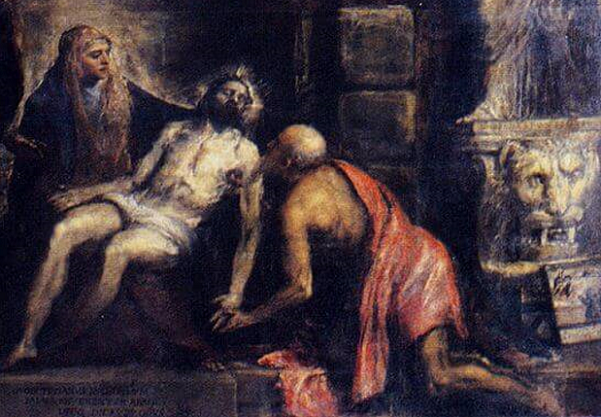
This detail of a painting by the great color master Titian shows from left to right the virgin Mary holding her son Jesus, who has just been brought down from the cross, dead, his hand held by a an old and weathered figure half-clothed in rad, believed by art historians to be a self-portrait by Titian, and representing St Jerome. and bottom right, an image of himself and his son as they’d be represented in a peasant’s ex voto or prayer plaque.
Jonathan Jones notes:
Titian painted this twilit image when Venice was being ravaged by plague. He portrays himself half-naked, prostrated before the image of Mary cradling the dead Christ. To make his message clear, he includes a picture within this picture: a crudely daubed popular ex-voto panel you might see in a church, depicting him and his son Orazio in prayer. This most sophisticated of artists is offering this great ashen canvas in the same simple spirit as an offering any peasant might make. It didn’t work. Titian and Orazio both died in the 1576 plague.
**
Mary Shelley:
Want a shiver down the spine? Mary Shelley gave us Frankenstein – here she is on pestilence, from this month’s Back Matter on Lapham’s:
Have any of you, my readers, observed the ruins of an anthill immediately after its destruction? At first it appears entirely deserted of its former inhabitants; in a little time you see an ant struggling through the upturned mold; they reappear by twos and threes, running hither and thither in search of their lost companions. Such were we upon the earth, wondering aghast at the effects of pestilence. Our empty habitations remained, but the dwellers were gathered to the shades of the tomb.
**
Caravaggio: The Seven Works of Mercy

St Matthew‘s gospel gives the standard set of “works of bodily mercy” (Matt. 25: 35-36:
I was an hungred, and ye gave me meat: I was thirsty, and ye gave me drink: I was a stranger, and ye took me in: Naked, and ye clothed me: I was sick, and ye visited me: I was in prison, and ye came unto me
Various artists have depicted what are now known as the Works of Corporal Mercy, Bruegel the Elder painted them in pen and ink, Bruegel the Younger painted them in color, but nobody had brought all seven together combined in such a single image as Caravaggio‘s. From Caravaggio.ogr:
He set the Acts described in Matthew 25 : 35-36 in a little piazza, perhaps in front of the same Taverna del Cerriglio where three years later he was attacked. It is night, and the padrone is directing three men to his inn (“I was a stranger, and you welcomed me”). One is hardly visible. The second is recognizable as a pilgrim by his staff, Saint James Major’s shell, and Saint Peter’s crossed keys on his hat; perhaps he can be identified as Saint Roch but more likely, following the Gospel, he is Christ in disguise. The third, a young bravo, is Saint Martin c utting his cloak to share it with the naked beggar in the foreground (“I was naked, and you clothed me”). In the shadow behind the blade is a youth whose legs seem to be twisted (“I was sick, and you visited me”). The group of loiterers is completed by a husky man, Samson, in the desert of Lechi (Judges 15 : 19), pouring water into his mouth from the jawbone of an ass (“I was thirsty, and you gave me drink”). Opposite this group, on the right, is Pero breast-feeding her aged father, Ci-mon, through the bars of his prison (“I was hungry, and you gave me food” and “I was in prison, and you came to me”). And in the background, a vested priest holds a torch to illuminate the hasty transport of a corpse, perhaps recalling the plagues that periodically decimated the city’s population (burial of the dead, the seventh Act, not mentioned in the Gospel). Above the scene hover the Madonna and Child with two angels, as if to warrant divine acknowledgment of human charity, particularly of the protagonists in the painting, who may portray members of the confraternity.
**
Susan Sontag:
Sontag on pestilence, in Disease as Political Metaphor — courtesy the New York Review of Books:
From pestilence (bubonic plague) came “pestilent,” whose figurative meaning, according to the Oxford English Dictionary, is “injurious to religion, morals, or public peace—1513”; and “pestilential,” meaning “morally baneful or pernicious—1531.”
**
Albrecht Dürer: The Four Horsemen of the Apocalypse:

Most beloved of the most famous set of illustrations of the Book of Revelation is this work by Albrecht Durer. The Met explains:
[T]he Four Horsemen presents a dramatically distilled version of the passage from the Book of Revelation (6:1–8): “And I saw, and behold, a white horse, and its rider had a bow; and a crown was given to him, and he went out conquering and to conquer. When he opened the second seal, I heard the second living creature say, ‘Come!’ And out came another horse, bright red; its rider was permitted to take peace from the earth, so that men should slay one another; and he was given a great sword. When he opened the third seal, I heard the third living creature say, ‘Come!’ And I saw, and behold, a black horse, and its rider had a balance in his hand; … When he opened the fourth seal, I heard the voice of the fourth living creature say, ‘Come!’ And I saw, and behold, a pale horse, and its rider’s name was Death, and Hades followed him; and they were given great power over a fourth of the earth; to kill with sword and with famine and with pestilence and by wild beasts of the earth.” Transforming what was a relatively staid and unthreatening image in earlier illustrated Bibles, Dürer injects motion and danger into this climactic moment through his subtle manipulation of the woodcut..
**
But as the Book of Revelation shows, better things eternally await us:–

Durer again, illustrating the Madonna portrayed as the “woman clothed with the sun, and the moon under her feet, and upon her head a crown of twelve stars” in Revelation 12.1
May you each and all receive a blizzard of blessings in these hard times.
Sancta Maria, Mater Dei, ora pro nobis.