zenpundit.com » Afghanistan

Archive for the ‘Afghanistan’ Category

Graphical footnotes, 1: Iwo Jima and the Muj

Thursday, November 8th, 2012

[ by Charles Cameron — another insight into mujahideen ethos via their graphics, this time from their Soviet era campaign ]
.

First, a current graphic which I’ve already shown you in a recent post on jihadist imagery — then a version of the same visual idea from earlier days:

credits: above, Ibn Siqilli, below, Mathew Trevithick for Foreign Policy

.

Ibn Siqilli‘s image is contemporary, Trevithick‘s is drawn from his fascinating series of images titled The Not-So-Funny Papers, which I missed myself when it first came out, and warmly recommend. The legend the flag in Trevithick’s piece carries is “Jihad”.

This post is intended as a footnote to my earlier post, Iwo Jihad? — the muj have clearly been at this business of graphical borrowing for a while…

Speaking of Pundita….

Wednesday, October 24th, 2012

She has a post up that skillfully weaves the case of Colonel Tunnell into a much larger, demoralizing, political and policy context:

On the perversion of nonviolence and religious tolerance in service of politics and war 

Two recently published essays, one by Belmont Club’s Richard Fernandez, one by Zenpundit’s Mark Safranski, when taken together reveal a portrait of human evil so horrific that young people and the severely depressed should not be allowed to see it. The rest of us need to contemplate what we have wrought by looking the other way as NATO military commands ordered soldiers in Afghanistan to act like saints in the face of ruthless armed militias and democratic governments promoted the lie that nonviolent resistance could topple dictators.  

In The Limits of Myth, Richard Fernandez amplifies on the theme I presented in On the Taliban shooting of Malala Yousafza: Pakistani human rights activists need to step believing in American fairy tales:

Pundita argues the notion of bloodless resistance has been oversold by the advocates of Mahatma Gandhi and Martin Luther King. It was a convenient alternative narrative to that perennial problem-solving algorithm, war.  By skipping over the War of Independence and the Civil War and emphasizing the Salt March and Selma, Alabama they gave the mistaken impression that resistance was all about speeches and heroic poses.
[…]
But nonviolence is a useful myth she argues, because it gives diplomats an excuse not to act. It makes a virtue of doing nothing by characterizing it as actively breaking the cycle of violence and counseling that eventually the tyrant will die of shame. But not before you die of a bullet.
[…]
The truth is that every resistance movement — even largely nonviolent ones — carries with it the implicit threat of force. The police and army of the regime often switch sides when they see that the cost of dealing with impending storm of popular violence exceeds the cost of turning on the tyrant. They fear force and therefore decline to exercise it.

The idea of consequences was once deeply rooted in the public consciousness. Yahweh thundered. And even Christ came to save us from the fires of hell. But hell there was. The opportunity for nonviolent change was always understood to be the ‘last chance’ prelude to violent consequences.  …  This kind of reasoning is now out of fashion…..

Read the rest here.

A Light at the End of the Tunnell

Tuesday, October 23rd, 2012


Colonel Harry Tunnell 

Michael Yon recently published a remarkable and courageous letter by US Army Colonel Harry Tunnell to the Secretary of the Army regarding deficiencies in our military operations in Afghanistan.  Colonel Tunnell is now retired, but the letter was sent while he was on active duty in 2010. Yon calls it “stunning” and I wholeheartedly agree. It is a “must read“.

Colonel Tunnell is a controversial figure in the Army. A bluntly outspoken critic of COIN with strong views on military professionalism and tactical leadership, he served as a commander of combat troops in Afghanistan and in Iraq, where he was badly wounded. Overcoming his injury, Colonel Tunnel returned to command a Stryker brigade in Afghanistan and clash with his ISAF superiors over his use of older Army doctrine on counter-guerrilla operations instead of the pop-centric COIN of FM 3-24.  Tunnell aggressively and repeatedly attacked the Taliban in his area of operations, pressing them, which resulted in frequent combat and casualties on both sides – something that was out-of-step with ISAF’s tactical guidance. Several enlisted soldiers in the Stryker brigade were convicted of the infamous “Kill Team” murders which led to Tunnell being investigated and cleared by the Army which found no causal responsibility from Tunnell’s advocacy of aggressive tactics but nonetheless reprimanded him for “poor command climate”.

In light of  Tunnell’s letter to the Secretary of the Army, interpret that administrative action as you wish. Afterwards, Colonel Tunnell continued to be a harsh critic of COIN and the focus of periodic,  extremely one-sided, negative stories in the media.

When Yon published his piece on Tunnell’s letter, I commented to him on a private listserv and he asked permission to use it, which I gave:

Mark Safranski Comments Col (ret.) Harry Tunnell 

The following email came from Mark Safranski subsequent his reading this letter from Colonel (ret.) Harry Tunnell.  The letter.

===Email from Mr. Safranski:===

Interesting, this part in particular:

“”A gross lack of concern for subordinates,” Tunnell wrote, “manifests itself in guidance that ‘zero’ civilian casualties are acceptable and coalition soldiers may have to be killed rather than defend themselves against a potential threat and risk being wrong and possibly resulting in injury or death of a civilian.”
….Tunnell’s memo exhibits particular disdain for British Maj. Gen. Nick Carter, commander of NATO forces in Regional Command South, which includes the Arghandab District where Sitton was killed.

It was Carter, Tunnell wrote, whose verbal order led commanders to risk their own troops rather than Afghan civilians – something Sitton complained about two years later in an email to his wife.”

Very helpful. I finally get it now.

I was always curious, reading threads [on private listserv] here on Afghanistan, how Colonel Tunnell was able to openly pursue counter-guerrilla operations in Afghanistan when pop-centric COIN was the heavy-handed, top-down and rigidly enforced tactical paradigm; Harry, IMHO, could do this because the *verbal* orders being issued went far beyond FM 3-24 theory into an unauthorized and unofficial but *politically desired* British policing model used in Northern Ireland. A kind of tactical guidance that could not be put in writing and enforced through the UCMJ because the American people would have found that guidance to be politically intolerable and morally outrageous – and rightly so.

Unlike Catholics in Ulster who are subjects of the Crown, Afghans are not American citizens and American soldiers and Marines are not cops in a bad neighborhood. Nor is the Taliban the IRA. Minimizing civilian casualties is a good and worthy goal; valuing political atmospherics over American lives is a sign of gross incompetence, at best.

Hence the anonymous leaks and smears about Harry to politically connected  Beltway scribes instead. Tunnell’s superiors were afraid to air their real dispute…..

Read the rest here.

In my view, Tunnell’s letter raises critical questions that every officer has a duty to raise with his superiors in the chain of command if, in their view, operations are not properly being carried out, which endangers the campaign and the lives of the troops. Moreover, if the United States military is to adhere to some bizarre, complicated, unworkable “law enforcement model” ROE not required by the Laws of War, or even our own COIN doctrine, then this is a subject for Congressional hearings and testimony from the administration, not something to be instituted on the sly using allied foreign officers.

Wanting to police the world is hard enough without making our soldiers into policemen.

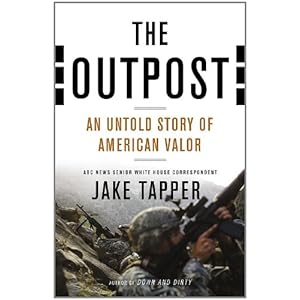
New Book: The Outpost by Jake Tapper

Thursday, October 18th, 2012

The Outpost: An Untold Story of American Valor by Jake Tapper

Influential ABC News Senior White House correspondent Jake Tapper has a new book coming out in November entitled The Outpost, about the battle of Outpost Keating in 2009 that the Taliban lost but inflicted high casualties on American troops and led to an ignominious withdrawal. Tapper’s PR folks have sent me an advance review copy, and at first glance, the book uncomfortably reminded me of Sebastian Junger’s WAR.

Sure enough, the site of Combat Outpost Keating in Nuristan is compared by Tapper to Junger’s deadly Korengal valley by page 6.  The xenophobic and remote Nuristanis were the last Afghans to convert to Islam, only by force, in the 1890’s. Their distant kin, the Kalash, are polytheists still.  Great place for an American outpost.

Looks like a gripping story. Will review in the near future.

Form is insight: the funnel, part 2

Thursday, October 11th, 2012

[ by Charles Cameron — a post in my importance of form in intelligence series — following up on part 1 with a series of quotes zeroing in from context via analysis to decision — Pakistan, Afghanistan, OBL ]
.

The 2nd funnel is from Duke's Structural Biology & Biophysics Program "folding funnels" page

.

In Part 1 of this post, I introduced the form of the funnel. I want to use this form, this recognizable and repeating pattern in nature, mathematics, and the transfer of oil into car engines, to illustrate a movement in time, an imperative in intelligence, and a loss in nuance. With regard to Obama and Osama.

I shall do this by offering a series of quotes that, in various voices, take us through the zeroing in process, by which an unimaginably complex world gets sorted into a complex analytic understanding and reduced from there to a yes/no decision and a single, definitive (fatal) command.

**

Let’s start here:

The universe is a complex system in which countless causal chains are acting and interacting independently and simultaneously (the ultimate nature of some of them unknown to science even today). There are in fact so many causal sequences and forces at work, all of them running in parallel, and each of them often affecting the course of the others, that it is hopeless to try to specify in advance what’s going to happen as they jointly work themselves out. In the face of that complexity, it becomes difficult if not impossible to know with any assurance the future state of the system except in those comparatively few cases in which the system is governed by ironclad laws of nature such as those that allow us to predict the phases of the moon, the tides, or the position of Jupiter in tomorrow night’s sky. Otherwise, forget it.

Further, it’s an illusion to think that supercomputer modeling is up to the task of truly reliable crystal-ball gazing. It isn’t. … Certain systems in nature, it seems, are computationally irreducible phenomena, meaning that there is no way of knowing the outcome short of waiting for it to happen.

That’s Ed Regis, responding to the Edge Question for 2008, What Have You Changed Your Mind About?

**

What do we do about it? The great (one might say visionary) biologist Francisco Varela has something important to say about that:

Let me try and be clear in the terminology here: for every system there is an environment which can (if we so decide) be looked at as a larger whole where the initial system participates. Since it would be impractical to do this at all times, we often chop out our system of interest, and put all the rest in the background as “environment.” To do this on purpose is quite useful; to forget that we did so is quite dangerous.

**

Moving on and zooming rapidly in, here’s the state of the FBI’s understanding of Al-Qaida very shortly after 9/11.

…the business of counterterrorism intelligence gathering in the United States is akin to the construction of a mosaic. … At this stage of the investigation, the FBI is gathering and processing thousands of bits and pieces of information that may seem innocuous at first glance. We must analyze all that information, however, to see if it can be fit into a picture that will reveal how the unseen whole operates. … What may seem trivial to some may appear of great moment to those within the FBI or the intelligence community who have a broader context.

**

Michael Taarnby gives us a sense of the various drivers in play in his paper, Profiling Islamic Suicide Terrorists: A Research Report for the Danish Ministry of Justice, 2003 — note that he’s working on suicide bombers, but many of the same drivers are at work more generally among jihadists:

It should be stressed that this study was based on a sceptical view of the exclusively religious nature of Islamic suicide terrorism. The purpose was to look for alternative interpretations with an open mind. The complexity related to the importance of these parameters is not related to a hierarchical dimension since it is the interplay between the parameters that produces a suicide terrorist over a period of time. The profiling of suicide terrorists from an exclusively psychological perspective for instance is no longer valid, reality is much more complex. Nor is it just a question of political disagreements. When existing profiling techniques have failed to understand the complex issues that leads an individual to sacrifice his life, it is because of a habit of using a monocausal approach. This is not to say that psychological studies cannot contribute to terrorist profiling …

Terrorism is not moncausal.

**

The war against the Taliban / AQ is complicated, if for no other reason, then because it is inherently self-referential, contains a paradox, pushes what it pulls against. In Steve Coll‘s words:

This could not be a more complicated war. If you think about it, the United States is essentially waging a war against its own ally. The Taliban are a proxy of the government of Pakistan. We are an ally of the government of Pakistan. We are fighting the Taliban. In the end, the Taliban will be defeated strategically when the government of Pakistan makes a strategic decision that its future does not lie in partnership with Islamic extremists.

**

That’s a fairly simple complexity, something a loop diagram could illustrate nicely. But it’s more multifactorial than that, as National Security Adviser James Jones remarked at the Munich Conference on Security Policy in February 2009:

But to move forward, we must understand the terms “national security” and “international security” are no longer limited to the ministries of defense and foreign ministries; in fact, they encompass the economic aspects of our societies. They encompass energy. They encompass new threats—asymmetric threats involving proliferation, involving the illegal shipment of arms and narcoterrorism, and the like. Borders are no longer recognized, and the simultaneity of the threats that face us are occurring at a more rapid pace …

The challenges that we face are broader and more diverse than we ever imagined, even after the terrible events of 9/11. And our capacity to meet these challenges, in my view, does not yet match the urgency of what is required. To be blunt, the institutions and approaches that we forged together through the twentieth century are still adjusting to meet the realities of the twenty-first century. And the world has definitely changed, but we have not changed with it. But it is not too late, and this is the good news …

**

And so we move from the complicated business of analytic understanding to the relative singularity of an individual making a decision — Steve Coll’s words again:

As with much of modern American national security as a whole, the bin Laden raid came down to a complicated decision made by one person. Only one person is asked to simultaneously weigh the certainties, manage all the various domestic, military, diplomatic, legal, and moral considerations, and make a decision Americans will live with for years to come. It is a remarkable — some might argue impractical — burden.

**

That’s the zoom, that’s my funnel, complete in seven quotes.

Let’s take things a bit further, and examine for a moment what has been said about the man making the decision. From The American Conservative:

To read Niebuhr is to relish these tensions, to grip the fundamental balance of the moral universe. “Man’s capacity for justice makes democracy possible,” he wrote. “But man’s inclination to injustice makes democracy necessary.” The concepts gear together like great cosmic cogs. “Goodness, armed with power, is corrupted,” he wrote. But “pure love without power is destroyed.” Much of Niebuhr’s worldview depends on these balances.

Reading Obama yields a similar effect. In 2009, literary critic Andrew Delbanco pointed out in the New Republic that Obama’s books are populated by counterweighted sentences, for instance: “There’s the middle-aged feminist who still mourns her abortion, and the Christian woman who paid for her teenager’s abortion.” Obama expresses his worldview, Delbanco wrote, in sentences “organized around pairs of sentiments or arguments that exert equal force against each other–a reflection of ongoing thinking rather than a statement of settled thoughts.”

To me, that’s reassuring: the issue can still be complex as it reaches the President’s mind, even if his decision and command has to be given in a single, definitive word.

**

What happens if an impoverished understanding is at work, the wrong answer is given, the wrong decision taken? HL Mencken to the rescue with this dismal truth:

For every complex problem, there is an answer that is clear, simple and wrong.

**

And finally — where are we now?

I’ll take my answer from a series of tweets Aaron Zelin made earlier today:

Al-Qaeda has never been dead, neither have they ever been resurgent. They’ve always just hovered. Nimble, patient, and exploitative. The problem is, we are always one step behind, we were fighting the AQ of 9/11 for yrs, now we are fighting the AQ of 2009-2011. As we have changed our tactics they have changed, too. AQ and its affiliates now are not the same as they once were.


Switch to our mobile site

