zenpundit.com » Afghanistan

Archive for the ‘Afghanistan’ Category

Vivaldi, veiling and revelation…

Wednesday, March 14th, 2012

[ by Charles Cameron — some glorious music, Venice, Kandahar ]
.

I was listening to Pergolesi‘s Stabat Mater the other day, and talk came around to the question of whether women would have sung the two solo parts – whether they were written for soprano and contralto, in other words, or for treble and counter-tenor – all of which reminded me that the “red priest” Vivaldi was, for over thirty years, maestro of the Ospedale della Pietà orphanage in Venice.

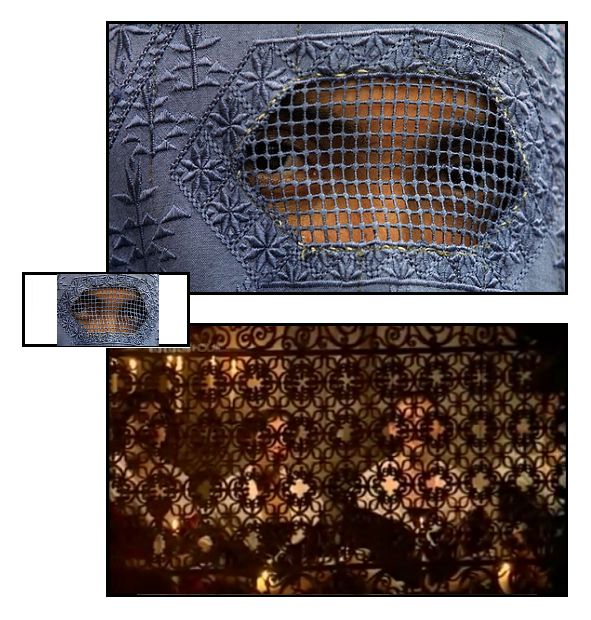
The Ospedale’s all-woman choir performed many of his sacred choral works in church, hidden from view if not speculation in a high balcony behind an iron grille…

The BBC has an hour-long documentary on the subject of Vivaldi’s Women, which features the Ospedale but also the contemporary choir and orchestra, Vivaldi’s Women, more properly known as the Schola Pietatis Antonio Vivaldi.

The (lower) image of the present-day women’s choir singing behind one of those grilles – accompanied by a voice-over reading from a fashionable “grand tour” diary of the day which reports that the “grilles conceal the angels of loveliness” (the writer was perhaps aware, perhaps not, that many of the orphans in Vivaldi’s day would have been scarred or deformed by the pox or their parents’ syphilis) reminded me of another contested icon of “women behind a grille” – this time, the traditional Afghan chadari (upper image)…

*

I have exchanged greetings through a grille with Carmelite nuns in California, and they clearly appreciated the sanctuary that their enclosure offered them…

My point is not to argue the superiority of bikini over burqa or vice versa: it is to offer you a chance to hear some Vivaldi or Pergolesi, and to consider the issue of veiling and revealing — intimacy’s equivalent of secrecy and transparency — from what was for me at least an unexpected and fresh angle.

A fatwa on the disposal of the Qur’an by fire

Saturday, March 10th, 2012

[ by Charles Cameron — fire, respect, or local fury? a meld of motives ]
.

Yesterday my friend and colleague Dr Tim Furnish posted a piece on the permissibility of Qur’an burning on PJ Media under the title Burning Defaced Korans: Islam-Approved. My own experience of Islam is colored by almost fifty years of exposure to the Sufi poets (I corresponded with Thomas Merton about “dervish” spirituality in 1964, see Merton’s Road to Joy: The Letters Of Thomas Merton To New And Old Friends, p. 333), so my emphasis in these matters differs somewhat from that of Dr Furnish, but I wanted in particular to thank him for pointing us all to the fatwa issued by the Permanent Committee of Research & Islaamic Rulings Of the Kingdom of Saudi Arabia, which informs us, among other things, that:

It has been confirmed in Saheeh al Bukhaaree in the chapter entitled, “The Collection of The Qur’an”, that ‘Uthmaan Bin ‘Afaan (radi Allahu ‘anhu) ordered four of the good and righteous reciters from the Sahaabah to transcribe copies of the Qur’an from the Mushaf which was gathered by the command of Abu Bakr (radi Allahu ‘anhu). When they completed this task, ‘Uthmaan sent out copies of these Qur’ans to every region. Then he ordered that all other pages and copies of the Qur’an be burnt.

The Director of Religious Affairs of the Islamic Center of Southern California, Imam Jihad Turk, similarly remarked in an NPR interview last September (again, h/t to Dr Furnish for the pointer):

The Qur’an as an idea is something that is in the hearts and the minds of the believers and followers of Islam. It’s not the actual text. It’s not the piece of paper. Muslims don’t worship the text of the Qur’an or destroy the Qur’an.

Although it’s not sacred or something that’s worshiped, it is considered the representation of the sacred word of God, and given that it’s a representation of it, a Muslim would want to make sure that it’s treated respectfully.

When Muslims want to respectfully dispose of a text of the Qur’an that is no longer usable, we will burn it. So if someone, for example, in their own private collection or library had a text of the Qur’an that was damaged or that was in disrepair, so the binding was ruined, etc., or it got torn, they might bring it by to the Islamic Center and ask that someone here dispose of it properly if they were unsure how to do that. And what I’ll do is I’ll take it to my fireplace at home and burn it there in the fireplace. So I sort of take the pages out and then burn it to make sure that it gets thoroughly charred and is no longer recognizable as script.

In the Islamic tradition, it’s the Arabic that is really considered the authentic, original scripture. The very early scripture of the Qur’an—when it was first collated and put into a binding there were a lot of loose papers around, and this was about 1,400 years ago. The first companions of Muhammad, led under the leadership of the third caliph, Uthman, actually instructed the followers to take all of those pages and burn them, and so that kind of set the precedent as to what should be done. If you burn it, it destroys the word, the ink on the paper. It’s no longer perceptible, and so therefore it is no longer scripture. It’s just ashes at that point.

Taking those two comments together, it would appear that it’s not fire so much as respect that’s at issue, theologically speaking. Not that the folks rioting in Afghanistan were necessarily rioting theologically.

And in today’s Afghanistan, it also stands to reason that there are other factors in play…

*

In my own response to Dr Furnish, I quoted Dr. Abdalqadir as-Sufi, who wrote:

We have news for the poor creature. He cannot burn the Qur’an. It is impossible. The Qur’an is the uncreated word of Allah. When a Muslim asks another Muslim to hand it to him he does not say, “give me the Qur’an” but rather “give me the Mus-haf.” That is to say , “give me the copy.”

[ … ] The Qur’an is the uncreated word of Allah. That is why it is unassailable. Of course, we treat the Copy with respect. However this unbalanced peasant preacher, in copying Mao and The Red Guards simply displays his ignorance. “Allah uses the enemies of the Deen to advance the Deen.”

When word came to a remote Muslim village in China that Mao’s Revolutionary Guards were coming to burn their Mus-hafs, the Imam assembled all the children and began to teach them to recite the Qur’an. When the Guards finally arrived they were met by smiling villagers in front of a pile of Copies. As the Guards set fire to the books the sounds of a hundred children came from the Mosque reciting the blessed words of the Qur’an.

The subtleties are always more interesting than the barbarities — which is why a scholarly approach to such enthusiastically contested issues is so important.

*

FWIW, I’ve come at this topic before, and found myself in some neat conversations — see Burning scriptures and human lives, also Of Quantity and Quality I: weighing man against book, and more recently On fire: issues in theology and politics – ii.

Should I whisper, should I scream? – Abu Musab al-Suri redux, Pt 2

Thursday, March 1st, 2012

[ by Charles Cameron — typology of intelligence failures, analytic blind spot, millennial movements, prophecy as strategy, abu Musab’s end times chronology ]
.

To tie in with the first part of this double-post, let me quote Aaron Zelin again:

I’ll back that up with Jean-Pierre Filiu‘s observation that in Abu-Musab al-Suri’s reading of jihadist history, “events lead on from one another toward the appearance of the Mahdi” — and that in Abu-Musab’s own words, “We shall be alive, then, when Allah’s order comes.”

I’ll give a brief account of the chronology below. Let’s get on with this.

1.

I don’t believe that Richard Landes, my mentor at the Center for Millennial Studies, mentions Abu Musab al-Suri in his Heaven on Earth: The Varieties of the Millennial Experiences (again as with Furnish, I could be wrong) — but if there’s a single book that will convince you of the enormity of our blind spot when it comes to taking millennial movements seriously, it’s this masterwork — simply stunning.

The thrust of his book is that millennial movements have been quite deliberately overlooked twice by the grand narratives of western civilization — first by religious writers who were embarrassed by the repeated cycle of enthusiasm followed by failure of end times prophecies and retroactively marginalized the topic, and more recently by…

secular historians, determined to push religion into the background of their story, [who] were hardly interested in highlighting religious phenomena that even the ecclesiastical historians considered ridiculous.

It is to undo the damage that this two-fold blindedness has caused us that Landes writes his remarkable book, covering in extraordinarily wide-ranging scholarly detail and with insight and wit, that current in human fear and hope he terms “the most protean belief in human history: millennialism.”

2.

In other words, the “the most protean belief in human history” has been consistently disregarded for way too long by academics, pundits and experts.

Put that in the context of this trenchant paragraph from Richards Heuer‘s Psychology of Intelligence Analysis, just recently quoted and indeed highlighted by Clint Watts and John E. Brennan in their paper Capturing the Potential of Outlier Ideas in the Intelligence Community:

Major intelligence failures are usually caused by failures of analysis, not failures of collection. Relevant information is discounted, misinterpreted, ignored, rejected, or overlooked because it fails to fit a prevailing mental model or mind-set.

3.

Rejected and overlooked?

Even the Psalmist (118.22) knows the importance of what’s rejected:

The stone which the builders rejected has become the chief cornerstone.

And just in passing, I’d argue that two of the seven “outlandish, unthinkable, and wholly anomalous” outliers that Watts & Brennan offer as bulleted examples in their paper — the Khomeini and bin Laden events — would have shown up rather more prominently had a subset of analysts been tasked to keep an eye on millenialist and / or specifically mahdist movements.

4.

Very quickly, then, here are some of the recent reports regarding al-Suri from well-informed analysts which seem to pay little mind to the Mahdist strand in his strategic thinking:

  • Raff Pantucci‘s January 26, 2012 post Whither al Suri? focuses on the implications of al-Suri’s release and quotes Brynjar Lia — insightful, but no mention of Mahdism.
  • Aaron Zelin‘s February 3 Foreign Policy post on al-Suri’s release comes closest to mentioning an apocalyptic angle when he writes:

    Additionally, his lore will grow in light of an alleged vision he had this past August, which was relayed by online jihadist Jundi Dawlat al-Islam (“Soldier of the Islamic State”), a member of the important Shamukh al-Islam Arabic Forum. “I have been informed that the Shaykh [Suri] saw in the past days a vision that he will have an important role in Bilad al-Sham (Syria), we ask Allah that it becomes true,” the jihadist wrote. Suri’s release will be seen as a vindication of that vision by his supporters, and no doubt boost his influence.

    The significant role of Shams — “the apocalyptic theater par excellence” — in al-Suri’s narrative is something J-P Filiu emphasized (p. 189).

  • Bill Roggio‘s February 5 piece for Long War Journal is an excellent backgrounder as befits LWJ — but no mention of eschatological strategy there, either.
  • Jarret Brachman‘s February 6 Abu Musab al-Suri Still Matters Online at Chronus Global is a brief note, just a tip-off that al-Suri is still influential…
  • MEMRI‘s February 8, 2012 The Release of Top Al-Qaeda Military Strategist/Ideologue Abu Mus’ab Al-Suri from Syrian Prison – A Looming Threat makes no mention of al-Suri’s eschatological thinking, and neither does their more extensive report on al-Suri, Al-Qaeda Military Strategist Abu Mus’ab Al-Suri’s Teachings on Fourth-Generation Warfare (4GW), Individual Jihad and the Future of Al-Qaeda, to which their February 2012 post links.
  • And the Jamestown Foundation‘s Feb 10 piece by Murad Batal al-Shishani, Syria’s Surprising Release of Jihadi Strategist Abu Mus’ab al-Suri, in their Terrorism Monitor v 10 # 3 doesn’t mention the apocalyptic angle — and Jamestown is where I heard Ali A Allawi speak on Millenarianism, Mahdism and Terrorism: The Case of Iraq back in 2007!

    Curious…

  • Ah well, there’s always Zenpundit [vbg].

    5.

    Okay, it looks to me as though we’re still so focused on the “nizam la tanzim / system not organization” and “lone wolf / leaderless resistance” aspects of al-Suri’s work, significant as they are, that it’s easy to overlook that damned ridiculous “end times” stuff the fellow also considers important, strategically speaking.

    So for the record, here’s the chronology of future events as J-P Filiu recounts it:

    Events will unfold in the following manner: “The Arabian Peninsula will be preserved [from harm] until the destruction of Armenia, Egypt will be preserved until the destruction of the [Arabian] peninsula, Kufa will be preserved until the destruction of Egypt, the city of impiety [mad?nat al-kufr] will be conquered only after the great wars, and the Antichrist will appear only after this conquest.” The concentrically expanding path of apocalyptic devastation will then close in upon Palestine, the sanctuary of Judeo- Crusader “impiety,” where the ultimate confrontation with the Byzantines will take place in and around the city of Acre.

    Well, that’s part of it, but you should read Filiu’s pp 186-191 for a fuller account — and somebody, please send me a reliable translation of those last 100 pages of abu Musab’s Call if you have one!

    Sadly, I don’t read or speak Arabic.

    6.

    Okay, that’s it, I’ve shouted, or whispered or whatever.

    The books at the top of this post are:

    David Cook, Contemporary Muslim Apocalyptic Literature
    Timothy Furnish, Holiest Wars: Islamic Mahdis, Their Jihads, and Osama bin Laden
    Jean-Pierre Filiu, Apocalypse in Islam
    Richard Landes, Heaven on Earth: The Varieties of the Millennial Experience

    All four are worthy of your consideration.

    A Wound That Does Not Cease to Bleed: The War in Vietnam

    Wednesday, February 29th, 2012

    Amigo of ZP blog, West Point military historian Colonel Gian Gentile, throws down the gauntlet in his review of Lewis Sorley’s new biography, Westmoreland: The General Who Lost Vietnam, in The National Interest:

    The Better War That Never Was

    DID GENERAL Westmoreland lose Vietnam? The answer is no. But he did lose the war over the memory of the Vietnam War. He lost it to military historian Lewis Sorley, among others. In his recent biography of William C. Westmoreland, Sorley posits what might be called “the better-war thesis”—that a better war leading to American victory was available to the United States if only the right general had been in charge. The problem, however, is that this so-called better war exists mostly in the minds of misguided historians and agenda-driven pundits.

    In the battle over the memory of the Vietnam War, Sorley annihilates Westmoreland and leaves his character and reputation in smoldering ruins. Yet Sorley’s victory in the fight for the memory of Vietnam has not brought us a balanced historical biography of Westmoreland.  

     ….The better-war thesis argues that if only the U.S. Army had concentrated from the start on building up the South Vietnamese armed forces and winning the hearts and minds of the South Vietnamese people through limited applications of military force, we would have won the war. But the question remains: Precisely how could tactical adjustments early in the war have overpowered the political constraints placed on the army by the Johnson administration, which kept it from taking the fight to the North Vietnamese? Or the dysfunctional nature of the South Vietnamese government and military that precluded them from standing on their own? Or the declining popular support and political will in the United States as the war dragged on without a decent end in sight? Or, perhaps most importantly, how could tactical adjustments toward better methods of counterinsurgency have overpowered a communist enemy that fought the war totally while the United States fought it with limited means? In his Westmoreland biography, Sorley essentially ignores these questions.

    Could the United States have prevailed in Vietnam? Yes, but it would have had to commit to staying there for generations, not a mere handful of years. The Vietnam War was an attempt at armed nation building for South Vietnam. Nations and their societies, however, are not built overnight, especially when they are violently contested by internal and external enemies. Thus, to prevail in Vietnam, the United States would have needed the collective will that it mustered to win World War II and would have had to be able to maintain it for generations. That kind of will—or staying power—was never a real possibility.

    In war, political and societal will are calculations of strategy, and strategists in Vietnam should have discerned early on that the war was simply unwinnable based on what the American people were willing to pay. Once the war started and it became clear that to prevail meant staying for an unacceptable amount of time, American strategy should have moved to withdraw much earlier than it did. Ending wars fought under botched strategy and policy can be every bit as damaging as the wars themselves.

    Well worth the read, not least for Gian’s model of how one historian carefully dismantles the thesis of another.

    We are a mere three years from the fiftieth anniversary of Lyndon Johnson’s escalation of the Vietnam War, less than two years from the fiftieth anniversary of the assassination of John F. Kennedy that brought LBJ into power and a year from the fiftieth anniversary of the infamous coup d’etat against American client, President Ngo Dinh Diem, that JFK had approved. Finally,  fifty years ago, Kennedy drastically increased the American military advisory mission to South Vietnam to just under 10,000 men and signed off on clandestine operations against North Vietnam.

    All those fiftieth anniversaries amount to a golden jubilee of rancor.

    The bitterness sown by the lost war in Vietnam still burns in American politics like red hot coals. Less bright perhaps than the open flame of 1968, but if you scratch the surface, you will find with no less heat. The war spawned division and polarization that twisted our politics and poisoned public debate to this day, echoing now as farce as much as tragedy.

    During the 1980’s, Vietnam historiography was virtually a cottage industry. It was the subject that ate the profession as a generation of academics who cut their academic teeth during the era of antiwar protest on campus acquired tenure, middle-aged paunches and lost hair while nursing their political grievances in their scholarship. I personally recall, as an  undergraduate, the war being referenced (usually along with vitriolic abuse of Ronald Reagan) in every humanities class, no matter how remote the course, with some professors being known for the quality of their off-topic rants.

    While Westmoreland bears heavy responsibility for his part in a losing a war, even as theater commander in Saigon he was only an executor, not a maker, of strategy, much less national policy. Westmoreland did not lose Vietnam in a stunning battlefield capitulation, so Gentile is right to defend “Westy” from being scapegoated for the poor strategic reasoning hatched in the Oval Office. Where Westmoreland was at fault was in his inability to either intellectually comprehend the bigger strategic picture in which he found himself struggling (most likely) or if he did, to effectively articulate the strategic environment in Southeast Asia to a domineering President who was stubbornly determined to brook no contrary advice (possible). Had Westmoreland tried, he likely would have failed (Brute Krulak’s effort in this regard got him physically ejected from the Oval Office by the seat of his pants by Johnson himself. I am dubious that LBJ would have been any happier with contradiction of policy from Westmoreland).

    Gentile, much like my professors of yore, is deeply interested in the congruence between events in his own time with those of the Vietnam era., in particular, the salience of counterinsurgency doctrine in the wars of Iraq and Afghanistan. There is, of course, some continuity between the Vietnam era and today present, a historical thread seized by the COINdinistas themselves in their veneration of Galula and slurping knife-blade portions of soup, but the continuity has limits. I suspect a Millennial generation vet of Kandahar or Fallujah, should they venture to become a historian, will frame and seek to explain their wars without much reference to the societal touchstone that is Vietnam.

    Perhaps by then, for American society, Vietnam will have finally ceased to bleed.

    On fire: issues in theology and politics – ii

    Tuesday, February 28th, 2012

    [ by Charles Cameron — burning and blasphemy ]
    .

    The question here is a simple one: which is the more blasphemous? burning holy scripture — or burning oneself, a human being?

    Now I imagine you think the answer to that’s quite obvious, and I do too. But there are people with the opposite opinion to mine — and when we burn their scriptures, even by mistake, even making apologies afterwards, they get enraged, and kill people. There may be many other factors that contribute to their rage, but this is the trigger, the religious sanction, the thing that pushes them over the top.

    Someone tweeted the other day:

    Souls are being burned alive in Homs & others riot over ink & paper. Where’s the logic?!

    It is not my purpose to attack or defend anyone’s beliefs or opinions here — what I would like to do instead is to see through the rage and glimpse that logic: I would like us to avoid needlessly triggering it.

    I want to bring what may at first seem utterly incomprehensible to us, a little closer to our comprehension.

    1.

    In the Quran 5.32, we read:

    We ordained for the Children of Israel that if any one slew a person – unless it be for murder or for spreading mischief in the land – it would be as if he slew the whole people: and if any one saved a life, it would be as if he saved the life of the whole people.

    On the one hand, that sets an extremely high value on human life — the Jewish equivalent is found in the Talmud, Tractate Sanhedrin 37a — and on the other hand, it can be claimed that that high value is set not by humans but by their Creator in his revealed Word, the Qur’an.

    2.

    What metaphor or analogy would allow me to understand that logic in terms of my own culture? Not the rage itself, not the killings — but the logic that potentiates them?

    3.

    If you think, as the melancholy Jaques has it in As You Like It, that all the world’s a stage, and all the men and women merely players – and as Hamlet might think, pondering what more things might be in heaven and earth than are dreamt of in philosophy – why then —

    How does one weigh the value of the life of a Jaques, or Hamlet, of one of us, one single human being – of whom Shakespeare, again through his Hamlet, said:

    how noble in reason! how infinite in faculty! in form and moving how express and admirable! in action how like an angel! in apprehension how like a god! the beauty of the world! the paragon of animals! ..

    against the value of a single copy of the Works of one William Shakespeare – who then continued on, through that same Hamlet’s voice, to ask:

    And yet, to me, what is this quintessence of dust?

    4.

    Shakespeare, the First Folio, Hamlet?
    God, the Scripture, you or me?

    5.

    It is said the imperishable Quran is writ in heaven before time was, and there is a hadith of Tirmidhi that describes Allah reciting Suras 20 and 36, Taha and Ya Sin, upon hearing which the angels responded “Happy are the people to whom this comes down, happy are the minds which carry this, and happy are the tongues which utter this”.

    I am not a literalist, I am a poet — so that makes poetic sense to me, the way Shakespeare’s “all the world’s a stage” makes sense.

    In reading these words, I see for a moment the beauty, the devotion that is possible towards this book, the fervent dedication.

    I am not about to kill people in the name of Shakespeare or the Gospels — yet I can understand a reverence for that which is greater than I, for that which is more than we dream of, and for that which “comes down” from thence.

    6.

    Suppose the body is a perishable scaffolding, and the book an eternal transcript written in the immortal soul…

    And now recall what that eternal transcript says:

    We ordained for the Children of Israel that if any one slew a person – unless it be for murder or for spreading mischief in the land – it would be as if he slew the whole people: and if any one saved a life, it would be as if he saved the life of the whole people.

    The paradox here, surely, is that we are each of us the quintessence of dust – each of us more than is dreamt of in philosophy.

    7.

    May the soul of Mohamed Bouazizi rest at last.

    Switch to our mobile site

