zenpundit.com » Afghanistan

Archive for the ‘Afghanistan’ Category

RESTREPO Review II. : Lexington Green

Saturday, July 3rd, 2010

An excellent review at Chicago Boyz by my comrade Lex:

Restrepo

First, the cryptic title. It looks like an acronym, but it is in fact the last name of a young soldier killed in Afghanistan, in the fighting which is recounted in the film. His name was Juan S. Restrepo.. His comrades in arms called him “doc.” His name is pronounced with an accent on the second syllable, reh-STREP-po.

The film was made by the noted author Sebastian Junger, and the photographer Tim Hetherington. (Junger wrote a book entitled simply War about his experiences being embedded with the troops, which Zen reviewed here. James McCormick reviewed Junger’s book on CB, here.)

The movie covers the hard fighting endured by a platoon of American troops in a 15 month deployement to the Korengal Valley in Afghanistan. It intercuts footage of the troops in the Valley with interviews after they left Afghanistan. The overall feel of the film is grim. The sense projected by the movie is that the troops who were not physically wounded have been psychologically damaged by their exposure to combat. The movie makes clear that their goal became survival and leaving Afghanistan alive. Other than the platoon commander, who was making a superhuman effort to carry out a counterinsurgency program, there was no sense that the troops perceived any achievable mission to carry out.   

The movie depicts the troops as facing an insurmountable task, trying to conduct a counter-insurgency campaign where they are bottled up in firebases and cannot come out to provide security for the population. The Taliban rule the countryside. The Americans can foray out, and bring down heavy firepower when they encounter the Taliban, but the fundamental mismatch between what the troops have been asked to do and the means provided to do it is apparent throughout….

Read the rest here.

Some Recommended Reading on Strategy

Thursday, July 1st, 2010

From this corner of the blogosphere…..

Armchair Generalist –  Declining Competency in Crafting Strategy

Via the blog “War, the military, COIN and stuff,” we learn of Andrew Krepenivich’s latest portrait of strategic thinking and what’s wrong with the Obama administration’s National Security Strategy. In short, the problem is that it isn’t really a strategy. It’s a wish list.

….Fortunately, there are more than two ways (increasing funding and creating efficiencies) to resolve a mismatch between the defense program and the resources available to sustain it. They involve strategy, which can be simply defined as how a state’s resources are best employed to achieve the ends it seeks. The better the strategy, the more that can be accomplished with a given set of resources.

Strategy necessarily involves setting priorities and taking risks. This is because no state, however powerful relative to other states, has ever had sufficient resources to eliminate all risks to its security and well-being. Thus two ways of dealing with the problem of having to work with a relative decline in resources are to reduce the objectives to be achieved; or to accept greater risk that they may not be accomplished.

Not sure I agree that the US needs to go all Julian Corbett but the strategy deficit definitely needs to be addressed and that will help maximize capabilities on declining budget dollars.

Current Intelligence ( Kenneth Payne)« The Strategists »

….Rather than riffing off a month’s worth of posts, I thought I’d home in on the one post that has generated more comments than any other we’ve done so far. Thomas Rid wanted to know why there were so few American strategists compared to those from Europe.  First problem, who is a strategist? Thomas distinguished between historians and strategists, but not between practitioners and theorists – so George Marshall and Bernard Brodie both count, and both, of course, are Americans too. In the discussion that followed, this question of man of letters versus man of action came up repeatedly. To be sure, it’s difficult to make hard and fast distinctions between thinkers and doers – Clausewitz would count as both theorist and practitioner, and something of a historian too; even a civilian like Thomas Schelling could lay claim to a certain practitioner status, in shaping the practice of US deterrence. My own view is close to Brodie – strategy certainly need not be an activity done by the military, even if it requires a firm grasp of military detail. In fact, a civilian strategist, with years of mulling the whys and wherefores of strategic behaviour, may be better placed than a general whose career has largely been spent wrestling with tactical and operational issues, away from the intersection of politics and violence. More than that, in both low intensity and nuclear strategy, the aggressive traits of a proven battlefield winner may actually prove disadvantageous. Don’t believe me? Take a quick flick through the transcripts of the Cuban missile crisis.

The Russian decision making process in the Cuban Missile Crisis is equally interesting and non-strategic, being partially a byproduct of Khrushchev’s political struggles over Soviet domestic policy in the Presidium.

Inkspots (Gulliver) – The foundational flaw of our Afghanistan strategy, universally ignored by its proponents

Can 400,000 ANSF deny sanctuary to al-Qaeda? Can 400,000 ANSF ensure that America won’t be attacked by individuals who train or plan their attacks from Afghan territory? (We already know they can’t do anything about the AQ folks on the other side of the Hindu Kush, but again, we’re going to leave that aside for now.) Can 400,000 ANSF do the job that 130,000 ISAF troops plus ~245,000 ANSF are currently doing? So, basically, what’s the time frame on which we can expect ANSF to effect a one-for-one, straight-up capability match with the ISAF troops who will be departing the country?

Seriously: is there anyone who thinks this can be done in a decade?

And if not, then why is this our strategic concept? Why aren’t we working on some other plan to mitigate the nearly certain shortfalls that will exist when U.S. troops pull chocks and head home?

SchmedlapIs Afghanistan an Arena?

I am not sure what we are going to do now. Will we start from the objectives that we seek to achieve in Afghanistan and then mold our response accordingly? Will we start from a set of tactics that we have been sold and attempt to mold our response to fit those tactics? Or will we attempt to mold our approach in order to facilitate a withdrawal timeline?

I’m not sure either. The Senate confiirmation hearings for General Petraeus made it clear that the Democrats consider the withdrawal timetable to be a sacred objective in isolation from everything else and the Republicans want it to be clear that this idea is Barack Obama’s. In other words momentary political “wins” occupy the minds of our elected officials and their interest in strategy – or the effects of not having one – is approximately zero.

Movie Review: RESTREPO Screening

Tuesday, June 29th, 2010

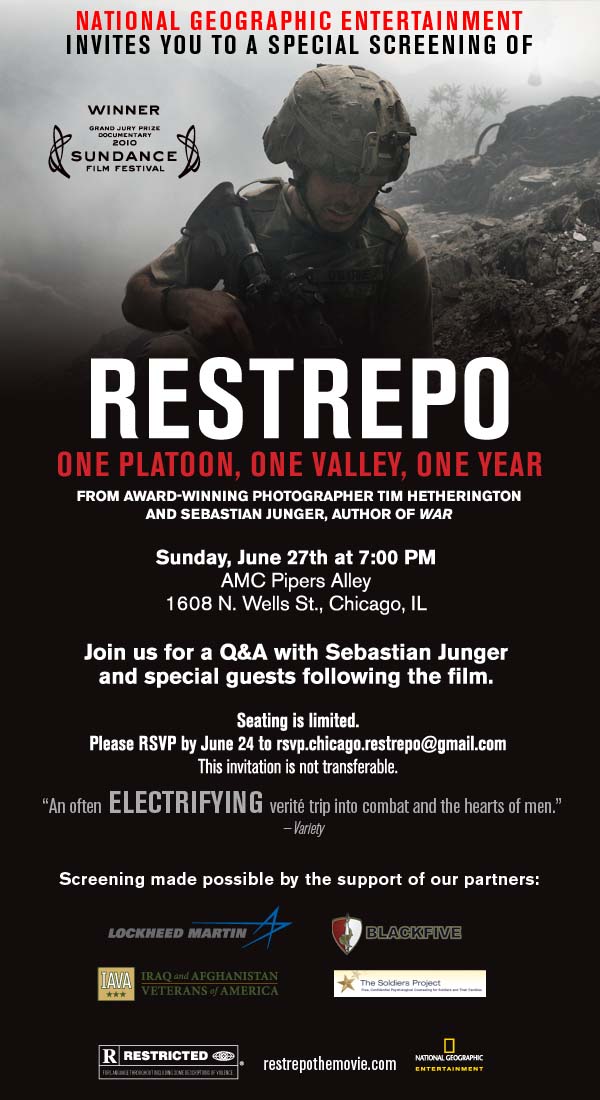
restrepo_evite_chi2.jpg  

RESTREPO 

As I mentioned yesterday, I had the good fortune to receive a courtesy invite to a screening of RESTREPO, a documentary of the experience of the second platoon of Battle Company in the Korengal valley of Afghanistan. The film takes its title from a fallen member of the platoon, a medic Pvt. Juan “Doc” Restrepo, in whose honor the platoon’s new outpost in that ferociously disputed valley is named. The film, largely compiled from footage shot by Tim Hetherington, is the companion to the book WAR by Sebastian Junger on the same subject. There are some substantial differences between the movie experience and reading the book ( which I reviewed here).

First, RESTREPO makes more explicit the harsh terrain in which the war is taking place for the young men of second platoon. If you have ever driven through the mountains of Tennessee or West Virginia, imagine those states as semi-arid, with steeper elevations and go back in time to circa 1900 so that the deeply impoverished residents are struggling to scratch a living out of sand and rocks with little or no comforts of modernity. The valley appears to always be dusty, sunny and very hot. Except up in the hills where it snows – then it looks cloudy and cold. That’s what Korengal looks like.

The Korengalis, it must be said, look like that too. Virtually every Korengali man in the film is hawk-faced gaunt and weathered, fierce faces deeply lined by sun and privation. Korengali elders have the look of determined survivors who built the fortified compounds that cling precariously to the rock wall of the hills, ascending, jerry-built. The village reminded me of what Cabrini-Green might have looked like had it been erected in the 9th century. The warmth of their elders’ feelings toward Americans can be described as “grudging”, well-demonstrated at the shura where the elders asked the Captain for the return of “Yusuf Mohammed” who had been arrested. As it turned out, young “fucking Yusuf Mohammed” had beheaded someone on a jihadi videotape and the clearly disgusted C.O. told the elders that Yusuf would not be coming back.

A second striking difference was that unlike WAR, which is narrated through Sebastian Junger’s perspective, the soldiers are speaking directly themselves, either in candid comments on patrol and in RESTREPO or in de-brief interviews. Junger accurately reflected the views of the soldiers he interviewed but where WAR has one voice, Junger’s, RESTREPO has a multitude of voices with their individual insights, irreverance, agonies, tedium, bitching, regrets and pride. Reading WAR depressed me, but watching RESTREPO, despite scenes of graphic suffering, definitely did not. If you see these young soldiers and do not come away impressed with their mettle and resilience of character, then you have a heart of stone and a head of straw.

A thought that kept coming back to me, which I think was stirred by the imagery of the valley seen in the film in a way the book did not, was that there was nothing of strategic value there whatsoever. Even the Taliban was not particularly welcome and tread very lightly among the Korengalis who are ruled by their elders to a degree that has eroded elsewhere in Afghanistan. It seemed with American operations in the Korengal we were replicating in miniature a Khe Sanh or Dien Bien Phu where the conventional army could draw out the insurgents and that the COIN elements were window dressing, Big Army humoring the party line at CENTCOM while playing a joke on the soldiers ordered to go through the motions of counterinsurgency on the ground. Junger, in his talk after the film hinted as much in saying that 150 men of Battle Company could hold their own there but could not do the COIN objectives in Korengal by themselves that required a full battalion.

After the film was over, Sebastian Junger took questions from the theater audience, which had a strong representation of veterans, including two who had served at RESTREPO and family members who lost sons in Afghanistan. He was a straight shooter in all of his answers, even the difficult moral questions and did not pretend he had all the answers or better answers and tried to testify primarily to what he personally witnessed. A performance that would make me comfortable in relying on Junger’s reporting in the future.

A moving and thought-provoking documentary, RESTREPO opens at Piper’s Alley in Chicago this Friday on July 2nd

Intriguing Analysis on NYT-Obama Admin Policy Split on Pakistan

Monday, June 28th, 2010

Pundita detects the Old Gray Lady going off Rahm Emanuel’s reservation:

Afghanistan War: Obama tries to quash New York Times mutiny

I don’t know whether the mutiny is actually against the White House or the ISAF command or both. All I’ve been able to piece together is that after fortifying themselves with rum and the battle cry, ‘We’re nobody’s poodle!‘ the New York Times editorial board gave the heave-ho to NATO’s march to the rear in Afghanistan.

So this is a very strange turn of events and worthy of examination.The mutiny might have started earlier but as near as I can figure it began June 11. On that date the New York Times reported on a version of what transpired during Karzai’s dispute with two officials….

….State Department spokesman P.J. Crowley, who evidently had not gotten the memo about the mutiny by the time of his June 25 press briefing, only poured fuel on the fire started by the mutineers:

QUESTION: … the New York Times today reported that the Pakistan army has offered to mediate for peace talks with the Taliban and also with the Haqqani network. Is the offer with you?MR. CROWLEY: Well, as we’ve said many times, this is an Afghan-led process, but obviously there are discussions going on between Afghan officials and Pakistani officials, and we certainly want to see ways in which Pakistan can be supportive of this broader process.

QUESTION: Do you see the Haqqani network coming – sharing power with the Afghan Government? Do you support that?

MR. CROWLEY: We have been very clear in terms of the conditions that any individual or any entity need to meet in order to have a constructive role in Afghanistan’s future: renouncing violence, terminating any ties to al-Qaida, and respecting the Afghan constitution. Anyone who meets those criteria can play a role in Afghan’s future.

The White House, more alarmed by the Times mutiny than Crowley’s foot-in-mouth replies, scrambled to do damage control. Yesterday Democratic Senator Dianne Feinstein and a toady in the GOP camp, Republican Senator Lindsey Graham, were packed off to Fox News Cable’s Sunday show to give assurances that if General Petraeus needed more time to win the war in Afghanistan he had it.Leon Panetta was also dispatched to the Sunday morning TV network circuit, which receives close attention here in the nation’s capital. So it came to pass that Panetta made his first appearance on American network television since he became director of the CIA. He appeared on ABC’s “This Week” and faced questions from Jake Tapper, who soon turned discussion to the June 24 Times report:

Pundita has much more here.

The problem for the Obama administration is that if the generally incurious and poorly informed American public ever grasped the nature and an accurate record of Pakistan’s ongoing sponsorship the Taliban, Pakistan would quickly become an object of hatred in the eyes of US voters which, with the right visceral image, could quickly turn passive disquiet into righteous rage. My read, and it is just an informal sense, is that frustrations with the war are building into a dangerous powder keg beneath a placid surface of widespread anxiety and concern for the well-being of the troops.

A mass-casualty act of terror on American soil traced back to Pakistan, or some grisly image broadcast from the Afghan battlefield could unleash a political tsunami.

RESTREPO Screening

Sunday, June 27th, 2010

restrepo_evite_chi2.jpg

RESTREPO 

Will be going to this Sunday night with Lex and Charles Cameron, Madhu and some of the cast of Chicago Boyz. Also present will be some of the gents from the popular milblog, BLACKFIVE and veterans groups in the Chicago area. 

WAR by Sebastian Junger was the book that was written in conjunction with this documentary; Junger will be on hand to answer audience questions. I am sure there will be a number of blog reviews of this screening come Monday and I will attempt to link to them all here when I write my own.

Deserving accolades for organizing this screening, a sizable undertaking, are Kanani Fong and Laura Kim. They have reached out to many people in this endeavor and extended every courtesy to veterans support groups and bloggers in particular.

RESTREPO opens to the public on July 2nd.


Switch to our mobile site

