zenpundit.com » games

Archive for the ‘games’ Category

Juxtaposition: chess in Wahhabism and Buddhism

Sunday, January 24th, 2016

[ by Charles Cameron — on the focus of similarity — sameness or differences? ]
.
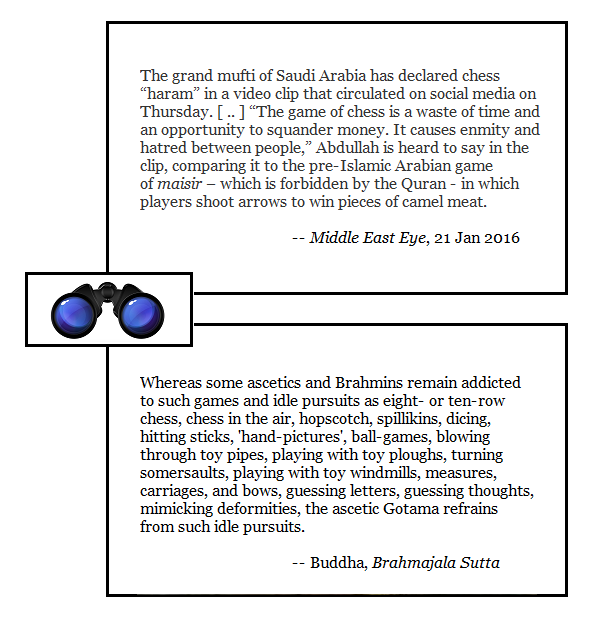
SPEC chess is haram

As I said recently, juxtaposition does not imply eqivalence.

It is only too easy these days to see a headline like Chess is ‘haram and a waste of time,’ says grand mufti of Saudi Arabia and view it purely in terms of Islam. It is in fact an Islamic ruling, though non-binding (there was, in fact, a chess tournament scheduled to take place in Mecca today, January 22, 2016), and can also be found in Shia sources (Grand Ayatollah Sistani of Iraq has also ruled against the game) — but many people who intensely dislike Islam may nonetheless admire Buddhism, and the Buddha dispproved of the game, even when played “in the air”..

Hey, to get a better sense of what “in the air” means here, let’s take a look at a different, more informative translation (albeit on that would not have fit into the procrustean bed of my DoubleQuote format:

Whereas some honorable recluses and brahmins, while living on food offered by the faithful, indulge in the following games that are a basis for negligence: atthapada (a game played on an eight-row chess-board); dasapada (a game played on a ten-row chess-board); akasa (a game of the same type played by imagining a board in the air); pariharapatha (“hopscotch,” a diagram is drawn on the ground and one has to jump in the allowable spaces avoiding the lines); santika (“spellicans,” assembling the pieces in a pile, removing and returning them without disturbing the pile); khalika (dice games); ghatika (hitting a short stick with a long stick); salakahattha (a game played by dipping the hand in paint or dye, striking the ground or a wall, and requiring the participants to show the figure of an elephant, a horse etc.); akkha (ball games); pangacira (blowing through toy pipes made of leaves); vankaka (ploughing with miniature ploughs); mokkhacika (turning somersaults); cingulika (playing with paper windmills); pattalaka (playing with toy measures); rathaka (playing with toy chariots); dhanuka (playing with toy bows); akkharika (guessing at letters written in the air or on one’s back); manesika (guessing others’ thoughts); yathavajja (games involving mimicry of deformities) — the recluse Gotama abstains from such games and recreations.

**

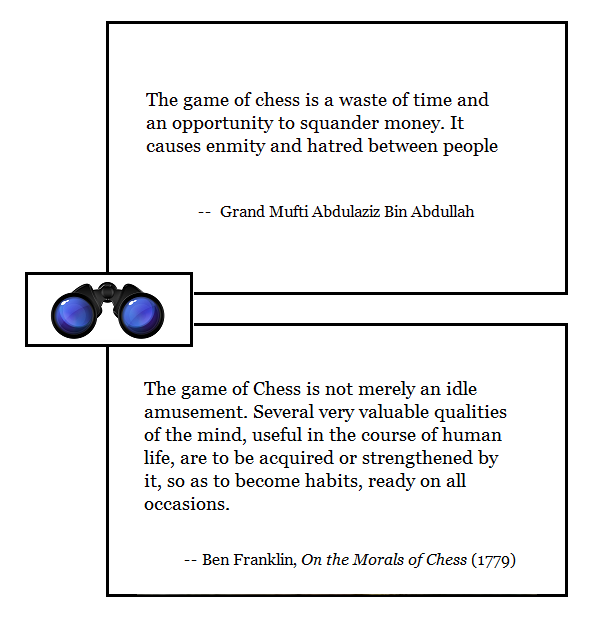
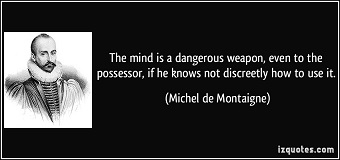
I trust that that juxtaposition of Mufti and Buddha carries an element of surpise. By way of contrast, one could always make a less surprising (less challenging?) juxtaposition, between the Grand Mufti — Sheikh Abdul Aziz al-Sheikh — and Benjamin Franklin:
SPEC-chess-is-haram 2

Politics as a pocketful of curiosities

Tuesday, January 19th, 2016

[ by Charles Cameron — a brief addendum to the previous post ]
.

While we’re on the topic of religion and politics, so to speak, here’s a theological curiosity — a pocketful of the current presidency:

I’ll leave it to individual viewers to decide whether that’s an interfaith pocketful or a pocketful of theological impossibility — either way, it’s thought provoking.

Quick summary: Christianity 2, Hinduism 1, Buddhism 1, Casinos 1.

DoubleTakes

Sunday, December 27th, 2015

[ by Charles Cameron — on juxtaposition as a force-multiplier in the war of ideas ]
.

Two potent examples of what I term DoubleQuotes in the Wild:

DefenseOne‘s ‘Call of Jihad’: ISIS Turns to Video Games, Hollywood to Reach Recruits is worth reading as a side-bar to Thomas Hegghammer‘s highly significant (and contested) Wilkinson Memorial Lecture, Why Terrorists Weep: The Socio-Cultural Practices of Jihadi Militants.

**

There’s a glib phrase about a picture being worth a thousand words, which given the quality of writing these days on the web may not be saying much about pictures — my point here is that two pictures can be worth a whole lot more than (twice) one — and the same goes for appositely juxtaposed verbal quotes.

Apposite juxtaposition, IOW, is a force-multiplier in the war of ideas.

War, Games and morale

Sunday, December 20th, 2015

[ by Charles Cameron — on gaming “living and moral forces” — with a whiff or two of Montaigne ]
.

the-mind-is-a-dangerous-weapon-even-to-the-possessor

**

Let’s start with Clausewitz, On War.

He says — and we’d be wise to pay attention — “most of the matters dealt with in this book are composed of equal parts of physical and of moral causes and effects.” Earlier in the paragraph, he’d said, “The effects of physical and psychological factors form an organic whole which, unlike a metal alloy, is inseparable..” — which puts the physical and the moral on equal footing. He then tilts the board decisively in favor of the “moral” factors —

One might say that the physical factors seem little more than the wooden hilt, while the moral factors are the precious metal, the real weapon, the finely-honed blade.

Furthermore, these “moral factors” are “intangible” — or as Michael Handel puts it:

In contrast to the physical forces, which are relatively easy to estimate, the equally important moral forces are more difficult to gauge.

**

Deputy Secretary of Defense Bob Work and Gen. Paul Selva, Revitalizing Wargaming is necessary to be prepared for future wars:

For example, faculty and students at the Naval War College integrated wargaming into their entire course of study, analyzing the then-novel concept of carrier task force operations, the role of submarines in scouting and raiding, and how to provide logistics support to fleet operations spread over the vast Pacific Ocean. Wargames in classrooms at Quantico helped the Marine Corps develop new concepts for amphibious warfare and conceive of new techniques for capturing advanced naval bases. Wargamers at the Army War College explored how to employ tanks and artillery on infantry-dominated battlefields and examined the logistical challenges of fighting a war far from American shores.

and:

Most importantly, players should be able to observe and live with the consequences of their actions (where possible, based on previous rigorous analysis) in the face of a thinking and reacting competitor, and so come to understand dynamic military competition from the perspective of opposing sides. Actions taken by the players on both sides must have tangible consequences that are determined — where possible — by the actual performance of weapons and sensors in the real world, backed by a rigorous adjudication process using the best available analysis and professional judgment.

**

In the first of those paragraphs, we have “carrier task force operations”, “the role of submarines”, “logistics support”, “fleet operations”, “amphibious warfare”, “advanced naval bases”, “tanks and artillery”, infantry-dominated battlefields”, and more “logistical challenges”.

Now admittedly, that’s pre-WWII wargaming — but no mention there of the impact of upcoming psychological forces such as the Nuremberg rallies, Hitler’s obsession with Wagner and Bayreuth, Leni Riefenstahl, Himmler’s occult interests, and so forth — not because they were known or in existence at the time, they weren’t, but because they constituted in the event precisely the sort of intangible morale boost / force multiplier that can tip a battlefield and slide a war, as per Clausewitz.

Nary a mention of psychology, moral, morale, espirt, spirituality, religion, let alone Dempsey’s “apocalyptic, end-of-days strategic vision” which we now face in IS.

And that second paragraph, dealing with the present and near future — the move to consider dynamic interaction is to be lauded, but once again we’rew in the realm of “weapons and sensors in the real world”. I’m led to the suspicion that current wargaming doesn’t know quite how to deal with “tangible consequences” that are not determined “by the actual performance of weapons and sensors” but by, ahem, passion.

**

Raisciac

**

If moral causes and effects are as potent as weapons, or even, as Clausewitz said, are themselves “the real weapon, the finely-honed blade”, games focused not on performances of weapons but on moral causes and effects — games that game passions — must surely have a significant role to play in revitalizing wargaming.

FYI: Mike Sellers, game designer extraordinaire

Monday, December 14th, 2015

[ by Charles Cameron — game design, systems thinking, education ]
.

An old and valued friend just popped up in my feed:

Enjoy!


Switch to our mobile site