zenpundit.com » games

Archive for the ‘games’ Category

Redux: I’d like to game an idea entering a mind

Tuesday, July 9th, 2013

[ by Charles Cameron — another angle on the whole idea of qualitative node-&-edge graphs for concept mapping ]
.

Image of a virus letting its DNA loose in a cell, from the Bjork app-game-song

The other day I found myself re-reading a comment I’d made on Zen’s post The Games People Play back in January 2008, which I’d been searching for in the back of my mind for months — too attic-like and cobwebbed, probably not the best place to look for it. In any case, now I’ve found it I’ve dusted it off and offer it here for your consideration:

**

Ideas can be infectious.  We know this, and thus we can explore the spread of ideas using models drawn from epidemiology, an approach which Malcolm Gladwell takes in his book Tipping Point. Ideas can also be viewed as existing in an ecosystem, and thus what we know of genetics can be applied to them, as Dawkins suggested in coining the term "meme". Having said that, I’d still like to game an idea entering a mind.

Specifically, I would like to game the way in which the idea that constitutes "martyrdom" (shahada) in an al-Qaida mind enters a mind that’s primed with the ideas of Tablighi Jamaat, for instance, and once it’s "in," conforms the idea of "obligation" (fard) that’s already present in TJ’s non-violent and apolitical version into the al-Q sense of the word — that "to kill the Americans and their allies — civilians and military — is an individual duty (fard ‘ayn) for every Muslim who can do it in any country in which it is possible to do it"… I’m thinking of something along the lines of the kind of research that allows someone to write, describing the John Cunningham virus (JCV):

the JC virus enters the central nervous system by fastening itself to the 5HT2AR receptor for serotonin, which is found on the surface of glial cells.  When this receptor for serotonin is triggered, it opens the pathway that allows the virus to enter the cell.

The thing is, we can manage a very brief verbal sketch of how an idea enters a mind and becomes part of a person’s "thinking" — and we can model in some detail the way that an idea spreads through a population — but we’re not very good at modeling, or gaming, thought processes.  And from my POV, that’s the most fascinating challenge of all.

My question is: what kind of game should this be, how do we set up the board, what markers shall we have for ideas or parts of ideas and for views or congregations of ideas, what rules do we need to use in combining them, etc — how do we get as close to a mental conversation as humanly possible?

I happen to think that meditators will have quite a bit to teach us here, that the Tibetans may have a better vantage point than we as a culture do… because they’ve been watching the mind, and in particular watching its various coiled springs uncoil, and putting the process into words, for longer than we have. But it will take a whole new series of aha!s to really figure this out.

**

The result wouldn’t look like the image at the top of this post — it might look more like a PERT chart, but with sequences of ideas rather than actions. And it would be based on narratives, not theories. Above all, it would be multi-voiced, polyphonic, fluid — like that diagram from Edward Tufte about the Ocean of Stories:

That’s it — what say you all?

The Bjork Virus video can be found here, the Virus app-game-song can apparently be downloaded here.


Egypt and the spider’s web

Tuesday, July 9th, 2013

[ by Charles Cameron — a short course in my own ignorance, plain, simple — and having to do with Egypt ]
.

.

Nathan Brown writes with humility (“I do not know what Egyptians should do”), and a lucidity that Lewis Carroll himself might admire in What’s Next in Egypt? A roadmap for backseat drivers:

Egyptian legal disputes could only have been diagrammed by M.C. Escher

And that, I’d say, is just the beginning of a very tangled web.

**

Spiders and dewdrops

Spiders and dewdrops do a pretty convincing job of portraying a certain level of complexity in this node-and-edge diagram of the global situation.

spider_web.jpg

When, say, Castro hands over power to his brother, or Musharraf has to give up control of the Pakistani army, it’s like snipping a couple of threads in that spiders web — and the droplets fall this way and that, carom into one another, the fine threads they’re on swing down and around until a new equilibrium is reached…

That’s something I wrote a while back, as you can see — but drop in a few different names and places, and it’s still good to go today.

**

I mean — can you imagine? Let’s use me for a guinea pig — or you can try it for yourself.

Mentally assign as many factors in the present situation as you can find to the various dewdrops on the spiders web — in such a way that cutting a given thread would nudge and budge, tear relationships apart and form new partnerships, until the whole thing settles into that new equilibrium — or even skip the Egyptian part, just imagine one of those threads snapping in the spider’s web itself, or a gust of wind shaking it, and the systemic shifts that would result…

Here, in full, are my own lab notes from that experiment:

**

Well, how about those better informed than I?

Morsi was living in Egypt, I’m not. Morsi speaks Arabic, I don’t. In addition to what anyone on the Cairene street might know, Morsi had access to whatever secrets could be derived from the Brotherhood apparatus, and from the Mukhabarat and sister services. He had a powerful position as President, and presumably preferred to keep it rather than going back to his old professorship at Cal State Northridge or languishing in Mubarak-like confinement.

He made his decisions with a view to aligning events in his favor. And voilà, he got what he not wanted.

I, of course, was not blinded by his particular lust for power, nor endowed with the perspective that researching and writing a dissertation on High-Temperature Electrical Conductivity and Defect Structure of Donor-Doped Al2O3 would give one… I just got dizzy at some point, wandered off and listened to Grimaud play Bach instead — but surely Morsi should have been able to figure out the future of Egypt, eh? Or Mubarak, perhaps? You’d have thought Mubarak at least must have had his finger on the pulse..

And Hilary Clinton? What with NSA hoovering, or better, dysoning up all the world’s communications, secret and otherwise, she must have seen both Mubarak’s fall and Morsi’s a mile off, eh? — and switched out Anne Patterson months ago, right? So we’d be well-placed for the turmoil that now ensues?

**

My sources for the DoubleQuote:

  • Steven Metz
  • Leah Farrall
  • And here, finally, for your consideration, is another tweet I liked:

    G’day, all.

    Jottings 3: Espionage on the chess board

    Friday, May 3rd, 2013

    [ by Charles Cameron — playing the two great games, from Caxton to Le Carré ]
    .

    .

    Karla, the Russian spymaster in John Le Carré‘s Smiley novels, is represented as the white queen in the 2011 Tomas Alfredson / Gary Oldman film of Tinker Tailor Soldier Spy (lower panel, above).

    In chess terms, that’s quite a step up for spies — pawn promoted to queen.

    **

    Before the digital age, in the early years of printing, way back in 1474, Thomas Caxton‘s press issued the second book ever printed in England — his Game and Playe of the Chesse — and things were subtly different. The eight pawns, for instance, differed one from another, each representing a different human type or craft, and named accordingly: “Labourer, Smith, Clerk, Merchant, Physician, Taverner, Guard and Ribald.”

    It’s the Ribald (in the upper panel, above) who interests us here — for he’s the spy on the chessboard, as surely as Joshua the son of Nun and Caleb the son of Jephunneh were spies in the land of milk and honey. Caxton describes the Ribald, stationing him in front of the Rook, thus:

    The rybaulders, players of dyse and of messagers and corrours ought to be sette to fore the rook/ For hit apperteyneth to the rook whiche is vicayre & lieutenant of the kynge to haue men couenable for to renne here and there for tenquyre & espie the place and cytees that myght be contrarye to the kynge/ And thys pawn that representeth thys peple ought to be formed in this maner/ he must haue the forme of a man that hath longe heeris and black and holdeth in his ryght hand a lityll monoye And in his lyfte hande thre Dyse And aboute hym a corde in stede of a gyrdell/ and ought to haue a boxe full o lettres

    And what should be the appearance of such a one?

    And thys pawn that representeth thys peple ought to be formed in this maner/ he must haue the forme of a man that hath longe heeris and black and holdeth in his ryght hand a lityll monoye And in his lyfte hande thre Dyse And aboute hym a corde in stede of a gyrdell/ and ought to haue a boxe full o lettres

    Let’s go over that first part one more time, and make sure we understand it:

    It pertains to the Rook, which is vicar and lieutenant of the King, to have men available to run hither and yon to make inquiries and spy out the place and cities that might be contrary to the King.

    **

    And isn’t that precisely what Moses sent Joshua and Caleb out to do, when he instructed them in Numbers 13.17-20:

    Get you up this way southward, and go up into the mountain: And see the land, what it is, and the people that dwelleth therein, whether they be strong or weak, few or many; And what the land is that they dwell in, whether it be good or bad; and what cities they be that they dwell in, whether in tents, or in strong holds; And what the land is, whether it be fat or lean, whether there be wood therein, or not. And be ye of good courage, and bring of the fruit of the land.

    **

    Espionage has been around longer than chess: some things never change — and some things have changed significantly.

    Today, you can’t tell one pawn from the next…

    For fans of Daniel Suarez? Iain McGilchrist?

    Saturday, January 12th, 2013

    [ by Charles Cameron — on, as usual, binocular vision, but this time 2020 as well as 20/20 ]
    .


    .

    I’m about half way through Freedom(TM), the second of the books in the trilogy by Daniel Suarez which began with Daemon and (I believe) ends with Kill Decision — I’d have finished all three pretty much as fast as I could lay my hands on them if I wasn’t trying to write quite so much myself. As those who have read or are reading the books know, there’s a lot in there about the difference in perspective between those who have and don’t have “augmented reality” glasses.

    Since I tend to like to have at least two lenses through which to view things — and am interested in general in what William Blake called “fourfold vision” — the topic itself is of interest me, quite aside from its potential to illuminate some pretty obscure corners of near future possibilities.

    Likewise, I’d like to have some roughly parallel universe with which to compare the one Suarez is providing me with — and this video introducing a game called Ingress looks like a suitable “second lens” to set up a stereoscopic inquiry and arrive at a measure of depth:


    .

    I’m not looking to make a qualitative comparison between the books and the game here, just to ask if anyone with access to both would like to discuss what we can learn from juxtaposing them?

    **

    Because juxtaposition is key. Because, as Iain McGilchrist says in his speech The Divided Brain and the Courage to Think Differently:

    There’s an oddity about the brain, which is that it makes all its everything that happens — the multifarious beauty of the world — come out of connections. It exists only to make connections.

    Because, as he also says:

    Relations matter more than things.

    So that a marvelous counterpoint to Suarez’ fast-paced action-oriented techno-thriller imagination is McGilchrist’s slow-paced psycho-stiller contemplative approach:


    .
    I hope you’ll find time to appreciate them both.

    The Story of Sembl, I: Herman Hesse’s Glass Bead Game

    Wednesday, January 2nd, 2013

    [ by Charles Cameron — cross-posted from Sembl — first in a series on the inspirations & developments that led to Sembl, & the aspirations that flow from them ]
    .

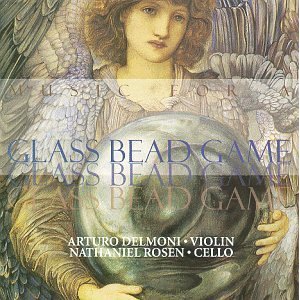
    Music for a Glass Bead Game, Arturo Delmoni & Nathaniel Rosen, from  John Marks Records

    .

    Hermann Hesse is just about due for a revival.

    While other novelists on the whole explored the “real world” around them, the outside world, the world of other people and things, Hermann Hesse was concerned with the “inner” world – the world of hopes, dreams, distress, anguish, rage and insight. With his 1927 novel Steppenwolf, he introduced us to the “dark side” of ourselves, our “shadow” to use Jung’s term, long before Star Wars, longer before the Sith Lord Cheney committed the United States to work “sort of the dark side, if you will … to spend time in the shadows in the intelligence world.” And if Steppenwolf showed us our shadow, in his earlier novel Siddhartha (1922) he had already shown us the light – in a deliciously sensual revisioning of the young Buddha‘s ascetic purity.

    Siddhartha and Steppenwolf between them provided cover for generations of young idealists coming to terms with their own dreams and nightmares, but it was in his final great novel Das Glasperlenspiel (1943), known in English as The Glass Bead Game or Magister Ludi, which won him the Nobel Prize in Literature while confusing and losing many of his admirers — and inspiring beyond measure those who stayed with him.

    Hesse’s grand vision was of a game played by the members of a scholarly caste – monastic Brahmins of a secular, post European world – whose purpose, pleasure and play it was to bring all human culture into one architecture, one music, woven of similarities, parallelisms, patterns, archetypes.

    As an architecture of insights, Hesse spoke of this great game of his as “harmoniously building the hundred-gated cathedral of Mind.” In musical terms, he described the game as a virtual music in which “ideas” rather than “melodies” would be harmonized or held in counterpoint:

    All the insights, noble thoughts, and works of art that the human race has produced in its creative eras, all that subsequent periods of scholarly study have reduced to concepts and converted into intellectual values the Glass Bead Game player plays like the organist on an organ. And this organ has attained an almost unimaginable perfection; its manuals and pedals range over the entire intellectual cosmos; its stops are almost beyond number.

    And the game’s ultimate destination – besides the creation of an overarching synthesis uniting sciences and arts, great leaps of discovery and profound flights of imagination?

    Every transition from major to minor in a sonata, every transformation of a myth or a religious cult, every classical or artistic formulation was, I realized in that flashing moment, if seen with a truly meditative mind, nothing but a direct route into the interior of the cosmic mystery, where in the alternation between inhaling and exhaling, between heaven and earth, between Yin and Yang, holiness is forever being created.

    The ultimate aim is contemplative simplicity, meditation, a renewed sense of the sacred.

    It was not the characters in the novel, nor its plot, that won Hesse the Nobel Prize: there is hardly a female character in the entire book, the males are largely cardboard imitations of people, and the plot such as it is might have made a fine twenty page novella – no need there for a 550-page masterpiece.

    No, it is the game itself that holds the imagination, as the Himalayas might hold the attention of one who had lived a lifetime in the lowlands. And catch hold the imaginations of brilliant minds it has.

    Hesse’s old friend and rival Thomas Mann inscribed a presentation copy of his novel Doctor Faustus with the words: “To Hermann Hesse, this glass bead game with black beads.”

    Christopher Alexander, the progenitor of pattern languages, distilled the essence of his thinking in his “Bead Game Conjecture”:

    That it is possible to invent a unifying concept of structure within which all the various concepts of structure now current in different fields of art and science, can be seen from a single point of view. This conjecture is not new. In one form or another people have been wondering about it, as long as they have been wondering about structure itself; but in our world, confused and fragmented by specialisation, the conjecture takes on special significance. If our grasp of the world is to remain coherent, we need a bead game; and it is therefore vital for us to ask ourselves whether or not a bead game can be invented.

    Manfred Eigen, Nobel laureate in Chemistry, wrote of his book on molecular biology with Ruth Winkler-Oswatitsch, Laws of the Game:

    We hope to translate Hermann Hesse’s symbol of the glass bead game back into reality.

    John Holland, father of genetic algorithms, told an interviewer:

    I’ve been working toward it all my life, this Das Glasperlenspiel. It was a very scholarly game, starting with an abacus, where people set up musical themes, then do variations on it, like a fugue. Then they’d expand it to where it could include other artistic forms, and eventually cultural symbols. It became a very sophisticated game for setting up themes, almost as a poet would, and building variations as a composer. It was a way of symbolizing music and of building broad insights into the world.

    If I could get at all close to producing something like the glass bead game I can’t think of anything that would delight me more.

    Mid-way between architecture and music, forming an arch between the arts and sciences, Hesse’s imaginative game has been construed on many levels and in many ways, serving the needs of molecular biology, artificial intelligence, architecture and more. But what of its nature as a game to be played?

    From my point of view as a game designer, Hesse’s game is both an artwork – to be played as Bach or the blues are played – and a game – to be played as soccer or chess are played.

    And what a game!


    Switch to our mobile site