“Gamification”
Thursday, April 19th, 2012Embedding games in education and everyday life.
Embedding games in education and everyday life.
[ by Charles Cameron — exploring a possible parallel between the interpretation of prophecies and the simulation of irregular operations ]
.

Well, not exactly, but you get the drift…
We seem to have been in the business of prophesying or predicting the future, especially with regard to warfare, for millennia. Wargaming and scenario planning are at least arguably just the latest souped-up, hi-tech versions of an age-old trade…
1.
The other day on Zenpundit, I quoted Bernard McGinn, the dean of apocalyptic studies, contrasting Martin Luther‘s approach to interpreting Revelation with that of such earlier eschatologists as Joachim of Fiore:
Earlier interpreters, such as Joachim (but not Augustine), had also claimed to find a consonance between Revelation’s prophecies and the events of Church history, but they had begun with Scripture and used it as a key to unlock history. Paradoxically, Luther, the great champion of the biblical word, claimed that history enabled him to make sense of Revelation…
Translating that into contemporary terms – does the believer scour the news media in search of evidence of “where we are” in an already defined end times scenario based on Revelation, or search Revelation to find a way to make sense of current events and breaking news?
That may seem a tricky question, and the empirical answer may be that believers shift back and forth between scripture and news, constantly adjusting their interpretation of each to fit the other.
2.
And yet there are some issues where the question comes more sharply into focus. If the 1948 creation of the State of Israel is a significant marker in the prophetic timeline –- as it is both for many Christian readers of apocalyptic literature and for many Muslims too -– then certain other things must happen.
Thus J. Daniel Hays and colleagues write in the Dictionary of Biblical Prophecy and End Times (Zondervan, 2009):
One of the more popular views among Christians in the United States and Canada is that the creation of the modern state of Israel is a literal fulfillment of Old Testament prophecy. In this view, a literal understanding of the Old Testament prophecies of the end times demands a physical state of Israel in Palestine; thus the creation of this state after hundreds of years is seen not only as a fulfillment, but as a sign that the end times are drawing near.
Many writers, primarily classic dispensationalists, state that with the formation of modern Israel, the world political stage is set for the unfolding of end-time events (see DISPENSATIONALISM, CLASSICAL). Some early writers went so far as to argue that when Israel was created in 1948, an end-times “time clock” began that would be fulfilled within one generation. They derived this understanding primarily from Mark 13:30, where after speaking of the end times, Jesus stated that “this generation will not pass away until all these things have happened.” Some writers believed that the end would come before 1988, or forty years (ie, one generation) after 1948.
3.
In line with this, Hal Lindsey discusses the fig tree parable of Matthew 24.32-34 in his best-selling Late Great Planet Earth, published in 1970:
Now learn the parable from the fig tree: when its branch has already become tender and puts forth its leaves, you know that summer is near; so, you too, when you see all these things, recognize that He is near, right at the door. Truly I say to you, this generation will not pass away until all these things take place.
Lindsey then writes:
But the most important sign in Matthew has to be the restoration of the Jews to the land in the rebirth of Israel… When the Jewish people, after nearly 2,000 years of exile, under relentless persecutiomn, became a nation again on 14 May 1948 the “fig tree” put forth its first leaves.
Jesus said that this would indicate that He was “at the door,” ready to return. Then He said, “Truly I say to you, this generation will not pass away until all these things take place” (Matthew 24:34 NASB).
What generation? Obviously, in context, the generation that would see the signs – chief among them the rebirth of Israel. A generation in the Bible is something like forty years. If this is a correct deduction, then within forty years or so of 1948, all these things could take place…
Within forty years or so of 1948 — and now it’s 2012.
4.
Indeed, one of Lindsey’s readers quoted Lindsey’s Late Great Plan Earth in his own book, The Day of Wrath, published at the tun of the millennium in 2000:
The large Jewish presence in Palestine which has not been seen in two thousand years. Hal Lindsey says in The Late Great Planet Earth that before the establishment of the State of Israel none of the future events were clearly understood, but now that that has occurred, the countdown has begun for the occurrence of the indicator events connected to all of the types of prophecy, and on the basis of the prophecies, the entire world will focus on the middle-east, and especially Israel in the last days.
That reader was Sheikh Safar al-Hawali — a writer known to bin Laden, who had read at least one of his earlier books — and in The Day of Wrath al-Hawali, using techniques of scriptural interpretation he borrowed from Hal Lindsey, calculated that the victorious armies of the jihad would re-take Jerusalem in 2012.
Which would fit nicely with a certain hadith — al-Hawali does not mention it — which describes a victorious army sweeping from Khorasan to Jerusalem under black banners …
Happily, both authors are wise enough to note that their own scriptures declare that “But of that day and hour no one knows, not even the angels of heaven, nor the Son, but the Father alone” (Matthew 24.36) and “Verily the knowledge of the Hour is with Allah alone” (Qur’an 31.34).
5.
And all this is what sprang to mind, when I read NDU CASL roundtable and talk in Rex Bynum Rex Brynen‘s fine PAXsims blog today.
Perhaps that’s not so surprising: the human mind is still the human mind, still driven by what al-Hawali calls the “innate yearning of mankind to unveil the future”.
6.
Bynum Brynen’s post describes Mike Markowitz of the Center for Naval Analyses talking about some research CNA had been doing into wargaming “irregular operations” and notes:
In his presentation, Mike drew a distinction at one point between simulation “modeling” and “representation,” the former more appropriate for the physics of kinetic operations, while the latter highlights the importance of narrative (as well as the inherent “fuzziness” of diplomatic, social, and economic factors — especially in irregular warfare). A large part of Joe’s presentation also touched upon the challenge of validating simulations of insurgency with their substantial DIME (Diplomatic/ Information/Military/Economic) or PMESII (Political/Military/Economic/Social/Infrastructure/ Information) elements.
We’re getting pretty close to the qualitative modeling or mapping of thoughts here, which interests me a great deal as the designer of “thinking games” — so Bynum Brynen definitely had my attention here.
But it was his next point that seemed to me to offer a close parallel to Bernard McGinn’s contrast between Joachim’s and Luther’s methods of interpreting Revelation:
With regard to gaming COIN, then, one is faced with a challenge. Does one build dynamics into the game that reflect doctrinal assumptions about the way the world works? Or does one build a model of the world and then see how doctrine (or alternative doctrinal approaches) work, thereby encouraging original, critical thinking? In the former case, how does one avoid building a simulation that confirms existing approaches because it is, in essence, biased from the outset to do so? In the latter case, where does one derive that alternative model from?
7.
Obviously, in both cases it’s best to find a shoe that fits the foot, rather than to shoe-horn a foot into a shoe that really doesn’t fit it.
But the same question needs to be answered in each case: which is to be the shoe, and which the foot?
[ by Charles Cameron — from sight to vision? ]
.

*
Which of these two images — the photo above, the MC Escher print below — calls you closer? Which takes you deeper?
*

And which draws you closer here — the MC Escher print above, or the Tenniel illustration for Alice, below? Which carries you deeper?
Where does the realistic end, and the imaginal begin?
*
Marina Warner writes in the introduction to her recently reviewed book, Stranger Magic:
The faculties of imagination — dream, projection, fantasy — are bound up with the faculties of reasoning and essential to making the leap beyond the known into the unknown. At one pole (myth), magic is associated with poetic truth, at another (the history of science) with inquiry and speculation. It was bound up with understanding physical forces in nature and led to technical ingenuity and discoveries. Magical thinking structures the processes of imagination, and imagining something can and sometimes must precede the fact or the act; it has shaped many features of Western civilization. But its influence has been constantly disavowed since the Enlightenment and its action and effects consequently misunderstood.
*
For the brilliant juxtaposition of images in the upper pair, I am grateful to http://www.giovis.com/atrani.htm, with an h/t to http://www.log24.com.
[ by Charles Cameron — gaming the future, rethinking thinking, NPS essay contest, mixing drinks ]
.
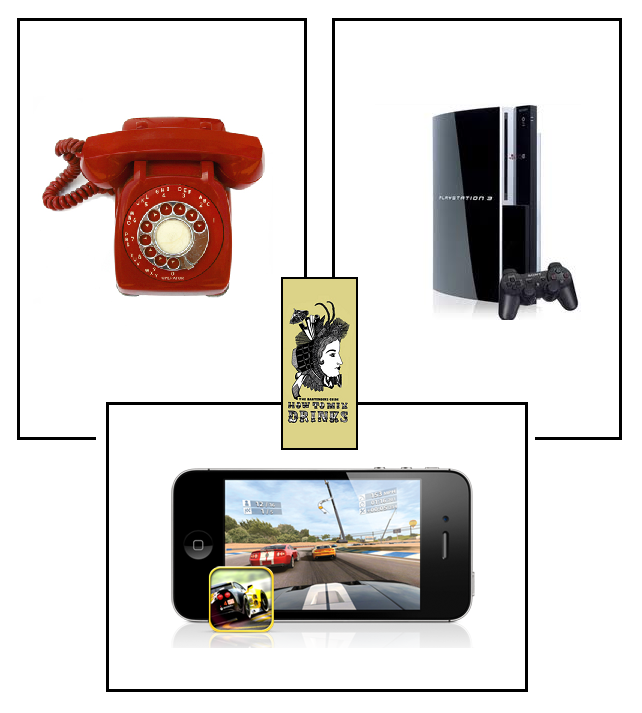
I’d like to introduce what may be a new format for my DoubleQuotes and SPECS. It features two ideas — in this case, the telephone and the game console — which merge into one via some overlap between them — here, the iPhone.
You want the neurosciwence behind all this? Try Fauconnier and Turner‘s The Way We Think: Conceptual Blending and The Mind’s Hidden Complexities.
It was a piece by Benjamin Kohlmann in today’s Small Wars Journal titled The Military Needs More Disruptive Thinkers that triggered this post.
*
Listen up:
The future lies with those individuals who can see connections across a myriad of professions and intellectual pursuits. The mind that can see that a phone and entertainment device can be intertwined into something like, say, an iPhone. Or, an intellect that recognizes how secondary and tertiary networks are often more valuable than first-order relationships, thus creating something like LinkedIn. Or the strategist who understands that crowdsourced, horizontally structured non-state actors pose a greater threat to our security than Nation states.
That’s from today’s Small Wars Journal piece — and when I read that paragraph, I was way too excited to read the rest, because:
1. That’s what my series of posts [1, 2, 3, 4, 5] on Arthur Koestler‘s notion of intersecting concepts has been all about, and…
2. I’ve been working on a family of games that will train people — pleasurably — in precisely this kind of “overlap” thinking for at least fifteen years now. Don Oldenberg of the Washington Post described one of my games as an “on-line match of ricocheting intellects” back in 1996.
But you’ll be hearing more on #2 in the not too distant, once our team has all its ducks in a row — and black swans permitting.
*
Hey, this kind of thinking can get you noticed — it’s what last year’s Naval Postgraduate School Center for Homeland Defense and Security essay contest [link opens .pdf] boiled down to:

*
If you’ll permit me a quick detour:
Not only that, it’s also the basis for cocktail hour!

It appears that the Bartender’s Guide was first published in 1862, so bartenders have been doing this — mixing ideas, mixing drinks — for at least a century and a half. Maybe the fact that they work with liquor has something to do with it.
*
In any case, isn’t it time for the rest of us to catch up?
The future lies with those individuals who can see connections across a myriad of professions and intellectual pursuits.
[ by Charles Cameron — on a mostly overlooked possible asymmetry ]

Michael Peck posted a piece at the game site Kotaku yesterday, titled The Immense Pleasure of Huge War Games, and his opening quote startled me – it’s not one I’d heard before. Here’s Peck’s first para:
“Quantity has a quality all its own,” said Josef Stalin, as he relentlessly flung waves of Soviet tanks and troops against Hitler’s elite but outnumbered panzers. Comrade Stalin might not have believed in a deity, but even a Communist warlord would surely have agreed with Napoleon’s dictum that God is on the side of the bigger battalions.
That interests me deeply, because I regard the relationship between quantity and quality as one phrasing of the knot at the heart of consciousness — the “hard problem” as science terms it — equivalent to the question of how our subjectivity and objective reality mutually arise.
*
And so to Napoleon’s dictum that God is on the side of the bigger battalions — I imagine he means real, flesh and blood battalions — which “even a Communist warlord would surely have agreed with”.
Not so the Qur’an, which reminded the Prophet of the battle of Badr (Quran 8.9-10):
Remember ye implored the assistance of your Lord, and He answered you: “I will assist you with a thousand of the angels, ranks on ranks.” Allah made it but a message of hope, and an assurance to your hearts: (in any case) there is no help except from Allah: and Allah is Exalted in Power, Wise.
Durer‘s angels of the Apocalypse, likewise, are militant angels, though like ourselves (Ephesians 6.12) they:
wrestle not against flesh and blood, but against principalities, against powers, against the rulers of the darkness of this world, against spiritual wickedness in high (celestial) places.
*
And so I would ask you: is there even the possibility of a higher asymmetry at work here — or are we speaking only of a matter of brute force versus high morale?

Zenpundit is a blog dedicated to exploring the intersections of foreign policy, history, military theory, national security,strategic thinking, futurism, cognition and a number of other esoteric pursuits.
Customized Web Site & Blog Design

