zenpundit.com » britain

Archive for the ‘britain’ Category

“Sin, Death, and Hell have set their Marks on Him”

Tuesday, February 5th, 2013

King Richard III 

The bones of Richard III, Shakespeare’s greatest villain and the last King of England to be killed in battle have been discovered and identified by DNA testing:

….There were cheers when Richard Buckley, lead archaeologist on the hunt for the king’s body, finally announced that the university team was convinced “beyond reasonable doubt” that it had found the last Plantagenet king, bent by scoliosis of the spine, and twisted further to fit into a hastily dug hole in Grey Friars church, which was slightly too small to hold his body.

But by then it was clear the evidence was overwhelming, as the scientists who carried out the DNA tests, those who created the computer-imaging technology to peer on to and into the bones in raking detail, the genealogists who found a distant descendant with matching DNA, and the academics who scoured contemporary texts for accounts of the king’s death and burial, outlined their findings.

….Richard died at Bosworth on 22 August 1485, the last English king to fall in battle, and the researchers revealed how for the first time. There was an audible intake of breath as a slide came up showing the base of his skull sliced off by one terrible blow, believed to be from a halberd, a fearsome medieval battle weapon with a razor-sharp iron axe blade weighing about two kilos, mounted on a wooden pole, which was swung at Richard at very close range. The blade probably penetrated several centimetres into his brain and, said the human bones expert Jo Appleby, he would have been unconscious at once and dead almost as soon.

The skull of Richard III

Injuries to the skeleton appear to confirm contemporary accounts that the king died in battle. Photograph: AFP/Getty Images

The injury appears to confirm contemporary accounts that he died in close combat in the thick of the battle and unhorsed – as in the great despairing cry Shakespeare gives him: “A horse! A horse! My kingdom for a horse!” 

Richard III, usurper and probable regicide of his nephew the boy King, was the last truly medieval King of England. Had Richard lived to rule, his reign would have been characterized by the same bloody uprisings and civil strife that marked the War of the Roses. England was fortunate in his successor who had bested him in battle, Henry Tudor who became King Henry VII was an energetic and far seeing monarch who restored a war-wracked and bankrupt England to peace and fiscal health and set the foundations of the modern United Kingdom and the future world-spanning British Empire. It was Henry who started the Royal Navy and curtailed the ability of the nobility to wage war as they pleased with large private armies, by taxing them for each man at arms, thus ending bastard feudalism ; recalcitrant rebels were executed and justices of the peace established in every shire to enforce the law of the realm rather than the corrupt whims of manorial courts.

Richard III has his devoted fans as well his detractors. Except for his impatient ruthlessness, Richard probably was little worse, morally speaking, than his fellow medieval monarchs in an age when brutality and the rule of the strong was the norm.  However, unlike the brilliant Henry, Richard would have done little to improve the situation and might have made life in England more savagely violent.

Concerning the enforcement of morals

Wednesday, January 30th, 2013

[ by Charles Cameron — enforcement of moral codes in the UK, US, Israel and KSA, unofficial and official, worsening, continuing and improving, quite the smörgåsbord ]
.


.

Moral vigilantism appears to be on the rise in parts of London, according to this first-person piece by Jane Kelly, consulting editor of the Salisbury Review, which identifies itself as “seriously right” — ‘I feel like a stranger where I live’ [Telegraph, 29 January 2013]:

“When you go swimming, it’s much healthier to keep your whole body completely covered, you know.” The Muslim lady behind the counter in my local pharmacy has recently started giving me advice like this. It’s kindly meant and I’m always glad to hear her views because she is one of the few people in west London where I live who talks to me.

[ … ]

More worryingly, I feel that public spaces are becoming contested. One food store has recently installed a sign banning alcohol on the premises. Fair enough. But it also says: “No alcohol allowed on the streets near this shop.” I am no fan of street drinking, and rowdy behaviour and loutish individuals are an aspect of modern British ”culture’’ I hate. But I feel uneasy that this shopkeeper wants to control the streets outside his shop. I asked him what he meant by his notice but he just smiled at me wistfully.

Perhaps he and his fellow Muslims want to turn the area into another Tower Hamlets, the east London borough where ”suggestive’’ advertising is banned and last year a woman was refused a job in a pharmacy because she wasn’t veiled.

On the other hand, maybe I should be grateful. At least in Acton there is just a sign in a shop. Since the start of the year there have been several reports from around London of a more aggressive approach. Television news footage last week showed incidents filmed on a mobile phone on a Saturday night, in the borough of Waltham Forest, of men shouting “This is a Muslim area” at white Britons.

The video commentary stated: “From women walking the street dressed like complete naked animals with no self-respect, to drunk people carrying alcohol, we try our best to capture and forbid it all.”

**

It also appears to be present in parts of Brooklyn, according to Modesty in Ultra-Orthodox Brooklyn Is Enforced by Secret Squads, [New York Times, January 29, 2013]:

In the close-knit world of ultra-Orthodox Judaism, community members know the modesty rules as well as Wall Street bankers who show up for work in a Brooks Brothers suit. Women wear long skirts and long-sleeved, high-necked blouses on the street; men do not wear Bermuda shorts in summer. Schools prescribe the color and thickness of girls’ stockings.

The rules are spoken and unspoken, enforced by social pressure but also, in ways that some find increasingly disturbing, by the modesty committees. Their power is evident in the fact that of the half dozen women’s clothing stores along Lee Avenue, only one features mannequins, and those are relatively shapeless, fully clothed torsos.

The groups have long been a part of daily life in the ultra-Orthodox communities that dot Brooklyn and other corners of the Jewish world. But they sprang into public view with the trial of Nechemya Weberman, a prominent member of the Satmar Hasidim in Brooklyn, who last week was sentenced to 103 years in prison after being convicted of sexually abusing a young girl sent to him for counseling.

[… ]

The details were startling: a witness for Mr. Weberman’s defense, Baila Gluck, testified that masked men representing a modesty committee in the Hasidic village of Kiryas Joel, N.Y ., 50 miles northwest of New Y ork City, broke into her bedroom about seven years ago and confiscated her cellphone.

The Brooklyn district attorney, Charles J. Hynes, who prosecuted the Weberman case, has now received allegations that members of a modesty committee forced their way into a home in the borough, confiscating an iPad and computer equipment deemed inappropriate for Orthodox children, officials say.

[ … ]

“They operate like the Mafia,” said Rabbi Allan Nadler, director of the Jewish studies program at Drew University in Madison, N.J.

**

And in Israel — from the same report, although perhaps more widely known? I’ve certainly seen mentions…

In Israel, there have been similar concerns. Though no modesty committee was overtly involved, there has been anger over ultra-Orthodox zealots who spit on and insulted an 8-year-old girl for walking to school through their neighborhood in a dress they considered immodest.

**

Meanwhile, the Saudis seem to be decreasing the scope of their official equivalent, according to Saudi limits powers of the notorious religious police [Al Arabiya, 30 January 2013]:

Saudi Arabia has set new limitations on the powers of its notorious religious police, charged with ensuring compliance with Islamic morality but often accused of abuses, its chief said on Tuesday.

The Commission for the Promotion of Virtue and Prevention of Vice “once had much expanded powers, but with the new system… some of these powers, such as interrogating suspects and pressing charges,” will be restricted to the police and public prosecution, Shaikh Abdul Latif Abdel Aziz Al Shaikh told AFP.

The religious police may still arrest those carrying out “flagrant offences such as harassing women, consuming alcohol and drugs, blackmail and the practice of witchcraft,” Shaikh said of the new law approved by the cabinet.

and:

Relatively moderate Al Shaikh, appointed last year, has raised hopes that a more lenient force will ease draconian social constraints in deeply conservative Islamic country.

Two weeks into his post, Al Shaikh banned volunteers from serving in the commission, which enforces the kingdom’s strict Islamic rules.

H/t John Burgess at Crossroads Arabia.

**

All these articles are worth reading in full, and you’ll be enriched by reading them together, comparatively — food for thought!

The possible unexpected consequences of intervention

Thursday, January 24th, 2013

[ by Charles Cameron — wondering whether it can ever be possible to expect the unexpected, and if so, what exactly that might mean? Libya & Mali ]
.


.

Alex Thurston at Sahel Blog: Covering Politics and Religion in the Sahel and the Horn of Africa posted Libya and Mali, Part I today. The topic is one I am not qualified to comment on, although I’m trying to learn from those (such as AT) who are — but this sentence caught my eye and got me writing:

A failure to soberly consider the possible unexpected consequences of intervention and transition has helped chaos to develop in post-Qadhafi Libya.

I wonder if that’s a koan?

**

Is it ever possible to “soberly consider the possible unexpected consequences” of anything? Consider Donald Rumsfeld‘s remark:

There are known knowns. These are things we know that we know. There are known unknowns. That is to say, there are things that we know we don’t know. But there are also unknown unknowns. There are things we don’t know we don’t know.

Throw in the missing fourth category, supplied by somebody for Wikipedia:

Moreover, one may criticize Rumsfeld statement for omitting the most dangerous type of unknown: the “unknown known”. That is, as Mark Twain famously expressed it, “It ain’t what you don’t know that gets you into trouble. It’s what you think you know that just ain’t so”. Indeed, Rumsfeld was really discussing an “unknown known” which provided faulty justification for the war — members of the Bush administration claimed that the Iraqi government possessed weapons of mass destruction (see Rationale_for_the_Iraq_War), but it just wasn’t so.

**

Now allow for what you might call informed guess-work, what CS Peirce called abduction — I’m just now introducing my elder son to Eco & Sebeok‘s magnificent book, The Sign of Three: Dupin, Holmes, Peirce — and “non-predictive” attempts to lay out a spread of possible outcomes by means of scenario-planning, as Tom Barnett wrote in his Year 2000 International Security Dimension Project Final Report:

By “decision scenario approach,” we mean using credible scenarios to create awareness among relevant decision-makers regarding the sort of strategic issues and choices they are likely to face if the more stressing pathways envisioned come to pass.

and:

Again, none of our material here is meant to be predictive in the sense of providing a step-by-step “cookbook” approach to Y2K and Millennial Date Change crisis management. Our fundamental goal in collecting and synthesizing this analysis is to avoid any situation where US military decision makers and/or operational commanders would find themselves in seemingly uncharted territory and declare, “I had no idea . . ..”

We (myself at times included) seem to be busily employed making non-predictive predictions.

**

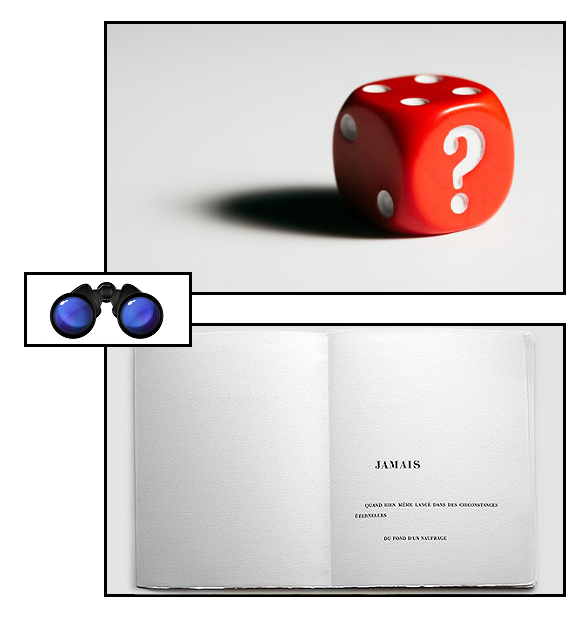
Black swansNassim Nicholas Taleb may have been the one who most recently crept up behind us and clapped loudly to alert us to the unexpected, but Stéphane Mallarmé was there first in 1897 with the great graphical poem Un coup de dés jamais n’abolira le hasard, featured in the lower image of the pair at the top of this post.

My own “zen telegram” version, for those who neither know the poem nor read French:

A ROLL OF THE DICE

NEVER

not even when tossed sub specie aeternitatis from the depth of a shipwreck

WILL NEVER EVER ABOLISH

CHANCE

— now there’s a koan for our times — and always.

**

Listen to the poets…

Hear the voice of the Bard!
Who Present, Past, & Future, sees;
Whose ears have heard
The Holy Word
That walk’d among the ancient trees…

**

Sources and links:

  • Un Coup de Dés Jamais N’Abolira Le Hasard from Wikipedia
  • le début de la typographie moderne by Étienne Mineur with page images
  • Un coup de dés, French original and English translation, by AS Kline
  • See that voice of the Bard, William Blake
  • Thomas Hegghammer on Morten Storm

    Tuesday, January 15th, 2013

    [ by Charles Cameron — in case you missed TH’s tweets on Storm today ]
    .


    .

    Here’s a quick overview of Morton Storm, the complex figure who is reported to have brought Anwar al-Awlaqi a bride from Europe — and thus betrayed Awlaqi’s whereabouts to the Agency:

    After converting to Islam, a former member of a Danish motorcycle gang travels to Yemen to study the Quran and soon comes in contact with radical preachers waging holy war against the West.

    On the verge of becoming a jihadist, he abruptly abandons his faith and embarks on a dangerous undercover mission to help Western intelligence agencies capture or kill terrorists.

    Morten Storm, 37, claims he worked for six years as an informant for the CIA, Britain’s MI5 and MI6 and Denmark’s security service, PET. All declined to comment for this article.

    “Could they just say `he never worked for us’? Sometimes silence is also information,” Storm told AP in Copenhagen. “I know this is true, I know what I have done.”

    Storm’s unlikely story, told in a new book and an interview with The Associated Press, has the drama and intrigue of a “Homeland” episode. But the burly, red-bearded Dane insists his tale isn’t fiction.

    Storm said he decided to reveal his secret-agent life to the media – he first spoke to a Danish newspaper in October – because he felt betrayed by his agent runners.

    In particular, he was upset that he wasn’t given credit for the airstrike that killed Anwar al-Awlaki, a senior al-Qaida figure, in Yemen in 2011.

    **

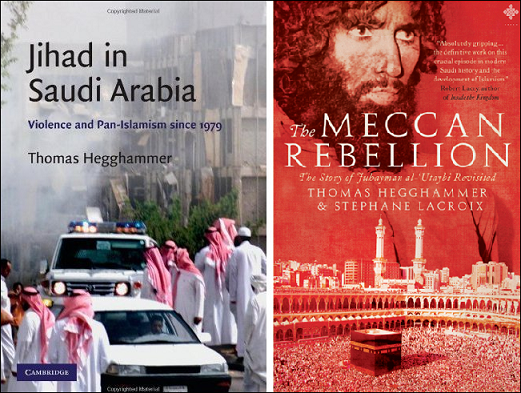
    Thomas Hegghammer, author of the two books depicted above, and a highly respected academic specialist in terrorism and poliical violence, tweeted:

    Enjoying new book on Danish ex-jihadi Morten Storm. Some highlights:

    1) Regents pk mosque da’i sends Storm to Muqbil in Yemen in 97

    2) Storm travels from Sanaa to Dammaj with “Rashid”, aging Afro-American Korea vet. They join 3000 Salafists in “gigantic boy scout camp”

    3) in 98, after 8 months wMuqbil, Storm goes to Sana’a to find wife. Connects with jihad vets from Bosnia, Afgh. Weds, divorces Djbouti girl

    4) Back to UK, Denmark; marries in Morocco; to Yemen again in 2001; almost goes to pre 9/11 Afgh; preaches jihad in Ta’iz (2001-2) instead.

    5) Returns to DK in 2002 with wife and son Osama. Joins radicals in Vollsmose. “Jihad training” (obstacle course and paintball) in Odense

    6) Moves to Luton in 2003; meets Omar Bakri, Taymour Abdelwahhab; demonstrates and jihad trains (in Barton Hills) with al-Muhajiroun

    7) Thought 7/7 bombings were “cool”; found Bakri and Choudhry too soft; went to Yemen again in Jan 2006 but found no jihadis to join

    8) Prepared to fight in Somalia in late 2006, but trip called off. Annoyed, he starts to doubt; turns completely after 2 weeks of googling

    9) becomes PET informant in Jan 2007; sent to Tripoli, Lebanon in April to report on Raed Hlayhel, Omar Bakri, Fath al-Islam.

    10) Meets w/MI6 and CIA (Jennifer Matthews) in spring of 2007; sent to UK for spy training; then travels between DK, UK, Kenya and Yemen.

    11) Storm had taken classes with Awlaqi in 2006; Awlaqi helped Storm find a wife. Storm back in Sana in Aug 2008, they reconnect.

    12) Aug: 2008: Awlaqi visits Storm’s flat; Awlaqi impressed by Dane’s Shabaab contacts. Awlaqi and Warsame speak on Storm’s mobile

    13) next meeting in Sep 2009 in al-Hawta (Shabwa); Awlaqi mentions plots in West; wants fridge to store explosives, and help finding wife

    14) Late 2009: Storm helps US-led operation against Saleh Nabhan in Somalia. Storm stays in touch w Awlaqi by email in 2009-2010

    15) late Nov 2009: random female Awlaqi fan from Croatia contacts Storm via FB fanpage. Storm vets her and puts her in touch wAA.

    16) Storm meets “Aminah” in Vienna in March 2010; shows her video from AA and records one of her for AA; gives her CIA-bugged suitcase.

    17) On 2 June 2010 Aminah flies to Yemen. On arrival, cautious AA aides discard her suitcase. Storm still gets $250k cash from CIA.

    18) New plan in spring 2011: go to Yemen, send AA a tracked USB. In Sanaa, Storm connects wAA, shops ladies items for Aminah on his request.

    19) early Sep 2011: AA courier picks up tracked USB from Storm. AA killed on 30 Sep. Storm, back in DK, expects recognition as key agent

    20) Storm, outraged at lack of recognition and reward, plots revenge. He secretly records next CIA meeting, then contacts press. THE END

    Then:

    PS: E-book version of the Morten Storm biography (Danish only) available here: http://tiny.cc/2wfxqw Sorry for overposting – I’ll shut up now

    **

    I’d asked Hegghammer’s impression of the book’s (and Storm’s) credibility, while Aaron Zelin had commented on TH’s #7 above:

    Right before the jailbreak in Feb ’06.

    To which Hegghammer responded:

    Exactly. It’s details like this (plus pics, receipts, recording etc) that makes it very credible

    Will McCants has the last word…

    also, his last name gives him superhero status

    **

    The brief account of Morton Storm at the top of this post is from Huffington Post. Name links are to twitter feeds, all are recommended. Hegghammer’s books are available on Amazon.

    When I was a very young poet

    Tuesday, January 1st, 2013

    [ by Charles Cameron — a suggested solution to what ails the US Congress, Bertold Brecht style — and trace evidence of some early unpublished poems ]
    .

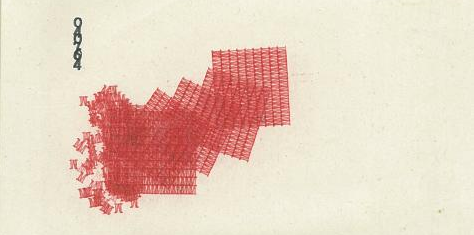
    from a private communication, dom sylvester houedard, 1964

    **

    I was reading Shivam Vij‘s piece, The epiphanic moment of the lathi charge, on Kafila today, and he included a quote from Bertolt Brecht that was intriguing enough — and appropriate enough to the fiscal-cliff-jumping mood in Congress these last few days — that I looked for the source, and found it in this poem:

    The Solution
    Bertolt Brecht, tr John Willett
    .

    After the uprising of the 17th June
    The Secretary of the Writer’s Union
    Had leaflets distributed in the Stalinallee
    Stating that the people
    Had forfeited the confidence of the government
    And could win it back only
    By redoubled efforts. Would it not be easier
    In that case for the government
    To dissolve the people
    And elect another?

    **

    When I was a very young poet, my friend Dom Sylvester Houédard sent some very young poems of mine to John Willett, who was then the Editor of the Times Literary Supplement. They didn’t publish them, but I did get a mention in the TLS a little later, in one of Sylvester’s own writings on the British poetry avant-garde. In any case, here’s the note Sylvester sent me, letting me know he’d been submitting my stuff to Willett:

    As you can see, Dom Sylvester could do some pretty nifty graphics with his old Olivetti Lettera 22 typewriter. He’d gotten into the habit while working in British Army Intelligence somewhere in the Far East during World War II as I recall — before he came home and became a monk. Why? Because Army Intelligence demanded he send them 16-page reports, and he could only ever find fifteen pages worth of intel to send them. They disapproved of blank pages, he complied with orders by filling the final pages of his reports with graphical poetry. And thus a tiny whirlpool in the arts was born…

    Okay, enough: Sylvester was a phenomenon of mind and heart, and is sorely missed.

    As I said, I was very young when he sent those poems of mine to the TLS — it was 1964, and I was a student at Christ Church, Oxford, “chch” in Sylvester’s abbreviation — but the name of John Willett stayed with me, like a runic talisman. So I just can’t help but notice when my daily reading, almost fifty years later, brings up his name again — this time as a noted Brecht translator.


    Switch to our mobile site