zenpundit.com » britain

Archive for the ‘britain’ Category

On the inforced uniformity of religion

Thursday, July 5th, 2012

[ by Charles Cameron — when religion strongly influences politics — greetings on the Fourth of July ]
.

God and Politics UK


**

At least in the words of the Library of Congress exhibit, Religion and the Founding of the American Republic, the US we know today was conceived as a “Religious Refuge”:

The religious persecution that drove settlers from Europe to the British North American colonies sprang from the conviction, held by Protestants and Catholics alike, that uniformity of religion must exist in any given society. This conviction rested on the belief that there was one true religion and that it was the duty of the civil authorities to impose it, forcibly if necessary, in the interest of saving the souls of all citizens. Nonconformists could expect no mercy and might be executed as heretics. The dominance of the concept, denounced by Roger Williams as “inforced uniformity of religion,” meant majority religious groups who controlled political power punished dissenters in their midst.

Haven’t we had enough wars of religion? There’s much to be said for that idea.

Happy glorious Fourth to all my American friends!

**

The image above of the Palace of Westminster in London looks quite lovely and tranquil, and some of what people hear when they quiet themselves and listen to the “still, small voice” is of inestimable value, beauty and insight. But it is not always so.

As Roger Williams shrewdly observed:

enforced uniformity, sooner or later, is the greatest occasion of civil war, ravishing consciences, persecution of Christ Jesus in His servants, and of the hypocrisy and destruction of millions of souls

**

United Kingdom Come

You will perhaps understand, therefore, why I am less than enthralled by the idea of a particular opinion within Christianity “declaring the plans of heaven” over my country of origin — as suggested in the graphic immediately above this — or any other country, the United States included, and why I hope that, in Williams’ words:

a permission of the most Paganish, Jewish, Turkish or anti-Christian consciences and worship be granted to all men, in all nations and countries; and they are only to be fought against with that sword which is only, in Soul matters able to conquer, to wit; the sword of the Spirit–the Word of God

I wouldn’t mind seeing that idea take hold in Iran or Saudi, either. Yeah!

Consider:

Let there be no compulsion in religion. Truth has been made clear from error. Whoever rejects false worship and believes in Allah has grasped the most trustworthy handhold that never breaks. And Allah hears and knows all things. — Qur’an, 2: 256

If it had been your Lord’s will, all of the people on Earth would have believed. Would you then compel the people so to have them believe? — Qur’an, 10: 99

**

Besides which, having prayed often enough “Thy kingdom come” myself, I have to say I’m less than enthused to find the publicists of this particular outpouring of faith modifying the phrase to read “United Kingdom Come”.

What is this, the Cup Final?
Of the sacred, II: trees

Wednesday, July 4th, 2012

[ by Charles Cameron — more on magical worldviews: following hot on the heels of the curative power of saliva, a breathtakingly beautiful tale a wise man told me ]
.

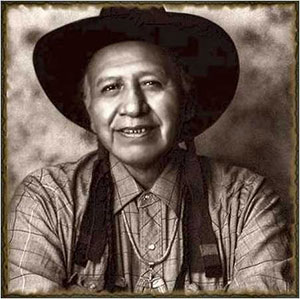
Wallace Black Elk


Look, you may detest saliva, saintly or otherwise, and I’d prefer not to leave you feeling queasy — so let’s follow the saintly saliva trail just a little further, and I think you’ll find it leads to something quite beautiful.

Susan Bayly continues:

Tamil Sufi texts often assert that the founding pir of a particular cult shrine identified his heir and successor by bequeathing him the twig which he used for tooth-cleaning. Such an object would naturally be impregnated with the saint’s saliva and would therefore serve to pass on the pir’s endowment of power and sanctity without involving him in an act of procreation.“ Fakiruddin is portrayed as having received a tooth-brushing twig as a token of spiritual succession from his murshid or preceptor, the Trichy pir Nathar Wali. According to the texts, it is this twig which grew up into the miraculous staff of the Nandi episode. The wooden staff also becomes imbued with the miraculous transforming barakat of the pir. …

Let’s forget saliva, let’s even forget neem-sticks, the organic Indian equivalent of the toothbrush — and consider the miraculous thorn tree that grows at Glastonbury:

After the crucifixion of Jesus lore has it that Joseph of Arimathea (who according to the Bible donated his own tomb for Christ’s interment after the Crucifixion) came to Britain, bearing the Holy Grail — the cup used by Christ at the Last Supper and later by Joseph to catch his blood at the crucifixion.

When Joseph landed on the island of Avalon, he set foot on Wearyall Hill — just below the Tor. Exhausted, he thrust his staff into the ground, and rested. By morning, his staff had taken root — leaving a strange oriental thorn bush – the sacred Glastonbury Thorn.

Lore has it that the thorn would bloom once a year, at Christmas.

**

But virtuous trees, like saintly saliva, can be found in more than one tradition. I had the privilege some while ago of spending a good deal of time in the company of the Lakota shaman, Wallace Black Elk, and would like to offer you one of his stories which I noted down pretty close to his own words.

I should perhaps preface this account by telling you that Wallace once told me he had twelve grandfathers — so the words grandpa and grandma don’t imply lineal descent here as they do in common usage, but function more as a term of respect for one’s elders:

I remember my grandfather, Black Elk. One time when I was very young, he came with my
grandfather Eagle Man to visit my grandmas in the tipi. My mother and my aunt were both young, so they let the old people visit together. “We’re good at cooking, so you just sit down and rest, and visit. We’ll look after the cooking.” And my father went off to take care of the horses, and to haul and chop wood, and left the old people to visit with each other.

That was the way it was. Everybody would eat a big meal, and some of those evenings my grandfathers would sit around telling ghost stories, spirit stories, and I’d listen. And while they were talking, they had a pipe. They would smoke the pipe and talk. So I was maybe seven years old, and I was sitting in the middle between grandma and grandpa, I used to sit there and listen, and watch them smoke the pipe.

My grandpa took the pipe-stem and planted it in the ground. He took a piece of charcoal and lit the fire, sprinkled some tobacco on it, and just puffed a little of that smoke. And that pipe-stem, you know, blossomed. Branches bloomed out of it, leaves bloomed out, and there’s a big red plum there. Red.

So my grandpa took the plum and gave it to his brother, and he ate it, and said: “Washtay, that’s really good.” And then he took the pipe and planted the pipe-stem, did the same thing, and put some tobacco over it, and that pipe-stem…that tree just bloomed, leaves just cropped out all over it, and there was a black cherry hanging there, it was a choke cherry. So my grandpa gave that choke cherry to his brother, and he ate it and blew the pit onto the ground. “Aah, very good.”

My grandmas were watching all this, and one of my grandmas picked up her moccasin and said, “Aaah, want some cherries, do you?” as if my grandpas were doing this to show their powers, and she was telling them, don’t do that! She threw her moccasin on the ground and an owl came up. It hopped around and flew in front of them, and started hooting whu whuwhuu, whu whuu.

My grandfathers looked at one another and said: “Hey, almost like our powers!” And they both started laughing, and that owl jumped down, and puffed itself up, and started hooting. So then my other grandma took her cane, she cried “Heeeeeee!” and threw it on the ground and it came out a rattlesnake. And it wasn’t just kind of a rattlesnake almost: boy, it really was a rattlesnake, and it coiled around the place. Boy, we bailed out.

Then my grandma reached over and took hold of that snake, and she took that cane and grabbed a hold of that owl by the neck, and pulled it back to her, and when it flopped down, when it landed, it was her sister’s moccasin, and she gave her sister her moccasin and put away her cane.

So that was my grandmas and grandpas. They had those powers, they knew that power was there. So I learned then there was a power in that pipe we hold, that the pipe could feed us. And he has been feeding us. There is no starvation, and we needn’t fear. That pipe represents the whole universe, and she can continue to multiply trees and plums and cherries.

That power of the Great Spirit is there, and those creatures can come from that pipe. Grandpa Great Spirit can do these things. From out of nowhere, he can do anything. I realized that.

A white man might think it was a bit of hocus pocus. Like a white man’s magician pulls a poor rabbit out of a hat, or a pigeon. But this is real. A tree comes up, and then it blooms, then it flowers, then it bears fruit. It’s a tree. And we are part of that tree. We absorb that fruit in our system, and we bear children, we bear fruit.

So that is an interpretation of the vision of the Tree of Life. That way my grandpa taught me.

**

Which reminds me (Exodus 7)…

And the LORD spake unto Moses and unto Aaron, saying, When Pharaoh shall speak unto you, saying, Shew a miracle for you: then thou shalt say unto Aaron, Take thy rod, and cast it before Pharaoh, and it shall become a serpent. And Moses and Aaron went in unto Pharaoh, and they did so as the LORD had commanded: and Aaron cast down his rod before Pharaoh, and before his servants, and it became a serpent. Then Pharaoh also called the wise men and the sorcerers: now the magicians of Egypt, they also did in like manner with their enchantments. For they cast down every man his rod, and they became serpents: but Aaron’s rod swallowed up their rods. And he hardened Pharaoh’s heart, that he hearkened not unto them; as the LORD had said.

Of the sacred, I: saliva

Wednesday, July 4th, 2012

[ by Charles Cameron — more on magical worldviews: first the curative power of saliva, Iran, India — then in the follow up, a breathtakingly beautiful tale a wise man told me ]
.

First off, a hat-tip to Shoshank Joshi, because were it not for his tweet, I might not have noticed Muhammad Sahimi’s post, stirred old memories, and written what follows.

The tweet:

Frankly, it was the mention of saliva in a religious context that caught my attentiont.

**

Sahimi’s post only mentions the Ayatollah Khamenei‘s saliva in passing, and is worth reading in its own right:

Some of the praise heaped on Khamenei is borderline blasphemy. But as the Prophet Muhammad said, “A ruler and his rule can survive blasphemy, but not injustice.” And terrible injustice is being done to a great nation and its people on a daily basis by Khamenei’s supporters. As far as the fate of the nation is concerned, the critical question is, Given that Khamenei is surrounded by minions, flatterers, and cronies who compete with each other to praise him lavishly, how realistic a view does he have of what is going on, either domestically or internationally? When his own chief of staff exaggerates and even lies about him, what type of information can he expect to receive? Mohammad Reza Shah Pahlavi was surrounded by the same sort of coterie, and by the time he realized the gravity of the state’s situation in the fall of 1978, it was too late to reform his regime and put it on a democratic path.

**

So, Charles, saliva. WTF?

**

TF is this. Sahimi begins his article, in which mention is made of the sacred qualities attributed to Khamenei’s saliva, with the following observation:

Praising national leaders and elevating them to mythic levels is as old as human civilization. Iran is no exception; indeed, the phenomenon has a very long history in the country, as manifested by the many tales of kings’ bravery, vision, kindness, and generosity that one finds in the Persian literature. This practice continues — the difference is that it is now entering uncharted territory and reaching absurd heights.

**

Okay, okay, the Shahnameh.

**

But then Sahimi gives us these two paragraphs:

In addition to producing reactionary clerics to serve Khamenei and his power, Mesbah — as he is commonly known — has been the Supreme Leader’s exaggerator-in-chief. Here are a few examples:

“Ayatollah Khamenei’s saliva can cure diseases.” According to dogma, only a saint can possibly perform such “miracles.”

And I’m sorry — that absolutely isn’t “uncharted waters” — it’s definitely charted.

**

As Sahimi says, in fact, it’s dogma — or, I’d prefer to think, an archetypal feature of pre-scientific religious thought.

Consider this, from Susan Bayly, Saints, Goddesses and Kings: Muslims and Christians in South Indian Society, 1700-1900, (Cambridge South Asian Studies), p. 127:

The explanation for this is that throughout India bodily secretions, especially blood, semen, saliva and human wastes, are thought of as being charged with a form of power and energy which may be both menacing and protective. The god manifests his awesome potency with a great flow of blood; the individual’s wastes and secretions are a source of danger and pollution to others. Lesser beings accept saliva-impregnated leavings from their superiors, and so the Hindu devotee and so the Hindu devotee takes the divine ‘leavings’ or prasatam of the god as a token of fealty and a source of protective and transforming sacred energy.

In south India the pir’s devotees also perceive their lord’s saliva as a medium which carries and transmits his barakat. Here too the disciple seeks out contact with a transforming substance which would otherwise be conceived of as unclean and defiling…

So that’s the sacredness of a saint’s saliva attested to in both Hindu and Sufi traditions — but it was apparently also a part of Christian tradition, as this by turns charming and arresting quotation from the description of Saint Columban in Sean Kelly and Rosemary RogersSaints Preserve Us!: Everything You Need to Know About Every Saint You’ll Ever Need p. 67 attests:

He was known to everyone, and cut a distinctive figure — he shaved the front of his shoulder-length hair into a half-tonsure, squirrels nested in his cowl, and he wandered around brandishing his staff and downing oak trees with his fist While in France, Columban and his monks followed the Irish tradition, often criticized by many as being too severe: a monk who cut his finger badly while reaping had the wound cleaned by Our Saint’s saliva and was ordered back to work.

**

But wait — there’s more… and it’s beautiful.

In memoriam: a tipi and a garden, II

Tuesday, May 29th, 2012

[ by Charles Cameron — Memorial Day, USA ]
.

2. The garden:


.

The Chelsea Flower Show is one of the minor Great British Occasions — a stroll in the park with some of the Kingdom’s finest horticulturalists displaying their best, and not usually the place you’d go to be reminded of war, though the show itself does take place in the grounds of the Royal Hospital, Chelsea, the home of the Chelsea Pensioners

.

.

It is only appropriate, then, to find this picture of Skippy, a Pensioner from the Korean War, with Korean designer Hwang Ji-hae, whose garden this year won a gold medal for its representation of the DMZ between North and South Korea…

.

.

with its abandoned watchtowers and partially overgrown barbed-wire fences…

.

.

its bottles, carrying messages from those on one side of the line to friends and family unreachable on the other…

.

.

its benches made of wood and dog-tags, its memories…

.

.

and the wildflowers that have been taking over the DMZ, reasserting nature’s primacy where men’s wars were fought.

*

Hwang Ji-hae named her garden Quiet Time: DMZ Forbidden Garden:

This year’s “DMZ Forbidden” garden is “going to be a symbolic place honoring everyone who suffered because of the war,” Hwang said in an interview with the Korea JoongAng Daily in December in her studio in Gwangju.

The garden is a recreation of the Demilitarized Zone between North and South Korea, which has been kept nearly untouched for six decades since the 1953 Armistice Agreement. The zone has become a diverse habitat for various kinds of rare plants and animals.

To Hwang, the DMZ has become the “most beautiful garden on the planet,” though it symbolizes the legacies of the war and the tragic division of the Korean Peninsula at the same time, the artist said in the interview.

“The DMZ was formed organically after a major upheaval. It was created because of the war but is now a symbol of peace.”

According to a press release issued by Hwang’s agency on Tuesday night after winning the prize, 60 percent of the plants in the “DMZ Forbidden” garden are from Korea and some of them are indigenous to the DMZ area.

Hwang said that some of the British veterans of the Korean War she met last year talked about plants they saw in Korea, and they asked her to find them.

“There are six plants that are indigenous to the area near the DMZ, including Geumgang chorong [a type of bellflower], and they will all be part of the garden I’m creating,” she said during the interview in December.

“This is my way of thanking the veterans.”

Carlos Fuentes (1928 – 2012)

Wednesday, May 16th, 2012

[ by Charles Cameron — in memory of Carlos Fuentes, requiescat in pace ]
.


.

Carlos Fuentes‘ great novel, Terra Nostra, opens with these words:

Incredible the first animal that dreamed of another animal.

It’s a sentence to stop you in your tracks, a sentence to give pause to time itself, circling back on itself like the serpent that eats its own tail, a dream of a sentence, a dream sentence.

Fuentes continues:

Monstrous the first vertebrate that succeeded in standing on two feet and thus spread terror among the beasts still normally and happily crawling close to the ground through the slime of creation. Astounding the first telephone call, the first boiling water, the first song, the first loincloth.

How does a mind move so agilely among these many and diverse firsts — the sleeping, the archeo-anthropological, the technical, the musical, the shameful or sinful or perhaps decorative, even erotic? In a single paragraph — the first in a book that will run 890 pages and not tire?

And Fuentes continues:

About four o’clock in the morning one fourteenth of July, Pollo Phoibee, asleep in his high garret room, door and windows flung wide, dreamed these things, and prepared to answer them himself.

Pollo Phoibee dreamed these things, Carlos Fuentes dreamed Pollo Phoibee…

And we are in Paris, Paris of the artists, of the garret, and yet a Paris where the Seine is boiling, where the Louvre has become crystalline, the black eyes of the gargoyles of Notre Dame see “a much vaster panorama”…

*

Carlos Fuentes died today, and I am saddened — remembering him signing my short, fat British Penguin paperback of Terra Nostra (its fondly remembered cover image above) and commenting that it was his preferred English edition, since one could slip it into one’s pocket…

And Terra Nostra was special to me, both as a great and tumultuous fiction, and as a fiction that quoted Norman Cohn‘s In Pursuit of the Millenniun, the book that back in my Oxford days introduced me to the history of apocalyptic thought… a fiction also familiar with Frances Yates, another scholar I greatly admire, and her writings on the Memory Theater

Carlos Fuentes, the imagination that conceived Terra Nostra, is no longer with us.

*

He had been a diplomat, this great imagination. Born into a diplo family, he had served as Mexican ambassador to Paris — Paris of the diplomatic banquets, but also of the artist’s garret, of this New World imagination spanning continents and centuries as though they were a playground, the playground of a single, multiple, cosmopolitan and erudite mind.

The poet Paul Claudel, French ambassador to Japan, was reproved by the Surrealists in 1925 with the words:

One cannot be both ambassador for France and poet!

The poet Saint-John Perse was secretary to the French Embassy in Peking, and later General Secretary of the French Foreign Office. The poet Giorgos Seferis was Royal Greek Ambassador to the United Kingdom. The poet Pablo Neruda was Chilean ambassador to France… The poet Octavio Paz, Mexico’s ambassador to India.

Among novelists, it was Lawrence Durrell — an Englishman born in India with what he described as “a Tibetan mentality” — one who found life in England itself “like an autopsy … so, so dreary” — who was British press attaché in Alexandria, Egypt, during World War II, where as they say:

Ostensibly working, Durrell was in reality closely observing the assortment of sights, sensations, and people that wartime Alexandria, a crossroads of the East and West, had to offer.

The result was his masterpiece, The Alexandria Quartet.

*

Fuentes is heir to many lineages: of Mexico, of the world, of literature, of diplomacy, of the imagination.

In honoring him today, my researches turned up this apposite quote from Aldo Matteucci at the Reflections on Diplomacy blog:

To survive, a diplomat needs poetry. Filed amidst the many layers of the brief, the short poem will refresh the bleary mind. Poetry brings distance – hence perspective and insight. Poetry reminds the diplomat that the best professional is the amateur.

Most deeply – poetry is truth.

Carlos Fuentes survives us all.


Switch to our mobile site