zenpundit.com » Strategy and War

Archive for the ‘Strategy and War’ Category

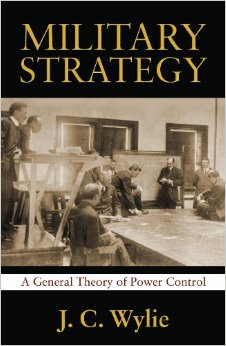
USNI Press to Rerelease J.C. Wylie’s Classic

Tuesday, October 29th, 2013

[by J. Scott Shipman]

Military Strategy, A General Theory of Power Control, J. C. Wylie

Mark your calendar; March 15, 2014, the USNI Press will rerelease J.C. Wylie‘s classic Military Strategy. A couple years ago I reviewed here.

If you have not read Wylie, I strongly recommend adding his little book to your list.

And a big “Thank You!” to the USNI Press!

POSTSCRIPT: A representative of the USNI notified me that an eBook will be forthcoming, too. 

New Article up at Pragati: Lethal Ideas & Insurgent Memories – Review of The Violent Image

Friday, October 25th, 2013

[by Mark Safranski, a.k.a. “zen“]


The Violent Image by Neville Bolt 

I have a new book review up at Pragati this morning:

Lethal ideas and insurgent memory 

….One expert who does acknowledge a paradigmatic shift and posits a powerful explanatory model for the behavior of what he terms “the new revolutionaries” is Dr Neville Bolt of the War Studies Department of King’s College, London and author of The Violent Image: Insurgent Propaganda and the New Revolutionaries. Taking a constructivist view of irregular military conflict as the means by which insurgents weave an enduring political narrative of mythic power and shape historical memory, Bolt eschews some cherished strategic tenets of realists and Clausewitzians. The ecology of social media, powered by decentralised, instant communication platforms and the breakdown of formerly autarkic or regulated polities under the corrosive effects of capitalist market expansion, have been, in Bolt’s view, strategic game changers “creating room to maneuver” in a new “cognitive battlespace” for “complex insurgencies”.  Violent “Propaganda of the Deed”, once the nihilistic signature of 19th century Anarchist-terrorist groups like the People’s Will, has reemerged in the 21stcentury’s continuous media attention environment as a critical tool for insurgents to compress time and space through “…a dramatic crisis that must be provoked”.

As a book The Violent Image sits at the very verge of war and politics where ideas become weapons and serve as a catalyst for turning grievance into physical aggression and violence. Running two hundred and sixty-nine heavily footnoted pages and an extensive bibliography that demonstrates Bolt’s impressive depth of research. While Bolt at times slips into academic style, for the most part his prose is clear, forceful and therefore useful and accessible to the practitioner or policy maker. Particularly for the latter, are Bolt’s investigations into violent action by modern terrorists as a metaphor impacting time (thus, decision cycles) across a multiplicity of audiences.  This capacity for harvesting strategic effect from terrorist events was something lacking in the 19th and early 20thcentury followers of Bakunin and Lenin (in his dalliances with terrorism); or in Bolt’s view, the anarchists “failed to evoke a coherent understanding in the population” or a “sustained message”.

Read the rest here.


Two Manea COIN Interviews at SWJ

Thursday, October 10th, 2013

[by Mark Safranski AKA “zen”]

Octavian Manea has two excellent interviews up at SWJ; for those interested in COIN theory and history, these are must-reads:

Learning From Today’s Crisis of Counterinsurgency

SWJ: What is the relevance of post-9/11 counterinsurgency campaigns for future Western expeditionary operations? What are the challenges you expect to see repeated in future campaigns? Is the past a prologue to the future?

Robert Egnell: In a simplified version, General David Petraeus already answered this question: “the counterinsurgency era is not over [because] the insurgency era is not over.” So long as the operating environment looks as it does today, so long as the character of conflict looks as it does today, the lessons at the tactical level of the last ten years remain highly relevant. Even if we can debate the concept of counterinsurgency and its application today and tomorrow, the lessons of operating in urban environments, foreign languages and foreign cultures will be relevant also in the future. Expeditionary powers cannot escape these challenges. It is not going to get easier: how to engage with a civilian population, how to establish and maintain civil order, how to collect and process human intelligence, how to operate in a foreign environment, how to provide basic services. These are challenges that are here to stay with us as we move forward.

David Ucko: Beyond these common operational challenges, one of the most pressing lessons from the cases discussed in the book is the need for greater strategic thinking. This sounds like a cliché these days, and becomes a catchall explanation with little substance. But despite great talk about the need for strategy, I don’t think the term or the art is widely understood. Looking at what happened in the last ten to fifteen years – whether we call it counterinsurgency, war, contingency operations, it doesn’t really matter – the ability to craft and implement a viable strategy is absolute, for any power involved in any kind of expeditionary operations. This is the relevance of the post-9/11 expeditionary operations and our book seems to place counterinsurgency within this strategic context. There are great lessons from these campaigns and we would be absolutely foolish to dismiss them as aberrations just because we don’t like the word “counterinsurgency.”

and

Gangs, Slums, Megacities and the Utility of Population-Centric COIN

SWJ: Are these trends here to stay with us? Are we heading towards a world that provides more opportunity for these dark networks to proliferate, to incubate? On one side, we see concentrated urbanization in coastal, hyper-connected areas that will need to accommodate more and more waves of rural immigrants. Presumably this will put pressure on an already overstretched city infrastructure. On the other side, we see what Moises Naim is talking in his latest book the decline/decay of power, the decoupling of power from size, the decoupling of the capacity to use power effectively from the control of a large Weberian bureaucracy.

VF-B: They will definitely stay and perhaps will intensify, partially for the reason that urbanization is taking place in a way and magnitude with which many governments struggle to cope. Much of Mexico City, a megacity of 20 millions people, for example, is really disconnected from the central government and the central business areas. Another example is Karachi: yes, the blood bath that we see there is partially instigated by state actors, but it is also a phenomenon of a very tenuous and limited control of the state in many areas of the city. I am intrigued by the Moises Naím’s suggestion of the decoupling of the effective exercising of power from the Weberian bureaucracy. I would say that the Weberian construct of power has never been as widespread as we imagine. Many areas in the world, Africa being the prime example, have had a different notion of the state, one much closer to the medieval conceptualization where the purpose of the state and the purpose of power competition for controlling the state apparatus is to make money for oneself as opposed to the public service state whose main raison d’etre is to deliver public goods to citizens in exchange for legitimacy and sustainability. In the end the social contract emerged because the self-interested elites understood that they need to offer something to the population. The notion that the state is weakening and collapsing might not be really appropriate for many parts of the world where the state has always been defined as a mafia bazaar. You take over the state so you can issue exceptions from law enforcement to your friends, so that you and your friends can make money.

In other parts of the world, the state might have also not been quite conceptualized in terms of social contract and Weber like notions.  For example, in parts of Latin America, the state lies somewhere in between the European/Western model and some of the Asian or African states. In Latin America, the state is often captured by and serves a very narrow elite. Many countries in Latin America are still highly exclusionary. Even in places like Colombia with all of its progress over the past decade, there is still a fundamental unequal society. Yes, the middle class is increasingly able to participate in state making, along with the political and economic elites, and being able to demand accountability. But still vast segments of population are really not experiencing the state in any positive manner or not experiencing the state at all. Much of Central America faces massive challenges: tax collection might be as low as 10%, and the political and economic power is enormously concentrated in the hands of narrow  elites.

All that said, the future, if troubling trends are not mitigated now, might bring some fundamental challenges. Imagine if in the long term, there is substantial global warming, major sea level rise, and large parts of Bangladesh, for example, are submerged. This will generate huge waves of immigrants, but also radically empower the non-state actors who are able to provide some sort of protection and public goods to the population.

Read the rest here.

Dawn and Decadence, Innovation, & The Face of Battle — top 3

Friday, October 4th, 2013

[by J. Scott Shipman]

From Dawn to Decadence, 500 Years of Western Cultural Life, by Jacques Barzun

In a year where I’ve not been able to read as much as normal and with 89 days remaining in 2013, these three titles are the best so far. I’m not finished with Dawn, but it seems like the late Professor Barzun is an old friend (here is a video from 2010). Barzun’s opus was published when he was 93 and was almost ten years in the making. Dawn has been sitting on my shelves for four or five years and I’d started it two or three times only to get bogged down and lose interest. Well over half way finished and I’m pretty sure I’ll be rereading this title for years to come (co-blogger Lynn Rees reports he’s read it four times). Barzun’s scope covers the gamut: religion, literature, poetry, theater, painting, sculpture, philosophy, and the aristocracy/life at court. Since many of these topics are interconnected he uses an ingenious method to assist the reader in keeping up. He uses this: (<page number)(page number>) to direct the reader to something previously discussed or something he will cover later. In the text, he will recommend “the book to read is” “the book to browse is” in brackets. I’ve found this method distracting as I’ve read three books he referenced since I started… Barzun also provides generous lift quotes in the margins to give the reader a flavor for a particular writer or idea/example. If the book had a traditional bibliography, I dare say it would cover a couple hundred pages–at least. Dawn has been a pleasure I’ve been taking in small doses and am in no hurry to finish. This is the best book of the genre that I’ve read.

Men, Machines and Modern Times, by Elting Morison

Elting Morison’s Men, Machines is reviewed at Amazon by former House Speaker Newt Gingrich as “purely and simply one of the best books ever written on the process of innovation and the interaction of technology, culture, systems, and individual personalities.” I could not agree more. Morison’s book is a collection of essays dealing with change and man’s inherit but paradoxical reaction to it:

Yet, if human beings are attached to the known, to the realm of things as they are, they also, regrettably for their peace of mind, are incessantly attracted to the unknown and things as they might be. As Ecclesiastes glumly pointed out, men persist in disordering their settled ways and beliefs by seeing out many inventions…Change has always been a constant in human affairs…

From gunnery at sea to 19th Century railroads, Morison provides illustration after illustration of man, his institutions, and the almost universal resistance of both to change. Morison observes of inventors (real “disruptive thinkers’) [this was written in the early 1950’s]:

I once collected evidence on the lives of about thirty of these men who flourished in the nineteenth century. A surprising number turned out to be people with little formal education, who drank a good deal, who were careless with money, and who had trouble with wives or other women.

Morison devotes one essay to the characteristics and ills of a “bureau.” He describes the difficulty of getting anything accomplished within an average bureaucracy—largely because bureaucrats live for process and harmony. He says:

Taken together, a set of regulations provides a pattern of behavior for the energies bureaus are set up to regulate….Regulations are a way of keeping a system of energies working in harmony and balance…First it is easier to make a regulation than to abolish it.

Morison’s eighth and concluding essay provide Some Proposals for dealing with change and newness—in a word, solutions to many of the problems identified earlier. That said, only the most dedicated reader will complete the seventh (and longest) chapter, according the Morison, originally intended to be a book about the history of 19th Century American railroad innovation. Overall, I concur with Speaker Gingrich and highly recommend this title.

The Face of Battle, by John Keegan

A title needing no introduction at Zenpundit, I’ll only offer this title as one of the best books of the genre I’ve read. Keegan covers three battles across 500 years of history, Agincourt, Waterloo, and The Somme. In each, he brings alive the battlefield and provides the conditions faced by combatants—often up close and personal. Keegan’s scholarship, insight, and importantly, his humility in addressing a topic he admittedly had no first hand experience make this a must read for anyone in the profession of arms, and recommended for anyone seeking more insight into how we fight.

That’s a wrap, be back soon! 
Charles Hill on Freedman’s Strategy: A History

Thursday, October 3rd, 2013

[by Mark Safranski, a.k.a. “zen“]


Charles Hill pens a favorable but also fairly critical review of Sir Lawrence Freedman’s tome-like, Strategy: A History.

The snares of strategizing

.…Sir Lawrence Freedman’s 750-page magnum opus, Strategy: A History, is encyclopedic, although not alphabetical, a pleasure to dip into here and there to get a carefully considered summary briefing on the strategy of the Hebrew Bible, the 1815 Congress of Vienna, Jane Addams, Black Power, or the strange array of social science attempts to redefine human behavior as a contribution to strategy. Everybody talks about strategy, but no one seems to know what it is. But now there are no excuses; it’s all here, at least in chronological array. As with my childhood set of Compton’s, I read it straight through for its several-thousand-years’-long narrative arc; it only remains to try to make sense of the whole thing as one big idea.

Freedman begins by admitting that there is no agreed-upon definition of strategy. When one encounters the word applied to battle plans, political campaigns, and business deals, “not to mention means of coping with the stresses of everyday life,” the concept may begin to seem meaningless. But not so for Sir Lawrence, a most distinguished professor of war studies at King’s College, London, who unapologetically focuses his modern section on American approaches because “the United States has been not only the most powerful but also the most intellectually innovative country in recent times.”

The “origins” of strategy run from David and Goliath to Machiavelli to Milton’s Paradise Lost, a vast stretch of time covered, for this big book, in a relatively short space, as though the author is hurrying to get to strategy in our modern age. All the old warhorses are here. Thucydides is analyzed as the start of “real” strategy and the distortions of language as a cause of Athens’ fall is featured. Plato’s Republic is taken seriously as a “strategic coup” by which philosophy defeats strategy. (I am one of those who read Plato’s Socrates as ironic, playing along with an overnight concoction of a perfect polity—which turns out horribly—as the most effective way of showing us what not to do when thinking strategically.) Sun Tzu is properly portrayed not so much as a strategist as a master of stratagems, a subset of the art in full: To do the opposite of what is expected is not enough to qualify as strategy. Overall, the centuries of “Origins” analyzed here could be characterized as “a series of footnotes to Homer,” a running debate between advocates of force (Achilles) and those who prefer guile (Odysseus). The Trojan Horse was guile personified; it worked, but thereafter could be scorned as a despicable trick unworthy of heroes. The strategic approach of Milton’s Satan to his own demonic team, as well as toward Adam and Eve, was all seductive guile and still seems to be working….

The book comes across as being rather unwieldy in size, scope and definition of strategy, though informative. I disagree with Hill’s interpretation of Sun Tzu as well as Plato ( Socrates was an ironist, Plato? Well, he wandered quite far from his master’s teachings in the fullness of time). Nevertheless, worth a read.


Switch to our mobile site

