zenpundit.com » Religion

Archive for the ‘Religion’ Category

Techno-Mahdi?

Saturday, August 4th, 2012

[ by Charles Cameron — of no practical importance, yet curious indeed, Mahdism, Pakistani history, shamanism, magic, the Kwakiutl / Tlingit, religion ]
.
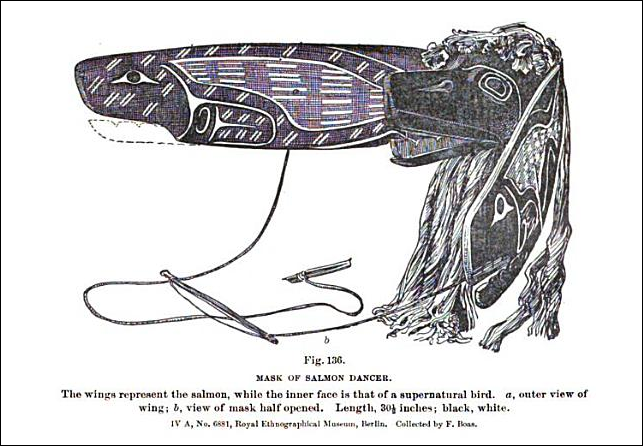
Kwakiutl Salmon Dancer's mask

.

I really don’t have much to say about this, but I’d like to note it as one more instance of Mahdism cropping up in unlikely places. And a h/t to Scott McWilliams @macengr for pointing me to the story. I can’t entirely vouch for its accuracy since I don’t have easy access to 1970s Pakistani newspapers, but I’ve seen allusions to the same story dating back a couple of years

When the Pakistani army and bureaucratic establishment realized that Mujib-ur-Rehman’s Awami League and Zulfiqar Ali Bhutto’s PPP were attracting people—with no other party able to draw even 5000 to its rallies—they imported Zohra Fona, a woman from Indonesia, pregnant with Imam Mehdi. She had visited several Islamic countries, it was propagated, where rulers had offered prayers in her Imamat [i.e. she led the prayers even if a woman is not supposed to do that].

Many Muslim intellectuals and scholars claimed through their writings and lectures that the time for Imam Mehdi’s appearance had arrived. A new Islamic world was about to emerge. During this period the Islamic parties, including Jamat-e-Islami, perpetrated violence. Members started attacking liberal and progressive professors, doctors, writers, journalists as well as their houses. They also burned many libraries and collections of books.

Zohra Fona claimed that the child in her womb recited Azaan [call for prayers] and could lead the prayers. Ulema like Maulana Okarvi and Ehtesham Ul Haque went to see Zohra Fona and listened to Azan with ears close to lady’s womb. Prayer events were arranged for her in open places as well as in the larger mosques, and the Ulema [religious scholars] were praying behind her. She would stretch her legs towards Kaaba [Mecca], directing her womb toward the pulpit. Suddenly Azaan would start coming from her womb or from another private part. The Ulema were so shameless that they were offering prayers while focusing their eyes on her private parts.

Back then the left was very organized so it was difficult to explain this farce. Finally the Pakistan Medical Association and doctors at Jinnah Hospital, Karachi decided to unearth the drama. Several lady gynecologists were asked to help; they knew that this kind of thing could not happen. But Zohra Fona was very clever. Whenever doctors were pursuing her to take a medical examination she avoided with help from the Pakistani security forces. But one day, when she was unable to escape, the doctors of Jinnah hospital, Karachi conducted an examination. The doctors recovered a small tape recorder from her womb.

Does the bit about the tape-recorder in the womb sound a bit far-fetched? Here’s another version, this one from The [International] News:

Zohra Fona, a blessed Indonesian woman, arrived in Pakistan just ahead its first general elections. She was said to be expecting a child who would be Imam Mehdi. She had visited several Islamic countries where, and it was propagated, that rulers had offered prayers in her imamat. Many ulema began to claim that the time for Imam Mehdi’s coming had arrived.

Zohra Fona claimed that the child recited Azaan. Reputed ulema like Maulana Okarvi and Ehteshamul Haque met Zohra Fona and listened to the Azaan with ears close to the lady’s stomach. She began to draw huge crowds to mosques and parks where she led prayers. Our reputed ulema would join the prayers.

Woe betide this country! Some leftist and agnostics at Karachi’s Jinnah Hospital decided to put the legend to scientific test. It was revealed that the holy woman was not even pregnant with an Azan-reciting messiah but had a recording device tied to her body. She immediately left for Indonesia once the farce was exposed.

That sounds more plausible.

**

A word of caution here.

Just as theater and film sometimes deploy “deux ex machina” interventions to immerse their audiences more deeply into their created micro-worlds, so have shamanic performances.

I’ve written about this before in an email to a religious scholars’ list, and in these days when even self-plagiarism is disdained, I am going to repeat here what I wrote then, with very minor changes:

It’s my recollection that [Tlingit / Kwakiutl winter ceremonials] were both entertainment for the long winter nights and “schooling” for the young, and I have a vivid recall of reading somewhere a shaman’s admission to an anthro of the exact nature of the dramatic means by which the shaman’s capacity to defeat death was demonstrated.

I read this in the early eighties, but searching on the web I’ve found something that comes close — Clellan Stearns Ford’s record of Charles James Nowell’s memories in _Smoke from their fires: the life of a Kwakiutl chief_. Around p 120, there are two stories, the first about a girl who “turned the wrong way” during a dance, the second about a girl who is put in a box and burned. In both cases, the nature of the trickery is described but in the version I read all those years ago, the two stories were one — the girl who was put in a box in the fire pit and “burned to death” escapes through a false bottom to the box along a tunnel into the adjoining room, and her voice then issues as if from her ashes, via a kelp tube that goes from the tunnel to the adjoining room where she’s now standing.

She describes her descent into the sea realm, where she is chastened and eventually granted a boon to return to the tribe. A canoe sets out to fetch her, but by the time the audience sees it set out, she’s already secured by rope to the far side of the boat, and at a suitable distance is hauled aboard and brought back to shore, alive.

A child seeing this would be mightily predisposed to believing the shaman had healing powers, and by the time the ruse was revealed, that underpinning of faith is already in place.

In the Nowell version, even the adults, who “know” the deception involved, are deceived: “The fire burned and the box burned, and she was still singing inside, and then the box go up in flames, and they can see her burning there in her blue blanket, and all her relatives just cry and cry. Although they know it is not real, it looks so real they can’t help it. It was all a trick. There was a hole under the box with a tunnel leading out of the house, and the woman went out of the box and put a seal in her place wrapped in a blue blanket, and then someone sang into the fire through a kelp tube, her song. Oh, it looked real!”

The Winter ceremonials of the Pacific Northwestern tribes are by turns opera, history, religion and “general education” to the children of the tribe, and “continuing education” to their elders…

Do we have anything to equal them?

Bearing such things in mind, we may want to consider trickery — a quality of the trickster gods, after all, in many mythologies — a not entirely illegitimate activity for a religious performer…

The most contested piece of real-estate on earth

Friday, July 27th, 2012

[ by Charles Cameron — Jerusalem and apocalyptic sentiment, not at the emergency crash warning level, but still something to keep an eye out for ]
.


.

If you’re interested, as I am, in the ways that end-times theology impacts geopolitics, whether in its Christian, Judaic or Islamic (Sunni or Shi’ite) formulations, then two recent articles in Ha’aretz deserve your attention.

**

The first, published July 27, has Ari Shavit interviewing Gov. Mitt Romney on behalf of Ha’aretz, and asking the following question:

Governor Romney, you’ll be arriving in Jerusalem on Saturday night, on the eve of the day on which we commemorate the destruction of the First and Second Temples. Many Israelis feel that the fate of the ‘Third Temple’ relies on its strong bond with a strong America. Can you assure them that should you be president, you will reverse the trend of American decline? Can you guarantee that both America, and Israel’s bond with America, will be strong once again?

Gov. Romney does not speak to the Third Temple issue in his response, though the rest of the interview will no doubt interest those with a focus on foreign policy – and policy with regard to a nuclear Iran in particular.

**

The second Ha’aretz piece, posted almost a month earlier, gives some context on why the issue of the Third Temple is important – it is part and parcel of Jewish messianic prophecy. The problem here is that the rebuilding of the Temple would presumably take place on the site that’s currently considered the third holiest in Islam – the plateau that Muslims term the Noble Sanctuary and Jews the Temple Mount.

And that could mean trouble:

In 1990, after Muslims became concerned that the Temple Mount Faithful would come to lay the cornerstone for the Third Temple – as they had several times in the past – the muezzin of the Al-Aqsa Mosque on the mount called on the thousands of worshippers there to defend the site against such a move. This led to what became known as the Temple Mount riots, in which 17 Palestinians were killed and several Jewish worshippers at the Western Wall were injured. The riots led to a serious toughening of the police stance regarding the Temple Mount, but it did not stop attempts by the various right-wing organizations to restore a full Jewish presence there.

**

As the navel is set in the centre of the human body,
so is the land of Israel the navel of the world…
situated in the centre of the world,
and Jerusalem in the centre of the land of Israel,
and the sanctuary in the centre of Jerusalem,
and the holy place in the centre of the sanctuary,
and the ark in the centre of the holy place,
and the foundation stone before the holy place,
because from it the world was founded.

— Midrash Tanchuma, Qedoshim.

Tisha B’Av, the day on which Jews mourn the destruction of the First and Second Temples, begins in the evening of Saturday, July 28 this year, and ends in the evening of Sunday, July 29.

**

Gershom Gorenberg calls the plateau “the most contested piece of real-estate on earth” — and his book The End of Days is the definitive text exploring the different apocalyptic expectations asspociated with it in the three Abrahamic religions.

In it, he notes that according to one Jewish source, the fight between Cain and Abel arose over a dispute as to which of them had the better claim to the Temple Mount.

No compulsion in religion

Thursday, July 26th, 2012

[ by Charles Cameron — conversion by force, the Qur’an — and a question about space travel ]
.

Under the header, Africa: ‘Christians Must Convert’ Says Islamist Group, the Catholic Information Service for Africa reported recently:

Islamist militants have claimed responsibility for the deaths of more than 50 people in north-central Nigeria – and called on the country’s Christians to convert to Islam. Boko Haram spokesman Abu Qaqa issued a statement that the Islamist group carried out the attacks on more than a dozen villages last weekend (June 30 – July 1) and said it will continue to attack the country’s Christians.

According to the statement: “Christians in Nigeria should accept Islam, that is true religion, or they will never have peace.”

“We do not regard them as trusted Christians as some illiterates are campaigning because it was Christians that first declared war on Muslims with the support of government.”

Violence in Plateau state last weekend was blamed on members of the predominantly Muslim Fulani ethnic group, which attacked Christian tribes in the region in March 2010 due to political and social tensions. According to a Red Cross statement issued late Sunday (July 1), aid workers counted 58 dead – but other estimates place the number higher. Press Trust of India reporters stationed in the capital Abuja stated that 135 people were killed.

In the statement Boko Haram thanked God for the massacre: “We praise God in this war for Prophet Mohammed, we thank Allah for the successful attack in Plateau state on Christians and security men”.

Speaking to Aid to the Church in Need last month, Bishop Martin Igwe Uzoukwu Minna said: “If we have to die for Christ, we will die for Christ, but why should we be forced to make the choice?”

**

Sheikh Sâmî al-Mâjid, professor at al-Imâm Islamic University, Riyadh, finds the answer quite simply set forth in the Qur’an:

Allah says: “Let there be no compulsion in religion. Truth has been made clear from error. Whoever rejects false worship and believes in Allah has grasped the most trustworthy handhold that never breaks. And Allah hears and knows all things.” [Sûrah al-Baqarah: 256]

He then comments:

One of the fundamental truths established by the sacred texts is that no one can be compelled to accept Islam. It is the duty of Muslims to establish the proof of Islam to the people so that truth can be made clear from falsehood. After that, whoever wishes to accept Islam may do so and whoever wishes to continue upon unbelief may do so. No one should be threatened or harmed in any way if he does not wish to accept Islam.

This verse is decisive in establishing that each person has the right to make his or her own choice about embracing Islam. There is other equally decisive evidence in the Qur’an, among which are the following verses:

Allah says: “If it had been your Lord’s will, all of the people on Earth would have believed. Would you then compel the people so to have them believe?” [Sûrah Yûnus: 99]

Allah says: “So if they dispute with you, say ‘I have submitted my whole self to Allah, and so have those who follow me.’ And say to the People of the Scripture and to the unlearned: ‘Do you also submit yourselves?’ If they do, then they are on right guidance. But if they turn away, your duty is only to convey the Message. And in Allah’s sight are all of His servants.” [Sûrah Âl `Imrân: 20]

Allah says: “The Messenger’s duty is but to proclaim the Message.” [Sûrah al-Mâ’idah: 99]

It is important to note that these last two verses were revealed in Madinah. This is significant, since it shows that the ruling they gave was not just contingent on the Muslims being in Mecca in a state of weakness, but is valid for all time.

**

We humans do seem to like imposing our own views on others, though, don’t we? And religion is a brilliant playground for that sort of thing.

If God had planted different the religions on different planets, do you think we’d have mastered space travel by now?

Myanmar: the Rohingya and the Buddhists

Tuesday, July 24th, 2012

[ by Charles Cameron — one person’s shrine is another person’s ex-shrine ]
.

I was struck by this sentence in a blog post on Myanmar today:

As for the Muslims, they have been force-converted, their places of worship, as in the case of mosques, transformed into Buddhist temples, and they have been attacked during their religious festivities.

Buddhists? Just like the rest of us? Okay…

**


.

You know how some Muslims must feel when they see a Christian cathedral sprouting right out of the heart of their beautiful Mezquita mosque in Cordoba (above)? Or some Christians, when they see the huge Islamic decals hanging in what was once the great cathedral of Istanbul, Hagia Sophia (below) — now a museum?

.

**

I believe we’re all pretty happy that Aung San Suu Kyi is no longer under house arrest, but even she hasn’t felt at easy commenting on the Rohingya / Muslims in her native Myanmar:

The issue of the Rohingya is so delicate that even Myanmar’s leading defender of human rights and democracy, Daw Aung San Suu Kyi, has been oblique and evasive about the situation. Asked at a news conference on Thursday whether the estimated 800,000 Rohingyas in Myanmar should be given citizenship, Ms. Aung San Suu Kyi was equivocal. “We have to be very clear about what the laws of citizenship are and who are entitled to them,” she said in Geneva, which she was visiting as part of a European tour. “All those who are entitled to citizenship should be treated as full citizens deserving all the rights that must be given to them.”

Since I doubt I could ever be as brave as she has been already, I can’t complain… but maybe, all the same, wish?

**

To backtrack a little, here’s the full paragraph from which that first quote was taken. It’s a two-fisted paragraph, a mind-blower:

To provide another case of discrimination and persecution of minorities and non-Buddhists, probably even less known than the Rohingya, I can mention the Christians amongst the Karen, Karenni, Chin and Kachin ethnic groups. As for the Muslims, they have been force-converted, their places of worship, as in the case of mosques, transformed into Buddhist temples, and they have been attacked during their religious festivities.

Unless, of course, your mind is already blown. Which, given the complexities of the world around us, it probably should be by now.

Liminality I: the kitsch part [note: NSFW]

Monday, July 16th, 2012

[ by Charles Cameron — a light-hearted post about serious matters — not for the squeamish — discusses politicians, fecal matter, children’s glee and Christmas spirit ]
.

top shelf: Mary, Joseph, the Christ Child, kings, shepherd; lower shelves: popes, princesses, and politicians, pooping

.

As children, we are taught that we extend from the crowns of our heads to the tips of our toes, that our skin is our outer boundary, that we’re us, here, this living, perceiving, thinking being — and we know that there’s an appropriate distance for others to keep, that under certain circumstances they can touch us, perhaps while demonstrating they don’t have a knife up their sleeve, and that with a certain amount of social approval, depending, they can enter partially inside us or vice versa — the result on occasion being the arrival of a third one that pretty much belongs to the two of us, growing inside one of us for months only to somewhat belatedly separate out…

That last example — child-bearing and childbirth — shows that the simple notion that we are our skin and whatever is inside it is a bit simple. And there are various bits of us that seem to cross the boundary that separates us from the rest without too much problem: nail clippings, hair, saliva, which I’ve covered in two recent posts, ear-wax…

Even the air we breathe in and hold in our lungs is “us” — our breath — though once we breathe it out again, it’s air, part of the room we’re in, or if we’re outdoors, part of the atmosphere, the sky…

Mathematician John Allen Paulos suggests in his book Innumeracy: Mathematical Illiteracy and Its Consequences, calculates that there’s a better than 99% chance that the last deep breath you breathed in and out contained one molecule from the dying breath of Julius Caesar

**

But it is poo, perhaps, that best exemplifies how something that was us a minute or two ago can be not us, and frankly faintly disgusting, a minute or two later. And because it breaches the me / not me distinction so forcefully, it’s a matter of keen delight and humor to all children, as far as I can tell, everywhere.

Which is where the caganer comes in.

**

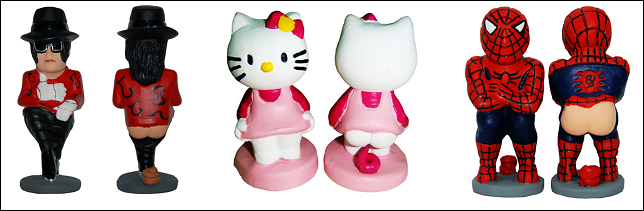
A caganer — I kid you not — is “a figurine depicted in the act of defecation appearing in nativity scenes in Catalonia and neighbouring areas with Catalan culture such as Andorra, Valencia, Northern Catalonia (in southern France) and the Balearic Islands. It is most popular and widespread in these areas, but can also be found in other areas of Spain (Murcia), Portugal and southern Italy (Naples)”. That’s Wikipedia‘s current take on the topic, which has also been written up extensively elsewhere, and indeed, caganers in their profusion have become collectibles in their own right

All of which brings me to Bob Dylan‘s “emperor’s new clothes” line:

Even the president of the United States: Sometimes must have to stand naked.

Or squat, vulnerable and with his pants down. Even Fidel Castro must do the same. Even Death

Even Elizabeth the Second, by the Grace of God, of Great Britain, Ireland and the British Dominions beyond the Seas Queen, Defender of the Faith.

**

All of which is either a complete mockery or a source of considerable hilarity — especially to the kids, who must find these caganer hidden in among the shepherds, kings, animals and straw that surround the Christ Child in his manger.

Right in the heart of the sacred, if you will.

Which brings up the twin questions:

Is no-one sacred?

Is everyone sacred?

**

Which is actually a pretty profound pair of questions — and one which, again, may help us understand a little more about religion than piety alone can tell us.

The fact is, religion can exalt us, but does so at the risk of our becoming pompous and inflated — and when we do, it can also deflate us.

Which lands us right on the topic of liminality, communitas and the work of Victor Turner, which I shall address in a follow-up post — invoking a US submarine, a Hindu avatar and St Francis along the way.


Switch to our mobile site