zenpundit.com » India

Archive for the ‘India’ Category

Furnish on Pew findings re: Islam

Thursday, May 2nd, 2013

[ Charles Cameron presenting guest-blogger Timothy Furnish ]
.

.

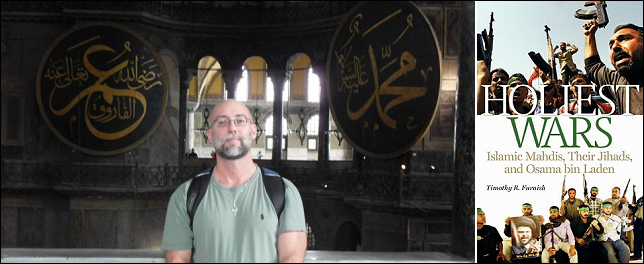
I’m delighted to welcome Dr Timothy Furnish as a guest-blogger here on Zenpundit. Dr Furnish has served as an Arabic linguist with the 101st Airborne and as an Army chaplain, holds a PhD in Islamic history from Ohio State, is the author of Holiest Wars: Islamic Mahdis, Their Jihads, and Osama bin Laden (2005), and blogs at MahdiWatch. His extended piece for the History News Network, The Ideology Behind the Boston Marathon Bombing, recently received “top billing” in Zen’s Recommended Reading of April 24th.

**

Does This Paint It Black, or Am I A Fool to Cry? Breaking Down the New Pew Study of Muslims
by Timothy R. Furnish, PhD
.

Pew has released another massive installment of data from its research, 2008-2012, into Muslim attitudes, entitled “The World’s Muslims: Religion, Politics and Society.” Over 38,000 Muslims in almost 40 countries were surveyed, thus constituting a survey both statistically sound and geographically expansive. Herewith is an analysis of that information and what seem to be its major ramifications.

The first section deals with shari`a, usually rendered simply as “Islamic law” but more accurately defined as “the rules of correct practice” which “cover every possible human contingency, social and individual, from birth to death” and based upon the Qur’an and hadiths (sayings and practices attributed to Muhammad) as interpreted by Islamic religious scholars (Marshal G.S. Hodgson, The Venture of Islam, Vol 1: The Classical Age of Islam, p. 74). Asked “should sharia [as Pew anglicizes it] be the law of the land,” 57% of Muslims across 38 countries answered “yes” — including, most problematically for the US: 99% of Afghans, 91% of Iraqis, 89% of Palestinians, 84% of Pakistanis and even 74% of Egyptians. Should sharia apply to non-Muslims as well as Muslims? Across 21 countries surveyed on this question, 40% answered affirmatively — with the highest positive response coming from Egypt (its 74% exceeding even Afghanistan’s 61%). And on the question whether sharia punishments — such as whippings and cutting off of thieves’ hands — should be enacted, the 20-country average was 52%, led by Pakistan (88%), Afghanistan (81%), the Palestinian Territories [PT] (76%) and Egypt (70-%). On the specific penalty of stoning for adultery, the 20-country average was 51% — with, again, Pakistan (89%), Afghanistan (85%), the PT (84%) and Egypt (71%) highest in approval. Finally, 38% of Muslims, across those same 20 nations, support the death penalty for those leaving Islam for another religion.

Huge majorities of Muslims across most of these surveyed nations say that “it’s good others can practice their faith” — but Pew’s imprecise terminology on this topic makes possible that this simply mean many Muslims are willing to grant non-Muslims the tolerated, but second-class, ancient status of the dhimmi. Majorities, too, in most countries say that “democracy is better than a powerful leader;” however, the latter was actually preferred by most surveyed in Russia, Bosnia-Hercegovina, Kyrgyzstan, Afghanistan and Pakistan, as well as by 42% of Iraqis, 40% of Palestinians and 36% of Egyptians. Most Afghans, Egyptians and Tunisians (and even 1/3 of Turks) believe that “Islamic political parties” are better than other ones, although 53% of Indonesians and 45% of Iraqis are also worried about “Muslim extremists.” (Curiously, 31% of Malaysians are, on the other hand, worried about “Christian extremists” — although evidence of such existing in that country is practically non-existent.) There is good news on the question of suicide bombing, however: across 20 countries, only 13.5% think it is ever justified — although the support is much higher in the PT (40%), Afghanistan (39%) and Egypt (29%).

In terms of morality, large majorities in most Muslim countries (especially outside Sub-Saharan Africa) think drinking alcohol is morally repugnant, notably in Malaysia (93%), Pakistan and Indonesia (both 91%). Most Muslims in most countries surveyed consider abortion wrong, as well as pre- and extra-marital sex and, almost needless to say, homosexuality. (Although one wishes Pew had asked about mu`tah, or “temporary marriage” — a practice originally Twelver Shi`i which has increasingly become used by Sunnis.) Yet, simultaneously — following Qur’anic rubrics — some 30% of Muslims in 21 countries support polygamy, including almost half of Palestinians, 46% of Iraqis and 41% of Egyptians. There is also significant support for honor killings in not just Afghanistan and Iraq but also Egypt and the PT. Over ¾ of Muslims across 23 countries says that “wives must always obey their husbands:” an average of 77%. And Pew notes that there is a statistically very significant correlation between sharia-support and believing women have few(er) rights.

Asked whether they believed they were “following Muhammad’s example,” 75% of Afghans and 55% of Iraqis answered affirmatively — although most Muslims were not nearly so confident. On the question “are Sunni-Shi`i tensions a problem,” 38% of Lebanese, 34% of Pakistanis, 23% of Iraqis and 20% of Afghans said “yes.”

It is no surprise that huge majorities of Muslims in most surveyed countries believe that Islam is the only path to salvation, nor that most also say “it’s a duty to convert others” to Islam. It is somewhat counterintuitive, however, that many Muslims say they “know little about Christianity” — even in places with large Christian minorities, such as Egypt. Muslims in Sub-Saharan Africa are the most likely to agree that “Islam and Christianity have a lot in common,” and so are 42% of Palestianians, as well as some 1/3 of Lebanese and Egyptians. But only 10% of Pakistanis agree. Asked whether they ever engaged in “interfaith meetings,” many Muslims in Sub-Saharan Africa said that they did (with Christians), and a majority of Thais said likewise (albeit with Buddhists). But only 8% of Palestinians, 5% of Iraqis, and 4% of Egyptians said they ever do so—despite substantial Christian populations in each of those areas.

Regarding the question “are religion and science in conflict,” most Muslims said “no” — with the exceptions of Lebanon, Bangladesh, Tunisia and Turkey where over 40% in each country (and, actually, a majority in Lebanon) said that they were at loggerheads. Most Muslims also say they have no problems with believing in Allah and evolution — the exceptions being the majority of Afghans and Indonesians. Regarding popular culture, clear majorities of Muslims in many countries say they like Western music, TV and movies—but, at the same time, similar majorities say that such things undermine morality (although Bollywood less so than Hollywood).

Observations:

1) The high degree of support for sharia is the red flag here. Contra media and adminstration (both Obama and Bush) assurances that most Muslims are “moderate,” empirical data now exists that clearly shows most Muslims, in point of fact, support not just sharia in general but its brutal punishments. Perhaps just as disturbing, almost four in ten Muslims are in favor of killing those who choose to follow another religion. And countries in which the US is heavily involved either diplomatically or militarily (or both) are the very ones where such sentiments run most high: Pakistan, Afghanistan, Egypt, the Palestinian Territories. So are the “extremists” these very Muslims who want to follow, literally, the Qur’an and hadiths? Messers Brennan, Holder and Obama have some explaining to do.

2) Afghanistan would appear to be a lost cause. Afghans are at the top of almost every list in support for not just sharia, suicide bombing, honor killing and — ironically (or perhaps not) — confidence that they are emulating Islam’s founder, as well as dislike for democracy. In light of this clear data, two points about Afghanistan become clear: tactically, ostensible American befuddlement as to the causes of “green on blue” attacks and the continuing popularity of the Taliban in Afghanistan appears as willful ignorance; strategically, the US decision to stay there after taking out the al-Qa`ida [AQ] staging, post-9/11, and attempt to modernize Afghanistan was a huge, neo-Wilsonian mistake. 2014 cannot come soon enough.

3) In some ways Islam in Southeastern Europe, and to a lesser extent in Central Asia, seems to be a more tolerant brand of the faith than the Middle Eastern variety. For example, the SE European and Central Asian Muslims are the least likely to support the death penalty for “apostasy,” and the most supportive of letting women decide for themselves whether to veil. And Muslims in Sub-Saharan Africa are the most likely to know about Christianity, and to interact with Christians. On the other hand, African Muslims are among the most enamored of sharia, and Central Asian ones fond of letting qadis (Islamic judges) decide family and property disputes. So there does not seem to be a direct link between Westernization and moderation; in fact, the influence of Sufism — Islamic mysticism — in the regard needs to be correlated and studied (beyond what Pew did on the topic in last year’s analysis).

4) One bit of prognostication based on this data: Malaysia may be the next breeding ground of Islamic terrorism. It’s home to some 17 million Muslims (61% of its 28 million people), who hold a congeries of unsettling views: 86% want sharia the law of the land; 67% favor the death penalty for apostasy; 66% like sharia-compliant corporal punishments; 60% support stoning for adultery; and 18% think suicide bombing is justified. PACOM, SOCOM and the intelligence agencies need to ramp up hiring of Malay linguists and analysts.

5) Finally, some words for those — like FNC’s Megyn Kelly and Julie Roginsky (on the former’s show “American Live,” 4/30/13) — who pose a sociopolitical and moral equivalence between Muslim support for sharia and Evangelical Protestant Christian support for wives’ obedience to husbands: that’s a bit too much sympathy for the devil. Yes, Evangelical Christian pastors hold some pretty conservative views of the family, as per a 2011 Pew study of them; for example, 55% of them do agree that “a wife must always obey her husband” (compared to 77% of Muslims). And, ironically, many such Evangelicals agree in large measure with Muslims on issues such as the immorality of alcohol, abortion and homosexuality. However, one searches in vain for any Evangelical (or other) Christian support for whippings, stonings, amputation of thieves’ limbs, polygamy or suicide bombing.

Islam is the world’s second-largest religion, numbering some 1.6 billion humans (behind only Christianity’s 2.2 billion). There is, thus, enormous diversity of opinion on many issues of doctrine and practice, and essentializing Islam as either “peaceful” or “violent” is fraught with peril. Nonetheless, this latest Pew study provides empirical evidence that many — far too many — Muslims cling to a literalist, supremacist and indeed brutal view of their religion. Insha’allah, this will change eventually — but time is not necessarily on our side.

Khorasan to al-Quds and the Ghazwa-e-Hind

Tuesday, April 2nd, 2013

[ by Charles Cameron — expecting the unexpected — transcribing Bill Roggio on “something that everyone is overlooking” and Ambassador Haqqani on “one of the unwritten books it has been my desire to write” ]
.

I’ve talked about the “Black Banners” hadith and the Mahdi‘s victorious army marching from (roughly) Afghanistan to Jerusalem more than once, and perhaps less frequently, the other prong of the jihad, the Ghazwa-e-Hind, which flows from Pakistan into India. In the video that follows, Bill Roggio of the Long War Journal talks with Husain Haqqani, one-time Pakistani Ambassador to the US — and both have some striking things to say.

We pick up the conversation close to the end of the first half of a two-tape session at the Foundation for the Defense of Democracies — and I’ve provided a transcript after the video, for easier quotation and annotation.

**

BILL ROGGIO:

One of Al-Qaida’s propaganda since it took a beating in Iraq was, that they made the Khorasan, which is an old Islamic empire basically in central Asia and South Asia, they said that this is where we are going to beat them, and once we win in the Khorasan, we’re going to move towards the Levant. So this has become a key part of AQ’s propaganda. What do we think is going to happen when we lose in Afghanistan, when the second superpower loses? That is going to be a huge recruiting boom for foreign terrorists operating in Afghanistan. I think this is something that everyone is overlooking as we’re running for the doors in Afghanistan.

That’s a pretty powerful prediction, though prediction itself is a high risk enterprise. And it bears repeating that the Khorasan hadith is explicitly an “end times” prophecy. Ambassador Haqqani then doubles up on Bill Roggio’s concern, adding in the Ghazwa-e-Hind, which he describes as both “famous” and “the final, biggest war between good and evil and between Islam and kufr”…

A lot of people make fun of the Pakistani analyst and Youtube personality, Zaid Hamid, who seems to be the main public proponent of the Ghazwa — take a look here to see a wild sampler! — which is why I find Ambassador Haqqani’s response particularly impactful.

HUSAIN HAQQANI:

You know, there are days when I think I should have stayed in the scholarship business and written some of that stuff I was writing at that time. This was one of the things, even before Iraq, I had pointed out. For example, bin Laden had given a statement at that time about Americans being the new Mongols, and nobody could understand what he was talking about, and I said he’s talking about the 1258 conquest of Baghdad, and he’s playing on Islamic history and Islamic mythology.

And so Khorasan was an important element in that because, if you remember, the Abbasids rose to power through Khorasan, because that was an important element, they overthrew the Umayyads based on the argument that there is a hadith – which in my opinion is of relatively weak significance, but I am taking off my hat of a theologian since I never completed my religious training – but anyway, they used that, that there is a hadith, that the people from Khorasan will come and save the people of the Levant or whatever. And so that was used, and that was used again, and that has been part of the Al-Qaeda thing.

And then the other part is this famous Ghazwa-e-Hind, and the Pakistani groups use it – actually, just as jihad is the war, a holy war or war for religious purposes, ghazwa is a battle — and there is ostensibly a saying of prophet Muhammad that before the end times, the final, biggest war between good and evil and between Islam and kufr is going to take place in Hind, which is India, which is the land east of the river Indus.

So Khorasan takes care of what is today Afghanistan and some parts of central Asia, and all of that – it means a lot to people who believe in it, these end times prophecies etcetera. So one of the unwritten books it has been my desire to write, I wrote a piece on it once, an article I think, which said, that, you know, Americans pay a lot of attention to their own end time prophecies, but getting into that whole theater, they have totally neglected this.

And so far as recruitment is concerned I am totally agreeing with you, that failure in Afghanistan is going to be a big boon for both. The TTP — the Tehrik-i-Taliban Pakistan — and the Pakistani groups are going to start saying, Right, now is the time to start recruiting, and fighting in that famous Ghazwa-e-Hind –let’s get ready for that. And the Arab groups are going to say, Ah, salvation is coming by joining up with the folks who are fighting in Khorasan.

And both those fronts are going to be a source of a lot of problems.

Increased jihadist recruitment, and India as a second major front for the jihad — that’s quite a left lead and right cross combo…

**

Do you recall the opening of Aldous Huxley‘s final novel, Island?

“Attention,” a voice began to call, and it was as though an oboe had suddenly become articulate. “Attention,” it repeated in the same high, nasal monotone. “Attention.”

A quick detail re: sacred calendars & terror

Sunday, March 31st, 2013

[ by Charles Cameron — timing ]
.

From Anurag Kashyap's film, Black Friday
.

I just received my own copy of Anuraga Kashyap‘s Black Friday, his terrific film about the 1993 Mumbai bombings which I’ve previously compared with Gillo Pontecorvo‘s Battle of Algiers, and was struck by the “date” detail in the screencaps above — compare the McVeigh OKC bombing on the anniversary of the Waco conflagration, and the Consulate events in Benghazi on the anniversary of 9/11.

Sacred calendars and sacred time: I was talking about them in a happier context in my post for Maundy Thursday, so the topic was on my mind, and I thought I should check out the journalistic account on which Kashyap’s movie is based — Hussain S. Zaidi‘s Black Friday: The True Story of the Bombay Bomb Blasts. And yes indeed, that’s Kashyap’s source, followed nearly word for word in this particular scene.

Zaidi has Tiger Memon say:

Friday, 12 March, is the seventeenth day of Ramazan. It will be the day when the Holy Prophet fought the first battle of Junge-Badr against the heathens of Mecca and forced them to retreat. The auspicious date will help us achieve success.

**

There are two sorts of calendar running simultaneously, two times: sacred and secular. Both kinds of calendar are important…

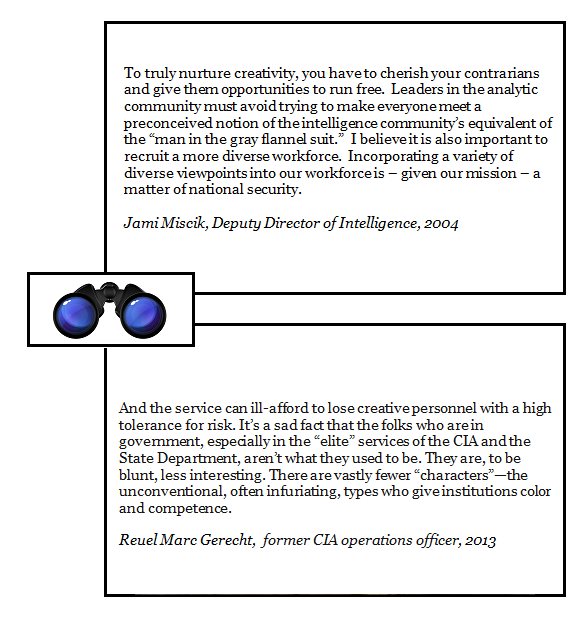
Miscik 2004, Gerecht 2013

Thursday, February 21st, 2013

[ by Charles Cameron — on the exclusion of worldviews not consonant with grey suits and security clearances ]
.

These two persons are likely being polite.

**

I’m wondering how any people at State or in the Agency or wherever know what it feels like to be one of the flagellants in Iran during Muharram, in Qom or Masshad perhaps… or at the Jamkaran mosque, and to believe the Mahdi is waiting close by in the wings… or to be in Afghanistan, Sunni, and expecting his army with black banners will sweep down on Jerusalem from Khorasan in accordance with hadith… or in Palestine, reliant on the hadith of the rocks and the trees, certain that Israel will soon fall… in Pakistan, listening to Syed Zaid Zaman Hamid and mentally preparing for the Ghazwa-e-Hind?

**

I suppose I’ve been struggling to say this for years:

The sanction for extremist violence, even to the point of death, is that the cause is just and right. The sanction for messianic violence is that the cause is not only humanly just and right but divinely so — and final, for the entirety of the cosmos, for all Creation.

**

Sources:

Jami Miscik, tesimony, House Intelligence Cttee
Reuel Marc Gerecht, Spooky Sex

h/t Nada Bakos

Further readings on messianisms:

Mahdi in the wings, Iran
Khorasan, army with black banners, Afghanistan
Hadith of the rocks and the trees, Palestine
Ghazwa-e-Hind, Pakistan

David Cook, Contemporary Islamic Apocalyptic Literature
David Cook, Studies in Islamic Apocalyptic
Timothy Furnish, Holiest Wars
Gershom Gorenberg, The End of Days
Anne-Marie Oliver & Paul Steinberg, The Road to Martyr’s Square
Jean-Pierre Filiu, Apocalypse in Islam
Syed Saleem Shahzad, Inside al-Qaeda and the Taliban
Ali Soufan, The Black Banners
Richard Landes, Heaven on Earth

When myth breaches the news media ocean

Wednesday, January 2nd, 2013

[ by Charles Cameron — Draupadi in the Mahabharata, the anonymous med student recently gang-raped on an Indian bus ]
.

Humpback whale breaching, source: Wikipedia under CC Attribution-Share Alike 2.5 Generic license

.
Some people go out on the oceans and watch and wait for whales to “breach” the surface — you know me, I go out on the interwebs and search for fragments of scripture and myth to breach the surface of the daily news — as when a minor warlord in Aleppo reports seeing angels, or Gregory Johnsen quotes the prophet Hosea in the title of a post on Waq-al-Waq.

**

Today’s main sighting concerns the rape of the young medical student in India, one of many tragedies in the tapestry of griefs and joys we all live with, and perhaps one that will make an incremental shift in global awareness.

It seems to me that India has had her share of violence both during and after Partition — most recently the Babri masjid takedown in Ayodhya, the Gujarat riots, two major sets of bombings in Mumbai, swathes of India under Naxalite influence, and so forth.

I’ve been noticing references to the recent rape, but not really following it in detail until today, when this Al Jazeera report, Rape of Draupadi: Why Indian democracy has failed women, caught my eye.

The author, Dinesh Sharma, quotes blogger Nilanjana Roy — the other person whose writing on the subject had particularly moved me — to list earlier instances of anti-woman violence:

Sometimes, when we talk about the history of women in India, we speak in shorthand. The Mathura rape case. The Vishaka guidelines. The Bhanwari Devi case, the Suryanelli affair, the Soni Sori allegations, the business at Kunan Pushpora. Each of these, the names of women and places, mapping a geography of pain; unspeakable damage inflicted on women’s bodies, on the map of India, where you can, if you want, create a constantly updating map of violence against women.

For some, amnesia becomes a way of self-defence: there is only so much darkness you can swallow.

When I’d first read that on Roy’s blog, I’d been saddened as much by my own ignorance of the named events as by the litany of sorroes Roy put together.

**

But it was Sharma’s invocation of Draupadi that triggered this post:

Draupadi, heroine of the Mahabharata epic, is bold and forthright even in adversity. Her husband Yudhisthira succumbing to his weakness for gambling, stakes and loses all (in a rigged game), including his wife. Draupadi challenges the assembly and demands to know how it is possible for one who has staked and lost his own self to retain the right to wager her.

Duryodhana, the winner of the bet, insists that Draupadi is indeed his to do with as he pleases and orders that she be disrobed. Furious at this insult to her honor, Draupadi loosens her coifed hair and vows that she will not knot it again until she has washed it in Duryodhana’s blood. As she is disrobed, the more her sari is pulled away the longer it becomes. It is this event which turns Draupadi from a contented, but strong willed wife into a vengeful goddess.

Until I saw the title of Sharma’s piece, I hadn’t thought of Draupadi — but she’s the quintessential figure of the woman wrongly treated in the rich mythology of the subcontinent, and thus offers the appropriate background against which to see the terrible event.

Draupadi is celebrated for her devotion to Krishna, the anonymous woman raped in the recent incident on a bus for her devotion to education, medicine, healing…

**

As Sharma says:

The perennial question has to be asked – “Who will protect Draupadi’s honour?”


Switch to our mobile site

