zenpundit.com » Apocalyptic

Archive for the ‘Apocalyptic’ Category

Of quantity and intensity: the case of the Sufiyan

Sunday, October 28th, 2012

[ by Charles Cameron — catching the apocalyptic mention in a broad sectarian overview ]
.


.

I’d like to discuss the last four paragraphs of a recent NYT piece on the influx of Iraqi Shiites to Syria:

Iraqi Shiites did not initially take sides in Syria. Many Shiites here despise Mr. Assad for his affiliation with the Baath Party, the party of Saddam Hussein, and the support he gave foreign Sunni fighters during the Iraq war.

But as the uprising became an armed rebellion that began to attract Sunni extremists, many Shiites came to see the war in existential terms. Devout Shiites in Iraq often describe the Syrian conflict as the beginning of the fulfillment of a Shiite prophecy that presages the end of time by predicting that an army, headed by a devil-like figure named Sufyani, will rise in Syria and then conquer Iraq’s Shiites.

It was the bombing of an important shrine in Samarra in 2006 that escalated Iraq’s sectarian civil war, and many Iraqis see the events in Syria as replicating their own recent bloody history, but with even greater potential consequences.

Hassan al-Rubaie, a Shiite cleric from Baquba, the capital of Diyala Province, said, “The destruction of the shrine of Sayyida Zeinab in Syria will mean the start of sectarian civil war in Iraq, Syria, Lebanon, Bahrain and Saudi Arabia.”

**

There’s a lot going on there, and I just want to point you to the little diagram I posted above, which features what I consider one very significant point that jumped out at me on this occasion from the “larger picture”.

It’s my impression that the name Sufiyan will be far less familiar to most readers than the names Iraq, Syria, Lebanon, Bahrain and Saudi Arabia. Furthermore, Iraq, Syria and so on are nations — real geopolitical entities with territories, wealth, militaries, populations, factions, fighting and so forth. The Sufyani, by contrast, is a single person, perhaps a figure of legend.

For the contemporary western mind, therefore, it is easy to read those last four paragraphs and be struck by the breadth, the sheer physical extent of the potential conflict described there – and after noting the basic concept of sectarian rivalry between Sunnis and Shiites, that may in fact be the major “takeaway” from the article: this thing could be huge.

I want to suggest there’s a more significant, and less studied takeaway – that Sufyani is the key word here, because Sufyani is a figure in a specifically end-times narrative, a precursor to and noted adversary of the Mahdi.

**

That’s my bottom line here – that this individual the Sufyan may be less known and less impressive-sounding than a swathe of nations between the Mediterranean, the Red Sea and the Persian Gulf – but he represents the power of end-times belief, and the intensity that inevitably accompanies the final showdown between good and evil, with heaven and hell the only possible outcomes of one’s chance and choice to participate.

**

There is not a whole lot of documentation in English regarding the Sufyani, especially as viewed in Shiite eschatology, but this quick excerpt archived from an Iranian state media site will give us a basic overview:

According to narrations Sofyani, a descendant of the Prophet’s archenemy Abu Sofyan will seize Syria and attack Iraq and the Hejaz with the ferocity of a beast. The Sofyani will commit great crimes against humanity in Iraq slaughtering people bearing the names of the infallible Imams, and his army will lay siege to the city of Kufa and to Holy Najaf. Of course, many incidents take place in this line and finally Imam Mahdi sends troops who kill the Sofyani in Beit ol-Moqaddas, the Islamic holy city in Palestine that is currently under occupation of the Zionists. Soon a pious person from the progeny of Imam Hasan Mojtaba (AS) meets with the Imam. He is a venerable God-fearing individual from Iran. Before the Imam’s appearance he fights oppression and corruption and enters Iraq to lift the siege of Kufa and holy Najaf and to defeat the forces of Sofyani in Iraq. He then pledges allegiance to Imam Mahdi.

The Rice University scholar David Cook gives a worthwhile account of the Sufiyani in Shiite perspective, in his Hudson Institute paper Messianism in the Shiite Crescent [CC note: this paragraph added about an hour after first posting]:

First among the major omens connected with the belief in the Mahdi’s imminent return is the appearance of his apocalyptic opponent, the Sufyani. Mainstream tradition tells that the Sufyani will be a tyrannical Arab Muslim ruler who will hail from the region of Syria and who will brutally oppress the Shiite peoples. Before the 2003 collapse of the Saddam Hussein regime in Iraq, many messianic writers in both the Sunni and Shiite traditions identified Saddam Hussein as the Sufyani. Since 2004, however, there has been a tendency to gloss over the classical belief in the Sufyani’s Syrian-Muslim identity and to identify him instead with the United States (as many Iraqis hold the U.S. responsible for the slaughters in their country.) Another recent trend within Shiite messianism has been to identify the Sufyani with prominent Sunni radicals such as Abu Musab al-Zarqawi (killed June 2006), who was virulently anti-Shiite. From the perspective of the classical sources, Zarqawi would have indeed been an excellent candidate, because his hometown in Jordan is extremely close to where the Sufyani is supposed to come from.

It’s worth noting, perhaps, that the Sufyani also features in the (Sunni AQ strategist) Abu Musab al-Suri‘s work, the Call to Global Islamic Resistance. As Jean-Paul Filiu reports:

Abu Musab al-Suri looks with favor upon a hadith that speaks of the restoration of Islam by an armed force “coming from the east.” This will be the vanguard of the Mahdi, known by its black banners and led by Shuaib ibn Saleh, whom every believer will join “even [if it means] marching in the snow.” The Sufyani, whose face is scarred by smallpox, will rise up against it in Damascus and ravage Palestine, Egypt, and Hijaz, proceeding as far as Mecca, where he will kill the “Pure Soul.” Yet it is also at Mecca that the Mahdi will appear, and he will reconquer Damascus after eighteen years…

Meanwhile, out there on the wild profusion of the net, there’s naturally controversy as to who the Sufyani might be – suggestions I’ve seen include Bashar al-Assad of Syria and Abdullah II of Jordan – in much the same way that the identity of the Antichrist is debated in Christian eschatological circles, with candidates ranging from the Emperor Nero to Ronald Reagan and more recently Oprah Winfrey [link is to an amazing video clip which also features President Obama and Louis Farrakhan].

**

So?

So. Rather than – or in addition to – considering the sheer extent of geopolitical space referenced in the NYT piece, I’d suggest we should pay attention to the intensity factor signaled by the mention of the Sufyani. Following that tack, after all, we will also be considering a wide swathe of territory —

in Abu Musab al Suri’s terms, from Syria via Palestine, Egypt, and the Hijaz, to Mecca – but with the added intensity that apocalyptic war brings with it.

A little diligence makes for a long post, 1: Kahlili

Wednesday, October 24th, 2012

[ by Charles Cameron — first part of a post on misreading Mahdism in Iran ]
.

book credit: amazon -- Mahdist graphic credit: Tim Furnish / MahdiWatch

.

Our blog friend Pundita has been relying on Reza Kahlili, the pseudonymous Iranian author of A Time to Betray: The Astonishing Double Life of a CIA Agent Inside the Revolutionary Guards of Iran, quite a bit recently, pointing to his recent discussion with John Batchelor and some reports of his on World Net Daily.

There are a number of people whose views on the religious issues surrounding an Iranian nuclear weapons program interest me — I leave other aspects of the problem to others better informed than I — some because they have insight, some because they have megaphones, and so on.

I’m not the person you’d want to ask whether Reza Kahlili was a CIA source, whether he was trusted, and if so, on what issues – issues which might range from troop movements to popular opinion of the IRG rank and file to theology and apocalyptic, a range that no single source is likely to be omnicompetent in – but WND is a media source I’ve followed off and on for a dozen years, it’s strongly associated with one of the strands of recent Christian apocalyptic with its own messianic take on Islam and Mahdism, and it isn’t necessarily a source I’d trust without verification…

**

So I did some checking of my own on Reza Kahlili, and found that he, or more likely some ghost writer employed to write his book for him (along with his publisher’s copy editor), simply doesn’t know what a hadith is. A hadith is a statement attributed to the Prophet (or in the Shi’a case, one of the infallible Imams who succeeded him) and passed down through an authoritative train of transmission (isnad). For a practicing Muslim, the corpus of hadith is second only to the Qur’an, and knowing what a hadith is is like knowing what the Epistles are for a practicing Christian: basic. For a theologically nuanced scholar from Qom or Najaf, it’s kindergarten.

Kahlili gets the use of the word “hadith” right early on in his book, but when he starts talking about the return of the Twelfth Imam or Mahdi he writes (p. 334.):

Like others who think as he does, Ahmadinejad believes that many of the signs of Mahdi’s return have emerged. Known as hadiths, these signs include the invasion of Afghanistan, the bloodshed in Iraq, and the global economic meltdown. According to prophecy, the hadiths will grow increasingly furious as Mahdi’s return comes closer, including “persecution and injustice” engulfing the earth, “chaos and famine,” and “many wars.” The hadiths predict that “many will be killed and the rest will suffer hunger and lawlessness.” People like Ahmadinejad so completely believed that these conditions would hasten the return of the twelfth Imam that they were willing to foment universal war, chaos, and famine to bring it about.

That’s at best very sloppy writing — the signs are known as ayat (as are the verses of the Quran), and the Quran states (28.59):

Nor was thy Lord the one to destroy a population until He had sent to its centre a messenger, rehearsing to them Our Signs; nor are We going to destroy a population except when its members practise iniquity.

Some translators actually render what this translation calls “signs” as “verses”.

Giving this passage from Kahlili a charitable reading, it could be understood to mean that signs as described in reliable hadith “include the invasion of Afghanistan, the bloodshed in Iraq, and the global economic meltdown” – though there’s a lot of interpretive scope in there, as there is in locating Gog and Magog (are both place names, or is one a prince of the other?) in comparable Christian eschatological circles.

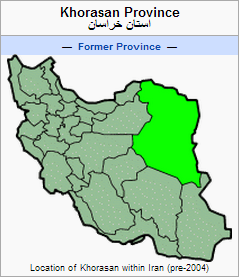
Taliban recruiters (Sunni) certainly take “Khorasan” as mentioned in some Mahdist hadith as referring to “Afghanistan” – see Ali Soufan‘s book, The Black Banners – but an Iranian would read “Khorasan” as referencing the region of that name in Iran, or perhaps a wider zone that includes it, but also encompasses portions of Afghanistan and other neighboring states – it was, after all, the name of Iran’s largest province until divided in three parts, North, South and Razavi Khorasan in 2004:

Interestingly too, the hadith traditions in question are considered likely to have been written by and for the Abbasids. David Cook, for instance, in his magisterial Contemporary Islamic Apocalyptic Literature writes of Khorasan (p. 173.):

The ‘Abbasids sought to present their movement as the fulfillment of messianic expectations, and so they produced a great quantity of materials given in the form of hadith traditions to indicate that the Mahdi would come from this region.

— not that scholarship of this kind is liable to influence popular apocalyptic sentiment…

**

Okay, so with a little creative forgiveness, we can read that first passage of Kahlili’s as saying that within the hadith can be found signs such mentions of Afghanistan / Khorasan, bloodshed in Iraq, and economic woes. But then we read this (p. 337.):

With the eyes of the world on them, the mullahs and the thugs who took orders from them fought mercilessly to hold on to the power that had never been their right, using extreme force to deny that their time was over. In their minds, Mahdi was coming and the blood they shed now was yet another hadith.

C’mon, now, has Kahlili even read his own book? Blood shed equals hadith?

The most charitable thing I can find to say is that Reza Kahlili may or may not have been some level of CIA source, but his credibility in matters involving any aspect of Iranian theology is utterly unconvincing.

**

Jeff Stern, in a WaPo piece from 2010, doesn’t sound any too convinced that Kahlili is worth our trust in other matters either, writing:

Reza Kahlili, a self-proclaimed former CIA “double agent” inside Iran’s Revolutionary Guards, appeared in disguise at a Washington think tank Friday claiming that Iran has developed weapons-grade uranium and missiles ready to carry nuclear warheads.

The pseudonymous Kahlili, whose previous accounts have been greeted with widespread skepticism, also said Iran was planning nuclear suicide bombings with “a thousand suitcase bombs spread around Europe and the U.S..

and:

Several current and former U.S. intelligence officials in the audience “rolled their eyes” at Kahlili’s claims, said one observer who was present.

Some in attendance compared Kahlili with Ahmed Chalabi, the former Iraqi exile who helped convince the George W. Bush administration that Iraqi leader Saddam Hussein had weapons of mass destruction. After the U.S.-led invasion of Iraq, the claims were proved false.

My personal knowledge-map features huge areas of ignorance where many others have strong opinions. On matters religious, Kahlili is not to be believed. On the siting of nuclear labs, or weapons development and deployment, we’re in areas that bear the legend “Here there be Smoke and Mirrors” on my map.

Thus endeth my blog-epistle to Pundita, whose knowledge of many of the other moving parts in the wider geopolitical situation far exceeds my own.

**

I’ll follow up with part II of this essay, in which I’ll talk a bit about Glenn Beck and Joel Rosenberg, and some other significant ways in which Shi’ite eschatology is being misrepresented via popular media in the west.

For those following the development of my book / media project, I am hoping the project will include a section of longer essays such as this one, in which I pull apart some of the myths currently surrounding western understanding of Islam, while pulling together major strands of a more nuanced view.

Cherry-picking or cherry-sorting?

Saturday, October 13th, 2012

[ by Charles Cameron — continuing discussion with Prof Kohen re Rushdoony, dominionism, and cherry picking of Torah laws for US implementation ]
.

Prof. Ari Kohen at Running Chicken responded to a comment of mine about Fuqua and Rushdoony, suggesting he’s cherry picking which Old Testament / Torah laws he would like to see brought into US law:

I’ll admit I don’t know anything at all about Rushdoony, but I use cherry-picking because my sense is that people like Fuqua aren’t really concerned with all of the laws in the Torah and that, in fact, they don’t follow most of them. Instead, they gravitate toward the ones that speak to their own (political) positions and then use the Torah as “back up.” Do you think, for example, that Fuqua cares about shatnes or kashrut? If not, why not? If so, what makes you think that he does? Also, what makes you think that Fuqua is connected to Rushdoony? Is there some evidence for the connection?

This sent me digging — I don’t know nearly as much as I’d like about Rushdoony and his influence on the Christian Right — and since my response was was too long to go in Running Chicken’s comment box, I thought I’d post it here.

**

Ari, if you’ll permit me to greet you thus, many thanks for your care in encouraging me to tease out the subtleties.

**

First, let me say that while I cannot say for certain that Fuqua is connected to Rushdoony, the latter’s impact on strands of modern evangelical thinking has been considerable, both overtly and covertly, by affiliation and more loosely by influence. He is generally considered the father of the Dominionist movement, sometimes termed Theonomy or Christian Reconstructionism, and Frederick Clarkson’s coverage of the movement for the progressive Political Research Associates magazine, Public Eye, characterizes it as a “stealth theology”:

A key, if not exclusively Reconstructionist, doctrine uniting many evangelicals is the “dominion mandate,” also called the “cultural mandate.” This concept derives from the Book of Genesis and God’s direction to “subdue” the earth and exercise “dominion” over it. While much of Reconstructionism, as one observer put it, “dies the death of a thousand qualifications,” the commitment to dominion is the theological principle that serves as the uniting force of Christian Right extremism, while people debate the particulars.
.
Christian Reconstructionism is a stealth theology, spreading its influence throughout the Religious Right. Its analysis of America as a Christian nation and the security of complete control implied in the concept of dominion is understandably appealing to many conservative Christians. Its apocalyptic vision of rule by Biblical Law is a mandate for political involvement. Organizations such as COR and the Rutherford Institute provide political guidance and act as vehicles for growing political aspirations.

In A Covert Kingdom, Part Four of his article, Clarkson writes:

Gary North proposed stealth tactics more than a decade ago in The Journal of Christian Reconstruction (1981), urging “infiltration” of government to help “smooth the transition to Christian political leadership. . . .Christians must begin to organize politically within the present party structure, and they must begin to infiltrate the existing institutional order.”

and:

The Christian Coalition actually proposed something similar to Gary North’s notion of “infiltration” when its 1992 “County Action Plan” for Pennsylvania advised that “You should never mention the name Christian Coalition in Republican circles.” The goal, apparently, is to facilitate becoming “directly involved in the local Republican Central Committee so that you are an insider. This way,” continues the manual, “you can get a copy of the local committee rules and a feel for who is in the current Republican Committee.” The next step is to recruit conservative Christians to occupy vacant party posts or to run against moderates who “put the Republican Party ahead of principle.”

**

The second issue you present me with has to do with shatnez and kashruth, and here I certainly need to be explicit in saying that there are some aspects of the Mosaic law that Rushdoony would not apply to Christians.

Brian Schwertley, who has published in Rushdoony publications, divides Jewish law into three categories: ceremonial law, now superseded in Christ; moral law, unchanging and “binding on all nations, in all ages”; and judicial, “civil laws which applied only to the nation of Israel” – though he quickly adds:

There are also civil laws which are moral case laws. These case laws are based upon the Ten Commandments and are moral in character, and as such, are binding on all nations, in all ages. Laws that reflect God’s moral character are as binding and perpetual as the Ten Commandments themselves. [ … ] The continuing validity and necessity of the civil laws is plainly seen in the case of sexual immorality.

I’d say that’s probably a widely-held breakdown, and my previous comment should have been less sweeping. To my mind, though, this is still very far from cherry-pickingcherry-sorting, perhaps?

With that under our belt, we can proceed to the issues you suggested, shatnez and kashruth specifically.

In his Institutes, p. 23, Rushdoony writes:

Men dress in diverse and strange ways to conform to the world and its styles. What is so difficult or ‘coarse’ about any conformity to God’s law, or any mode God specifies? There is nothing difficult or strange about this law, nor any thing absurd or impossible.
.
It [the wearing of fringed garments] is not observed by Christians, because it was, like circumcision, the Sabbath, and other aspects of the Mosaic form of the covenant, superseded by new signs of the covenant as renewed by Christ. The law of the covenant remains; the covenant rites and signs have been changed. But the forms of covenant signs are no less honorable, profound, and beautiful in the Mosaic form than in the Christian form. The change does not represent an evolutionary advance or a higher or lower relationship. The covenant was fulfilled in Jesus Christ; but God did not treat Moses, David, Isaiah, Hezekiah, or any of His Old Testament covenant people as lesser in His sight …

So yes, I’d have to agree that Rushdoony does not demand the fulfillment of all 613 mitzvoth, any more than most of Judaism does, if I understand correctly — but just as Judaism sees a specific subset of commandments as at least temporarily suspended in the absence of a Temple in Jerusalem, so Dominionism sees certain commandments suspended as fulfilled in Christ – with Rushdoony’s position tending to be very strict in limiting their number.

**

Kashruth is an interesting case, because here Gary North, one of the premier writers on Dominionism and Rushdoony’s son-in-law, differs from Rushdoony himself.

There’s a section titled Rushdoony on the Dietary Laws in one of Gary North’s books which addresses the issue thus:

Because of a theological division within the Christian Reconstruction movement, I need to devote a little space to Acts 10. In a vision, God announced to Peter His definitive annulment of the Mosaic dietary laws:
.
On the morrow, as they went on their journey, and drew nigh unto the city, Peter went up upon the housetop to pray about the sixth hour: And he became very hungry, and would have eaten: but while they made ready, he fell into a trance, And saw heaven opened, and a certain vessel descending unto him, as it had been a great sheet knit at the four corners, and let down to the earth: Wherein were all manner of fourfooted beasts of the earth, and wild beasts, and creeping things, and fowls of the air. And there came a voice to him, Rise, Peter; kill, and eat. But Peter said, Not so, Lord; for I have never eaten any thing that is common or unclean. And the voice spake unto him again the second time, What God hath cleansed, that call not thou common. This was done thrice: and the vessel was received up again into heaven (Acts 10:0-16).
,
Rushdoony’s comment on Acts 10 asserts, but does not prove, his opinion that the dietary laws are still in force in New Testament times. He writes: “Acts 10 is commonly cited as abolishing the old dietary restrictions. There is no reason for this opinion. . . . There is no evidence in the chapter that the vision had anything to do with diet; . . .” [ … ]
.
Rushdoony insists that the Mosaic dietary laws are still mandatory as health laws. “The various dietary laws, laws of separation, and other laws no longer mandatory as covenantal signs, are still valid and mandatory as health requirements in terms of Deuteronomy 7:12-16.”
.
It is worth noting that Rushdoony broke sharply with Calvin on this crucial covenantal point. Calvin stated emphatically in his comments on Acts 10 that anyone who today establishes distinctions among foods based on the Mosaic law has adopted a position of “sacrilegious boldness” …

**

There’s also an eschatological angle to Rushdoony’s (postmillennialist) influence and its reception in circles that also tend to favor “soon coming” / “left behind” (dispensational premillennialist pre-trib rapture) expectation — but that’s another story for another day…

Three from Haaretz on the Temple Mount

Sunday, October 7th, 2012

[ by Charles Cameron — growth and mainstreaming of Rebuild the Temple movements in Israel, parallels with perceived slights against the Prophet of Islam, volatility of the situation ]
.

You saw the New York Times headline, New Clashes at Site in Jerusalem Holy to Both Muslims and Jews? That was just a taste, here’s more of the story:
.


.

Haaretz has posted three pieces in the last couple of days about the movement to build a Third Temple on the Temple Mount / Noble Sanctuary in Jerusalem. I’ll give you the title, link and brief summaries of for the two shorter pieces, and some significant quotes from the Longer one.

**

I’d also like to suggest considering the issues here as analogues of those in the recent “blasphemy” incidents.

We might think in terms of freedom of speech being akin to freedom of worship — but we should also consider the dangers inherent in what would likely be perceived as a huge provocation, in what may be the most volatile hot-spot on earth.

Consider: building the Third Temple might involve the destruction of the Al-Aqsa Mosque, whether by an act of God or by human intervention. Whether it would or not is in dispute, as we shall see — but as we shall also see, attempts to destroy it have already been made…

Bearing that in mind..

**

1: Temple Mount Faithful: From the fringes to the mainstream

Once consigned to messianic extremist fringes, movements fighting the ban on Jewish
prayers on Temple Mount are now endorsed by moderate rabbis. Even the Education Ministry has taken sides by encouraging pupils to visit the site.

If that’s accurate, it’s a significant shift in relation to what my American-Israeli journalist friend Gershom Gorenberg called in his book about the Mount, The End of Days, “the most contested piece of real-estate on earth” — for a quick overview of the importance of the site, see my piece of that name from July of this year.

**

2: Jerusalem Magistrate’s Court: Jews should be allowed to pray on Temple Mount

Police currently enforce the Muslim ban on Jewish prayer at the site, citing security concerns.

Put those two pieces together, and you have a sense of momentum gathering for an epic clash, one which would have immense apocalyptic significance in terms of those eagerly awaiting a Coming One in each of the three Abrahamic traditions

**

3: Following the dream of a Third Temple in Jerusalem

More than 90 percent of Israel’s religious public wants to be allowed to pray at the Temple Mount in Jerusalem. Some groups, though, wish to go even further and build a Third Temple in place of the Al-Aqsa Mosque. What fuels the dreams of these Jewish extremists?

Shany Littman, the author of this impressive magazine-length piece which is behind a paywall on the Haaretz site but has been reposted here, expresses through the voices of a diverse group of people she met and talked with, the deep-seated longing behind the movement —

I pray for it three times a day and I wanted to take seriously what I say. I say, ‘Next year in rebuilt Jerusalem.’

and the theological logic behind that —

It is the heart of Judaism. Numerically, one-third of the 613 commandments are not fulfilled today because of the absence of a Temple. The Temple is the Jewish public sphere that we lost. I want a transnational Judaism, which will encompass all the commandments.

the sacred politics —

I want to take the movements to a place that is more sensible: a Temple-based state, where the state’s entire content revolves around the Temple.

the somewhat archaic-sounding motivations involved —

the fulfillment of the three commandments the Israelite nation was given in anticipation of its imminent entry into the Land of Israel: to appoint their king and establish his kingdom, to wipe out the seed of Amalek and to build their Holy Temple.

the progress that has already been made in terms of preparation —

only two vessels that are not yet ready are the Ark of the Covenant, which cannot be reconstructed because it contained the stone tablets from Mount Sinai, and the huge external altar, on which the sacrifices were performed.

and recent trends on the part of Israeli police and politicians that seem to show an increasing willingness to allow Jews to pray in what is, after all, their holiest of holy places.

**

I have been pondering these things, and I think we can helpfully, if carefully, draw a parallel between the extreme caution with which the Israelis have approached the issue of the potential for Jewish behavior — up to and including the possible removal of the Al-Aqsa Mosque and or Dome of the Rock — enraging not just Jerusalem’s Palestinians but the Islamic world, and the far smaller provocations of Charlie Hebdo, the puerile video, and the Qur’an-burning Revd. Jones.

Consider the rules and regulations invoked by the Israeli poloice on Jewish visitors to the Mount (compare also the rabbinic decree in the “traffic sign” at the top of this post):

Because this was the month of Ramadan, no food or drink was to be brought. Also forbidden were praying, bowing, kneeling, singing and anything that might disturb the public order. And have a good day.

Prayer is banned — have I heard that phrase somewhere before?

Prayer is banned because it would be blasphemous — the ironies, the echoes, the resonances and paradoxes here are endless.

**

To understand the depth of feeling here — and remember, we are only examining the Judaic side of the issue here, and there are other perspectives in play — let’s peer a little deeper into the sacred / sacral motivation:

Sacrifice, not a very “contemporary” word but one with strong, archaic / archetypal meaning, is the heart of the Temple’s purpose:

Animal sacrifice was the primary ritual activity in the Temple. Rivka spoke of the practice yearningly. “Today it is hard to understand what sacrifice is,” she said. “When a person errs, makes a mistake, sins ? instead of bringing himself, he brings a substitute; he brings either an offering or an animal whose blood atones for his soul. This is something we have lost today. The media always talks about korbanot [the Hebrew word “korban” means both “sacrifice” and “victim”] ? victims of traffic accidents, victims of the peace process, victims of terrorism. And I say to myself, despairingly, that there is a place for korbanot ? and it is here. And what is the root of the word ‘korban’? It is from lehitkarev, to draw closer. To draw closer to Hashem.

Indeed, the sacrifice of a red heifer is widely believed to be necessary to purify those who would enter the Temple grounds — note in this next paragraph the reference to the return of the Messiah:

According to religious belief, until the ashes of a red heifer are obtained, access to the courtyard of the Temple is prohibited for Jews (see Numbers 19:1-22 and Mishna tractate Parah). Water mixed with the ashes of a red heifer can cleanse people of the impurity of the dead, which clings to everyone. Tradition holds that there have been only nine ritually suitable red heifers, and that the 10th will appear upon the advent of the Messiah. The absence of the ashes of a red heifer, with the concomitant inability to become ritually clean, is one of the reasons that many Jews are unwilling to visit the Temple Mount. However, the Temple movement activists claim this is only an excuse, and that there is no problem obtaining a red heifer today.

**

Now back to “on the ground” realities — and risks, including the risks of terrorism and war.

This situation of contesting claims to one of the world’s most sacred sites the has been simmering for quite some time, and I think the gist of the three Haaretz articles could be read as “the stew’s beginning the bubble”.

For another glimpse of the potential volatility of the situation, we can turn to a decade-old piece by Jeffrey Goldberg in the NYT — though if the situation is as significant as I take it to be, you’d also be well-advised to read Gershom Gorenberg’s book The End of Days.

Back in 1999, Goldberg wrote a piece which carried the sub-head:

There are Jews who want to seize the Temple Mount by any means necessary. And Christians who want to see the Jewish Temple rebuilt — and destroyed to bring on Armageddon. And Muslims who will never give up the Dome of the Rock. Will the peace process be stalled by the apocalypse?

It’s a long magazine piece, and like Littman’s piece for Haaretz, well worth pondering. Here I’ll just pull a couple of excerpts that touch on how Temple movement participants view the possible repercussions of their actions. Gershon Salomon is the leader of one such movement, and not infrequently raises funds addressing Christian audiences.

“The mountain is within reach,” Salomon told me. “God is waiting for us to move the mosques and rebuild. The Jews may not be ready, but the Christians are.”

In Casselbery, I saw Salomon work the Christian congregants into a flag-waving — Israeli flag waving — frenzy. After, as the congregants lined up to give Salomon checks and even their jewelry to pay for rebuilding the Temple, I asked him, “Do you think these people believe that God will remove the Dome of the Rock, or that man must remove it?”
He smiled beatifically.
“They know that God will make this miracle happen.”
By the hand of man?
“Only God knows.”

[ … ]

I ask him how he would feel if someone blew up the Dome of the Rock.
“The question is, Why did they build their mosque on our holy mountain, anyway? Who gave them permission? God didn’t.”
Would you be saddened if the destruction of the Dome of the Rock led to war?
“I don’t think it will come to that. The Muslims know in their heart that this belongs to us.”
“But what if it did lead to war?”
Salomon smiled. “The Temple will be a reality. God has promised it.”
But what about war?
“O.K.,” he said impatiently, “so we’ll have a war.”

Returning to the Haaretz magazine piece, we can perhaps temper that last remark with a word of moderation.

Journalist Arnon Segal is the activist son of a member of the Jewish Underground of the 1980s — one of whose leaders, Yehuda Etzion, plotted to blow up the Dome of the Rock. His views are accordingly of considerable interest.

Contrary to the usual image of those who are involved with the Temple, they are a great deal more soul-searching and hesitant than people think. People did not want to join with Yehuda Etzion, who was the one who raised the idea [of blowing up the mosque].

“I think it is nonsensical to blow up [Al-Aqsa Mosque]. We would not have achieved anything by doing that. That is not how to solve issues. The Arabs are against the Jewish presence on the Temple Mount as such. If the State of Israel were to permit sacrifices to be made, that would already be enough to make me jump for joy. Obviously my inspiration is from home, but not from a fanatic place. I was not brought up to hate Arabs. But an as-yet unattained Jewish national purpose and the concept of the Temple Mount? those are definitely notions I got at home.”

Segal insists that the debate over the Temple Mount is basically an internal Jewish issue and is not related to the conflict with the Arabs. “I am not an enemy of the Arabs. I do not say that I don’t want Arabs on the Mount. Even Rabbi Dov Lior said that all nations are permitted to pray on the Mount. We will not tell others not to pray to God on the Mount, even though the Muslims do not respect our right to pray there. I am ready to leave them Al-Aqsa. But Al-Aqsa is not the whole Mount.”

And here is Segal’s pragmatic evaluation of the risk:

I don’t think the Arab states are lovers of Zion, even now; if they could destroy us, they would already have done it. The Temple Mount will not irk them more than other things.

Would you want to test that hypothesis in “real life”?

Introducing the Person / Position Paradox

Saturday, October 6th, 2012

[ by Charles Cameron — ye olde war of science vs religion embodied in Rep. Paul Broun, with sundry comparisons to human rights, UN, dominionism, JFK, creeping shariah etc ]
.


.

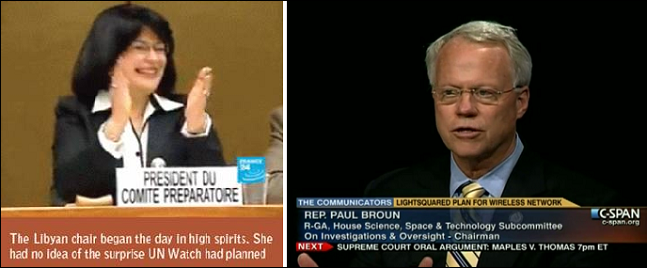
Lest we forget, Muammar Gaddafi‘s Libya, in the person of Ms. Najat Al-Hajjaji (above, left), was elected to preside over the United Nations Commission on Human Rights in 2003:

The Commission on Human Rights — meeting this morning under a new procedure two months in advance of its annual six-week session — elected Najat Al-Hajjaji of the Libyan Arab Jamahiriya as Chairperson for 2003, along with three Vice-Chairpersons and a Rapporteur.

And as recently as May 2010, still under Col. Gaddafi’s rule, Libya was elected a member of the UN Human Rights Council, and only suspended in February 2011.

Might we call this an instance of a Person / Position Paradox?

**

You know I like what I term “forms” as analytic tools — this would be another one to keep an eye out for, a particularly intriguing sub-type of the self-referential paradoxes I discussed in an earlier post.

It isn’t, of course, an analytical breakthrough for me to recognize the paradox inherent in a brutal dictatorship gaining the chair of the international Human Rights Commission at this late date: the United States protested Libya’s nomination at the time, which is why there had to be a secret ballot in the first place.

Let’s look at some of the accompanying language. Here’s Ms. Al-Hajjaji herself:

In an address following the ballot, Ms. Al-Hajjaji said among other things that the Commission must send a message that it would deal with human rights in all countries, and not just some of them; that it would take into account in its activities the world’s many different religious, cultural and historical backgrounds; and that among its tasks was to affirm the universality, indivisibility, and complementarity of human rights

Who could complain about that? And here’s the UN High Commissioner, praising the system that got her elected for its wisdom:

High Commissioner for Human Rights Sergio Vieira de Mello, also speaking briefly, reviewed his recent mission to the Democratic Republic of the Congo and to Angola, lauded the Commission’s new procedure for early election of a Bureau, and said it was important for the Commission to demonstrate that it could manage with wisdom, speed and restraint its procedural business so as to create the best possible spirit and conditions for addressing and resolving the many substantive issues on its agenda.

The lesson I learn here?

Paradoxes of this kind lead to a divergence of words from truths — in line with de la Rochefoucauld‘s maxim:

Hypocrisy is the homage vice pays to virtue.

**

Now comes the potentially contentious part.

Rep. Paul Broun MD (R-GA) (top, right), member of the US House Committee on Science, Space and Technology and chairman of the US House Science Subcommittee on Investigations and Oversight, told the Liberty Baptist Church of Hartwell, Georgia’s Sportsman’s Banquet last month:

God’s word is true. I’ve come to understand that. All that stuff I was taught about evolution and embryology and the Big Bang Theory, all that is lies straight from the pit of Hell. And it’s lies to try to keep me and all the folks who were taught that from understanding that they need a savior. You see, there are a lot of scientific data that I’ve found out as a scientist that actually show that this is really a young Earth. I don’t believe that the Earth’s but about 9,000 years old. I believe it was created in six days as we know them. That’s what the Bible says.

As a student of religions, I don’t find that statement particularly surprising: while the original 1611 edition of the King James Version of the Bible doesn’t include Archbishop Ussher‘s dating of the creation to 4004 BC, many versions of the KJV since 1701 have done so, the wildly popular “dispensationalist” Scofield Reference Bible, first published in 1909, does so… and Broun is being somewhat generous in allowing for the passage of 9,000 years since creation, where others might see the earth as entering the seventh (Sabbath) day (or millennium) about now…

As a religious belief, then, this is one of many attempts to fit chronology to scripture. I recall from my days studying the religious impact of millennial rollover (“Y2K”) concerns that one Rabbi Pinchas Winston claimed the year 2,000 (5760 in the Jewish calendar) would be a year of purification:

The secret regarding this is that, at the end of the year 5760 from creation, the verse, ‘I [God] will remove the impure spirit from the land’ (Zechariah 13.2) will be fulfilled.

For my source and further millennial date issues in Islam, Hinduism etc, see my chapter, Y2KO to Y2OK in Cathy Gutierrez and Hillel Schwartz, eds., The End that Does: Art, Science and Millennial Accomplishment, Equinox, 2006.

Politics, though — and the politics of science and science funding at that? Here’s more of Rep. Broun’s talk, explaining how Broun’s theology affects his politics:

And what I’ve come to learn is that it’s the manufacturer’s handbook, is what I call it. It teaches us how to run our lives individually, how to run our families, how to run our churches. But it teaches us how to run all of public policy and everything in society. And that’s the reason as your congressman I hold the Holy Bible as being the major directions to me of how I vote in Washington, D.C., and I’ll continue to do that.

**

I’m afraid this reminds me all too clearly of RJ Rushdoony‘s Institutes of Biblical Law, which opens with the following words:

When Wyclif wrote of his English Bible that “This Bible is for the government of the people, by the people, and for the people,” his statement attracted no attention insofar as his emphasis on the centrality of Biblical law was concerned. That law should be God’s law was held by all…

Those are the opening words of Rushdoony’s Introduction to his magnum opus. And I know, I know, I’m cherry-picking from its 850-page first volume, but on p. 251 he writes:

The law here is humane and also unsentimental. It recognizes that some people are by nature slaves and will always be so. It both requires that they be dealt with in a godly manner and also that the slave recognize his position and accept it with grace.

Is this all just another version of “creeping” theocracy?

Compare John Hubbard, Arkansas State Rep, whose book Letters to the Editor: Confessions of a Frustrated Conservative (not on Amazon) apparently includes this choice morsel:

… the institution of slavery that the black race has long believed to be an abomination upon its people may actually have been a blessing in disguise …

**

Some possible parallels that may be worth pondering, coming at similar issues from a diversity of angles — hopefully with enough different implications to generate some questioning of easy assumptions:

Can a Catholic be POTUS (JFK, eg) without serving the every whim of a foreign Head of State? Can a Mormon be POTUS without serving the wishes of a living prophet, seer and revelator? Can a person who aspires to the highest post in a “government of the people, by the people, for the people” be relied upon if he says things like this?

There are 47 percent of the people who will vote for the president no matter what. All right, there are 47 percent who are with him, who are dependent upon government, who believe that they are victims, who believe that government has a responsibility to care for them, who believe that they are entitled to health care, to food, to housing, to you name it. … And so my job is not to worry about those people — I’ll never convince them that they should take personal responsibility and care for their lives.

And what if he then admits he was in error?

In this case, I said something that’s just completely wrong.

Is that hypocrisy (see above) — or humility? And come to that: in politics, is honesty a vice?

**

But I’m sliding from religion into politics here, unless you take the Gettysburg Address as one of the central documents — akin to a scripture — of American civil religion. Or remember it was the Bible translator John Wyclif who said those words about government of, by, and for the people first…

Religion, not politics, is my concern and my “beat” — but right now, the “Warfare of Science With Theology” (to quote the apt title of Andrew Dickson White’s celebrated 1895 book) is once again in full swing, so the question of whether Rep. Broun’s positions as a a member of the US House Committee on Science, Space and Technology and chairman of the US House Science Subcommittee on Investigations and Oversight, given his views on voting according to his reading of the Bible, is also an instance of the Person / Position Paradox?

**

It seems to me that questions such as these are of vital to many of us. The question is: are they vital to our democratic principles — or to our salvation?


Switch to our mobile site