zenpundit.com » Mahdist

Archive for the ‘Mahdist’ Category

Techno-Mahdi?

Saturday, August 4th, 2012

[ by Charles Cameron — of no practical importance, yet curious indeed, Mahdism, Pakistani history, shamanism, magic, the Kwakiutl / Tlingit, religion ]
.
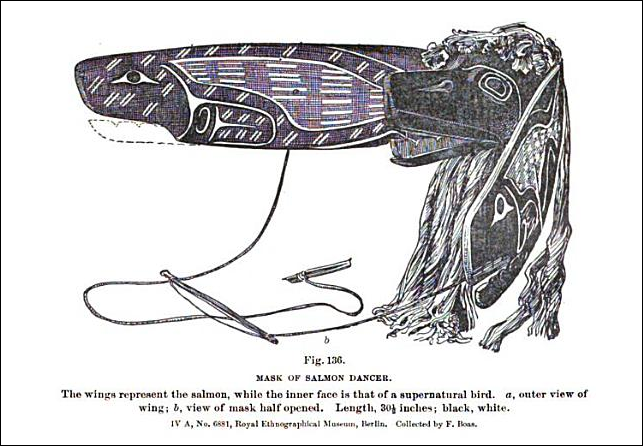
Kwakiutl Salmon Dancer's mask

.

I really don’t have much to say about this, but I’d like to note it as one more instance of Mahdism cropping up in unlikely places. And a h/t to Scott McWilliams @macengr for pointing me to the story. I can’t entirely vouch for its accuracy since I don’t have easy access to 1970s Pakistani newspapers, but I’ve seen allusions to the same story dating back a couple of years

When the Pakistani army and bureaucratic establishment realized that Mujib-ur-Rehman’s Awami League and Zulfiqar Ali Bhutto’s PPP were attracting people—with no other party able to draw even 5000 to its rallies—they imported Zohra Fona, a woman from Indonesia, pregnant with Imam Mehdi. She had visited several Islamic countries, it was propagated, where rulers had offered prayers in her Imamat [i.e. she led the prayers even if a woman is not supposed to do that].

Many Muslim intellectuals and scholars claimed through their writings and lectures that the time for Imam Mehdi’s appearance had arrived. A new Islamic world was about to emerge. During this period the Islamic parties, including Jamat-e-Islami, perpetrated violence. Members started attacking liberal and progressive professors, doctors, writers, journalists as well as their houses. They also burned many libraries and collections of books.

Zohra Fona claimed that the child in her womb recited Azaan [call for prayers] and could lead the prayers. Ulema like Maulana Okarvi and Ehtesham Ul Haque went to see Zohra Fona and listened to Azan with ears close to lady’s womb. Prayer events were arranged for her in open places as well as in the larger mosques, and the Ulema [religious scholars] were praying behind her. She would stretch her legs towards Kaaba [Mecca], directing her womb toward the pulpit. Suddenly Azaan would start coming from her womb or from another private part. The Ulema were so shameless that they were offering prayers while focusing their eyes on her private parts.

Back then the left was very organized so it was difficult to explain this farce. Finally the Pakistan Medical Association and doctors at Jinnah Hospital, Karachi decided to unearth the drama. Several lady gynecologists were asked to help; they knew that this kind of thing could not happen. But Zohra Fona was very clever. Whenever doctors were pursuing her to take a medical examination she avoided with help from the Pakistani security forces. But one day, when she was unable to escape, the doctors of Jinnah hospital, Karachi conducted an examination. The doctors recovered a small tape recorder from her womb.

Does the bit about the tape-recorder in the womb sound a bit far-fetched? Here’s another version, this one from The [International] News:

Zohra Fona, a blessed Indonesian woman, arrived in Pakistan just ahead its first general elections. She was said to be expecting a child who would be Imam Mehdi. She had visited several Islamic countries where, and it was propagated, that rulers had offered prayers in her imamat. Many ulema began to claim that the time for Imam Mehdi’s coming had arrived.

Zohra Fona claimed that the child recited Azaan. Reputed ulema like Maulana Okarvi and Ehteshamul Haque met Zohra Fona and listened to the Azaan with ears close to the lady’s stomach. She began to draw huge crowds to mosques and parks where she led prayers. Our reputed ulema would join the prayers.

Woe betide this country! Some leftist and agnostics at Karachi’s Jinnah Hospital decided to put the legend to scientific test. It was revealed that the holy woman was not even pregnant with an Azan-reciting messiah but had a recording device tied to her body. She immediately left for Indonesia once the farce was exposed.

That sounds more plausible.

**

A word of caution here.

Just as theater and film sometimes deploy “deux ex machina” interventions to immerse their audiences more deeply into their created micro-worlds, so have shamanic performances.

I’ve written about this before in an email to a religious scholars’ list, and in these days when even self-plagiarism is disdained, I am going to repeat here what I wrote then, with very minor changes:

It’s my recollection that [Tlingit / Kwakiutl winter ceremonials] were both entertainment for the long winter nights and “schooling” for the young, and I have a vivid recall of reading somewhere a shaman’s admission to an anthro of the exact nature of the dramatic means by which the shaman’s capacity to defeat death was demonstrated.

I read this in the early eighties, but searching on the web I’ve found something that comes close — Clellan Stearns Ford’s record of Charles James Nowell’s memories in _Smoke from their fires: the life of a Kwakiutl chief_. Around p 120, there are two stories, the first about a girl who “turned the wrong way” during a dance, the second about a girl who is put in a box and burned. In both cases, the nature of the trickery is described but in the version I read all those years ago, the two stories were one — the girl who was put in a box in the fire pit and “burned to death” escapes through a false bottom to the box along a tunnel into the adjoining room, and her voice then issues as if from her ashes, via a kelp tube that goes from the tunnel to the adjoining room where she’s now standing.

She describes her descent into the sea realm, where she is chastened and eventually granted a boon to return to the tribe. A canoe sets out to fetch her, but by the time the audience sees it set out, she’s already secured by rope to the far side of the boat, and at a suitable distance is hauled aboard and brought back to shore, alive.

A child seeing this would be mightily predisposed to believing the shaman had healing powers, and by the time the ruse was revealed, that underpinning of faith is already in place.

In the Nowell version, even the adults, who “know” the deception involved, are deceived: “The fire burned and the box burned, and she was still singing inside, and then the box go up in flames, and they can see her burning there in her blue blanket, and all her relatives just cry and cry. Although they know it is not real, it looks so real they can’t help it. It was all a trick. There was a hole under the box with a tunnel leading out of the house, and the woman went out of the box and put a seal in her place wrapped in a blue blanket, and then someone sang into the fire through a kelp tube, her song. Oh, it looked real!”

The Winter ceremonials of the Pacific Northwestern tribes are by turns opera, history, religion and “general education” to the children of the tribe, and “continuing education” to their elders…

Do we have anything to equal them?

Bearing such things in mind, we may want to consider trickery — a quality of the trickster gods, after all, in many mythologies — a not entirely illegitimate activity for a religious performer…

A digital Mahdi? No way…

Tuesday, July 17th, 2012

[ by Charles Cameron — a computer virus with mild Mahdist implications ]
.

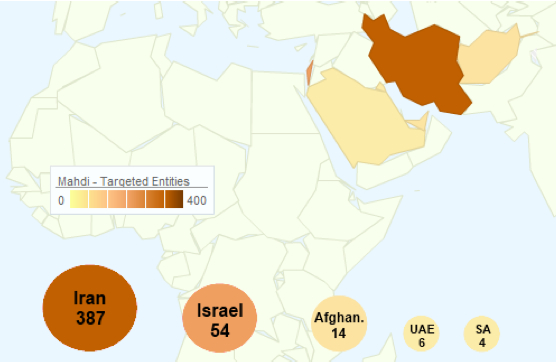
Mahdi: targeted entities, credit: Seculert via Wired

.

Ah. From a religious studies standpoint, the targeting here is curious.

Iran is the country of the Mahdaviat, the nation whose President, wreathed in light, prays at the United Nationsfor the soon coming of the Promised One, that perfect and pure human being, the one that will fill this world with justice and peace, the Mahdi.

**

My own concern is not with the virus, but with the religious connotations of the name that has been given to it.

For those whose concern is with the virus itself, I’d suggest the Wired article, although if blog-friends involved in computer security would like to offer further pointers, I’m sure our readers would welcome them.

**

In case you were wondering, here are the key paras regarding the implications as I see them, from the Jerusalem Post:

Seculert and Kaspersky dubbed the campaign Mahdi, a term referring to the prophesied redeemer of Islam, because evidence suggests the attackers used a folder with that name as they developed the software to run the project.

They also included a text file named mahdi.txt in the malicious software that infected target computers.

and from the Wired coverage:

The infections in Iran and Israel, along with the Farsi strings, suggest the malware may be the product of Iran, used to spy primarily on domestic targets but also on targets in Israel and a handful of surrounding countries. But the malware could also be a product of Israel or another country that’s simply been salted with Farsi strings in order to point the finger at Tehran.

**

So we really can’t tell if it’s the Mahdi (Islam’s awaited one) or the Dajjal (Islam’s antichrist figure)?

**

Here, for your edification, is the potrait of the Dajjal from the cover of Okasha Abdelmannan al-Tibi’s The Whole Truth about the Antichrist (courtesy of JP Filiu):

image credit: J-P Filiu, Apocalypse in Islam

According to the tradition as narrated by ‘Abdullah bin ‘Umar, the Prophet said:

I turned my face to see another man with a huge body, red complexion and curly hair and blind in one eye. His eye looked like a protruding out grape. They said (to me), He is Ad-Dajjal.

And here is a portrait of the Mahdi, the “Birth of Hope” — insofar as the artist Mahmoud Farshchian feels able to depict him:

image credit: Mahmoud Farshchian

**

While it’s pretty clear that neither Mahdi or Dajjal could be a computer virus, it also seems likely that the virus is associated, either mockingly or sympathetically, with the Mahdi — an indicator, if nothing else, that this end-times figure once little known outside Shi’ite Islam has by now become part of a wider “universe of discourse” and general conversation.

Mahdi has arrived among the geeks.

Byzantium, Constantinople, Istanbul

Sunday, July 8th, 2012

[ by Charles Cameron — different styles of online communication, main topic: Istanbul in three Islamic videos ]
.

There’s passionate and visceral communication, and there’s communication that’s more scholarly, dispassionate and calm. Let’s begin and end with calm.

**

Visceral communication is essential for getting people out of a theater on fire, but a 30% application of scholarly distance and calm may be prerequisite for avoiding panic — and scholarly communication may be important for conveying in detail the high-dimensionality of a complex topic, but a drop of visceral may ease the salient points into more general circulation.

In an earlier, text heavy post — Damascus, Dearborn, Rome, Vienna? — I belabored you with details as to just how much ambiguity and fog surrounds the use of place names in scriptural and prophetic contexts. Here I’d like to give you a visceral sense of what some prophetic voices are doing with those place names.

One of the easiest ways to move from scholarly to visceral is to switch from text quotation to video clip, so that’s what I’ll do here — but my first video clip will be relatively calm and scholarly as video clips go, the next one more visceral and exhortatory, while the third and final clip will use all the tricks of the feature movie trade to provide a Tolkien-heroic account of the Muslim siege and taking of then-Christian Constantinople in 1453.

**

First, a very short clip from Adnan Oktar, aka Harun Yahya, widely known in the Islamic world for his lavishly illustrated books, CDs and DVDs presenting an Islamic version of creationism, the Mahdist end times — which he sees as entirely peaceable — and more besides.

In this clip, he’s talking about Istanbul, and he means that very city, even if it has sometimes been called Byzantium or Constantinople — or even on occasion, Rome.
.

**

My second clip is far longer, and presents an interview with Sheikh Imran Nazar Hosein, Islamic scholar, sometime Trinidadian diplomat and sometimes fiery YouTube preacher, whom I have quoted previously in Al-Awlaki and the former and latter rains and elsewhere.

Hosein discusses the prophecies of the conquest of Constantinople by Muslim forces as part of the background for a grand sweep overview of what he terms the first and second Arab Springs — which he locates a century apart and views as both engineered by an Anglo-American alliance to advance a Zionist agenda — and contemporary events in Bahrain, Saudi, Syria, Iran, Israel, and Russia:
.

.

It’s an hour-long interview, perhaps you didn’t watch the whole way through. Hosein concludes this interview, centered in Islamic prophecy about Constantinople, with a Saudi-American alliance facing off against an Iranian-Russian alliance in service to very long term Zionist interests, making the video a window not only on the Sheikh’s own worldview but also on how widely perceptions of the world situation can diverge:

I want the viewing audience to know that a situation is evolving in the world before our eyes, and we must understand it, that the two major powers in the world are now moving in a collision course, that collision course between these two major powers, the American-led alliance and the Russian-led alliance, is going to lead to nuclear warfare of such a magnitude that there is only one word that we can look for in the vocabulary to fit it, and that’s called Armageddon, that is, millions and millions and millions are going to die, most of them probably in North America and Europe, Europe of the East and Europe of the West — and what is left of the world after that, the Zionists hope that they can cope with it, and they can somehow survive and come out on top and Israel will rule the world, the rump that is left after the two giants engage in a war of mutual destruction, That is what we are facing now…

Is that what you thought scholarly Islamists were thinking? By what paths did a highly educated and world traveled man come to that conclusion?

**

My third clip speaks for itself. It is a trailer for an upcoming motion picture about the siege of Constantinople, presented as heroic spectacle with improbable but striking feats of arms, beautiful but not excessively modestly dressed women, obligatory mass choruses of Allahu Akbar, and at least one reference to the Antichrist.
.

.

I can’t wait to see it — but I expect to do so with mixed emotions. Perhaps they will stir up a decent blog post or two.

What emotions will they stir in those who identify with the heroic Mehmet II, and how much of an echo will those emotions find in the world around us? Long shot — any Turkey-NATO impact?

**

To return to a calmer clime:


.

Byzantium, Constantinople, Istanbul. I have prayed in the Sultan Ahmed — click image above to glimpse its beauty — I have relaxed deliciously at a nearby hammam.

The history of Istanbul could be the rich study of many lifetimes, its promise — for better or worse or a little of both — may have been variously prophesied or predicted, but remains to be seen.

Not Morsi but Mahdi

Tuesday, June 26th, 2012

[ by Charles Cameron — Egyptian presidency, Mahdist candidate, Center for Millennial Studies, Christ candidate ]
.


Source.
.

I ran across this reasonably remarkable web image while following a link from the tail end of Tim Furnish‘s comments on the Egyptian presidential election, and can’t really comment on the candidate himself, either as Mahdi-claimant or as (failed) aspirant to the Presidency.

I am, however, put in mind of my days with the Center for Millennial Studies at Boston University, and a fellow I met at one of their conferences there called Chris King. But I’ll let another friend of mine from those days make the introduction — here’s Damian Thompson, writing in the Daily Telegraph a while back:

I spent the evening of December 31, 1999, climbing up the Mount of Olives, only to be confronted by a wild-haired messiah figure in a patchwork robe walking down the slope. That was surprising enough, but my jaw really dropped open when he said: “Hi, Damian.” Turned out we’d met a few weeks earlier, at a conference organised by the Center for Millennial Studies in Boston. The “messiah” was a Kiwi maths lecturer called Chris King, which he explained also meant “Christ the King”, though only in a complex esoteric way. (He was a lovely guy, actually.)

Chris King was, as Damian reports, both a likeable guy and an academic, and what I found most appealing about his self-presentation — beyond the very fact of his turning up to attend a conference on Millennial Studies — was that his view, essentially a gnostic one, was that we are all Christs in potentia, if we would but realize it… wait for it…

and his consequent request that his claim to messianic status should be peer-reviewed!

Video clips II: Egyptian roulette and the Apocalypse

Saturday, June 16th, 2012

[ by Charles Cameron — fear, hope, the Egyptian military, the Supreme Court, the Muslim Brotherhood, certainty and roulette ]
.

The Apocalypse is a trump card — the Final Trump card if you will.

And because we so often associate “apocalyptic” with devastation and “post-apocalyptic” with a glowing nuclear waste-land, I’d like to establish first the joyous feelings the word “apocalypse” can also evoke. From Handel‘s Messiah, then, the glorious sound of the apocalyptic trumpet:

*

That sounds pretty terrific, granted, but as we all know, apocalypse also has a darker side — in fact it is a two-sided business, offering both maximal terror and optimal hope.

On the one hand, as Yeats puts it:

Things fall apart; the centre cannot hold;
Mere anarchy is loosed upon the world,
The blood-dimmed tide is loosed, and everywhere
The ceremony of innocence is drowned;
The best lack all conviction, while the worst
Are full of passionate intensity.

While on the other, as John of Patmos says, “I John saw the holy city, new Jerusalem, coming down from God out of heaven, prepared as a bride adorned for her husband.”

Utmost disintegration and devastation — and the immaculate hope of a new heaven and a new earth.

*

As we watch events unfolding in Egypt, then, there are some specifically apocalyptic themes in the air, both on the Egyptian Islamic side…

… where a vision-swept crowd can chant for the triumph of Islam in Jerusalem … and on the Christian side, where an apocalyptic writer such as Joel Richardson can use that same clip to reinforce a message of the lateness of the hour from the other side of the apocalyptic coin:

*

We can, it seems to me, react to the clip of the TV preacher Safwat Hijazi in at least four ways — with jubilation, as the crowd in the video does; with quiet satisfaction, as the politicians of the MB who stand to gain from his support presumably do; with fear, as those of us roused by the video to a vision of the Middle East plunging headlong, unavoidably, into war are likely to do; or with concern — a more temperate approach, and one that await further details, further indicators, further events unfolding.

I don’t think it’s time, yet, to place any bets. Dr. Hegazi’s statement, and the crowd’s response, certainly concern me. The motif of a victorious march of Islam to retake Jerusalem is and end times motif, and I can think of few things more terrifying than a Mahdist army on the march.

But we are not there yet, Dr Hegazi is articulating a dream, not a party political program. And between that dream — a powerful one, to which many Egyptians are clearly susceptible — and its realization we have the moderating factors of realpolitik, of the Supreme Court rulings just a day or two ago — and of the power and entrenched financial interests of the Egyptian military.

In watching the video of Dr Hegazi it is possible to forget all this and be swept up by fear, just as the crowd was swept up by hope of conquest.

And as I’ve said before, I take comfort also in the fact that Joel Richardson is at pains not only to argue, from his own perspective, for the conversion of Muslims — but also to renounce the use of explicitly Christian force until that Trumpet sounds:

I explained to my host that unless a supernatural man bursts forth from the sky in glory, there is absolutely nothing that the world needs to worry about with regard to Christian end-time beliefs. Christians are called to passively await their defender. They are not attempting to usher in His return. Muslims, on the other hand, are actively pursuing the day when their militaristic leader comes to lead them on into victory. Many believe that they can usher in his coming.

*

From my point of view, then, we should be cautious, informed and deliberative. This is not the time to be leaping to conclusions.

I am no expert on Egypt. What I am attempting here is to be aware of the apocalyptic current that was stirring in that Egyptian crowd — and of the apocalyptic currents stirring here, also, in the United States — with calm, with moderation, with an eye to the other influences, some of them both powerful and entrenched, which will themselves tend to divert, moderate, arouse or inflame the situation.

The Supreme Court. The election and whatever comes of it in terms of both power and backlash. The Supreme Council of the Armed Forces. American dollars. Israeli nukes. The inevitable ebbing away at some point of heightened emotions. The economics of tourism…

The unknowns…


Switch to our mobile site