zenpundit.com » Israel

Archive for the ‘Israel’ Category

Joyner and the coup

Thursday, January 16th, 2014

[ by Charles Cameron — a bit disconcerted by what I see looming in the futuristic mist — your view may of course differ ]
.

Okay, let’s begin this little tour with a recent news flash, to keep us grounded. This comes to you from Indiana:

Indiana guardsman stopped for speeding in Madison County had 48 bombs, prosecutor says

An Indiana National Guardsman was arrested outside Columbus on New Year’s Day after a state trooper found nearly 50 bombs and the blueprints for a Navy SEAL training facility inside his car, the Madison County prosecutor said yesterday.

Targeting the SEALs, hunh? Not, I’d imagine, a soft target.

**

I guess there’s something like a buzz or ripple going on, and it concerns me. It crops up in various forms in various places, in fact it’s very various indeed, and varied, and variegated too no doubt. Let’s see…

There are calls in certain circles for a coup of some kind in the US of A. Here’s the televangelist pastor Rick Joyner

One of Joyner’s closest military friends is Lt. Gen. Jerry Boykin — ex Delta Force, Mogadishu guy, also ex Deputy Under Secretary of Defense for Intelligence — seen here talking with Joyner:

**

Joyner is one of the more prominent pastors associated with C Peter Wagner‘s New Apostolic Reformation, so it’s worth noting that Wagner doesn’t limit his ambitions to “Christendom” but is working for Christian dominion over the entire world, much as certain trends in the Islamic world look for global Islamic dominion:

My favorite term is “dominion eschatology.” Why? Because Jesus did not give His Great Commission in vain.

The battle will be ferocious, and we will suffer some casualties along the way. However, we will continue to push Satan back and disciple whole nations.

We are aggressively retaking dominion, and the rate at which this is happening will soon become exponential. The day will come when “‘The kingdoms of this world have become the kingdoms of our Lord and of His Christ, and He shall reign forever and ever’” (Rev. 11:15, NKJV)!

So that’s one part of the context for Messers. Joyner and Boykin, and Joyner’s thoughts about a coup — also for Boykin’s proffered scenarios for foreign policy, which I addressed in a recent post.

**

Then there are the Oathkeepers

Oath Keepers is instructing its 30,000 members nation-wide to form up special teams and sub-teams in each Oath Keepers chapter, at the town and county level, modeled loosely on the Special Forces “A Team” (Operational Detachment A ) model, and for a similar purpose: to be both a potential operational unit for community security and support during crisis, but also, as mission #1, to serve as training and leadership cadre, to assist in organizing neighborhood watches, organizing veterans halls to provide community civil defense, forming County Sheriff Posses, strengthening existing CERT, volunteer fire, search-and-rescue, reserve deputy systems, etc., and eventually to assist in forming and training town and county militias (established by official act of town and county elected representatives). We want our chapters to organize themselves as a working model that we can then take to other veterans organizations, such as the VFW, American Legion, Marine Corps League, etc. in each town and help them establish such teams within their already existing veterans halls. And likewise, to serve as a model and training cadre to help churches, neighborhood watches, and any other civic organization organize.

These guys are more about resisting government oppression than endorsing a coup, eh? — but there’s morphing potential between one and the other.

What I’m up to here, y’see, is not about presenting a coherent argument starting from a premise and arriving at a conclusion, but creating a mini-topography, manpping a landscape if you will, by identifying certain features, with the suggestion that they are somehow related.

Somehow, I said.

I am not defining the relationships, which may be quite varied, and also subject to individual interpretation. I am suggesting they may be, very likely are, all features of a common terrain — and worth considering as such.

**

Picking up on the theological side of things, we have many people, including legislators like Rep. Michelle Bachmann, who view current events at home and abroad as fulfilling one of the various “end times” scnarios now current in both Christian and Islamic circles:

People who hold such beliefs tend to take them very seriously, as sanctioned by the supreme authority — and may therefore be strongly influenced by them when making policy decisions. But is Bachmann’s eschatology right, or Netanyahu’s, or Khamenei’s perhaps? Or one of the secular eschatologies, global warming, nuclear winter, heat death of the universe?

My most recent post on the foreign side of things, A Clash of Messianisms: now let me get this straight, fits in here somewhere, too.

Policies driven by an erroneous eschatology might make an unstable situation even worse, no?

Caveat emptor.

**

Let’s move from preachers and pols to regular folks like, well, Josie the Outlaw. What does she have to say for herself — and us all?

This (above) was quite a hit with some of my liberal friends… who mostly didn’t notice the Gadsden Flag on its brief appearance…

They were in some cases less happy with this one…

**

And then of course, it has indeed been said that…

whenever any Form of Government becomes destructive of these ends, it is the Right of the People to alter or to abolish it, and to institute new Government, laying its foundation on such principles and organizing its powers in such form, as to them shall seem most likely to effect their Safety and Happiness. Prudence, indeed, will dictate that Governments long established should not be changed for light and transient causes; and accordingly all experience hath shewn that mankind are more disposed to suffer, while evils are sufferable than to right themselves by abolishing the forms to which they are accustomed. But when a long train of abuses and usurpations, pursuing invariably the same Object evinces a design to reduce them under absolute Despotism, it is their right, it is their duty, to throw off such Government, and to provide new Guards for their future security…

The question then arising of how much prudence — prudence, the virtue — is in evidence in this day and age?

**

This is where I should really soar, with a short yet powerful invocation af all those virtues one might wish for. We’ve almost forgotten their names. Humility? Is that something to do with humiliation? Sure sounds like it. Prudence? I think I have a great aunt Pru…

Joyner and Boykin — if you believe we’re in the end times, then wait up — no need to go all guns and MRE on us — fast and pray, will you please, and wait for the new heaven and the new earth?

And the rest of you — call your great aunt, we need her STAT!!

A Clash of Messianisms: now let me get this straight

Wednesday, January 15th, 2014

[ by Charles Cameron — slightly tongue-in-cheek, intrigued at a rhetorical level, not sure who here, if anyone, necessarily believes the words they speak ]
.

Okay, let’s see now.

  • In December 2009, Israeli PM Netanyahu said, “You don’t want a messianic apocalyptic cult controlling atomic bombs. When the wide-eyed believer gets hold of the reins of power and the weapons of mass death, then the entire world should start worrying, and that is what is happening in Iran.” 
  • In April 2012, former Israeli Shin Bet intelligence chief Yuval Diskin, said “I don’t believe in either the prime minister (Netanyahu) or the defense minister (Barak). I don’t believe in a leadership that makes decisions based on messianic feelings…” 
  • In October 2013, Israeli PM Netanyahu told the UN General Assembly, “In our time the Biblical prophecies are being realized.” 
  • In January 2014, Israeli Defense Minister Moshe Yaalon is quoted as calling Kerry “obsessive” and “messianic”.
  •  

    **

    I told you messianism was a big deal. Now will you listen?

    At the very least, it’s heating up the rhetoric of the the quest for peace…

    So how many “wide-eyed believers” have gotten hold of “the reins of power and the weapons of mass death” at last count?

    **

    I coulda made at least two DoubleQuotes out of that little lot.

Brilliant use of “DoubleQuote in the Wild” images!

Thursday, January 2nd, 2014

[ by Charles Cameron — a succinct and powerful double photo display, excellent for teaching critical thinking ]
.


.
Seeing is believing, no?

**

Hat tip: Tim Mathews.

Furnish: the Dome of the Rock or the Iron Dome?

Monday, December 16th, 2013

[ by Charles Cameron — introducing a significant post by Tim Furnish re Israel’s safety, Iran and more ]
.

The Dome of the Rock in Jerusalem (Picturesque Palestine, 1881, left) and the Israeli Iron Dome missile defence system (contemporary, right)

.

Our occasional guest-blogger and friend Dr Timothy Furnish has a new post up at his MahdiWatch blog that I’d like to bring to your attention.

Here’s his closing paragraph, containing (a) an observation comparing the “end times” significance of Syria and Jerusalem vs Mecca and Medina, (b) a corresponding hint to security analysts, and (c) the implication that Iranian nukes would likely not be used against Jerusalem, since the Noble Sanctuary / Temple Mount with its two great mosques is altogether too important in Islamic eschatological terms to be put at risk…

Muslim eschatological fervor is boiling over in nearby Syria, as I analyzed on this site in September, 2013. The extent to which Muslims in Israel are aware of, and inflamed by, this is unknown; what is known is that Damascus and Jersualem are much more prominent in Islamic traditions (both Sunni and Shi`i) about the coming of the Mahdi and the subsequent eschatological events than are Mecca and Medina. Therefore, it would behoove Western geopolitical and intelligence analysts—both in and out of government—to put some effort into studying this topic, rather than relegating it to the theater of the absurd or myopically obsessing over what Evangelical Christians think about the end of the world. I would also add that the historical eschatological significance of Jersualem to Muslims is a major argument against the thesis that the Iranian regime wants nuclear weapons in order to destroy Israel (I have already argued at length elsewhere that this charge little accords with Twelver Shi`i doctrines): Islam’s third-holiest site is that religion’s most important eschatological locale, and no one is more respectful of such traditions than the ayatollahs in Qom and Tehran. Thus, if al-Quds is nuked or even contaminated with fall-out from a bomb on Tel Aviv, the Mahdi and Allah will not only be displeased but unable to stage the eschatological denouement. The presence of the Domes of the Rock and Chain in Jerusalem is thus, in my studied opinion, an even greater deterrent to Islamic nuclear attack on that city than is Israel’s more prosaic Iron Dome anti-missile system.

To read the whole thing, go to Domes of the Rock and Chain v. A Dome of Iron: Which Best Protects Israel from Islamic Attack?

Clever title, that — and a must-read post.

**

As a mild reinforcement to Tim Furnish’s point, I’m going to drop in here a part of an earlier ZP post of mine, including two quotes on the close kinship between the Kaaba in Mecca and the Dome of the Rock in Jerusalem, as constituting in some sense the book-ends both of world history and of the history of Islam considered as the final revelation.

**

As I’ve noted before, al-Aqsa isn’t just the focal point of the Palestinian / Israeli question, nor it is only the place at which the Prophet alighted from his steed, Buraq, and ascended to receive the divine instructions for prayer in the Miraj — it is also the destination of the Mahdi‘s victorious army in the Khorasan strand of ahadith.

Indeed, it has been suggested that the Pierced Rock of the Dome of the Rock in al-Aqsa is closely related to the Black Stone of the Kaaba. Kanan Makiya, in his part-fictional part-documentary book, The Rock, quotes Charles Matthews‘ translation of Burhan al-Din ibn Firka al-Fazari‘s Kitab Ba’ith al-Nufus ila Ziyarat al-Quds al-Mahrus (The Book of Arousing Souls to Visit Jerusalem’s Holy Walls) from Matthews’ Palestine: Mohammedan Holy Land:

Verily, the Kaaba is in an equivalent position to the Frequented House in the Seventh Heaven, to which the angels of Allah make pilgrimage. And if rocks fell from it, they would have fallen on the place of the Rock of the Temple of Mecca [i.e. the Black Stone]. And indeed, Paradise is in the Seventh Heaven in an equivalent position to the Holy Temple (in Jerusalem) and the Rock; and if a rock had fallen from it, it would have fallen upon the place of the Rock there. And for this case the city is called Urushalim, and Paradise is called Dar al-Salam, the House of Peace.

Indeed, David Roxburgh mentions all these matters, writing in Salma Khadra Jayyusi et al., The city in the Islamic world, vol. 1. p 756:

This movement corresponded to other efforts — before, during, and after the Crusades — to establish “geo-theological” connections between Jerusalem and Mecca, whose preeminent sanctity was inviolable up until the end of days. Examples linking Mecca to Jerusalem include the Prophet Muhammad’s nocturnal journey from Mecca to Jerusalem (isra) and his ascension from Jerusalem to the throne of God (miraj); the underground joining of the waters of Zamzam to Silwan (var. Siloam) during the “feast of the sacrifice” (id al-adha); and the transfer of the Kaba and its black stone from Mecca to Jerusalem during the last days. these various traditions linked Jerusalem to Mecca, sometimes by sets of doubled features, in a near symmetry and in a calendar that will culminate during the end of days.

So there’s an eschatological dimension to all these parallelisms, too…

Myanmar between Woolwich and Al-Aqsa 1: interfaith hatred

Wednesday, October 23rd, 2013

[ by Charles Cameron — in which jihadis take on Jews, Christians, Muslims and Buddhists, quite an interfaith haul for hatred ]
.

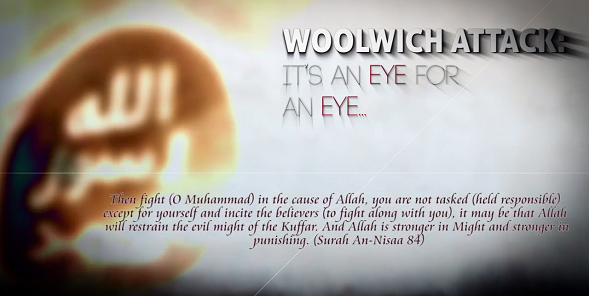
Aaron Zelin at Jihadology posted an hour-long video entitled Woolwich Attack a week or so ago, and I found it particularly interesting on two accounts: first, that it makes a multi-faith attack that includes Buddhism in its catalogue of enemies of Islam, and second, that it uses an innovative feature of modern digital typography. Here, I’ll concentrate on the first. Here’s the video’s title:

**

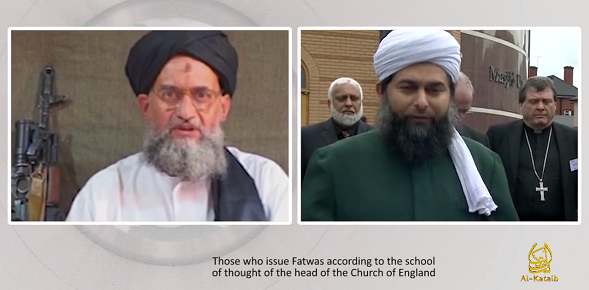
Christianity as a target is well represented in the form of Dr Justin Welby, the recently-appointed Archbishop of Canterbury:

Notice also the lower of these two screengrabs, this one showing Ayman al-Zawahiri (left) berating a leading Muslim spokesman in the UK, Ibrahim Mogra of the Muslim Council of Britain (right), for speaking at the same event as the Archbishop. The damning subtitle suggests he’s one of those “who issue Fatwas according to the school of thought of the head of the Church of England”.

**

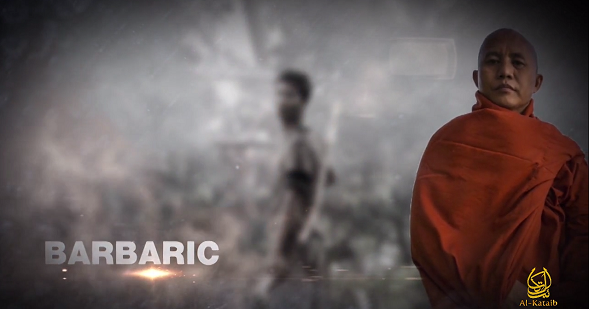
It wasn’t the attack on Christians or fellow Muslims that caught my eye, though, but the unexpected presence of the monk Wirathu, the rhetorical leader of Myanmar’s recent Buddhist rioting against Burmese Muslims. I’d seen his face on Time magazine and elsewhere, but it came as a bit of a shock here in a jihadist video — I’d filed him and his 969 movement under “Buddhism” rather than “Islam” in my mental listing of violent movements with religious underpinnings.

Ugly, ugly.

**

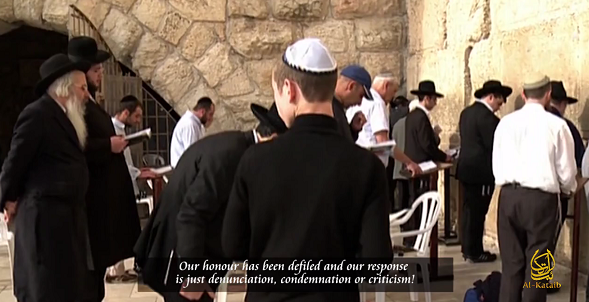
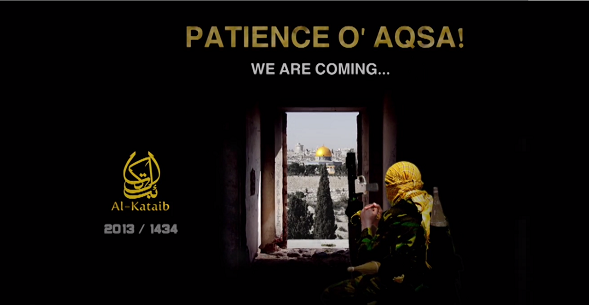
Finally, no invitation to jihad these days is complete without its mention of the al-Aqsa mosque and Jerusalem — and it is here that Judaism comes in for attack. Consider these two screengrabs:

**

The video closes, significantly, with a long shot of the Dome of the Rock through a window…

Yesterday my friend William Benzon made a post titled On Describing a Painting which began:

Harvard art historian Jennifer Roberts bills her article thus: The Power of Patience: Teaching students the value of deceleration and immersive attention. OK. But I take a different lesson from it, one about one of my current hobby horses: description. Roberts focuses on an 18th Century painting by John Singleton Copley, A Boy with a Flying Squirrel. Her point is that the more you look at the painting, the more you notice and hence the more you can note in a written description. She asks her students to spend a full three hours with a single painting.

Of her own experience with that painting she observes:

It took me nine minutes to notice that the shape of the boy’s ear precisely echoes that of the ruff along the squirrel’s belly—and that Copley was making some kind of connection between the animal and the human body and the sensory capacities of each. It was 21 minutes before I registered the fact that the fingers holding the chain exactly span the diameter of the water glass beneath them. It took a good 45 minutes before I realized that the seemingly random folds and wrinkles in the background curtain are actually perfect copies of the shapes of the boy’s ear and eye, as if Copley had imagined those sensory organs distributing or imprinting themselves on the surface behind him. And so on.

She begins her next paragraph: “What this exercise shows students is that just because you have looked at something doesn’t mean that you have seen it.”

Looking at that final screengrab with this in mind, I see a close correlation between the golden Dome that focuses our attention on the Noble Sanctuary / Temple Mount, and the round, yellow-gold keffiyeh of the jihadist observing it through his window — “making some kind of connection between” them, to echo the words of Harvard’s Elizabeth Cary Agassiz Professor of the Humanities…

It’s a skilled and meaning-filled use of the medium.

**

In my second post in this series, I’ll point to a significant development in graphics and technology introduced in this video.


Switch to our mobile site