zenpundit.com » Israel

Archive for the ‘Israel’ Category

Byzantium, Constantinople, Istanbul

Sunday, July 8th, 2012

[ by Charles Cameron — different styles of online communication, main topic: Istanbul in three Islamic videos ]
.

There’s passionate and visceral communication, and there’s communication that’s more scholarly, dispassionate and calm. Let’s begin and end with calm.

**

Visceral communication is essential for getting people out of a theater on fire, but a 30% application of scholarly distance and calm may be prerequisite for avoiding panic — and scholarly communication may be important for conveying in detail the high-dimensionality of a complex topic, but a drop of visceral may ease the salient points into more general circulation.

In an earlier, text heavy post — Damascus, Dearborn, Rome, Vienna? — I belabored you with details as to just how much ambiguity and fog surrounds the use of place names in scriptural and prophetic contexts. Here I’d like to give you a visceral sense of what some prophetic voices are doing with those place names.

One of the easiest ways to move from scholarly to visceral is to switch from text quotation to video clip, so that’s what I’ll do here — but my first video clip will be relatively calm and scholarly as video clips go, the next one more visceral and exhortatory, while the third and final clip will use all the tricks of the feature movie trade to provide a Tolkien-heroic account of the Muslim siege and taking of then-Christian Constantinople in 1453.

**

First, a very short clip from Adnan Oktar, aka Harun Yahya, widely known in the Islamic world for his lavishly illustrated books, CDs and DVDs presenting an Islamic version of creationism, the Mahdist end times — which he sees as entirely peaceable — and more besides.

In this clip, he’s talking about Istanbul, and he means that very city, even if it has sometimes been called Byzantium or Constantinople — or even on occasion, Rome.
.

**

My second clip is far longer, and presents an interview with Sheikh Imran Nazar Hosein, Islamic scholar, sometime Trinidadian diplomat and sometimes fiery YouTube preacher, whom I have quoted previously in Al-Awlaki and the former and latter rains and elsewhere.

Hosein discusses the prophecies of the conquest of Constantinople by Muslim forces as part of the background for a grand sweep overview of what he terms the first and second Arab Springs — which he locates a century apart and views as both engineered by an Anglo-American alliance to advance a Zionist agenda — and contemporary events in Bahrain, Saudi, Syria, Iran, Israel, and Russia:
.

.

It’s an hour-long interview, perhaps you didn’t watch the whole way through. Hosein concludes this interview, centered in Islamic prophecy about Constantinople, with a Saudi-American alliance facing off against an Iranian-Russian alliance in service to very long term Zionist interests, making the video a window not only on the Sheikh’s own worldview but also on how widely perceptions of the world situation can diverge:

I want the viewing audience to know that a situation is evolving in the world before our eyes, and we must understand it, that the two major powers in the world are now moving in a collision course, that collision course between these two major powers, the American-led alliance and the Russian-led alliance, is going to lead to nuclear warfare of such a magnitude that there is only one word that we can look for in the vocabulary to fit it, and that’s called Armageddon, that is, millions and millions and millions are going to die, most of them probably in North America and Europe, Europe of the East and Europe of the West — and what is left of the world after that, the Zionists hope that they can cope with it, and they can somehow survive and come out on top and Israel will rule the world, the rump that is left after the two giants engage in a war of mutual destruction, That is what we are facing now…

Is that what you thought scholarly Islamists were thinking? By what paths did a highly educated and world traveled man come to that conclusion?

**

My third clip speaks for itself. It is a trailer for an upcoming motion picture about the siege of Constantinople, presented as heroic spectacle with improbable but striking feats of arms, beautiful but not excessively modestly dressed women, obligatory mass choruses of Allahu Akbar, and at least one reference to the Antichrist.
.

.

I can’t wait to see it — but I expect to do so with mixed emotions. Perhaps they will stir up a decent blog post or two.

What emotions will they stir in those who identify with the heroic Mehmet II, and how much of an echo will those emotions find in the world around us? Long shot — any Turkey-NATO impact?

**

To return to a calmer clime:


.

Byzantium, Constantinople, Istanbul. I have prayed in the Sultan Ahmed — click image above to glimpse its beauty — I have relaxed deliciously at a nearby hammam.

The history of Istanbul could be the rich study of many lifetimes, its promise — for better or worse or a little of both — may have been variously prophesied or predicted, but remains to be seen.
Of the sacred, II: trees

Wednesday, July 4th, 2012

[ by Charles Cameron — more on magical worldviews: following hot on the heels of the curative power of saliva, a breathtakingly beautiful tale a wise man told me ]
.

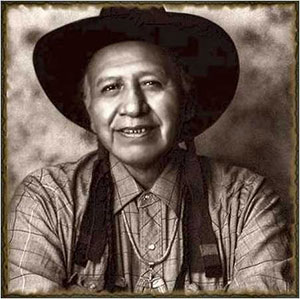
Wallace Black Elk


Look, you may detest saliva, saintly or otherwise, and I’d prefer not to leave you feeling queasy — so let’s follow the saintly saliva trail just a little further, and I think you’ll find it leads to something quite beautiful.

Susan Bayly continues:

Tamil Sufi texts often assert that the founding pir of a particular cult shrine identified his heir and successor by bequeathing him the twig which he used for tooth-cleaning. Such an object would naturally be impregnated with the saint’s saliva and would therefore serve to pass on the pir’s endowment of power and sanctity without involving him in an act of procreation.“ Fakiruddin is portrayed as having received a tooth-brushing twig as a token of spiritual succession from his murshid or preceptor, the Trichy pir Nathar Wali. According to the texts, it is this twig which grew up into the miraculous staff of the Nandi episode. The wooden staff also becomes imbued with the miraculous transforming barakat of the pir. …

Let’s forget saliva, let’s even forget neem-sticks, the organic Indian equivalent of the toothbrush — and consider the miraculous thorn tree that grows at Glastonbury:

After the crucifixion of Jesus lore has it that Joseph of Arimathea (who according to the Bible donated his own tomb for Christ’s interment after the Crucifixion) came to Britain, bearing the Holy Grail — the cup used by Christ at the Last Supper and later by Joseph to catch his blood at the crucifixion.

When Joseph landed on the island of Avalon, he set foot on Wearyall Hill — just below the Tor. Exhausted, he thrust his staff into the ground, and rested. By morning, his staff had taken root — leaving a strange oriental thorn bush – the sacred Glastonbury Thorn.

Lore has it that the thorn would bloom once a year, at Christmas.

**

But virtuous trees, like saintly saliva, can be found in more than one tradition. I had the privilege some while ago of spending a good deal of time in the company of the Lakota shaman, Wallace Black Elk, and would like to offer you one of his stories which I noted down pretty close to his own words.

I should perhaps preface this account by telling you that Wallace once told me he had twelve grandfathers — so the words grandpa and grandma don’t imply lineal descent here as they do in common usage, but function more as a term of respect for one’s elders:

I remember my grandfather, Black Elk. One time when I was very young, he came with my
grandfather Eagle Man to visit my grandmas in the tipi. My mother and my aunt were both young, so they let the old people visit together. “We’re good at cooking, so you just sit down and rest, and visit. We’ll look after the cooking.” And my father went off to take care of the horses, and to haul and chop wood, and left the old people to visit with each other.

That was the way it was. Everybody would eat a big meal, and some of those evenings my grandfathers would sit around telling ghost stories, spirit stories, and I’d listen. And while they were talking, they had a pipe. They would smoke the pipe and talk. So I was maybe seven years old, and I was sitting in the middle between grandma and grandpa, I used to sit there and listen, and watch them smoke the pipe.

My grandpa took the pipe-stem and planted it in the ground. He took a piece of charcoal and lit the fire, sprinkled some tobacco on it, and just puffed a little of that smoke. And that pipe-stem, you know, blossomed. Branches bloomed out of it, leaves bloomed out, and there’s a big red plum there. Red.

So my grandpa took the plum and gave it to his brother, and he ate it, and said: “Washtay, that’s really good.” And then he took the pipe and planted the pipe-stem, did the same thing, and put some tobacco over it, and that pipe-stem…that tree just bloomed, leaves just cropped out all over it, and there was a black cherry hanging there, it was a choke cherry. So my grandpa gave that choke cherry to his brother, and he ate it and blew the pit onto the ground. “Aah, very good.”

My grandmas were watching all this, and one of my grandmas picked up her moccasin and said, “Aaah, want some cherries, do you?” as if my grandpas were doing this to show their powers, and she was telling them, don’t do that! She threw her moccasin on the ground and an owl came up. It hopped around and flew in front of them, and started hooting whu whuwhuu, whu whuu.

My grandfathers looked at one another and said: “Hey, almost like our powers!” And they both started laughing, and that owl jumped down, and puffed itself up, and started hooting. So then my other grandma took her cane, she cried “Heeeeeee!” and threw it on the ground and it came out a rattlesnake. And it wasn’t just kind of a rattlesnake almost: boy, it really was a rattlesnake, and it coiled around the place. Boy, we bailed out.

Then my grandma reached over and took hold of that snake, and she took that cane and grabbed a hold of that owl by the neck, and pulled it back to her, and when it flopped down, when it landed, it was her sister’s moccasin, and she gave her sister her moccasin and put away her cane.

So that was my grandmas and grandpas. They had those powers, they knew that power was there. So I learned then there was a power in that pipe we hold, that the pipe could feed us. And he has been feeding us. There is no starvation, and we needn’t fear. That pipe represents the whole universe, and she can continue to multiply trees and plums and cherries.

That power of the Great Spirit is there, and those creatures can come from that pipe. Grandpa Great Spirit can do these things. From out of nowhere, he can do anything. I realized that.

A white man might think it was a bit of hocus pocus. Like a white man’s magician pulls a poor rabbit out of a hat, or a pigeon. But this is real. A tree comes up, and then it blooms, then it flowers, then it bears fruit. It’s a tree. And we are part of that tree. We absorb that fruit in our system, and we bear children, we bear fruit.

So that is an interpretation of the vision of the Tree of Life. That way my grandpa taught me.

**

Which reminds me (Exodus 7)…

And the LORD spake unto Moses and unto Aaron, saying, When Pharaoh shall speak unto you, saying, Shew a miracle for you: then thou shalt say unto Aaron, Take thy rod, and cast it before Pharaoh, and it shall become a serpent. And Moses and Aaron went in unto Pharaoh, and they did so as the LORD had commanded: and Aaron cast down his rod before Pharaoh, and before his servants, and it became a serpent. Then Pharaoh also called the wise men and the sorcerers: now the magicians of Egypt, they also did in like manner with their enchantments. For they cast down every man his rod, and they became serpents: but Aaron’s rod swallowed up their rods. And he hardened Pharaoh’s heart, that he hearkened not unto them; as the LORD had said.

Not Morsi but Mahdi

Tuesday, June 26th, 2012

[ by Charles Cameron — Egyptian presidency, Mahdist candidate, Center for Millennial Studies, Christ candidate ]
.


Source.
.

I ran across this reasonably remarkable web image while following a link from the tail end of Tim Furnish‘s comments on the Egyptian presidential election, and can’t really comment on the candidate himself, either as Mahdi-claimant or as (failed) aspirant to the Presidency.

I am, however, put in mind of my days with the Center for Millennial Studies at Boston University, and a fellow I met at one of their conferences there called Chris King. But I’ll let another friend of mine from those days make the introduction — here’s Damian Thompson, writing in the Daily Telegraph a while back:

I spent the evening of December 31, 1999, climbing up the Mount of Olives, only to be confronted by a wild-haired messiah figure in a patchwork robe walking down the slope. That was surprising enough, but my jaw really dropped open when he said: “Hi, Damian.” Turned out we’d met a few weeks earlier, at a conference organised by the Center for Millennial Studies in Boston. The “messiah” was a Kiwi maths lecturer called Chris King, which he explained also meant “Christ the King”, though only in a complex esoteric way. (He was a lovely guy, actually.)

Chris King was, as Damian reports, both a likeable guy and an academic, and what I found most appealing about his self-presentation — beyond the very fact of his turning up to attend a conference on Millennial Studies — was that his view, essentially a gnostic one, was that we are all Christs in potentia, if we would but realize it… wait for it…

and his consequent request that his claim to messianic status should be peer-reviewed!

Of games IV: the apocalyptic touch

Tuesday, June 19th, 2012

[ by Charles Cameron — some recent game references with seriously playful intent ]
.

Two things, really.

If you read the Jerusalem Post, you’ll likely have seen that:

Iran, Russia, China and Syria will hold the Middle East’s largest ever war game, Iranian news outlets reported quoting unnamed sources.

According to the report, 90,000 troops, 400 warplanes and 1,000 tanks from the four countries will take part in land and sea exercises. The war games will feature Russian atomic submarines, according to Iranian media, as well as warships, aircraft carriers and mine-clearing destroyers. Semi-official Iranian FARS news agency stated that the exercise was being planned in coordination with Egypt, which recently acceded to grant the passage of 12 Chinese warships through the Suez Canal. The report stated that the Chinese naval convoy is due to dock in Syrian harbors within the next two weeks.

That’s pretty much on the materiel side of things, IMO.

*

On the other hand, if you read Joel Rosenberg, you’ll have seen all that and more — and then this:

The story is particularly intriguing — and disturbing — in light of Bible prophecies in Ezekiel 38-39 that indicate a Russian-Iranian military alliance will develop in the “last days” to attack the nation of Israel. In my first nonfiction book, Epicenter, and in my novel, The Ezekiel Option, I describe these prophecies in detail. While it remains too early to know for certain if the “War of Gog and Magog” prophecies are going to be fulfilled in the near future, geopolitical trends in recent years and even in recent months have been curiously consistent with the ancient Biblical text. A militaristic Czar — Vladimir Putin — has risen to power in Russia. Putin is the only Russian leader in history to visit Israel (7 years ago), and is preparing to visit again on June 25, trying to make the Israelis feel comfortable with him. Yet Russia has been selling billions of dollars in arms to Iran and other nations described in the prophecies. Russia is currently sending naval ships and forces to Syria. Israelis are living more securely in the land, and are more prosperous, than ever in their modern history, also consistent with the prophecies.

Followed without a paragraph break by:

To learn more about the prophecies of Ezekiel 38-39, please click here.

And the headline?

That’s more morale than materiel, I’d say!

*

So that’s Thing One, as Dr Seuss might put it. But what about Thing Two?

The big, apocalyptic war games are for big fellows like Gog, Magog and Putin, guys who can afford to wear the big-boy pants.

What about the little guys and gals?

That, YNet tells us, is where a spot tourism might come in handy…

Gush Etzion has become a hot destination in recent months for tourists seeking an Israeli experience like no other: The opportunity to pretend-shoot a terror operative. Residents of the nearby settlements, who run the site, offer day-trippers a chance to hear stories from the battleground, watch a simulated assassination of terrorists by guards, and fire weapons at the range.

The fact that the tourist attraction is located beyond the Green Line only intensifies the thrill for the visitors, who often appear disappointed when told by their guides that they are not in any danger.

That strikes me as just a tad messianic, too… in a very post-modern sort of way.

Cute pic from that YNet article, photo credit Alex Kolomoisky:

To judge by the surrounding text, that young lady’s from Miami. She’s five.

Messianic symmetries

Sunday, April 29th, 2012

[ by Charles Cameron — Shin Bet’s Yuval Diskin calles Netanyahu messianic, Netanyahu called Ahmadinejad messianic, and other millenarian parallels and face-offs ]
.

One man’s Christ is another man’s Antichrist:

We’ll get to Diskin and Netanyahu, but first some background.

It is not uncommon to see the face-off between the West and Global Jihad — however you might prefer to name the opposing sides — as both asymmetrical (our kevlar vs their shalwar kameez, so to speak) and symmetrical (our crusaders vs their mujahideen, so to speak).

There are several aspects of these symmetries and asymmetries that interest me:

1.

The first is that the asymmetries are typically quantitative: one side has more firepower than the other, more troops and more sophisticated weaponry, and indeed, the conflict or flurry of conflicts in question does seem to fall under the rubric of asymmetric warfare, and those who write about asymmetries with the deepest understanding are typically those whose “loop” is to observe, orient, decide and act… while by way of contrast, the symmetries are most frequently observed by those whose “loop” is to observe, comprehend, describe and influence, and the symmetries they observe are typically qualitative, operating at the level of ideas.

I’ll get to a couple of examples shortly.

2.

The second is that within the asymmetries, it is not uncommon to find a reversal of polarities by which the lesser outsmarts and defeats the greater force. I’m thinking here of David and Goliath as the archetypal version, and of Nigel Howard, in Confrontation Analysis: how to win operations other than war, writing:

the problem of defense in the modern world is the paradoxical one of finding ways for the strong to defeat the weak.

A different aspect of asymmetry emerges when one can think of Israel as both the powerful high-tech occupier of a poorly-equipped and stateless mass of Palestinians, and a tiny emergent Jewish democracy surrounded on all sides (except the sea) by Arab and or Muslim once and future foes… a Goliath seen one way, a David the other…

What’s intriguing here is that in some ways everybody wants to be David, right?

3.

The third point of interest is the frequency with which the symmetries appear to contain explicit millenarian, messianic or apocalyptic elements.

Here are two examples. The first is from Gilles Kepel, who has been studying Muslim political movements for decades – he wrote The Prophet and the Pharaoh: Islamist movements in Sadat’s Egypt in 1984. In his 2010 Beyond Terror and Martyrdom: The Future of the Middle East, p. 10, he writes:B

ush, Cheney, and the neoconservatives on one hand, Bin Laden, Zawahiri, and Al Qaeda on the other — both sides staked their claim to power on a vision of global rectification through violent means. But the utopian ends that supposedly justified those means — universal democracy or a universal Islamist state — proved impossible to achieve, and in a few short years the opposing dreams of Bush and Bin Laden had devolved into an endless shared nightmare.

And then there’s Arundhati Roy, whose Guardian piece, The algebra of infinite justice, written less than a month after 9/11, asked:

What is Osama bin Laden? He’s America’s family secret. He is the American president’s dark doppelganger. The savage twin of all that purports to be beautiful and civilised. He has been sculpted from the spare rib of a world laid to waste by America’s foreign policy: its gunboat diplomacy, its nuclear arsenal, its vulgarly stated policy of “full-spectrum dominance”, its chilling disregard for non-American lives… Now that the family secret has been spilled, the twins are blurring into one another and gradually becoming interchangeable. … Now Bush and Bin Laden have even begun to borrow each other’s rhetoric. Each refers to the other as “the head of the snake”. Both invoke God and use the loose millenarian currency of good and evil as their terms of reference.

Note here that Kepel’s “vision of global rectification through violent means” and Roy’s “loose millenarian currency of good and evil” both have resonance that falls clearly within Richard Landes’ corpus of “varieties of millennial experience“.

4.

Even more explicitly messianic is the parallelism / opposition observed by Jean-Pierre Filiu, Kepel’s Sciences Po colleague, in his Apocalypse in Islam, where he notes that:

the emergence of al-Qaida has been accompanied by a millenarian rereading of jihadist terrorism that considers the Taliban sanctuary in Afghanistan to be only a first step toward the establishment of a universal caliphate… the Hour is near. The signs are there for all to see.

and writes with reference to Ahmadinejad and his Mahdist cohorts in the next paragraph:

These tragic visionaries share with the most farsighted of American neoconservatives the conviction that an implacable conflict is foretold in prophecy.

concluding (with regard to both, I would imagine):

It is therefor less a clash of civilizations that is now beginning to take shape than a confrontation of millenarianisms.

5.

Tim Furnish has a milder variant on the classic “One man’s Christ is another man’s Antichrist” theme as the opening sentence of his study of Mahdisms, Holiest Wars — he writes:

One man’s messiah is another man’s heretic…

which in turn reminds me of Jorge Luis Borges and his short classic, The Theologians, in which he describes the vicissitudes of two men deeply concerned with the nature of God — the heretic John of Panonia and the heresy-hunter Aurelian, his nemesis: Borges concludes his tale of these two intertwined lives with an extraordinary symmetry:

The end of this story can only be related in metaphors since it takes place in the kingdom of heaven, where there is no time. Perhaps it would be correct to say that Aurelian spoke with God and that He was so little interested in religious differences that He took him for John of Pannonia. This, however, would imply a confusion in the divine mind. It is more correct to say that in Paradise, Aurelian learned that, for the unfathomable divinity, he and John of Pannonia (the orthodox believer and the heretic, the abhorrer and the abhorred, the accuser and the accused) formed one single person.

But let there be no mistake about it, theologies differ. Safar Al-Hawali may use some of Hal Lindsey‘s exegetical devices to elucidate the end times from an Islamic perspective and proclaim “the Messiah = Christ Jesus Son of Mary, Allah’s servant and messenger” — but Islam’s Mahdi is pretty clearly Joel Richardson‘s Antichrist.

6.

What I hope to have accomplished thus far is to show two things: that keeping an eye out for symmetries and antitheses is a powerful tool for exploring conflict, especially at the qualitative and ideological level, and that messianic juxtapositions in particular have great force, and crop up with significant frequency in the literature of the “sacred vs secular war” also known to some as “jihad vs crusade”.

7.

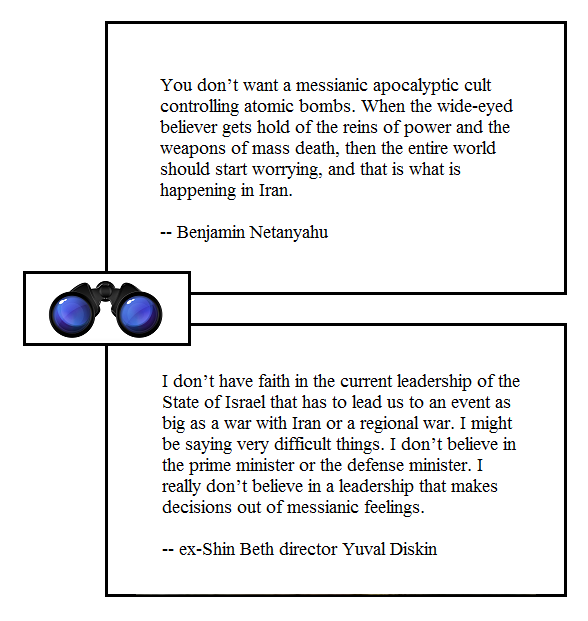
But hey, we came here to talk about Netanyahu and his spy, right? I find the juxtaposition of these two quotes — one from the current Israeli Prime Minister shortly before he was elected, the other just a few days ago by the man who was recently his spy-chief — striking, particularly in the contex provided above:

I try to read carefully. When I first saw the Yuval Diskin quote it was contextualized as suggesting that Benjamin Netanyahu and Ehud Barak were the leaders making “decisions out of messianic feelings” – but then for a moment it occurred to me that Diskin might have been saying “I don’t believe the prime minister’s accusation that the leadership of Iran makes decisions based on messianic feelings is correct – I see them as rational, persuadable actors.”

But no: Yuval Diskin is quite clear that it is Netanyahu and Barak he is talking about in this extended quote from Ha’Aretz:

My major problem is that I have no faith in the current leadership, which must lead us in an event on the scale of war with Iran or a regional war. I don’t believe in either the prime minister or the defense minister. I don’t believe in a leadership that makes decisions based on messianic feelings. They are two messianics – the one from Akirov or the Assuta project and the other from Gaza Street or Caesarea. Believe me, I have observed them from up close… They are not people who I, on a personal level, trust to lead Israel to an event on that scale and carry it off. These are not people who I would want to have holding the wheel in such an event.

Perhaps because I am more than usually sensitive to apocalyptic and messianic fervor, I find the implications of both Netanyahu’s and Diskin’s observations – if accurate as to the respective temperaments of the leaders concerned — quite chilling.

8.

As so often, I’m hoping to raise questions here — to prompt deliberative thinking, not to argue or persuade.


Switch to our mobile site