Al Farrow: an artist who leaves me uneasy, questioning
Wednesday, September 7th, 2011[ by Charles Cameron — art, religion, and violence ]
.
Al Farrow, the San Francisco-based artist, finds and shows us that violence which is one pole of religion — what I think of myself as the landmines in the garden, where the garden is pardis, pairidaeza, paradise, the opposite pole of religion — perhaps inseparable from the violence, perhaps separable — the pole of peace, eirene, salaam…
He show us this uncanny juxtaposition by building. meticulously, a cathedral out of guns and bullets:
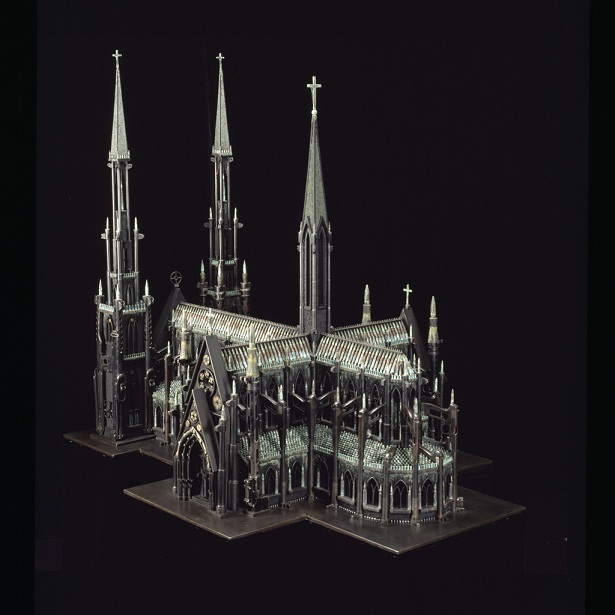
His work leaves me impressed, but ill at ease, and for that I am grateful: he makes me think.
Take a close look at one of those flying buttresses… and compare it with its cousins at Notre Dame:
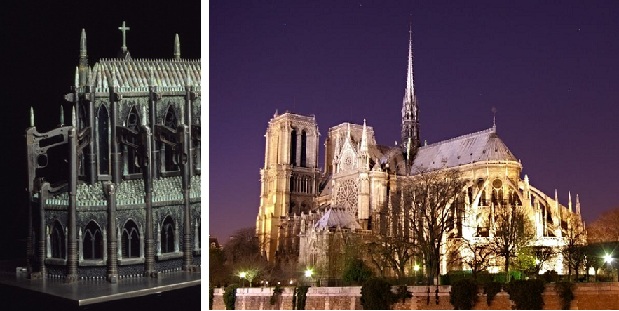
That detail really brings the power of Farrow’s work home to me.
*
William Blake suggested that it is the artist’s function to “cleanse the doors of perception” — to give us fresh eyes, to see the world anew for us.
Al Farrow does this: it is as though in his cathedral, Catholic and Protestant Ireland meet. Indeed, in an exhibit of his works — he has built mosques and synagogues of guns and bullets too — Christianity faces off against Islam, Judaism confronts its demons.
But there’s something more here, perhaps – the clash of war and peace, of hate and love — and how hatred can at times work with “love” as a protective shield…
Farrow himself says:
I am perpetually surprised by the historical and continuing partnership of war and religion. The atrocities committed in acts of war absolutely violate every tenet of religion, yet rarely do religious institutions speak against the violations committed in the name of God. Historically, Popes have even offered eternal salvation to those who fought on their behalf (The crusades, etc.).
In my constructed reliquaries, I am playfully employing symbols of war, religion and death in a facade of architectural beauty and harmony. I have allowed my interests in art history, archeology and anthropology to influence the work. The sculptures are an ironic play on the medieval cult of the relic, tomb art, and the seductive nature of objects commissioned and historically employed by those seeking position of power.
There’s considerable further irony, therefore, in the way in which Farrow’s already ironic work can be juxtaposed with it’s utterly non-ironic equivalent – Saddam Hussein‘s concept of the Mother of All Battles Mosque:

*
Farrow’s work does not instruct us to be warriors, nor to be pacifists – it draws our attention to the blend of violence and peace of which our human dreams and lives are made. As Farrow says in this video clip from an exhibit of his work in Washington:
I use real bones, real bullets, real guns, because fake bones wouldn’t shake anybody up, nor would a fake gun. The purpose of my work is actually to get people to think about that complex relationship between war and religion – or any violence and religion. And a lot of violence is committed and has been through history in the name of religion, and that’s an ongoing thing, in any part of the world you look.
And yes, I think it’s fair to say Farrow’s juxtapositions of religion and violence clearly lean us towards peace. War does the same, no?
War, after all, destroys places of worship, along with many and varied other places – munitions dumps and churches, mosques and homes:

But just as religion has its landmines, so too it offers us its gardens – and just as a mosque or church or temple may be a rallying point offering a divine sanction to violence, so too it may be a focus for peace and reconciliation.
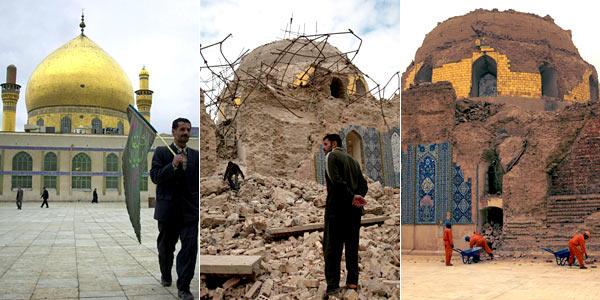
Out of the ashes of destruction: creation, renewal, rebuilding…
For more on Al Farrow’s work, visit the Catharine Clark Gallery page. And feel uneasy by all means, meditate — the koan I am sitting with this month is “Stop the War” — and ponder…