zenpundit.com » Buddhist

Archive for the ‘Buddhist’ Category

Blessed are the conflict resolvers I: in three religions

Monday, August 5th, 2013

[ by Charles Cameronpeace making tells us that the goal of the activity is peace, conflict resolution tells us that this goal is not achieved in peace but on the field of conflict ]
.

Michael Lempert‘s book, Discipline and Debate: The Language of Violence in a Tibetan Buddhist Monastery, has a somewhat harsh take on the practice of debate in the education of Buddhist monks. The Introduction begins:

Buddhist ‘debate’ (rtsod pa), a twice-daily form of argumentation through which Tibetan monks learn philosophical doctrine, is loud and brash and agonistic. Monks who inhabit the challenger role punctuate their points with foot-stomps and piercing open-palmed hand-claps that explode in the direction of the seated defendant’s face. I was curious about the fate of this martial idiom in which monks wrangle, curious especially about its apparent disregard for ideals like nonviolence, compassion, and rights that Tibetans like the Dalai Lama have promoted…

For a more “nonviolent” view, see Daniel E. Perdue, Debate In Tibetan Buddhism — and by way of comparison, John Daido Loori‘s account of the Zen equivalent, Cave of Tigers: The Living Zen Practice of Dharma Combat

**

For a comparable Christian form of debate, we can turn to the writings of Peter Abelard, the medieval scholastic (educator and lover of Heloise) who introduced his book Sic et Non — “Yes and No” — in which he selected what are essentially DoubleQuotes from the Early Church Fathers, setting them one against another to display their seeming contradictions, with the following words:

In view of these considerations, I have ventured to bring together various dicta of the holy fathers, as they came to mind, and to formulate certain questions which were suggested by the seeming contradictions in the statements. These questions ought to serve to excite tender readers to a zealous inquiry into truth and so sharpen their wits. The master key of knowledge is, indeed, a persistent and frequent questioning. Aristotle, the most clear-sighted of all the philosophers, was desirous above all things else to arouse this questioning spirit, for in his Categories he exhorts a student as follows: “It may well be difficult to reach a positive conclusion in these matters unless they be frequently discussed. It is by no means fruitless to be doubtful on particular points.” By doubting we come to examine, and by examining we reach the truth.

**

The essence of both the above examples is conflict circumscribed, with the goal of enlightenment.

It’s my impression that Sura 49 verse 13 of the Qur’an implies a similar process, though here it is difference rather than conflict that is the starting point, and mutual understanding that is the goal:

O mankind, We have created you male and female, and appointed you races and tribes, that you may know one another. Surely the noblest among you in the sight of God is the most godfearing of you. God is All-knowing, All-aware.

That’s AJ Arberry‘s translation. Yusuf Ali‘s draws out more of the implications:

O mankind! We created you from a single (pair) of a male and a female, and made you into nations and tribes, that ye may know each other (not that ye may despise (each other). Verily the most honoured of you in the sight of Allah is (he who is) the most righteous of you. And Allah has full knowledge and is well acquainted (with all things).

**

In the second part of this post, I’ll present two extraordinary examples of conflict presented as art…

Furnish on Pew findings re: Islam

Thursday, May 2nd, 2013

[ Charles Cameron presenting guest-blogger Timothy Furnish ]
.


.

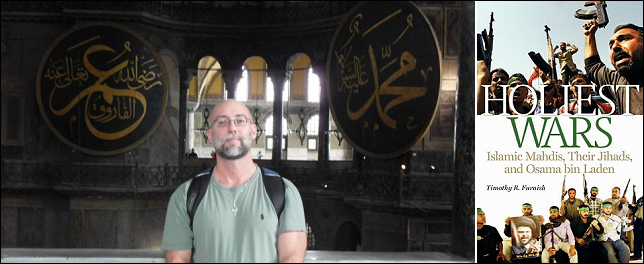
I’m delighted to welcome Dr Timothy Furnish as a guest-blogger here on Zenpundit. Dr Furnish has served as an Arabic linguist with the 101st Airborne and as an Army chaplain, holds a PhD in Islamic history from Ohio State, is the author of Holiest Wars: Islamic Mahdis, Their Jihads, and Osama bin Laden (2005), and blogs at MahdiWatch. His extended piece for the History News Network, The Ideology Behind the Boston Marathon Bombing, recently received “top billing” in Zen’s Recommended Reading of April 24th.

**

Does This Paint It Black, or Am I A Fool to Cry? Breaking Down the New Pew Study of Muslims
by Timothy R. Furnish, PhD
.

Pew has released another massive installment of data from its research, 2008-2012, into Muslim attitudes, entitled “The World’s Muslims: Religion, Politics and Society.” Over 38,000 Muslims in almost 40 countries were surveyed, thus constituting a survey both statistically sound and geographically expansive. Herewith is an analysis of that information and what seem to be its major ramifications.

The first section deals with shari`a, usually rendered simply as “Islamic law” but more accurately defined as “the rules of correct practice” which “cover every possible human contingency, social and individual, from birth to death” and based upon the Qur’an and hadiths (sayings and practices attributed to Muhammad) as interpreted by Islamic religious scholars (Marshal G.S. Hodgson, The Venture of Islam, Vol 1: The Classical Age of Islam, p. 74). Asked “should sharia [as Pew anglicizes it] be the law of the land,” 57% of Muslims across 38 countries answered “yes” — including, most problematically for the US: 99% of Afghans, 91% of Iraqis, 89% of Palestinians, 84% of Pakistanis and even 74% of Egyptians. Should sharia apply to non-Muslims as well as Muslims? Across 21 countries surveyed on this question, 40% answered affirmatively — with the highest positive response coming from Egypt (its 74% exceeding even Afghanistan’s 61%). And on the question whether sharia punishments — such as whippings and cutting off of thieves’ hands — should be enacted, the 20-country average was 52%, led by Pakistan (88%), Afghanistan (81%), the Palestinian Territories [PT] (76%) and Egypt (70-%). On the specific penalty of stoning for adultery, the 20-country average was 51% — with, again, Pakistan (89%), Afghanistan (85%), the PT (84%) and Egypt (71%) highest in approval. Finally, 38% of Muslims, across those same 20 nations, support the death penalty for those leaving Islam for another religion.

Huge majorities of Muslims across most of these surveyed nations say that “it’s good others can practice their faith” — but Pew’s imprecise terminology on this topic makes possible that this simply mean many Muslims are willing to grant non-Muslims the tolerated, but second-class, ancient status of the dhimmi. Majorities, too, in most countries say that “democracy is better than a powerful leader;” however, the latter was actually preferred by most surveyed in Russia, Bosnia-Hercegovina, Kyrgyzstan, Afghanistan and Pakistan, as well as by 42% of Iraqis, 40% of Palestinians and 36% of Egyptians. Most Afghans, Egyptians and Tunisians (and even 1/3 of Turks) believe that “Islamic political parties” are better than other ones, although 53% of Indonesians and 45% of Iraqis are also worried about “Muslim extremists.” (Curiously, 31% of Malaysians are, on the other hand, worried about “Christian extremists” — although evidence of such existing in that country is practically non-existent.) There is good news on the question of suicide bombing, however: across 20 countries, only 13.5% think it is ever justified — although the support is much higher in the PT (40%), Afghanistan (39%) and Egypt (29%).

In terms of morality, large majorities in most Muslim countries (especially outside Sub-Saharan Africa) think drinking alcohol is morally repugnant, notably in Malaysia (93%), Pakistan and Indonesia (both 91%). Most Muslims in most countries surveyed consider abortion wrong, as well as pre- and extra-marital sex and, almost needless to say, homosexuality. (Although one wishes Pew had asked about mu`tah, or “temporary marriage” — a practice originally Twelver Shi`i which has increasingly become used by Sunnis.) Yet, simultaneously — following Qur’anic rubrics — some 30% of Muslims in 21 countries support polygamy, including almost half of Palestinians, 46% of Iraqis and 41% of Egyptians. There is also significant support for honor killings in not just Afghanistan and Iraq but also Egypt and the PT. Over ¾ of Muslims across 23 countries says that “wives must always obey their husbands:” an average of 77%. And Pew notes that there is a statistically very significant correlation between sharia-support and believing women have few(er) rights.

Asked whether they believed they were “following Muhammad’s example,” 75% of Afghans and 55% of Iraqis answered affirmatively — although most Muslims were not nearly so confident. On the question “are Sunni-Shi`i tensions a problem,” 38% of Lebanese, 34% of Pakistanis, 23% of Iraqis and 20% of Afghans said “yes.”

It is no surprise that huge majorities of Muslims in most surveyed countries believe that Islam is the only path to salvation, nor that most also say “it’s a duty to convert others” to Islam. It is somewhat counterintuitive, however, that many Muslims say they “know little about Christianity” — even in places with large Christian minorities, such as Egypt. Muslims in Sub-Saharan Africa are the most likely to agree that “Islam and Christianity have a lot in common,” and so are 42% of Palestianians, as well as some 1/3 of Lebanese and Egyptians. But only 10% of Pakistanis agree. Asked whether they ever engaged in “interfaith meetings,” many Muslims in Sub-Saharan Africa said that they did (with Christians), and a majority of Thais said likewise (albeit with Buddhists). But only 8% of Palestinians, 5% of Iraqis, and 4% of Egyptians said they ever do so—despite substantial Christian populations in each of those areas.

Regarding the question “are religion and science in conflict,” most Muslims said “no” — with the exceptions of Lebanon, Bangladesh, Tunisia and Turkey where over 40% in each country (and, actually, a majority in Lebanon) said that they were at loggerheads. Most Muslims also say they have no problems with believing in Allah and evolution — the exceptions being the majority of Afghans and Indonesians. Regarding popular culture, clear majorities of Muslims in many countries say they like Western music, TV and movies—but, at the same time, similar majorities say that such things undermine morality (although Bollywood less so than Hollywood).

Observations:

1) The high degree of support for sharia is the red flag here. Contra media and adminstration (both Obama and Bush) assurances that most Muslims are “moderate,” empirical data now exists that clearly shows most Muslims, in point of fact, support not just sharia in general but its brutal punishments. Perhaps just as disturbing, almost four in ten Muslims are in favor of killing those who choose to follow another religion. And countries in which the US is heavily involved either diplomatically or militarily (or both) are the very ones where such sentiments run most high: Pakistan, Afghanistan, Egypt, the Palestinian Territories. So are the “extremists” these very Muslims who want to follow, literally, the Qur’an and hadiths? Messers Brennan, Holder and Obama have some explaining to do.

2) Afghanistan would appear to be a lost cause. Afghans are at the top of almost every list in support for not just sharia, suicide bombing, honor killing and — ironically (or perhaps not) — confidence that they are emulating Islam’s founder, as well as dislike for democracy. In light of this clear data, two points about Afghanistan become clear: tactically, ostensible American befuddlement as to the causes of “green on blue” attacks and the continuing popularity of the Taliban in Afghanistan appears as willful ignorance; strategically, the US decision to stay there after taking out the al-Qa`ida [AQ] staging, post-9/11, and attempt to modernize Afghanistan was a huge, neo-Wilsonian mistake. 2014 cannot come soon enough.

3) In some ways Islam in Southeastern Europe, and to a lesser extent in Central Asia, seems to be a more tolerant brand of the faith than the Middle Eastern variety. For example, the SE European and Central Asian Muslims are the least likely to support the death penalty for “apostasy,” and the most supportive of letting women decide for themselves whether to veil. And Muslims in Sub-Saharan Africa are the most likely to know about Christianity, and to interact with Christians. On the other hand, African Muslims are among the most enamored of sharia, and Central Asian ones fond of letting qadis (Islamic judges) decide family and property disputes. So there does not seem to be a direct link between Westernization and moderation; in fact, the influence of Sufism — Islamic mysticism — in the regard needs to be correlated and studied (beyond what Pew did on the topic in last year’s analysis).

4) One bit of prognostication based on this data: Malaysia may be the next breeding ground of Islamic terrorism. It’s home to some 17 million Muslims (61% of its 28 million people), who hold a congeries of unsettling views: 86% want sharia the law of the land; 67% favor the death penalty for apostasy; 66% like sharia-compliant corporal punishments; 60% support stoning for adultery; and 18% think suicide bombing is justified. PACOM, SOCOM and the intelligence agencies need to ramp up hiring of Malay linguists and analysts.

5) Finally, some words for those — like FNC’s Megyn Kelly and Julie Roginsky (on the former’s show “American Live,” 4/30/13) — who pose a sociopolitical and moral equivalence between Muslim support for sharia and Evangelical Protestant Christian support for wives’ obedience to husbands: that’s a bit too much sympathy for the devil. Yes, Evangelical Christian pastors hold some pretty conservative views of the family, as per a 2011 Pew study of them; for example, 55% of them do agree that “a wife must always obey her husband” (compared to 77% of Muslims). And, ironically, many such Evangelicals agree in large measure with Muslims on issues such as the immorality of alcohol, abortion and homosexuality. However, one searches in vain for any Evangelical (or other) Christian support for whippings, stonings, amputation of thieves’ limbs, polygamy or suicide bombing.

Islam is the world’s second-largest religion, numbering some 1.6 billion humans (behind only Christianity’s 2.2 billion). There is, thus, enormous diversity of opinion on many issues of doctrine and practice, and essentializing Islam as either “peaceful” or “violent” is fraught with peril. Nonetheless, this latest Pew study provides empirical evidence that many — far too many — Muslims cling to a literalist, supremacist and indeed brutal view of their religion. Insha’allah, this will change eventually — but time is not necessarily on our side.

The Oscars, the Conclave and the Chinese

Monday, February 25th, 2013

[ by Charles Cameron — more on the upcoming papal election from a “comparative” perspective ]
.

As you know, I noodle around with parallelisms and oppositions quite a bit. Here are two recent pairings that caught my attenion — one of them just in time for the Oscars:

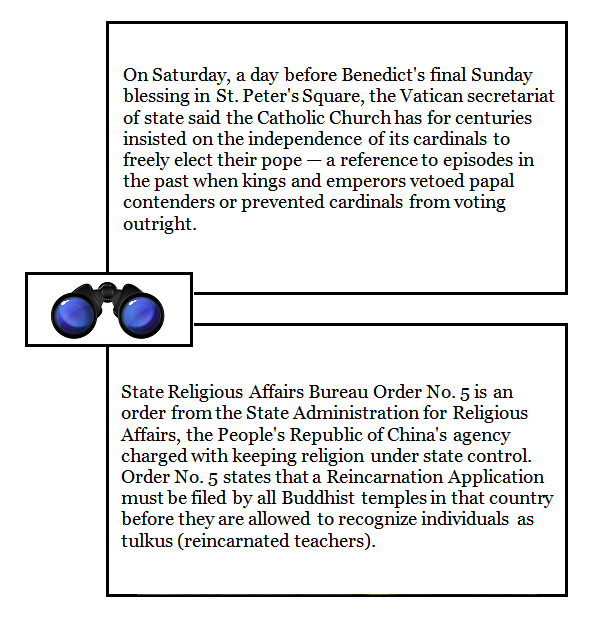
The other concerns political influence on spiritual appointments…

I had the good fortune to meet and befriend a “tulku” while I was at Oxford, so the whole business of the identification and recognition of reincarnated Tibetan lamas has long been an interest of mine.

Infinite in faculty, quintessence of dust

Saturday, January 12th, 2013

[ by Charles Cameron — on the cutting off of hands, the eternal life of martyrs, and the vast and petty nature of we poor amazing humans ]
.

As you know, I love apposite juxtapositions between religious texts – if you’re into cognition, it’s called pattern recognition, in Jung or Plato it would be familiarizing oneself with the archetypes, and in terms of creativity it’s “one swell foop” of analysis and synthesis, an oak in an acorn, insight in a nutshell.

At times, as here, the comparison presents a significant similarity that “sees things” from a very different vantage point from our everyday selves – a refreshing and salutary reminder, perhaps, from high altitude, even if it’s not the street-level view we require to navigate life’s many smaller obstacles and minor goals.

**

Here are two such comparisons that have served a somewhat different purpose for me –- showing me that aspects of another religion’s practice that I find shocking have echoes in my own tradition. I do not claim these correspondences to be exact — but if we allow them to be, I believe we may find them illuminating:

and:

My hope is that such examples can help us to approach the “other” with greater respect and understanding — where we agree, and even where we strongly disagree.

In the way of peace. For it is written in the Injil, in the Gospel (Matthew 5:9):

Blessed are the peacemakers: for they shall be called the children of God.

**

But to return us to the high altitude view from which we began, I’ll give Shakespeare the final word:

   HAMLET: I have of late–but
wherefore I know not–lost all my mirth, forgone all
custom of exercises; and indeed it goes so heavily
with my disposition that this goodly frame, the
earth, seems to me a sterile promontory, this most
excellent canopy, the air, look you, this brave
o’erhanging firmament, this majestical roof fretted
with golden fire, why, it appears no other thing to
me than a foul and pestilent congregation of vapours.
What a piece of work is a man! how noble in reason!
how infinite in faculty! in form and moving how
express and admirable! in action how like an angel!
in apprehension how like a god! the beauty of the
world! the paragon of animals! And yet, to me,
what is this quintessence of dust?

Cross-grain thinking, 3: ASP’s Report on Climate Security

Wednesday, November 21st, 2012

[ by Charles Cameron — as Dylan sang, a change in the weather is known to be extreme ]
.

People sit at a flooded table in Piazza San Marco, Venice -- photo: Luigi Costantini / AP

.
Right at the top of Part I of the recent three-part Report on Climate Security from the American Security Project, we read this paragraph:

Climate change is real: we see its impacts every day, around the world. A melting Arctic, unprecedented droughts across the world, extreme examples of flooding, and uncontrollable wildfires are all examples of the changing climate.

That’s right, that’s right and important, that’s right, important and timely.

But you know, at heart I’m a poet. And although I’m concerned about the issues the report addresses, I can’t help thinking of climate and weather, atmosphere and wind, in a manner that crisscrosses the “interior” vs “exterior” divide.

If you lean to the scientific more than the poetic, you might want to consider what I’m talking about as an instatiation of the insight Gregory Bateson expressed in the title of his seminal book, Mind and Nature: A Necessary Unity.

**

Let me lean to the poetry-side for a paragraph or so, then we’ll come back to security issues the report raises.

I probably caught this particular “weather and weather” disease from Dylan Thomas’ great and celebrated poem, A Process in the Weather of the Heart:

A process in the weather of the heart
Turns damp to dry; the golden shot
Storms in the freezing tomb.
A weather in the quarter of the veins
Turns night to day; blood in their suns
Lights up the living worm.

Writing about this poem in his Reader’s Guide to Dylan Thomas, William York Tindall notes “Thomas’ obsessive concern with the natural process that, linking man and world, inner and outer, turns upon the axis of life and death” and specifies that “applying ‘weather,’ a word for outer climate, to inner climate joins two worlds.”

Thomas is concerned in that extraordinary poem to join, likewise, life with death, night with day, womb with tomb, seeing eye with blind bone and more – or not so much to join them as to see them as inseparable, as parts of the single unfolding that is the world.

There is much more to the poem than the central obsessive theme of the “process in the weather of the heart” with which the poem opens and the “process in the weather of the world” with which it closes. It is their conjunction, their inseparability which interests me here – the poet’s perception that there is no inner without the outer, no outer without the inner – that in each there is weather, which Tyndall also calls climate, that weather is in both…

**

Back to meteorology and national security..

Look, I’m not exactly an enemy of thinking about climate change and national — or global — security. I admire ASP for today’s piece by Catherine Foley, Climate Change: The Missing Link in Tackling the Mali Crisis. We need more considerations of that kind, they’re rare and extremely valuable.

Mecca is one of the hottest cities in the world, and the Kaaba the central pivot around which all Islam revolves — potentially a double hot-spot. What are the implications of climate change for the Saudis, for Mecca, for Islam?

**

When I think about weather, I think about storms in the world, storms in the heart and mind, almost in the same breath. Specifically, when I think of global warming, I can’t help but see the problem as being one of double-awareness – rising temperatures and rising tempers, rising sea-levels and rising levels of anxiety and / or denial, the climate of meteorology and the climate of opinion…

Seen from my bifocal perspective, the report is notably focused on externals. Take another sentence from the brief bullet points on the first page;

The climate influences people’s everyday lives, from what they eat to where they live.

We eat food, food that can be weighed and measured, and analyzed for its nutrient elements and health properties. We live in cities, towns and villages, in houses, or developments, which can located on maps…

With my bifocals on, it would be more accurate, more encompassing to say:

The climate influences people’s everyday lives, from what they eat to how they feel, and from where they live to what they think and how they behave.

Because in my view, the situation is as much about “mind change” as it is “climate change” — in my view, the “fulcrum that can move the world” is to be found in the geography of mind and heart.

**

Okay, let’s back up a bit.

The “first page” I quoted is the first page of the First Part of the Report, but there’s also an Introduction, and I want to pick up the thread there now, because the Introduction is written with human thought — specifically “honest dialogue” — in mind, and opens with what seems at first glance like one of those obvious truths that serve as the jumping off points for more detailed considerations:

The American Security Project is organized around the belief that honest, public discussion of national security requires open, non-biased, non-partisan discourse about the dangers and opportunities of the 21st Century.

There’s just one problem here, though — a single paragraph later, we read:

Climate change poses a clear and present danger to the United States

I’d give my assent happily enough to either of these two propositions, if they weren’t both talking about the same situation. Because when someone sees a “clear and present” hungry tiger coming at them and doesn’t take rapid action to avoid being eaten, it’s not “open” and “unbiased” — it’s “in denial”.

Which in turn means there’s a swathe of the population that may not be willing to hear “open, non-biased, non-partisan discourse” nor able to contribute to it. “I don’t believe my eyes, they’re deceiving me with all this hogwash about tigers”…

And those people have loved ones, bring foods to community pot-lucks, and teach class, and vote…

**

Some time ago, I was working on a transposition of the Gospel narratives of Luke and John into the Troubles in Northern Ireland, with Britain playing the part of Rome and so forth, and adding some commentary along the way. Here’s a slightly revised version of my comment on John 3.8:

There is one particular word that John uses which has what we today might call a triple (rather than a double) meaning. When Christ in this verse says, “The wind bloweth where it listeth, and thou hearest the sound thereof, but canst not tell whence it cometh, and whither it goeth: so is every one that is born of Spirit,” it is the Greek word pneuma that can be translated both as wind and spirit. It also means breath.

Christ is saying here that those who are born of spirit are like the wind, like breath, and like inspiration: each of which can be noticed but not predicted, because each moves of its own accord — yet in the Greek these are not three separate concepts as they are for us today. As CS Lewis says in another context, we must always remember “that the various senses we take out of an ancient word by analysis existed in it as a unity.”

In telling us this, St John is saying at one and the same time that nobody knows where the first breath comes from or when the last breath will leave us, nobody knows how to forecast exactly which path a hurricane will take, and nobody knows how to make an assembly line for inspiration – if we did, Beethoven could have written another three symphonies as great as his Ninth to order, stat!

One of the reasons we don’t know how the heart and mind work is that we’ve separated “meteorological” weather from “the weather of the heart” — and there’s a storm brewing, inextricably, on both fronts.

If the ASP report is anything to judge by, we’re only looking at one of them.

**

Oh, and here by way of confirmation is an old friend from my Oxford days, the late Chogyam Trungpa Rinpoche, quoted in a piece for the November issue of Shambhala Sun:

No matter where we are in the world, there is a need for enlightened society, wherever natural disasters hit. In this case, “natural disaster” refers to aggression, passion, and ignorance. These kinds of natural disasters occur in the minds of people.

Trungpa’s sense of “natural disaster”, I humbly submit to the folks at the American Security Project, either needs to run like a woof through the warp of their report on climate change — which it doesn’t — or it deserves a fourth section of its own.


Switch to our mobile site