Congratulations!
Thursday, August 30th, 2012
On behalf of Charles, Scott and myself, I would like to extend congratulations to our esteemed friend Lexington Green, for the honor he has received.
On behalf of Charles, Scott and myself, I would like to extend congratulations to our esteemed friend Lexington Green, for the honor he has received.
[by J. Scott Shipman]

The First Battle, Operation Starlite and the Beginning of the Blood Debt in Vietnam, by Otto J. Lehrack, Lt.Col., USMC, Ret.
This is an older book, but important. A few weeks ago I was having lunch with a good friend, Bruce. Bruce is a Vietnam veteran and since both of us are readers many of our lunch conversations revolve around the books we have read, and this meeting was no exception. Bruce enthusiastically recommended The First Battle and No ShiningArmor, both by Lt.Col. Lehrack, and Last Men Out, by Bob Drury and Tom Clavin. He said Lehracks first twenty pages of The First Battle was the best description of the situation that led the United States to become involved in Vietnam. Since my knowledge of Vietnam is embarrassingly meager, I ordered all three when I returned home from lunch. Given Bruce’s descriptions, The First Battle was first up. Lehrack begins the first chapter, Inching Towards the Abyss, with a profound first sentence:
The United States came to this pass in baby steps, characterized more by Cold War fears, hubris, and inattention than by level-headed policy examination.
(Sounds familiar doesn’t it?)
The result of Lehrack’s effort is a readable and powerfully inspiring story of the first battle of the Vietnam War fought only by Americans, specifically, the United States Marine Corps. Code named, Operation Starlite, this “first battle” was a coordinated air, sea, and land attack, but to the green, untested Marines fighting battle-hardened Viet Cong troops nothing about this first encounter was typical or routine.
Lahreck, drawing on interviews with warriors from both sides, provides the reader an up-close view of the savagery and the valor of this battle that resulted in two Americans receiving the Congressional Medal of Honor. The prose is fast paced and detailed, but not so detailed one with no experience/knowledge of Marine Corps jargon can’t keep up. Lehrack includes a fairly exhaustive glossary of the unique terms used, so the military/USMC novice will have a ready guide close-by.
The book is divided in three parts. Part 1 describes general attitudes of the American public, politicians, and military personnel with respect to Vietnam. Part 1 also provides a description of the planning process for the battle and the rationale. Also included is an assessment by the Viet Cong of their American opponents, dated 3 July 1965 (about a month prior to Operation Starlite):
American strong points
- The have reached the training level of an expeditionary force.
- Armed with modern weapons, lighter than French expeditionary forces, they have quick transportation, quick movement, have capability of quick reinforcement, thanks to vehicles, aircraft, boats.
- Usually concentrated in groups.
Weak points compared with French
- No spirit of combat; afraid of guerillas; always rely on modern weapons, so they lose initiative and self-confidence (when in contact, they call fire for support and reinforcement); sometimes artillery must conduct fire support for the whole period of operation.
- Lack of combat experience, just know combat in theory only (through field manuals). Moreover, on a strange terrain, they usually walk in the open, bewildered like ducks (we say that American troops are most opportune targets for guerrillas).
- Much effort required for messing; and water. Food must be supplied for each meal by helicopters. When moving to any place they must use helicopters and artillery fire support, so objective will always be disclosed, brining good opportunity for guerrilla follow up.
- Cannot undergo long and hard operations. When operating far from base, about seven kilometers, must use vehicles.
- Not able to bear local weather and climate, so troops will fall ill.
- Defensive positions sometimes well organized but they are slow to get that way. In one instance it took ten days to organize defenses and thirty to install mines.
- They do not know the terrain well.
- They run slowly.
(This list is offered for those readers who have insight into whether these weaknesses persist in our military—I do not know.)
In Part 2, Lehrack describes the battle, and the aims of the American commander “to isolate, and then destroy the enemy.” Lehrack follows individuals and units through the battle, and spares no detail in the hardships, risks, and depravations endured by the participants. He offers a gripping and realistic description of the “fog of war:”
The Marines quickly learned a practical lesson that all warriors have known since ancient times. Theoretically, one is supposed to line up in an assault or other planned formation and fight that way. But once battle is joined the formation rapidly degenerates into a series of isolated small actions. In Starlite, as in most battles, it seemed that the fights generally meant that four or five men on one side would be heavily engaged with a similar number on the opposite side. Each combatant became so preoccupied with taking care of his situation that he often had little knowledge of and didn’t really care what was going on a few yards away. Throw in the sounds, the smells, and the fear and you have the notorious “fog of war” that explains why such widely differing accounts describe the same battle.
Good friend of this blog, Lynn Wheeler adds this observation in another forum on the effect Starlite had on Viet Cong planning/tactics::
Perhaps the most important reason for the so-so result was that the Viet Cong had gained an enormous appreciation of the Marines’ ability to project power from the sea as a result of Starlite. Never again in the course of the war did they permit their units to tarry on the coastal plain. When they had a job to do near the water, they came in and did it, and then they fled inland again. Although they developed good antiaircraft techniques and weaponry during the war they had neither the ordnance nor the expertise to thwart an amphibious landing force.
Part 3 is titled The Blood Debt. As eloquently as Lehrack introduced the reader the to attitudes and assumptions of most Americans in his opening chapter, so he concludes. Fifty-four Americans died and an estimated six hundred of the enemy perished in Operation Starlite. By the numbers and a “body count” mentality, we “won” the battle, but in 1965 the Vietnam War was just getting started, and we know how it ended. Lehrack writes:
America spent another ten years, and more than 56,000 additional lives, to follow a failed policy. Like gamblers who have already lost their gambling money, and then the rent money, and the car payment, and then the grocery money, and then borrowed or stole in the hope of changing their luck, the Johnson and Nixon administrations kept signing markers to America for a debt in gore that they hoped a reversal of fortune would justify.
The criminal portion of this gut wrenching conclusion is that American political leaders had no confidence in a military solution in Vietnam. Lehrack quotes President Johnson speaking with a senator, “They hope they will wear us out. And I really believe they’ll last longer than we do.” Eventually, and thankfully, the American public said, “no more.” Amazingly, Lehrack citing Hugh M. Arnold‘s examination found that of an official justification of the war there “were a total of twenty-two separate American rationales: From 1949 to 1962, the emphasis was on resisting communist agression; from 1962 to 1968, it was on counter-insurgency; after 1968, it was on preserving the integrity of American commitments.”
Lehrack correctly laments American unfamiliarity with Vietnamese culture and their visceral attitude towards foreign invaders. We were making the world safe for democracy, and the Vietnamese fell back on nationalism as a recruiting tool and justification for feeding over a million people into the maw of war. Lehrack also points out that Marine leadership knew early on “that Vietnam was more a political war than military.” The Marines had the Small Wars Manual derived from their actions in the Philippines, Nicaragua, and Haiti while the U.S. Army had four pages in their Field Regulations on guerilla warfare. Lehrack speculates a pacification effort, something the Marines knew well, may have been successful if properly applied to good governance on the part of the South Vietnamese government.
Of course these speculations are just that, and there is little evidence given our current predicament in Afghanistan that we learned our lessons. The shelf-life of hubris is eternal.
Bruce was right; this is a powerful little book, and comes with my highest recommendation.
Addendum: LCDR B.J. Armstrong has an enlightening essay on rotary aircraft, which includes Operation Starlite here.
Cross-posted at To Be or To Do.
[ by Charles Cameron — I pretty much follow the people I follow because I learn from them, and that builds trust and friendship ]
.
I mean, I can well imagine there are some phony “experts” on terrorism out there, but Glenn Greenwald hasn’t done his homework and misfires. Let me explain.
**
I don’t know about you, but I sometimes think the words that someone ends a book with are kinda significant. They’re the ones that give you the impression the author wants to leave you with. That’s partly why I go on and on at such length about the final hundred pages of Abu Musab al-Suri‘s Treatise being devoted to an exposition of apocalyptic hadith with strategic application.
So when Daveed Gartenstein-Ross writes an entire book arguing that al-Qaida’s strategy is to defeat the US by draining its economy – fair enough, given that bin Laden himself said he was continuing a policy of “bleeding America to the point of bankruptcy” – it should come as no surprise when Gartenstein-Ross closes his book with the following words:
When we are facing a crushing national debt, the interest payments for which are projected to eclipse our current defense budget by 2019, we cannot afford to overreact to every terrorist threat and to intervene in every conflict.
The course to maintaining American power in the twenty-first century begins with conserving our resources. And this must be as true of our counterterrorism and military efforts as it is of any other segment of the federal budget.
Likewise, when someone writes a 30-page analysis of the FBI’s infiltration of the Patriot movement, as JM Berger did in his report on PATCON for the New America Foundation, it’s hard to imagine that he’s solely concerned with Islamic terror. Indeed, Berger was researching the “Aryan Republican Army” at least as far back as 2006, when he posted Richard Guthrie’s Suicide: New Details Of ‘Aryan’ Bank Robber And OKBOMB Suspect’s Death In Prison; more recently, he published a piece about the Turner Diaries and today’s Patriot movement in the Daily Beast in June of this year.
**
It’s curious, then, and sad, that these are the two people that Glenn Greenwald specifically picks out by name and photograph to attack in his final, ill-informed piece for Salon, The sham “terrorism expert” industry, writing:
Gartenstein-Ross’ entire lucrative career as a “terrorism expert” desperately depends on the perpetuation of the Islamic Terror threat.
of the fellow who wrote:
we cannot afford to overreact to every terrorist threat
and similarly:
he spends his time doing things like shrieking about the Towering Menace of Anwar al-Awlaki and generally hopping on whatever Muslim-Terrorism-is-a-Grave-Danger train that comes along.
about the fellow who has been tracking many forms of US native terror – including all those mentioned in his piece, A Nation of Spies and Snitches in Foreign Policy in May of this year:
And it isn’t just about Muslims, or even terrorism. In recent months, informants and undercover agents have played a key role in criminal cases involving anarchists in Ohio associated with the Occupy movement and right-wing extremists in Georgia, Arizona, and Michigan
**
Greenwald has gotten this same sort of thing wrong at least once before, when he pilloried Will McCants. Greenwald had written:
I had a somewhat lengthy debate on Twitter last night about the Awlaki assassination with several people often identified as “Terrorism experts” — such as Will McCants and Aaron Zelin — and they and others (such as Andrew Exum and Robert Farley) objected rather vigorously when I said I found the entire concept of “Terrorism expert” to be invalid, as it is a honorific typically assigned due to ideology and interests served rather than actual expertise.
Ouch.
Exum neatly skewered him that time, too, albeit at greater length, writing:
Second, let me consider the case of my friend Will McCants, who Greenwald very much picked on in his Twitter feed along with Aaron Zelin (who I do not know well but who seems really smart in his own right). Greenwald is correct that the decade after the September 11th attacks created all kinds of incentives for self-proclaimed terrorism “experts” to rise to the fore, hawking their “expertise” and opinions on both the consulting market as well as in the mainstream media. Too often, this expertise has been ignorant or barely concealed Islamophobia. Ironically, though, one of the scholars who has done the most to condemn what he calls “CT hucksters” is Will McCants. Will is one of the more rigorously credentialed scholars studying violent Islamist extremist groups as well as being one of the most careful. Will fell into a study of terrorism after doing a Ph.D. in Near Eastern Studies at Princeton. He had no initial academic training in strategic studies or military affairs as far as I know, but his Arabic and understanding of the intellectual currents of political Islam made him ideal to work on al-Qaeda as a case study. And just like I started a dissertation on Hizballah with a background in Middle Eastern Studies and boned up on the theories related to small wars and insurgencies as I went along, so too did Will with respect to terrorism as a phenomenon. At the end of the day, Will is best described as an Arabist, perhaps, but if he is not a bona fide terrorism expert as well — again, no scare quotes necessary this time — I don’t know who is.
History may not repeat, but Greenwald seems to.
The equivalent skewering this time around can be found in Foreign Affairs — in Dan Trombly‘s What’s Glenn Greenwald’s Problem?
**
[ Saving grace note: I don’t think it quite admits me to the clique, but I’ve exchanged emails or tweets with all four of the people Greenwald mentioned with less than due diligence, and consider each of them “virtual acquaintances” and in some cases “friends” ]
Some of you may recall the blogger Kotare a.k.a Peter Hodge, who sometimes commented here and at Chicago Boyz blog. He has been inactive in the strategy-mil blogosphere for several years.
Lexington Green and I have an important issue we need to discuss with Mr. Hodge. The email address he used previously with his blog has not yielded any response.
If anyone is in touch with Peter, please ask him to contact me via this blog.
If anyone has a suggestion regarding where I might contact him, please
contact me via this blog.
[ by Charles Cameron — on war, life and death, IEDs, Carl Prine, prayer ]
.
People in general — Americans, British, Israelis, Iranians, Japanese, people from all over — don’t much like the idea of having an atom split right in their faces. But the problem isn’t necessarily so much the splitting of the atom, a technical feat which can be accomplished safely in, say, the heart of the sun — it’s the splitting of life from body, the work of a split second.
Which can also be accomplished by IED.
**
**
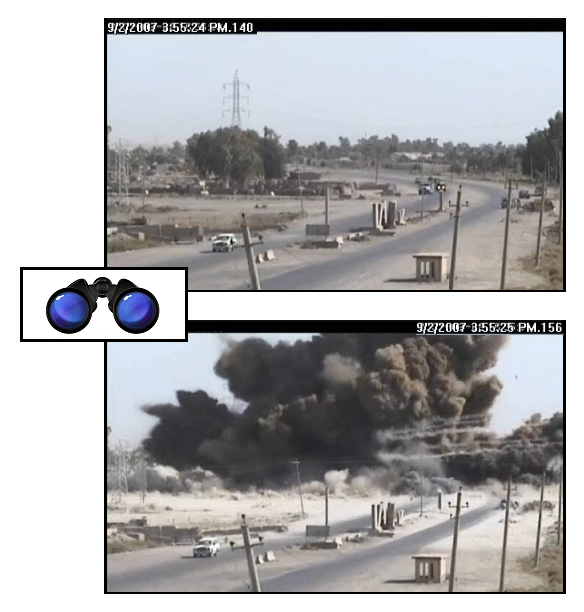
I’ve split these two images, both drawn from the same video one second apart, to give myself the fraying edges of a visceral sense of what that separation of life from body might be about.
See how little the car, bottom left, has advanced between the first image and the second.
The video the two images come from is embedded in Michael Yon‘s tribute to Carl Prine. I’d have embedded the video here myself if I could, but it’s in Vimeo rather than YouTube, and either because I’m incompetent or because Vimeo isn’t set up that way, I couldn’t figure out how to do the embed.
The Marine who sent Yon the video wrote:
This is the type of explosion that our troops are dealing with, not the puny kind we see on television or in the movies. Pass this on… so Americans will now understand what an IED truly is… and what our war veterans are dealing with.
Click on the link in red above if you haven’t already seen the movie nor lived through the event, and get that edge of a visceral sense — like a second-cousin-once-removed of the real thing.
My thoughts and prayers are with Carl Prine and all those battle-scarred in body, mind and soul.
**
One second passes between the first screen-grab and the second: time enough to sneeze, but not time enough to respond, “God Bless you”.
Life and death: a snapshot, a split second.

Zenpundit is a blog dedicated to exploring the intersections of foreign policy, history, military theory, national security,strategic thinking, futurism, cognition and a number of other esoteric pursuits.
Customized Web Site & Blog Design