zenpundit.com » FBI

Archive for the ‘FBI’ Category

McCants explains the Saudis, Quantico rebukes them

Friday, August 26th, 2016

[ by Charles Cameron — Saudi-sourced jihadism, the FBI, Baader-Meinhof — hey, it’s all about terrosism ]
.

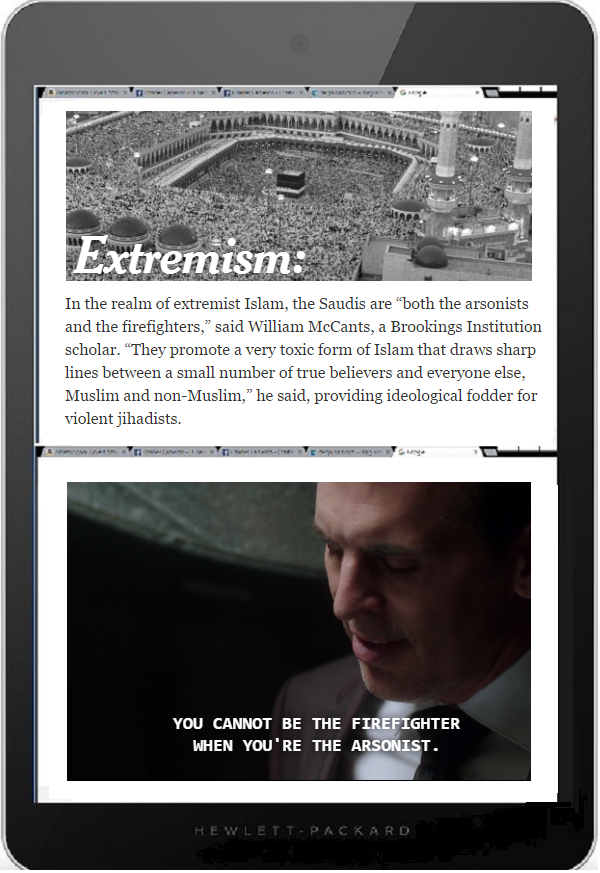
Will McCants explains [upper panel, below] how the Saudis are and are not promoting terrorism —

Tablet DQ 600 arsonist

— while a screen-cap from episode 9 in the first season of Quantico explains just why such an approach is logically bound to be defective.

**

Oh well, not to worry. It’s just another example of the illusion colloquially known as the Baader-Meinhof phenomenon. I wouldn’t want to go all irrational on you, so I’ll let RationalWiki explain:

The frequency illusion (also known as the Baader-Meinhof phenomenon) is the phenomenon in which people who just learn or notice something start seeing it everywhere.

Except that — well, there it is again — Baader-Meinhof — it’s all terrorism!

Clinton Comey?

Wednesday, July 6th, 2016

[ by Charles Cameron — with a side dish of Tzipi Livni ]
.
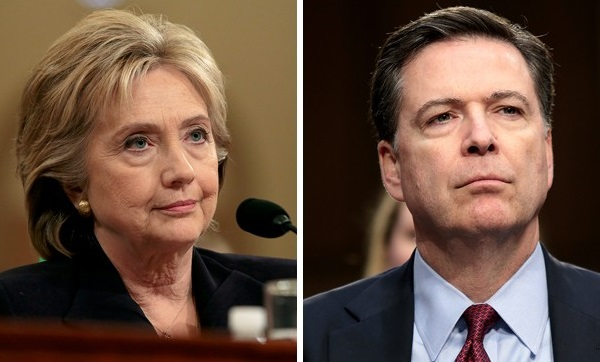
Ckinton Comey
photo credit: Greg Nash via The Hill

I’ll be socratic here, asking questions to illuminate my hunches.

**

I’m seldom fully convinced by anything that comes from the left and reads the way I’d expect the left to read, and seldom convinced by anything that comes from the right and reads the way I’d expect the right to read, so I don’t take the left’s assertions downplaying H Clinton’s security behavior with reflex belief, and on the whole I’m inclined to follow John Schindler, who — both as an ex-NSA analyst and as a regular at The Observer — takes a very hard line on Clinton’s security behavior, writing just a couple of weeks ago under the title, The Coming Constitutional Crisis Over Hillary Clinton’s EmailGate.

I also follow War on the Rocks, though, and was struck a while back by a post there from Mark Stout, drawing some interesting distinctions in line with its subtitle, “A former intelligence analyst who worked at both the CIA and the State Department explains how different approaches to classifying information sits at the heart of the scandal that threatens to undo Hillary Clinton.”

Which does somewhat complicate matters, while somewhat helping us understand them.

**

I’m neither an American nor a lawyer, and as someone who is generally inclined more to bridge-building than to taking sides in any case, I don’t feel qualified to debate the Comey-Clinton affair – but was interested to see emptywheel’s Marcy Wheeler, whom I take to be leftish, coming out today describing Comey’s decision as an “improper public prosecutorial opinion”. She writes:

Understand, though: with Sterling and Drake, DOJ decided they were disloyal to the US, and then used their alleged mishandling of classified information as proof that they were disloyal to the US ..Ultimately, it involves arbitrary decisions about who is disloyal to the US, and from that a determination that the crime of mishandling classified information occurred.

Comey, in turn, seems to have made it pretty clear that “Secretary Clinton or her colleagues“ were extremely careless in their handling of very sensitive, highly classified information” – specifically:

.. seven email chains concern matters that were classified at the Top Secret/Special Access Program level when they were sent and received.  These chains involved Secretary Clinton both sending emails about those matters and receiving emails from others about the same matters.

**

Is there, in your views, special treatment in this matter for persons of high rank present here?
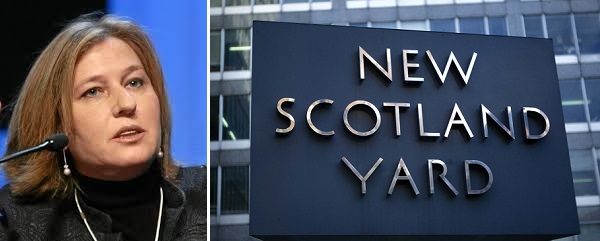
livni

And out of curiosity, if so, do you see a similar case of special treatment for persons of high rank over in the UK, known to be substantially less Israel-friendly than the US, where Scotland Yard wanted to question Tzipi Livni about alleged Israeli war crimes in Gaza under her watch as Foreign Minister, and “after diplomatic talks” Livni was “granted special diplomatic immunity”?

**

On the one hand, I don’t like show-trials, trials-by-press, banana courts or mob justice, and far prefer just laws justly applied – and on the other, I can understand that the scrutiny those in high office find themselves under can render them legally vulnerable in ways that may unduly influence their decision-making – and justice may be platonically blind, but is not always uniformly applied in practice. Such, it seems to me, is the human dilemma.

What say you?
Gaming Violent Extremism

Friday, February 12th, 2016

[ by Charles Cameron — compare, contrast, and consider ]
.

Let’s do some remote comparative play-testing, okay?

You are an impressionable youth — imagine! — which game would entice you? This one, from the Federal Bureau of Investigation, “played” here without a soundtrack —

— reviewed with wider context, more detail and critique here:

— or, this one, from the Islamic State

— with a hat-tip to Grand Theft Auto?

Ali Soufan on strategy & tactics

Tuesday, September 8th, 2015

[ by Charles Cameron — short and sweet ]
.

Everyone here knows that we are in a conflict with Islamic extremism. Everyone here knows that strategic outweighs tactical success. And most everyone here knows that Ali Soufan is one of the key voices on that topic — lead FBI agent investigating the Cole bombing, author of The Black Banners: The Inside Story of 9/11 and the War Against al-Qaeda, and outspoken interrogator-spokesman against the use of torture.

Hear him on strategy & tactics:

Analysis, and the question of trust

Sunday, March 29th, 2015

[ by Charles Cameron — who was taught to think of “longer term” as extending to our children of the seventh generation ]
.

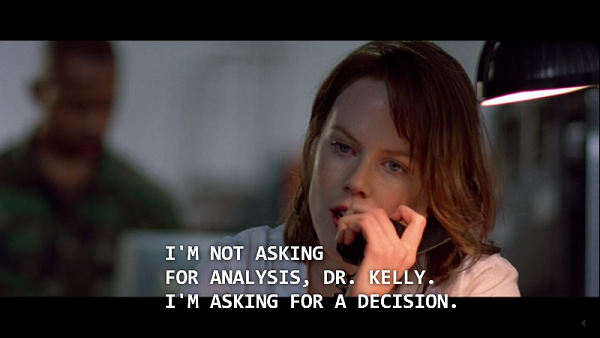
Here’s the problem:

Nicole Kidman as analyst Dr Julia  Kelly in DreamWorks SKG's first movie, The Peacemaker

Nicole Kidman as analyst Dr Julia Kelly gets an order in DreamWorks SKG’s movie, The Peacemaker

**

In the Introduction to Cyber Analogies (Feb 2014, 133 pp., Emily Goldman & John Arquilla, eds) we read:

The project was conceived and carried out to help very senior, busy, responsible people understand topics and issues that are fast-moving and dynamic, and have potentially great consequences for society, security, and world affairs.

I’m never quite sure that “very senior, busy, responsible people” are the right people to task with understanding “topics and issues that are fast-moving and dynamic, and have potentially great consequences for society, security, and world affairs.”

Ahem.

Do I qualify as a heretic yet?

I feel some kinship here with Pundita‘s recent comment:

I venture there are too many Grand Master chess players in America’s defense/diplo establishment and not enough ping pong players.

And the estimated number of exposures varies, I know — but how far would you trust the “very senior, busy, responsible people” who, we now know [1, 2, 3], covered up our poison gas casualties in Iraq?

**

At the expense of strategic analysis..

I’m thinking about all this because there’s a shift under way in intel circles, as described in the recently issued Report of the Congressionally-directed 9/11 Review Commission, The FBI: Protecting the Homeland in the 21st Century:

Once deployed to the field, many of these analysts have been embedded in operational squads in the field, though their work favors support to tactical and case work at the expense of strategic analysis. The FBI launched a more structured Integrated Curriculum Initiative (ICI) in 2014, with the primary goal to develop a comprehensive basic training program for new agents and analysts that teaches them to operate in a threat-based, intelligence-driven, operationally-focused environment.

More explicitly, Scott Shane wrote in C.I.A. Officers and F.B.I. Agents, Meet Your New Partner: The Analyst:

Some people who study intelligence and counterterrorism are concerned that the pendulum could swing too far. Intelligence analysts, said Amy Zegart, a Stanford scholar who studies intelligence, could become too consumed by daily operations and neglect strategic thinking about threats that could be years away.

At the C.I.A., she said, counterterrorism analysts are already “too tactical,” focused on the next drone target. If the same model is now applied to the rest of the agency’s work, other analysts, too, could be caught up in short-term demands, she said. “Who in the U.S. government,” she asked, “is going to be thinking about longer-term threats?”

Longer-term? You mean, longer than the current electoral cycle?


Switch to our mobile site