zenpundit.com » egypt

Archive for the ‘egypt’ Category

Should I whisper, should I scream? – Abu Musab al-Suri redux, Pt 2

Thursday, March 1st, 2012

[ by Charles Cameron — typology of intelligence failures, analytic blind spot, millennial movements, prophecy as strategy, abu Musab’s end times chronology ]
.

To tie in with the first part of this double-post, let me quote Aaron Zelin again:

I’ll back that up with Jean-Pierre Filiu‘s observation that in Abu-Musab al-Suri’s reading of jihadist history, “events lead on from one another toward the appearance of the Mahdi” — and that in Abu-Musab’s own words, “We shall be alive, then, when Allah’s order comes.”

I’ll give a brief account of the chronology below. Let’s get on with this.

1.

I don’t believe that Richard Landes, my mentor at the Center for Millennial Studies, mentions Abu Musab al-Suri in his Heaven on Earth: The Varieties of the Millennial Experiences (again as with Furnish, I could be wrong) — but if there’s a single book that will convince you of the enormity of our blind spot when it comes to taking millennial movements seriously, it’s this masterwork — simply stunning.

The thrust of his book is that millennial movements have been quite deliberately overlooked twice by the grand narratives of western civilization — first by religious writers who were embarrassed by the repeated cycle of enthusiasm followed by failure of end times prophecies and retroactively marginalized the topic, and more recently by…

secular historians, determined to push religion into the background of their story, [who] were hardly interested in highlighting religious phenomena that even the ecclesiastical historians considered ridiculous.

It is to undo the damage that this two-fold blindedness has caused us that Landes writes his remarkable book, covering in extraordinarily wide-ranging scholarly detail and with insight and wit, that current in human fear and hope he terms “the most protean belief in human history: millennialism.”

2.

In other words, the “the most protean belief in human history” has been consistently disregarded for way too long by academics, pundits and experts.

Put that in the context of this trenchant paragraph from Richards Heuer‘s Psychology of Intelligence Analysis, just recently quoted and indeed highlighted by Clint Watts and John E. Brennan in their paper Capturing the Potential of Outlier Ideas in the Intelligence Community:

Major intelligence failures are usually caused by failures of analysis, not failures of collection. Relevant information is discounted, misinterpreted, ignored, rejected, or overlooked because it fails to fit a prevailing mental model or mind-set.

3.

Rejected and overlooked?

Even the Psalmist (118.22) knows the importance of what’s rejected:

The stone which the builders rejected has become the chief cornerstone.

And just in passing, I’d argue that two of the seven “outlandish, unthinkable, and wholly anomalous” outliers that Watts & Brennan offer as bulleted examples in their paper — the Khomeini and bin Laden events — would have shown up rather more prominently had a subset of analysts been tasked to keep an eye on millenialist and / or specifically mahdist movements.

4.

Very quickly, then, here are some of the recent reports regarding al-Suri from well-informed analysts which seem to pay little mind to the Mahdist strand in his strategic thinking:

  • Raff Pantucci‘s January 26, 2012 post Whither al Suri? focuses on the implications of al-Suri’s release and quotes Brynjar Lia — insightful, but no mention of Mahdism.
  • Aaron Zelin‘s February 3 Foreign Policy post on al-Suri’s release comes closest to mentioning an apocalyptic angle when he writes:

    Additionally, his lore will grow in light of an alleged vision he had this past August, which was relayed by online jihadist Jundi Dawlat al-Islam (“Soldier of the Islamic State”), a member of the important Shamukh al-Islam Arabic Forum. “I have been informed that the Shaykh [Suri] saw in the past days a vision that he will have an important role in Bilad al-Sham (Syria), we ask Allah that it becomes true,” the jihadist wrote. Suri’s release will be seen as a vindication of that vision by his supporters, and no doubt boost his influence.

    The significant role of Shams — “the apocalyptic theater par excellence” — in al-Suri’s narrative is something J-P Filiu emphasized (p. 189).

  • Bill Roggio‘s February 5 piece for Long War Journal is an excellent backgrounder as befits LWJ — but no mention of eschatological strategy there, either.
  • Jarret Brachman‘s February 6 Abu Musab al-Suri Still Matters Online at Chronus Global is a brief note, just a tip-off that al-Suri is still influential…
  • MEMRI‘s February 8, 2012 The Release of Top Al-Qaeda Military Strategist/Ideologue Abu Mus’ab Al-Suri from Syrian Prison – A Looming Threat makes no mention of al-Suri’s eschatological thinking, and neither does their more extensive report on al-Suri, Al-Qaeda Military Strategist Abu Mus’ab Al-Suri’s Teachings on Fourth-Generation Warfare (4GW), Individual Jihad and the Future of Al-Qaeda, to which their February 2012 post links.
  • And the Jamestown Foundation‘s Feb 10 piece by Murad Batal al-Shishani, Syria’s Surprising Release of Jihadi Strategist Abu Mus’ab al-Suri, in their Terrorism Monitor v 10 # 3 doesn’t mention the apocalyptic angle — and Jamestown is where I heard Ali A Allawi speak on Millenarianism, Mahdism and Terrorism: The Case of Iraq back in 2007!

    Curious…

  • Ah well, there’s always Zenpundit [vbg].

    5.

    Okay, it looks to me as though we’re still so focused on the “nizam la tanzim / system not organization” and “lone wolf / leaderless resistance” aspects of al-Suri’s work, significant as they are, that it’s easy to overlook that damned ridiculous “end times” stuff the fellow also considers important, strategically speaking.

    So for the record, here’s the chronology of future events as J-P Filiu recounts it:

    Events will unfold in the following manner: “The Arabian Peninsula will be preserved [from harm] until the destruction of Armenia, Egypt will be preserved until the destruction of the [Arabian] peninsula, Kufa will be preserved until the destruction of Egypt, the city of impiety [mad?nat al-kufr] will be conquered only after the great wars, and the Antichrist will appear only after this conquest.” The concentrically expanding path of apocalyptic devastation will then close in upon Palestine, the sanctuary of Judeo- Crusader “impiety,” where the ultimate confrontation with the Byzantines will take place in and around the city of Acre.

    Well, that’s part of it, but you should read Filiu’s pp 186-191 for a fuller account — and somebody, please send me a reliable translation of those last 100 pages of abu Musab’s Call if you have one!

    Sadly, I don’t read or speak Arabic.

    6.

    Okay, that’s it, I’ve shouted, or whispered or whatever.

    The books at the top of this post are:

    David Cook, Contemporary Muslim Apocalyptic Literature
    Timothy Furnish, Holiest Wars: Islamic Mahdis, Their Jihads, and Osama bin Laden
    Jean-Pierre Filiu, Apocalypse in Islam
    Richard Landes, Heaven on Earth: The Varieties of the Millennial Experience

    All four are worthy of your consideration.

    Egyptian Graffitology

    Saturday, February 18th, 2012

    [ by Charles Cameron — politics and esthetics of revolutionary graffiti ]
    .
    At first, I was looking to see whether Anonymous made an appearance in the graffiti of the Egyptian popular uprising, and yes indeed:

    What I found in my searching around included some pretty striking graphics — and a well-wrought English pun-slogan, too!

    *

    In fact I stumbled onto a number of interesting visuals — many of them in Gigi Ibrahim‘s photostream of Egyptian street art

    One image that struck me featured “Tantawi’s underpants” — a popular motif, apparently, and one that seemed to me to make an interesting response / riposte to the iconic “blue bra girl” so shamelessly exposed by the Egyptian police:

    *

    So you can find a modern, maybe even a post-modern Egypt, up on the walls however fleetingly. But there’s also a sense of Egypt ancient and sophisticated — and this, too, I though worthy of your attention:

    These two murals are grieving / protesting those who died in the “Port Said massacre” which followed a football game between rival Egyptian teams.

    *

    There’s much more to be seen — from “Facebook” and “the revolution will not be tweeted” to “no more guns” and images of a young man throwing a molotov cocktail… to graphics of cross and crescent intertwined.

    The point being that this kind of “unofficial” art, like the anasheed of jihad, can give us a glimpse into the substrate of feeling that constitutes the morale of a given movement — which can at times be raw and stark, and at times strikingly beautiful, too.

    Iconic: compare and contrast

    Thursday, December 22nd, 2011

    [ by Charles Cameron — iconic images, riot police, compare and contrast, repetition with variation ]

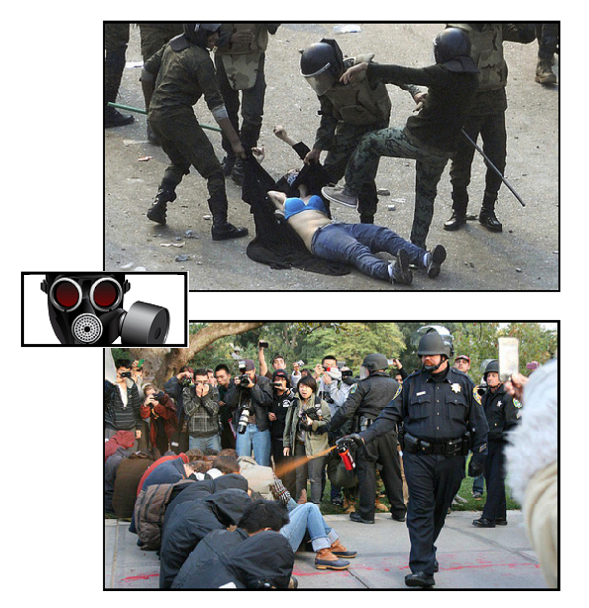
    First, let’s be clear that both these images have been widely considered iconic.

    Thus NPR reported of the first photo:

    There have been countless accounts of violence recorded during the uprisings in Egypt but the image that perhaps has captured the most attention is the most recent. The image has been widely referred to as the “girl in the blue bra.”

    While Real Clear Politics quotes Michael Moore on the second:

    “The images have resonated around the world in the same way that the lone man standing in front of the tanks at Tiananmen Square resonated. It is an iconic movement in Occupy Wall Street history,” Michael Moore declared on MSNBC’s “Last Word” program.

    Moore was referring to police pepper spraying students at an “Occupy” protest at UC Davis.

    So we have two similarities between the two images: they both show police in riot gear taking action against demonstrators, and they have both caught the public eye as somehow being representations that can “stand in” for the events they seek to portray.

    Beyond that, it’s all compare and contrast territory — or variations on a theme, perhaps — and different people will find different reasons to attack or defend the demonstrators or the police in one, the other, or both cases.

    1.

    These are, for many of us, “home” and “away” incidents, to borrow from sports terminology, and some of our reactions may reflect our opinions in general of what’s going on in Egypt, or in the United States.

    We may or may not know the rules of engagement in effect in either case, on either side.

    In a way, then, what the photos tell us about those two events, in Tahrir Square and on the UC Davis campus, may tell us much about ourselves and our inclinations, too.

    2.

    As I’ve indicated before, I am very interested in the process of comparison and contrast that the juxtaposition of two images — or two quotes — seems to generate. And I’ve quoted my friend Cath Styles, too:

    A general principle can be distilled from this. Perhaps: In the very moment we identify a similarity between two objects, we recognise their difference. In other words, the process of drawing two things together creates an equal opposite force that draws attention to their natural distance. So the act of seeking resemblance – consistency, or patterns – simultaneously renders visible the inconsistencies, the structures and textures of our social world. And the greater the conceptual distance between the two likened objects, the more interesting the likening – and the greater the understanding to be found.

    I’d like to examine these two particular photographs, then, not as images of behaviors we approve or disapprove of, but as examples of juxtaposition, of similarity and difference — and see what we might learn from reading them in a “neutral” light.

    3.

    What I am really trying to see is whether we can use analogy — a very powerful mental tool — with something of the same rigor we customarily apply to questions of causality and proof, and thus turn it into a method of insight that draws on our aha! pattern recognition and analogy-finding intuitions, rather than the application of inductive and deductive reason.

    And that requires that we should know more about how the mind perceives likenesses — a topic that is often obscured by our strong emotional responses — you’re making a false moral equivalence there! or look, one’s as bad as the oither, and it’s sheer hypocrisy to suggest otherwise!

    So among other things, we’re up against the phenomenon I call “sibling pea rivalry” — where two things, places, institutions, whatever, that are about as similar as two peas in a pod, have intense antagonism between them, real or playful — Oxford and Cambridge, say, and I’m thinking here of the Boat Race, or West Point and Annapolis in the US, and the Army-Navy game.

    Oxford is far more “like” Cambridge than it is “like” a mechanic’s wrench, more like Cambridge than it is a Volkswagen or even a high school, more like it even than Harvard, Yale, Princeton or Stanford — more like it than any of the so-called “redbrick universities” in the UK — so like it, in fact, that the term “Oxbridge” has been coined to refer to the two of them together, in contrast to any other schools or colleges.

    And yet on the day of the Boat Race, feelings run high — and the two places couldn’t seem more different. Or let me put that another way — an individual might be ill-advised to walk into a pub overflowing with partisans of the “dark blue” of Oxford wearing the “light blue” of Cambridge, or vice versa.  Not quite at the level of the Zetas and the Gulf Cartel, perhaps, but getting there…

    4.

    So one of the things I’ve thought a bunch about is the kind of analogy that says a : A :: b : B.

    As in: Egyptian cop is to Egyptian protester as UC Davis cop is to UC Davis protester.

    Which you may think is absolutely right — or cause for impeachment — or just plain old kufr!

    And I’ve figured out that the reason people often have different “takes” on that kind of analogy — takes so different that they can get extremely steamed about it, and whistle like kettles and bubble over like pots — has to do with the perceptual phenomenon of parallax, whereby some distances get foreshortened in a way that others don’t.

    5.

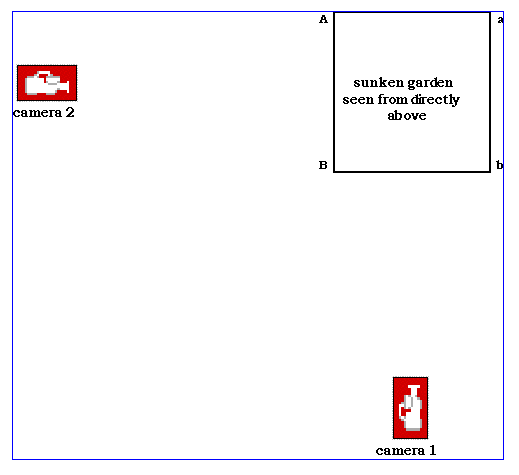
    So my thought experiment sets up a sunken garden — always a pleasure, with two video cameras observing it, as in this diagram:

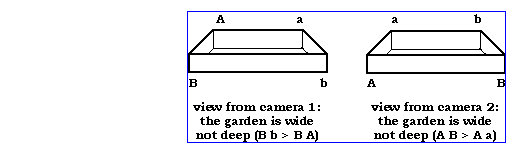
    And from the two cameras, the respective views look like this:

    In this scheme of things, Aa (Oxford) seems very close to Bb (Cambridge) seen from the viewpoint of camera 1 — but from camera 2’s standpoint, Aa (Oxford) and Bb (Cambridge) are at opposite ends of the garden, and simply couldn’t be father apart.

    6.

    Now, my thinking here is either so obvious and simple as to be a platitude verging on tautology — or one of those subtle places where the closer examination of what looks tautological and obvious leads to the emergence of a new insight, a new “difference that makes a difference” in Bateson’s classic phrase.

    And clearly, I hope that the latter will prove to be the case here.

    7.

    What can we learn from juxtapositions? What can we learn from our agreements about specific juxtapositions — and what can we learn from our specific disagreements?

    Because it’s my sense that samenesses and differences both jump out at us, as Cath Styles suggested — and that both have a part to play in understanding a given juxtaposition or proposed likeness.

    Each juxtaposition will, in my view, suggest both a “sameness” and a “difference” — in much the same way that an arithmetic division of integers, a = qd + r, gives both quotient and dividend.

    And then we have two or more observers of the juxtaposition, who may bring their own parallax to the situation, and have their own differences.

    8.

    Tahrir is to Tienanmen as Qutb is to Mao?

    Or is pepper spray just a food additive?

    And how do icons become iconic anyway? Are they always juxtapositions, cops against college kids, girl vs napalm, man against line of tanks?  Even in the iconic photo of Kennedy from the Zapruder film, the sudden eruption of violence into the stateliness of a presidential parade is there — a morality play in miniature.

    Any thoughts?

    Twitter combat, al-Shabaab, black banners, Tahrir and more

    Thursday, December 8th, 2011

    [ by Charles Cameron — first Twitter as combat zone, then black banners again, Somalia, Mahdism, Babism, AQ, Iraq, Libya, Egypt  ]


    Just for the record.

    You probably already knew ISAF has been tweeting back at the Islamic Emirate, and you can follow both at @ABalkhi and @ISAFmedia…

    Well, @HSMPress just joined the fray — that’s al-Shabaab:

    Notice the flag?

    It’s that black banner again.

    *

    There has been some controversy over whether or not there was an element of support for AQ in Libya, and at the recent Tahrir Square demonstrations, and black banners have featured heavily in the discussions.

    Let’s get our black banners straight. First, Libya.

    This was the black flag allegedly flown in Libya after the ouster of Col. Gadhafi.  It was published as illustrated here by the Daily Telegraph, under the headline “Libya: Al Qaeda flag flown above Benghazi courthouse” and with the commentary ” The black flag of Al Qaeda has been spotted flying over a public building in Libya, raising concerns that the country could lurch towards Muslim extremism.”

    Note the resemblance to the logo al-Shabaab is using.

    *

    Juan Cole pooh-poohed the idea that this was an AQ flag, calling it a “silly urban legend going around” and quoting a Libyan scholar-friend on the point:

    I looked up the mentioned flag, it appears to be a black flag with the shahada [Muslim profession of faith] in it. A black flag goes back all the way to the prophet, and the addition of the shahada makes it a Jihadist flag. There have been Jihadists in Libya from day one, and they fought against Qaddafi. But is Al-Qaeda, as in the global network taking over? No.

    Cole’s friend’s comments are worth reading in full: they provide context on the various factions and their relative strengths, and Cole sums it all up in terms of the specific issue of AQ and Benghazi thus:

    What this informed observer is saying is that a miniscule group of jihadists put up that flag, in the chaos of the post-revolutionary period, but that they are highly unrepresentative of politics in Benghazi.

    Fair enough. But that wasn’t just a black flag with the Shahada, was it?

    When Cole’s friend rites “A black flag goes back all the way to the prophet, and the addition of the shahada makes it a Jihadist flag,” Cole comments “Moreover, the black flag as a symbol is not a monopoly of al-Qaeda. Revolutionaries raised a black flag in the medieval Abbasid Revolution of 750 AD.”

    Indeed. They may also have produced the ahadith about the army with black banners from Khorasan, which give such flags a distinctively Mahdist application – ahadith which Ali Soufan tells us have been used extensively in AQ recruitment.

    So there are black banners and black banners. There was “Khalifa Abdullah’s great black banner, black-lettered with text from the Koran and the Mahdi’s sayings” mentioned in Burleigh‘s account of the Battle of Omdurman – and a little earlier, the Bab had instructed his followers to “gather under the black standard which was being raised in Khurasan” according to Munirih Khanum‘s Memoirs and Letters.

    *

    Aaron Zelin has a post at The Wasat which allows for a quick comparison between various black flags and banners. Here’s the flag that Aaron identifies as that of the Islamic State of Iraq:

    That’s an AQ-related flag, and it distinctly features what is believed to be the seal of Muhammad:

    So I wouldn’t be so sure that “No, that wasn’t an al-Qaeda Flag over Benghazi” Dr. Cole.

    *

    What about Egypt?

    In another piece — this one entitled “Did the Muslim Brotherhood Threaten to Kill “All Jews”?” — Dr. Cole wrote:

    The Muslim Brotherhood and other religious parties in Egypt (including the Salafis and the Gama’a al-Islamiya) held a rally at al-Husayn Square in Cairo last Friday to which a few thousand people came. The big rally was at Tahrir Square in downtown Cairo and was dominated by secular forces.

    Cole is entirely right in rebutting a YNet correspondent’s claim that “a Koran quote vowing that ‘one day we shall kill all the Jews’ was uttered” at the al-Husayn site:

    Beck, who clearly does not know what he is talking about, said that the crowd repeatedly quoted a verse in the Qur’an that spoke of killing all Jews. There is no such verse in the Islamic holy book. The Jewish revelation from God to Abraham and Moses is retold in the Qur’an, which has positive stories of the Children of Israel. The castigation of the Children of Israel in the Qur’an is of the same sort you see in the Hebrew Bible, and often put in the mouth of Moses or another Jewish prophet.

    Indeed, a commenter on the YNet article from Quebec went further:

    Eldad Beck wrote: “Time and again, a Koran quote vowing that ‘one day we shall kill all the Jews’ was uttered at the site”.

    There is NO such verse in the Qur’an. In fact, the Qur’an says this:

    “Those who believe in the Qur’an, those who follow the Torah and the Sabians and Christians–anyone who believes in G-d and the Last Day and who does righteous deeds need not be in fear and will not grieve.” (5:69)

    There were indeed hotheads in the crowd who yelled that they would “fight the Jews (i.e., Israelis)”. If Mr. Beck spoke Arabic fluently, he would not have mistaken the shouted word “mutaqalah” (to fight, combat, overcome) with the word “qatala” (to kill). In addition, he would know that in Palestinian colloquial Arabic “al-yahud” (the Jews) usuallhy has the limited meaning of “the Israelis”.

    Sadly the errors (or willful misrepresentations) of Beck have been repeated in dozens if not hundreds of paper and electronic media.

    If he made an innocent error, he should apologize and set the record straight.

    If not, let him stand before the Mercy Seat of Ha-Shem and explain why he violated the commandment given to Moses: “You shall not bear false witness against your neighbour.”

    *

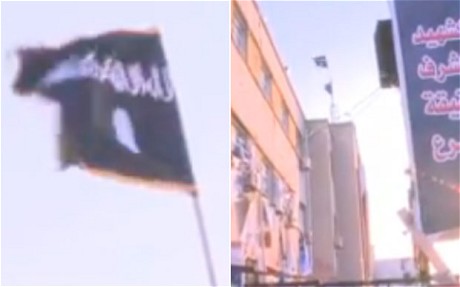
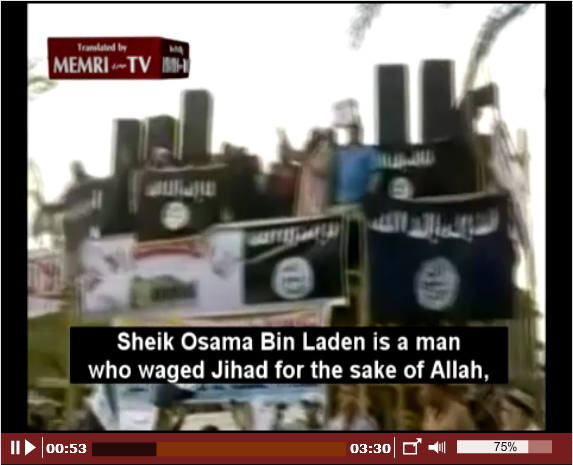
    The thing is — getting back to our black banners with Shahada and distinctive seal of Muhammad — there were in fact demonstrations in Tahrir Square just a week earlier, at which those pesky black flags were in evidence:

    MEMRI brought us the video of which that is a screen-capture, and provided a transcript of Sheikh Tawfiq al-Afni‘s address to the crowd, of which this is an excerpt:

    Tawfiq Al-Afni (On stage): ”Sheikh Osama bin Laden is a man who waged Jihad for the sake of Allah, and we pray that Allah will unite us with him and the martyrs in Paradise. My brothers, in Islam, we say with great pride that we adhere to the Jihad for the sake of Allah…”

    Crowd: “Allah Akbar.”

    Tawfiq Al-Afni: “We are not waging Jihad for worldly benefits or for positions. By Allah, we have only come to pledge our allegiance to Islam. We wage Jihad for the sake of Allah and the Koran. […]

    “We respond to Your call. Please turn our skulls into a ladder for your glory.”

    Crowd:
    “We respond to Your call. Please turn our skulls into a ladder for your glory.”

    Black banner, Shahada, seal of Muhammad, Tahrir Square.

    *

    So it’s important that we should know these things (oh, and much more besides):

    • The black banners are in Tahrir and Somalia, as they have been in Mahdist movements stretching back to the Abbasids.
    • Black banners featuring the seal of Muhammad appear to have a connection with AQ, often indicative of sympathetic support, if not active participation.
    • That such voices exist in Egypt should not make us think that they represent a majority, nor indeed that they are the voice of the Muslim Brotherhood, but rather that they are among the voices raised in a tumultous situation.
    • There are many secular voices raised in Tahrir, and also Islamist voices with a willingness to take the path of politics and compromise.
    • We should remember that there are voices in Tahrir of both terror and reconciliation. We should not forget the voices of those Muslims who protected Coptic churches, nor of the Copts who protected Muslims while they bowed their heads in prayer
    • And no-one, no-one left or right should forget that the Egyptian army, too, has a voice, and a megaphone, and much more besides.

    Gunpowder, treason and plot

    Saturday, November 5th, 2011

    [ by Charles Cameron — instance of religious terrorism, UK, Catholicism, Protestantism, Vendetta-the-movie, Anonymous, OWS, Pharaoh ]

    .

    men.jpg

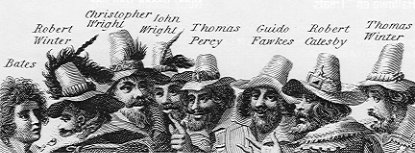
    I am seven hours “behind” the land of my birth, but today would be the day on which to remember one Guy — named Guido in the image above — Fawkes, a terrorist whose religious and political sympathies were closely interwoven.

    *

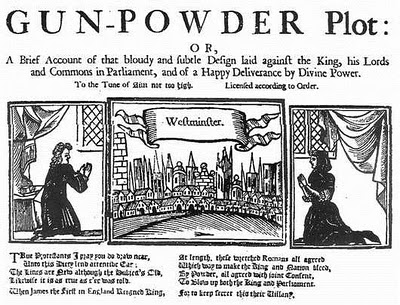
    Archbishop Cranmer‘s [dare I say, Laudable?] blog today has a poetic description of the event, a fine illustration:

    gunpowderplot.jpg

    and some fascinating comments portraying both the event itself and religious terror more generally…

    We have had four hundred years to “remember, remember” — should we remember, or should we forgive and forget?

    *

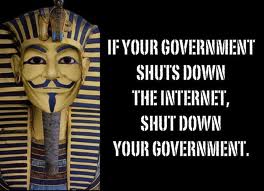
    The mask worn in the movie V for Vendetta is a Guy Fawkes mask, now also associated with both the Anonymous group and the Occupy movement… and it shows up in all sorts of strange places…

    images1.jpg

    Pharaoh? Guy Fawkes?

    Clear proof that if you connect too many dots, you may go what we Brits call “dotty”…


    Switch to our mobile site