zenpundit.com » egypt

Archive for the ‘egypt’ Category

And a little child shall lead them…

Monday, October 14th, 2013

[ by Charles Cameron — on two viral videos of children ]
.

Malala Yousafzai has been in many hearts and minds recently, and deservedly so. Her speech before the United Nations Youth Assembly, like her John Stewart interview, went viral on YouTube– here’s a version that has the grace to include her opening invocation of the Name of God:

Thinking idly about her the other day I was reminded of anither video of a schoolchild that went viral just a few months ago — this one the more off-the-cuff speech of a boy, Ali Ahmed, interviewed on the street. He’s twelve, Malala spoke at the UN on her sixteenth birthday, but he testifies eloquently to Malala’s point by his own obvious clarity and intelligence:

I think it’s worth holding these two video clips in mind together, the young woman and the young man, she almost fatally wounded and now recovered, he happening to be at the right spot on the right moment to be interviewed, her words reaching us directly in her fluent English, his coming to us only via sub-titles, as in an art-house “foreign” movie… If she has eclipsed him, let us remember him again.

The intelligence, the clarity. the education. And how many thousands more must there be, unviral and unsung, but no less intelligent?

**

Unless ye become as little children, saith the Gospel, and a little child shall lead them, saith the Prophet.

With God on both our sides…

Sunday, September 15th, 2013

[ by Charles Cameron aka hipbonegamer — shall we file this under religion, or politics? ]
.

**

Let’s see, now: religiously speaking, you can support a murderous dictator on a rampage against his own people, or the rebels who oppose him who take video selfies of themselves eating their deceased enemies’ hearts — or abstain from taking sides and let the two parties shoot and rape it out among themselves…

Sheikh Youself al-Qaradawi is an Egyptian cleric with a following in the tens of millions, while Roman Silantyev is a “religious expert and head of the Human Rights Center of the World Russian People’s Council” and staff member of the Moscow Patriarchate Department for External Church Relations.

**

Sources:

Serpent logic and related

Saturday, September 14th, 2013

[ by Charles Cameron — where paradox begets form in phrasing, redux ]
.

Here for your entertainment and entrainment are some further instances where the tweet doubles back on itself, bites its tail, or otherwise embodies some form of “form” that’s noteworthy in its own right, and possibly indicative of the heart of a problem — think of these tweets as eddies in the flow of things, knots in the wood…

Two arms crossed as in that MC Escher hand-draws-hand piece:

And a net version of the same, aka “tit for tat”:

Speaking of economics, here’s a bit of spiral logic — the economics of spiralling out of control?

And here’s an example of “endless” recursion, as featured in two tweets about “end” times from Barth’s Notes:

and its 2013 equivalent:

**

Okay, here are some simple sample opposites. First, the weather forecast for Syria:

— spelled our explicitly by Andrew Stroehlein, who tweeted “Sunny with a chance of cluster bombs…” in response.

That one seems fairly fair, but click on the links yourself to see the nuances in King‘s actual statements.

**

Now for some regular serpents’ tails, from the reasonably light-hearted to the heavier end of the scales:

Okay, here are two from Mikko Hypponen, the first of which is frankly outdated, but still fun:

Angela Watercutter caught the tide at just the right moment with her Wired piece, Skynet Becomes Self-Aware: How to Welcome Our AI Overlords:

The time has come. According to the Terminator clock, at 8:11 p.m. Tuesday, Skynet will become self-aware. And humanity will be screwed. Going by canon set out in the Terminator: The Sarah Connor Chronicles TV series, Judgment Day should hit Thursday.

Never mind Mikko, this one’s funny too — if and only if one’s also familiar with Wikipedia, which seems plausible in all cases for those who follow twitter — it wins double-honors in fact, hitting it out of the self-reference ball-park and into parallelism as satire:

**

Namarupa, or “name and form”, has to do with parallelisms between a name and its referent — or what zen might call the “finger pointing” and the moon — always fun:

The next one depends on your knowing that the Greek mythological creature known as a Naiad refers to “any of the nymphs in classical mythology living in and giving life to lakes, rivers, springs, and fountains”:

— aptly named indeed.

**

We’re almost done — here’s one with a built in time-factor:

It it still there? Aha!

**

Finally, this isn’t a serpent eating its tail by itself:

— but it becomes one, I’d suggest, when Husain Haqqani, Pakistan’s Ambassador to the US from 2008 to 2011, retweets it!

**

Until next time…

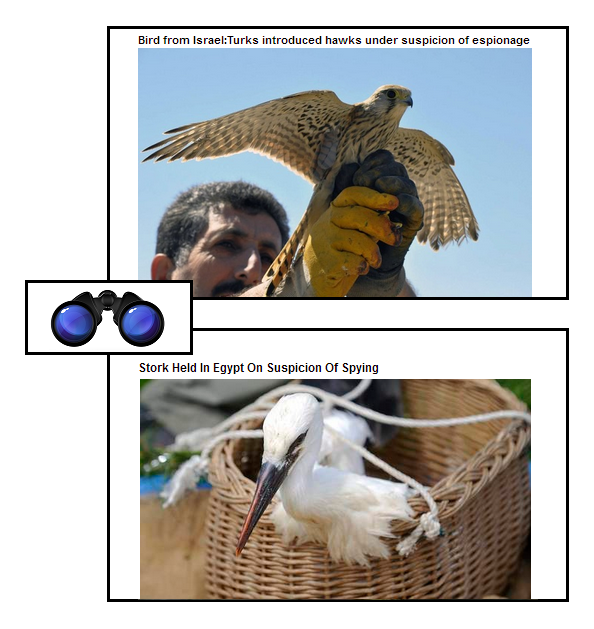
A wildlife DoubleQuote in the Wild, hat-tip Dan Trombly

Sunday, September 1st, 2013

[ by Charles Cameron — carrier pigeons, guilty, 1914, okay — dolphins, jury still out — but these storks and hawks, innocent I do believe ]
.

Sources:

  • Sky News, Stork Held In Egypt On Suspicion Of Spying, 31 August, 2013
  • National Turk, Turks introduced hawks under suspicion of espionage, 27 July, 2013
  • **

    I can claim no responsibility for this DoubleQuote, which I would never have “caught” without Dan Trombly‘s keen eye as manifest in his tweet today:

    For extra bite:

    The stork story concludes with this delicious tid-bit:

    In 2010, a series of shark attacks along Egypt’s Mediterranean coast were blamed on “GPS-controlled sharks” allegedly sent by Israeli security services into Sinai waters.

    Jumping the shark?

    Big Pharaoh: Levels of complexity in presentation

    Thursday, August 29th, 2013

    [ by Charles Cameron — Syria, yes, but with a focus on networks, tensions, mapping, and understanding ]
    .

    Binary logic is a poor basis for foreign policy, as Tukhachevskii said on Small Wars Council’s Syria under Bashir Assad: crumbling now? thread, pointing us to the work of The Big Pharaoh. Here are two of the Big Pharaoh’s recent (before Obama‘s “undecided” speech) tweets:

    Each of those tweets is non-linear in its own way, but via its implications — we “complete the loop” by knowing that the “mass murderer” is the Syrian President, Bashar al-Assad and the “cannibal” is the Syrian rebel, Abu Sakkar, and that Al-Qaeda typically cries “allahu Akbar” after killing Americans, while Americans typically rejoice after killing Al-Qaeda operatives. So these two tweets are already non-linear, but not as complex as what comes next>

    **

    The Big Pharaoh also put this diagram on his blog, and Max Fisher picked it up and blogged it at the Washington Post as The Middle East, explained in one (sort of terrifying) chart:
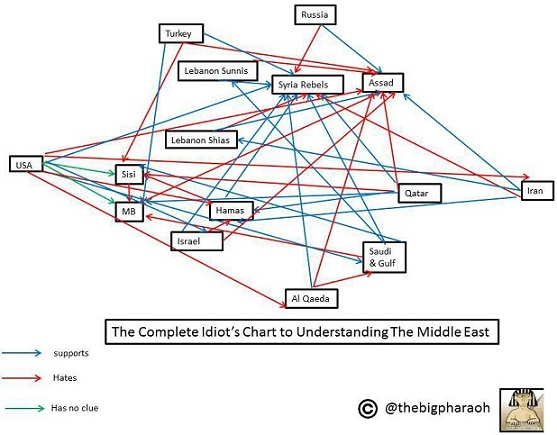
    I’d have some questions here, of course — one about the directionality of the arrows, which only seem to go in one direction — okay for the “supports” and “has nu clue” arrows, perhaps, but surely the “haters” would mostly be two-way, with AQ hating US as well as US hating AQ? There’s no mention of Jordan, I might ask about that… And there are no arrows at all between Lebanese Shias and Lebanese Sunnis — hunh?

    **

    What really intrigues me here, though, is that while this chart with fifteen “nodes” or players captures many more “edges” or connections between them than either or even both of the two tweets above, the tweets evoke a more richly human “feel” for the connections they reference, by drawing on human memories of the various parties and their actions.

    Thus on the face of it, the diagram is the more complex representation, but when taken into human perception and understanding, the tweets offer a more immediuate and visceral sense of their respective situations.

    And scaled down and in broad strokes, that’s the difference between “big data” analytic tools on the one hand, and HipBone-Sembl approach to mapping on the other. A HipBone-Sembl board may offer you two, or six, ten, maybe even a dozen nodes, but it fills them with rich anecdotal associations, both intellectual and emotional — a very different approach from — and one that I feel is complementary to — a big data search for a needle in a global needlestack…

    **

    But I’d be remiss if I didn’t also point you to Kerwin Datu‘s A network analysis approach to the Syrian dilemma on the Global Urbanist blog. He begins:

    A chart by The Big Pharaoh doing the rounds of social media shows just how much of a tangled mess the Middle East is. But if we tease it apart, we see that the region is fairly neatly divided into two camps; it’s just that one of those camps is divided amongst itself. Deciding which of these internal divisions are fundamental to the peace and which are distractions in the short term may make the diplomatic options very clear.

    and goes on from there, offering a series of network graphs of which is the fourth:

    from which he draws the following observation:

    What can we do from this position? If the US decides to pursue a purely military route to remove Assad from power, it will incur the ire of Russia, Iran and Lebanese Shias, but it can do so with a broad base of support including the Syrian rebels themselves, Israel, Qatar, Turkey, Lebanese Sunnis, and even Al Qaeda. However if it chooses a diplomatic route to curry support to remove Assad it must isolate him in the above graph by making an ally out of Russia and/or Iran (assuming that making an ally out of Lebanese Shias would have little impact). Russia doesn’t hate the US but it does hate the Syrian rebels, making it an unpromising ally against Assad. Iran hates the Syrian rebels and the US hates Iran, but the Al Qaeda is a thorn in both their sides, making it a potential though unlikely source of cooperation.

    Really, you and I should read the whole piece, and draw our own conclusions.

    **

    Or lack thereof. I’ll give the last tweet to Teju Cole, who articulates my own thoughts, too:


    Switch to our mobile site