zenpundit.com » scriptures

Archive for the ‘scriptures’ Category

Manhunt: Radicalization, & comprehending the full impact of dreams

Saturday, June 8th, 2013

[ by Charles Cameron — how do you intercept messages that come via dreams? I’m thinking of al-Balawi ]
.

My little graphic (below) may be kidding — but what of reality?

**

In the bin Laden documentary, Manhunt, which I mentioned before seeing it here, and discussed briefly here, another passage (at 1.22.31) that is missing from the CNN transcript concerns the dream which radicalized Humam al-Balawi, the Khost bomber. Balawi speaks, the subtitles translate for us:

God blessed me to have this dream. I dreamed I saw Zarqawi. He was in my house. His face was like a full moon. He was busy. Preparing an attack. I wishes I could fight with him. Be killed with him. I am your humble brother from Jordan. I am 32 years old and a medical doctor.

I’m not suggesting there was no prior fertilization of Balawi’s mind and heart, nor that he was influenced by no other drivers: I just wonder what the impact of such a dream would be, given that intense smuggling goes on between our waking and dream lives, of a kind that no intercepts can capture for analysis.

**

How powerful can influence can a dream exert?

Consider this example, taken from Marie-Lousie von Franz, On Dreams & Death: A Jungian Interpretation, p. 64:

She sees a candle lit on the window sill of the hospital room and finds that the candle suddenly goes out. Fear and anxiety ensue as the darkness envelops her. Fear and anxiety ensue as the darkness envelops her. Then, the candle re-lights on the other side of the window and she awakens. She died the same day.

**

If I may borrow a bit from some unpublished writings of mine…

Dreams as early indicators:

The western secular paradigm considers dreams to be of little or no significance, and it is therefore entirely possible that intelligence gleaned from the recounting of dreams will seem of little interest to western analysts. In the Islamic view, however, certain dreams are of considered to be of real significance, their importance being indicated by the hadith reported by Bukhari:

Narrated Ibn ‘Umar: Allah’s Apostle said, “The worst lie is that a person claims to have seen a dream which he has not seen.”

— Sahih Bukhari, book 87: Interpretation of Dreams, #167.

One early indicator of a Mahdist tendency in a given population, therefore, would be the presence of dreams about the Mahdi in a given discourse — in jihadist chat rooms, for instance — while the frequency of such mentions would be a useful heuristic measure of the development of such a movement. Thus Yaroslav Trofimov reports [Siege of Mecca, hb. p.50.] that in the run-up to the 1979 siege of the Grand Mosque and Ka’aba in Mecca, many followers of Juhayman al-Otaibi, the leader of the raid, dreamed dreams:

Then, one after another, hundreds of Juhayman’s supporters experienced detailed, vivid dreams. Mohammed Abdullah’s sister appears to have been the first, quickly followed by others. In their sleep, they all had the same vision: Mohammed Abdullah standing by the sacred Kaaba in Mecca’s Grand Mosque, accepting allegiance as the blessed Mahdi amid multitudes of believers. Militants from as far away as Lebanon who never encountered Mohammed Abdullah in person claimed to have had the same dream.

It is worth noting here that while, as Trofimov suggests, much of the dreaming “must have been caused by self-suggestion” this in no way invalidates their significance as indicators. Indeed, Reuven Paz writes of the mediaeval scholar Ibn Sirrin‘s still-popular Interpretation of Dreams that “high selling rates of this book can provide us an indicator for rising apocalyptic notions”. Paz also notes a “sizable number” of jihadis publishing their dreams and visions on Jihadist forums on the web [p.4..

Dream narration of this sort certainly corresponds to hikayat as discussed by Michael Vlahos in his essay Terror’s Mask: Insurgency Within Islam — still one of the most necessary pieces I have read on al-Qaeda..

**

Closer to home, in one sense, than the siege of the Grand Mosque, is the 9/11 attack on the Twin Towers and Pentagon. This too had its dream precursors, as we can tell from the video transcript of bin Laden‘s taped meeting of mid-November 2001:

UBL: He [Abu-Al-Hasan Al-Masri] told me a year ago: “I saw in a dream, we were playing a soccer game against the Americans. When our team showed up in the field, they were all pilots!” He said: “So I wondered if that was a soccer game or a pilot game? Our players were pilots.” He didn’t know anything about the operation until he heard it on the radio. He said the game went on and we defeated them. That was a good omen for us.

Shaykh: May Allah be blessed.

Unidentified Man: Abd Al Rahman Al-Ghamri said he saw a vision, before the operation, a plane crashed into a tall building. He knew nothing about it.

Shaykh: May Allah be blessed!

and notably:

UBL: We were at a camp of one of the brother’s guards in Qandahar. This brother belonged to the majority of the group. He came close and told me that he saw, in a dream, a tall building in America, and in the same dream he saw Mukhtar teaching them how to play karate. At that point, I was worried that maybe the secret would be revealed if everyone starts seeing it in their dream. So I closed the subject. I told him if he sees another dream, not to tell anybody, because people will be upset with him.

(Another person’s voice can be heard recounting his dream about two planes hitting a big building).

For your in-depth reading pleasure, see Iain R. Edgar, The Inspirational Night Dream in the Motivation and Justification of Jihad if you can get past the paywall…

**

Vlahos quotes Albert Hourani, A History of the Arab Peoples, on this point — I’ll present my own version of that quote here, because it describes a mindset that, mutatis mutandis, many of our opponents share to this day:

It was commonly held, in all cultures before the modern age, that dreams and visions could open a door into a world other than that of senses. They might bring messages from God; they might disclose a hidden dimension of a person’s own soul; they might come from jinns or devils. The desire to unravel the meaning of dreams must have been widespread, and was generally regarded as legitimate; dreams told us something which it was important to know.

Dreams are “outside the box” of waking reality — and we need to learn to appreciate the force of dream logic, if we want to think outside our own western prejudices, and inside our adversaries’ heads…

Human beings a whole lot more interesting than expected

Thursday, June 6th, 2013

[ by Charles Cameron — human beings are a whole lot more interesting than was previously thought, evidence suggests ]
.
First, you should know that the English Defence League is, by its own account, “an inclusive movement dedicated to peacefully protesting against Islamic extremism.”

Now read on..

Or as Qur’an 49.13 puts it:

O mankind, We have created you male and female, and appointed you races and tribes, that you may know one another.

**

The Gospel suggests, Matthew 5.44:

Love your enemies, bless them that curse you, do good to them that hate you, and pray for them which despitefully use you, and persecute you…

and I am put in mind of this pair of images, both of which feature people I learned about for the first time in just the last couple of days:

**

Rev. Will D Campbell is the one shaking hands with Rev. Ralph D. Abernathy after the MLK assassination, in the top panel of the DoubleQuote above. He was a rare man — as the NYT puts is, “one of the few white clerics with an extensive field record as a civil rights activist” — which naturally reminds me, too, of my own mentor, Fr. Trevor Huddleston.

C.P. Ellis was a Ku Klux Klan leader until he met civil rights worker Ann Atwater, with whom he is pictured immediately below Abernathy and Campbell.

**

Wait, there’s more —

The first pair of images, above, comes from the UK, and the second pair from the US. So what’s the difference?

Apparently, the Brits serve tea while the Americans sip whiskey

Abernathy’s reverend friend is the gentleman described in the lower panel here, the one who drinks whiskey with Klansmen. Go figure: love trumps hate.

**

To get the full charge of these various stories, you might want to read:

  • Woolwich Attacks: Muslim Leaders At York Mosque Invite EDL In For Tea
  • EDL March With Muslims In Ipswich In Memory Of Lee Rigby
  • Rev. Will D. Campbell, Maverick Minister in Civil Rights Era, Dies at 88
  • The Ann Atwater approach
  • **

    Of course, the type of beverage you offer on these occasions must depend to some extent on the dietary habits and restrictions of both parties…

    Disrespect of the Prophet’s Mosque in Medina in Azan #2?

    Wednesday, June 5th, 2013

    [ by Charles Cameron — the second holiest site in Islam disrespected by the editors of Azan? ]
    .

    I’ve taken out the surrounding matter, but here’s the section on “decorated mosques” as a sign of the time of the Dajjal or Islamic antichrist, from Maulana Asim Umar‘s Third World War and Dajjal in the second issue of Azan:
    .


    .

    **

    There’s no doubt that the photo that has been dropped in there is of the interior of the Mosque of the Prophet in Medina — compare, for instance here and specifically the larger image here — and the accompanying hadith are less than flattering of “decorated” mosques — suggesting they signal the time of the Dajjal:

    Anas ibn Malik narrates that the Prophet of Allah said that the Hour would not arrive until the people show off to each other in (the construction and going to) of mosques. [Saheeh Ibn Khuzaima Vol. 2 Pg. 282, Saheeh Ibn Hibban Vol. 4 Pg. 493]

    Abu Darda said that when you start decorating your mosques and beautifying your Mushaf (i.e. The Quran – adorning it with jewellery etc.), then upon you will be destruction. [Kashf-ul-Khifa’ Vol. 1 Pg. 95]

    Abdullah ibn Abbas narrated that the Prophet said that when the sins of a nation increase, then their mosques become greatly decorated. And decorated mosques will only be constructed at the time of the emergence of the Dajjal. [Al Sunnan Al-Waridah Fil Fitn: Vol. 4 Pg. 819]

    **

    What exactly do the Pakistani brothers intend to signal to their readers with this juxtaposition? As Mr Orange has reminded me, they are Deobandis, and consider devotions at the tombs of saints to be a form of shirk — but would they bring bulldozers to the Prophet’s mosque on that account, as their Wahhabi brothers in jihad did to a small shrine commemorating Abraham in Ayn al-Arous, Syria, recently?

    I’d like to get a better sense of whether the juxtaposition is as unexpected in Pakistani context as it was to me, thousands of miles away, and would appreciate further clarification…

    Apocalyptic Fire in Azan #2

    Wednesday, June 5th, 2013

    [ by Charles Cameron — on end-times rhetoric and having no need of sun or moon ]
    .

    Detail from a Commentary on the Apocalypse by Beatus of Liebana

    **

    On the whole, the “signs of the end times” described in the installment of Maulana Asim Umar‘s Third World War and Dajjal, pp. 23-31, and now posted in the second issue of Azan on pp 83-89 are standard fare of the “wars and rumors of wars” type that could fit pretty much any time n history, including our own — “When the most despicable person of a nation would be its leader” would fit an astounding number of rulers across recorded history, depending on your point of view, including Nero and Diocletian, George III and Abe Lincoln, and a slew of Saddams, Mubaraks and Assads

    There was one section, however, that struck me as a powerful piece of visionary apocalyptic, and I wanted to bring it to the attention of those interested in such things.

    The Maulana writes [I’ve omitted the Arabic honorifics since I lack Arabic, and corrected one typo in Enlish]:

    “Hazrat Abu Hurayrah narrates that the Prophet of Allah said that the Day of Judgment would not occur before a fire erupts from Hijaz and lights up the necks of the camels of Basra.” [Bukhari, Muslim]

    The incident mentioned in this Hadith has already occurred according to Hafiz Ibn Kathir (RA) and other historians. This fire appeared in 650 H on the Day of Jumu’ah in some valleys of Madinah Munawwarah and remained for about a month. The narrators have said that the fire suddenly erupted from the direction of Hijaz. The scene looked like a whole city of fire – containing a whole castle, tower or battlement etc. Its height was 4 “farsakh” (around 12 miles) and its width was 4 miles. The fire would melt any mountain it reached as if the mountain was made out of wax or glass. Its flames had the sound of thunder and the energy of river waves. Blue and red-colored rivers looked to be coming out of the fire. In such a (horrible) state, the fire reached Madinah Munawwarah. But the curious thing was that the wind that was emanating from the direction of the flames felt cool in Madinah. The scholars have written that the fire had encompassed all the jungles of Madinah such that in the Haram-e-Nabwi and in Madinah, all the houses were lit up as if from the sun. The people would do all their work in the night from the light (of the fire); in fact, the light of the sun and the moon would became faded because of the light of the fire.

    Some people of Makkah (at the time of the fire) bore witness that they saw the fire while they were in Yamama and Basra.

    A strange quality of the fire was that it used to burn the stones to coal but it would not have any effect on the trees. It is said that there was a large stone in a jungle – half of it was in the limits of Haram-e-Madina and half of it was outside the limits. The fire burnt to coal the half of the stone that was outside the limits of the Haram-e-Madina. However, it cooled when it reached to the other half and hence, this half remained safe.

    The people of Basrah bore witness that they saw the necks of camels light up from the light of the fire…

    [The Beginning and the End: Ibn Kathir (RA)]

    **

    You know my interest in semblances and parallelisms. Compare:

    in fact, the light of the sun and the moon would became faded because of the light of the fire

    in that narrative with:

    the city had no need of the sun, neither of the moon to shine in it, for the glory of God did lighten it

    in Revelation 21:23.

    I am not arguing that there is an echo between the two accounts, nor that they describe the same phenomenon — simply that the rhetoric of each has a similar poetic intensity. This just happens to be one of those occasions when there are more things in heaven than are dreamed of in your natural sciences.

    Various body parts for various body parts

    Friday, May 31st, 2013

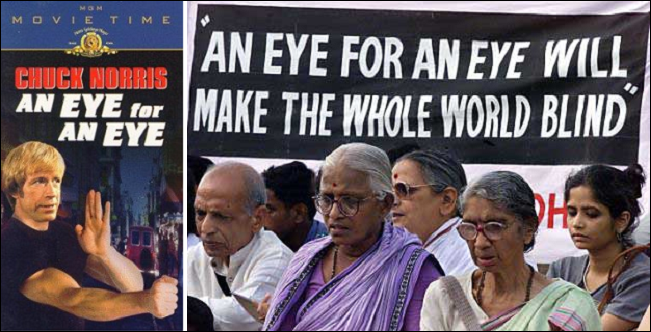
    [ by Charles Cameron — mostly about a fascinating quote from Martin Luther King ]
    .


    .

    Let’s start with the Code of Hammurabi, 196-97:

    If a man put out the eye of another man, his eye shall be put out. If he break another man’s bone, his bone shall be broken.

    A few days ago, I found I was feeling mildly exercised by one Dan Hodges writing in the Telegraph:

    Indeed, “An eye for an eye, a tooth for a tooth,” quoted by one of Lee Rigby’s suspected killers, comes from the Bible, not the Koran.

    Hodges was quoting Michael Adebolajo, who had said on camera:

    The only reason we have killed this man today is because Muslims are dying daily by British soldiers. And this British soldier is one. It is an eye for an eye and a tooth for a tooth. By Allah, we swear by the almighty Allah we will never stop fighting you until you leave us alone.

    **

    It is true that Deuteronomy 19.21 reads:

    And thine eye shall not pity; but life shall go for life, eye for eye, tooth for tooth, hand for hand, foot for foot.

    and Exodus 21.23-25:

    And if any mischief follow, then thou shalt give life for life, Eye for eye, tooth for tooth, hand for hand, foot for foot, Burning for burning, wound for wound, stripe for stripe.

    — but its is clear that Adebolajo — who was brought up devoutly Christian in Nigeria, converted (“reverted”) to Islam, and now references suras of the Qur’an using their Arabic names — would also be aware of Sura Al-Ma’ida (5) 45:

    And therein We prescribed for them: ‘A life for a life, an eye for an eye, a nose for a nose, an ear for an ear, a tooth for a tooth, and for wounds retaliation’; but whosoever forgoes it as a freewill offering, that shall be for him an expiation.

    **

    The quote “An eye for an eye makes the whole world blind” is often attributed to Mohandas Gandhi, but I checked with Quote Investigator and found it was originally used by one Louis Fischer to paraphrase Gandhi’s teaching, although the Gandhi family apparently think it sounds authentic. But what interested me most was that a form of the same phrase can safely be attributed to Martin Luther King, who is quote in Stride Toward Freedom: The Montgomery Story, p 208, as saying:

    Violence as a way of achieving racial justice is both impractical and immoral. It is impractical because it is a descending spiral ending in destruction of all. The law of an eye for an eye leaves everyone blind. It is immoral because it seeks to annihilate the opponent rather than win his understanding; it seeks to annihilate rather than to convert. Violence is immoral because it thrives on hatred rather than love. It destroys community and makes brotherhood impossible. It leaves society in monologue rather than dialogue. Violence ends by defeating itself. It creates bitterness in the survivors and brutality in the destroyers.

    That’s quite a paragraph.

    **

    Of note, besides the parallel structure with which King addresses violence as both impractical and immoral, are two matters I have often pointed to here on Zenpundit:

    Self-reference:

    Violence ends by defeating itself.

    and polyphony:

    It leaves society in monologue rather than dialogue.

    **

    Gandhi’s position seems to come close to that presented in Matthew 5. 38-48 — in which Christ clearly countermands the lex talionis as promulgated in Exodus and Deuteronomy:

    Ye have heard that it hath been said, An eye for an eye, and a tooth for a tooth: But I say unto you, That ye resist not evil: but whosoever shall smite thee on thy right cheek, turn to him the other also. And if any man will sue thee at the law, and take away thy coat, let him have thy cloke also. And whosoever shall compel thee to go a mile, go with him twain. Give to him that asketh thee, and from him that would borrow of thee turn not thou away.

    Ye have heard that it hath been said, Thou shalt love thy neighbour, and hate thine enemy. But I say unto you, Love your enemies, bless them that curse you, do good to them that hate you, and pray for them which despitefully use you, and persecute you; That ye may be the children of your Father which is in heaven: for he maketh his sun to rise on the evil and on the good, and sendeth rain on the just and on the unjust. For if ye love them which love you, what reward have ye? do not even the publicans the same? And if ye salute your brethren only, what do ye more than others? do not even the publicans so? Be ye therefore perfect, even as your Father which is in heaven is perfect.

    And. for that matter, to The Richmond Declaration of Faith of 1887, as quoted today by my friend, Friend Marshall Massey:

    We feel bound explicitly to avow our unshaken persuasion that all war is utterly incompatible with the plain precepts of our divine Lord and Law-giver, and the whole spirit of His Gospel, and that no plea of necessity or policy, however urgent or peculiar, can avail to release either individuals or nations from the paramount allegiance which they owe to Him who hath said, ‘Love your enemies.’ (Matt 5:44, Luke 6:27)

    **

    How — without denigrating those who are of either the Deuteronomic or the Gandhian persuasion — does one nudge the world-system gently away from justice and towards mercy, away from revenge and towards reconciliation, away from war and towards peace? Towards a new and more viable homeostasis?


    Switch to our mobile site