zenpundit.com » scriptures

Archive for the ‘scriptures’ Category

Infinite in faculty, quintessence of dust

Saturday, January 12th, 2013

[ by Charles Cameron — on the cutting off of hands, the eternal life of martyrs, and the vast and petty nature of we poor amazing humans ]
.

As you know, I love apposite juxtapositions between religious texts – if you’re into cognition, it’s called pattern recognition, in Jung or Plato it would be familiarizing oneself with the archetypes, and in terms of creativity it’s “one swell foop” of analysis and synthesis, an oak in an acorn, insight in a nutshell.

At times, as here, the comparison presents a significant similarity that “sees things” from a very different vantage point from our everyday selves – a refreshing and salutary reminder, perhaps, from high altitude, even if it’s not the street-level view we require to navigate life’s many smaller obstacles and minor goals.

**

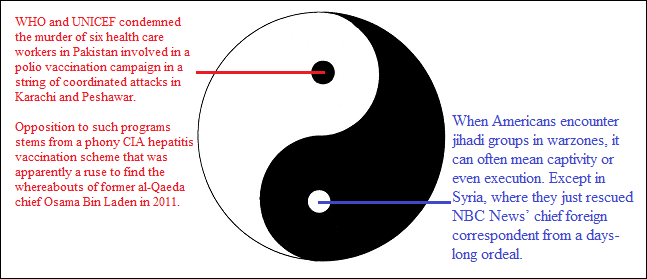
Here are two such comparisons that have served a somewhat different purpose for me –- showing me that aspects of another religion’s practice that I find shocking have echoes in my own tradition. I do not claim these correspondences to be exact — but if we allow them to be, I believe we may find them illuminating:

and:

My hope is that such examples can help us to approach the “other” with greater respect and understanding — where we agree, and even where we strongly disagree.

In the way of peace. For it is written in the Injil, in the Gospel (Matthew 5:9):

Blessed are the peacemakers: for they shall be called the children of God.

**

But to return us to the high altitude view from which we began, I’ll give Shakespeare the final word:

   HAMLET: I have of late–but
wherefore I know not–lost all my mirth, forgone all
custom of exercises; and indeed it goes so heavily
with my disposition that this goodly frame, the
earth, seems to me a sterile promontory, this most
excellent canopy, the air, look you, this brave
o’erhanging firmament, this majestical roof fretted
with golden fire, why, it appears no other thing to
me than a foul and pestilent congregation of vapours.
What a piece of work is a man! how noble in reason!
how infinite in faculty! in form and moving how
express and admirable! in action how like an angel!
in apprehension how like a god! the beauty of the
world! the paragon of animals! And yet, to me,
what is this quintessence of dust?

Steady breathing

Tuesday, January 8th, 2013

[ by Charles Cameron — something as simple as spirit, important to special ops & law enforcement — an open question ]
.


.

Let’s begin with a quote from Buddhist monk Thich Nhat Hanh, The Miracle of Mindfulness: An Introduction to the Practice of Meditation:

Breath is the bridge which connects life to consciousness, which unites your body to your thoughts. Whenever your mind becomes scattered, use your breath as the means to take hold of your mind again.

That’s about as basic as you can get. Breath begins with your first gasp (in-spiration) and runs like a silk thread through your life till your last sigh (ex-spiration) and it’s all spirit — which turns out to be beyond the mind-body dichotomy, and a balancing factor for both.

**

Fast forward.

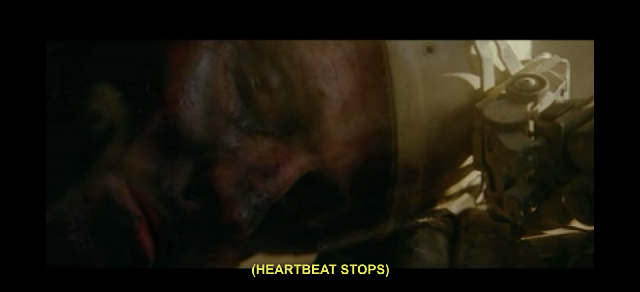
Let’s turn from breath — spiritus in Latin, as in spiritus ubi vult spirat, “breath blows where it wants to”, John 3.8 — to its specific application in “combat breathing” as illustrated by the still from the National Geographic movie Seal Team Six: the Raid on Osama bin Laden at the head of this post.

In “Fear Factor”, his review of Amanda Ripley’s fascinating-sounding The Unthinkable: Who Survives When Disaster Strikes, published in City Journal 21 June 2008, blog-friend John Robb writes:

… in complex disasters, the biological-fear response can slow thinking so severely that it can kill you.

We can counter fear, however. The best method, FBI trainers say, is to get control of your breathing. “Combat breathing” is a simple variant on Lamaze or yoga training — breathe in four counts, hold four counts, exhale four counts, and repeat. It works because breathing is a combination of the somatic (which we control) and the autonomic (which we can’t easily control) nervous systems. Regulation of the autonomic system deescalates the biological-fear response and returns our higher-level brain functions to full capacity. So one of the best ways you can prepare yourself to overcome fear in a crisis is as simple as a meditation, Lamaze, or yoga class.

I find it fascinating and also sensible that yogic / meditative techniques are now taught by members of the special ops and law enforcement communities:

Training under stress also will help officers learn to control their arousal level. As their physiological agitation escalates, so might their susceptibility to perceptual and memory distortions. Thus, learning to control arousal level can help reduce distortions. Therefore, officers should receive training in and regularly practice ways to control arousal levels in high-stress situations. One process, the combat breathing technique, has proven highly effective in this area.

Alexis Artwohl, “Perceptual and memory distortion during officer-involved shootings”, FBI Law Enforcement Bulletin, Oct, 2002

This reminds me of Richard Strozzi Heckler’s In Search of the Warrior Spirit: Teaching Awareness Disciplines to the Green Berets, now in its fourth edition.

**

Breath, spirit, breathing — it’s …

… “right under our noses”, all too easily overlooked, and heart-stoppingly, mind-blowingly important.

Let’s talk a bit about it…

Angels in Aleppo

Monday, December 31st, 2012

[ by Charles Cameron — a quick glimpse of the Qur’an in a Guardian report from war-torn Syria ]
.

Noted in passing:


.

It always interests me to see echoes of the visionary in everyday life, and this comment by a local commander in Aleppo, Syria is interesting both for the curious blend of ideas and references that Abu Ali has picked up along the way, and for its direct echo of the Qur’anic motif of angels accompanying the faithful in battle.

Sow wind, reap whirlwind

Sunday, December 30th, 2012

[ by Charles Cameron — on blowback, in praise of a Gregory Johnsen post, and literacy ]
.

William Blake, The Lord Answering Job Out of the Whirlwind

.

ED Hirsch and Joseph F Kett‘s New Dictionary of Cultural Literacy doesn’t appear to have an entry for the phrase “For they have sown the wind, and they shall reap the whirlwind” which is straight out of the prophet Hosea and is now something of a proverb in the form “sow the wind, reap the whirlwind”. Hunh.

It’s an elegant phrase. The translators of the King James Bible were masterful in their singular ear for English, and no doubt Hosea‘s original Hebrew (Hosea 8.7) is no less pithy. Seed preceding harvest is about as basic a notion of cause resulting in effect as one can find in the lived world of agriculture, with the actual mechanism through which it comes to pass hidden in the “black box” between them where, as another biblical passage (John 12.24) puts it:

unless a kernel of wheat falls to the ground and dies, it remains only a single seed. But if it dies, it produces many seeds.

**

Sow the wind…

It doesn’t sound like much, does it? Put an airy nothing in the ground…

reap the whirlwind.

If you were within media reach of the devastation that Sandy caused to New York and New Jersey — or Haiti (yet again) for that matter — you know what reaping the whirlwind is about. And the proverb, with the prophet behind it, tells us we get it by sowing the wind.

Blowback.

**

Gregory Johnsen, in a recent Waq-al-Waq post, Sowing the Wind: Three years of strikes in Yemen, pulls together three recent news pieces on Yemen to give us a view from 30,000 feet — in which blowback is clearly visible as the “whirlwind” his title implies we are already beginning to reap.

This sort of “here’s how the weather system looks from above” picture comes from the juxtaposition of key quotes, and since that’s one of my specialties, I’ll present two quotes that Johnsen selected in my own format devised with just that sort of exercise in mind:

That first quote is from Letta Tayler in Foreign Policy, and the second from Sudarsan Raghavan in the Washington Post.

As Johnsen puts it:

This is clear: the US bombs, kills civilians and AQAP sends compensation – ie, helps out the families that have been killed – and takes advantage of the carnage the US has sown to reap more recruits.

This is at once all too sad, and at the same time all too predictable.

**

There’s plenty more in Johnsen’s post, obviously, and being a trawler for religious details, I myself was particularly amused, or maybe alarmed, by this sentence:

That opening strike in the US’ war against AQAP in Yemen was a disaster, a strike so bad that the Pentagon lawyer who authorized it famously said later: “if I were Catholic, I’d have to go to confession.”

Indeed, as I hope to show shortly in a review of his book, The Last Refuge: Yemen, al-Qaeda, and America’s War in Arabia, Johnsen has a great deal to tell us, and he tells it with the added grace of a real appreciation for the language he uses.

Which brings me to the reason why I singled this particular post for commendation, given that I read a number of insightful people on a number of interesting topics each day.

Gregory Johnsen is literate, lettered.

**

I can’t estimate for myself just how many people would know and recognize the Hosea quote, nor how many more would at least know the proverb “sow the wind, reap the whirlwind” well enough to recognize its first half and provide the second half from memory… That’s why I looked it up in Hirsch’s New Dictionary of Cultural Literacy. And when I didn’t find it there, I have to say I wasn’t surprised.

Way back in 19232, was it, TS Eliot was dropping snippets of already obscure (obsolete?) texts in English, Italian, Latin, and French — from Thomas Kyd‘s Spanish Tragedy, Dante‘s Purgatorio, the Pervigilium Veneris, and Gérard de Nerval‘s El Desdichado — into his poem The Waste Land, with the comment “these fragments I have shored against my ruins.”

As Eliot would note later in Burnt Norton, “Words strain, / Crack and sometimes break, under the burden, / Under the tension, slip, slide, perish, / Decay with imprecision, will not stay in place…”… And how much more so the myths, fables and proverbs made of them — myths, fables and proverbs which pass down the embodied wisdom of generations, as this proverb from Hosea passes down embodied wisdom about blowback — or negative positive feedback loops, as a latter-day Hosea might call them.

Johnsen is, precisely in this sense, literate, and in addition to the benefit his analysis brings, it’s a delight to read him for that very reason.

But there’s an even bigger issue here — the one Eliot was on about — the question of what happens when we lose the cultural underpinnings which, I’ll repeat, pass down the embodied wisdom of generations?

Johnsen speaks to the present, to Yemen, to the Yemeni people and to American politics. But in quoting that fragment of a proverb in his title, and expecting us to recognize it, he also speaks to memory, to culture, and to wisdom — wisdom, the capacity to act wisely — to which memory and culture are portals.

**

William Blake painted The Lord Answering Job Out of the Whirlwind, which I’ve placed at the top of this post, and it is said in Job 38.1, “the Lord answered Job out of the whirlwind”.

In a forthcoming post — how often have I posted those words, and how seldom do I manage to fullfil them? — I hope to address the other possibility, the one in which as I Kings 19 has it (verses 11-12):

And, behold, the Lord passed by, and a great and strong wind rent the mountains, and brake in pieces the rocks before the Lord; but the Lord was not in the wind: and after the wind an earthquake; but the Lord was not in the earthquake: And after the earthquake a fire; but the Lord was not in the fire: and after the fire a still small voice.

But the Lord was not in the wind — it might be nice if the evangelists of righteous doom would remember that verse, before they inform us that a hurricane like Sandy is simply God reproving Cuba, Haiti and the eastern seaboard of the United States!

The circle in the swirl

Sunday, December 23rd, 2012

[ by Charles Cameron — the one prediction that never fails to amaze is “surprise”! ]
.


.

There are two great paeans to diversity that my mind constantly recurs to: the Svalbard global seed vault, with its more than 750,000 distinct varieties of seed deposited in “black boxes” by various national genebanks — and the Jesuit Gerard Manley Hopkins‘ great poem, Pied Beauty:

GLORY be to God for dappled things—
For skies of couple-colour as a brinded cow;
For rose-moles all in stipple upon trout that swim;
Fresh-firecoal chestnut-falls; finches’ wings;
Landscape plotted and pieced—fold, fallow, and plough;
And áll trádes, their gear and tackle and trim.

All things counter, original, spare, strange;
Whatever is fickle, freckled (who knows how?)
With swift, slow; sweet, sour; adazzle, dim;
He fathers-forth whose beauty is past change:
Praise him.

The world is fundamentally dappled: look where you will, you will find general rules — and unexpected exceptions. The whole Syrian opposition business is dappled, it’s a mixed bag, it’s subtle.

I dunno, maybe this can be my motto: keep it subtle, stupid.

**

Seen from another angle… variety is, as they say, the spice of life.

Or as the Qur’an puts it (49:13):

O mankind, We have created you male and female, and appointed you races and tribes, that you may know one another. Surely the noblest among you in the sight of God is the most godfearing of you. God is All-knowing, All-aware.


Switch to our mobile site