zenpundit.com » Specs

Archive for the ‘Specs’ Category

Twitter mixology

Friday, August 23rd, 2013

[ by Charles Cameron — bemused by all you young people ]
.

Kim Kierkegaardashian is exactly the right amount of Kardashian for me to allow into my life. It’s a twitterstream consisting entirely of combination authentic Kardashian soundbites and Kierkegaard quotes, and it’s usually hilarious.

JM Berger‘s tweet, by contrast, sets out one version of an aesthetic principle which seems to underlie much of today’s culture: mixing pop-reference in with serious culture, for serio-popular effect.

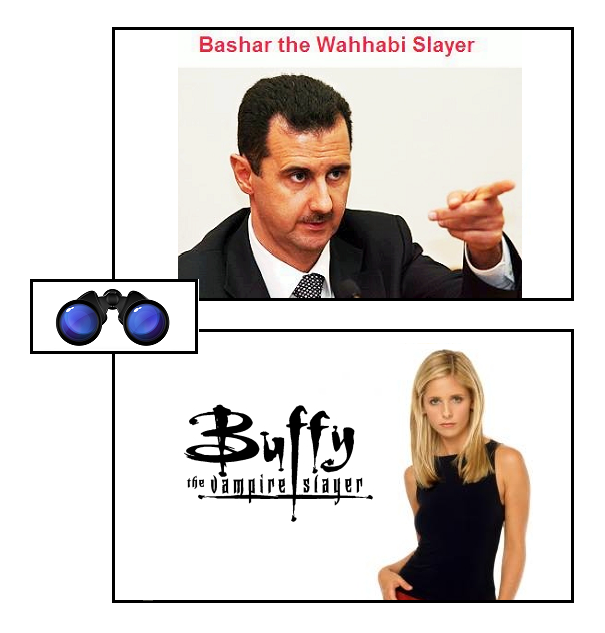
Bashar al-Assad‘s supporters do this, aligning their man with Buffy the Vampire Slayer. Salafi jihadists likewise, borrowing footage from the Lord of the Rings. Dan Drezner does it — using zombies to discuss international politics — and wins an Association of American Publishers honorable mention for the 2011 PROSE Award in Government & Politics. Kim Kierkegaardashian does nothing else…

**

Has this sort of hi-lo-brow mixing always happened?

L’homme armé was a French pop song from the 14th or 15th century, its melody used as the basis for Masses by composers from Dufay and Okeghem to Palestrina — and thence to Peter Maxwell Davies in our own times:

The man, the man, the armed man,
The armed man
The armed man should be feared, should be feared.
Everywhere it has been proclaimed
That each man shall arm himself
With a coat of iron mail.

It must be noted that some believe the “armed man” in question is the Archangel Michael. His fight, unlike Kierkegaardashian’s, is neither with God nor man, but directly with the Devil.

**

DoubleQuotes Sources:

  • Kim Kierkegaardashian
  • JM Berger
  • Egypt: The Blame Game

    Tuesday, August 20th, 2013

    [ by Charles Cameron — not the world’s most illuminating game, but popular in some circles ]
    .

    Add these two together, and you get “Zionists and Crusaders” — with a tragic chorus chanting, “told you so”..

    **

    Sources:

  • Zach Novetsky
  • Thomas Hegghammer
  • Bashar the Vampire-Slayer

    Tuesday, August 20th, 2013

    [ by Charles Cameron — pop messianism, Syria, 2013 ]
    .

    The caption for the Bashar al-Assad image reads:

    Bashar the Wahhabi Slayer [ image ] Has killed more than 40,000 Wahhabi terrorists who came from all over the world to destroy Syria

    and Phillip Smyth, who tweeted it, commented:

    This photo has been uploaded onto many pro-#Assad & pro-Shia (in #Syria) militia pages. Note how dead are characterized

    **

    How the dead are characterized?

    Why, as Wahhabi terrorists, explicitly — and implicitly as vampires.

    FWIW, I’d argue (broad strokes) that “Wahhabi terrorists” is directed at the conscious mind, and “vampires” at the emotions.

    Egypt and the Churches

    Sunday, August 18th, 2013

    [ by Charles Cameron — always glad to see good will on both sides of a widening chasm ]
    .

    In these days when Egyptian churches have been repeatedly attacked and burned by Ikhwan supporters, it is good to remember that there is love as well as enmity at work… Putting that in Johannine terms (John 1.5, RSV): The light shines in the darkness, and the darkness has not overcome it.

    The captions that go along with these two images read, respectively:

  • above, Muslim men protecting a Catholic Church in Egypt during mass. Beautiful.
  • below, Christians pray inside one of the charred churches. Their papers read: “My extremist brother, I came to pray for you.”
  • On understanding Hijra

    Friday, August 16th, 2013

    [ by Charles Cameron — the lure of exile, of hijra, in the context of western jihadists going abroad ]
    .

    Whereas the Prophet’s first visionary reception of the Quran dates to 609-610 CE, and the Prophet himself was born some 40 years earlier, the Islamic reckoning of time (AH, Anno Hegirae) begins with his hijra or migration from Mecca, his home, to Medina — an event of huge Islamic consequence, with echoes in our own times.

    One of the questions I have been pondering recently has to do with those echoes. I have been asking myself how strong a part in the decisions of westerners to migrate to Syria and elsewhere to participate in jihad might be played by the concept of hijra — either in the minds of recruits, or in the rhetoric of recruiters.

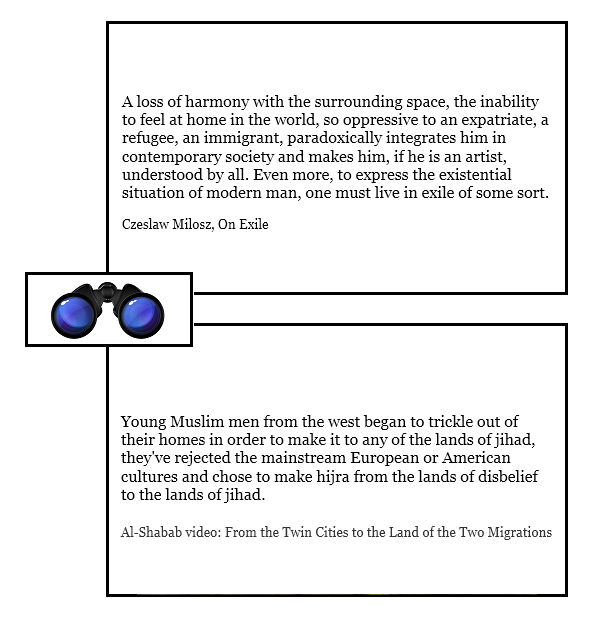
    When I came across the quote from Czeslaw Milosz (above, upper panel), I recognized that I had stumbled upon the expression of a secular equivalent of that yearning — and thus perhaps an opening into our own deeper understanding of hijra (lower panel) — a sacralization and hence an intensification of the same yearning.

    **

    It is therefore instructive to note conversely that Thomas Hegghammer, in his paper Should I Stay or Should I Go? Explaining Variation in Western Jihadists’ Choice between Domestic and Foreign Fighting, p 7, quotes Anwar al-Awlaki as advising a correspondent:

    [Hearing] that you intend on making hijrah [emigration], I immediately wanted to contact you to tell you that my advice to you was to remainin your current position.

    Here, strategic rationalism attempts to prevail over romantic yearning…

    **

    Sources:

  • Czeslaw Milosz, On Exile, quoted in Paris Review
  • Al-Shabab video: The Path to Paradise: from the Twin Cities to the Land of the Two Migrations, at 08.23-08.36

  • Switch to our mobile site