zenpundit.com » symbolism

Archive for the ‘symbolism’ Category

On fire: issues in theology and politics – ii

Tuesday, February 28th, 2012

[ by Charles Cameron — burning and blasphemy ]
.

The question here is a simple one: which is the more blasphemous? burning holy scripture — or burning oneself, a human being?

Now I imagine you think the answer to that’s quite obvious, and I do too. But there are people with the opposite opinion to mine — and when we burn their scriptures, even by mistake, even making apologies afterwards, they get enraged, and kill people. There may be many other factors that contribute to their rage, but this is the trigger, the religious sanction, the thing that pushes them over the top.

Someone tweeted the other day:

Souls are being burned alive in Homs & others riot over ink & paper. Where’s the logic?!

It is not my purpose to attack or defend anyone’s beliefs or opinions here — what I would like to do instead is to see through the rage and glimpse that logic: I would like us to avoid needlessly triggering it.

I want to bring what may at first seem utterly incomprehensible to us, a little closer to our comprehension.

1.

In the Quran 5.32, we read:

We ordained for the Children of Israel that if any one slew a person – unless it be for murder or for spreading mischief in the land – it would be as if he slew the whole people: and if any one saved a life, it would be as if he saved the life of the whole people.

On the one hand, that sets an extremely high value on human life — the Jewish equivalent is found in the Talmud, Tractate Sanhedrin 37a — and on the other hand, it can be claimed that that high value is set not by humans but by their Creator in his revealed Word, the Qur’an.

2.

What metaphor or analogy would allow me to understand that logic in terms of my own culture? Not the rage itself, not the killings — but the logic that potentiates them?

3.

If you think, as the melancholy Jaques has it in As You Like It, that all the world’s a stage, and all the men and women merely players – and as Hamlet might think, pondering what more things might be in heaven and earth than are dreamt of in philosophy – why then —

How does one weigh the value of the life of a Jaques, or Hamlet, of one of us, one single human being – of whom Shakespeare, again through his Hamlet, said:

how noble in reason! how infinite in faculty! in form and moving how express and admirable! in action how like an angel! in apprehension how like a god! the beauty of the world! the paragon of animals! ..

against the value of a single copy of the Works of one William Shakespeare – who then continued on, through that same Hamlet’s voice, to ask:

And yet, to me, what is this quintessence of dust?

4.

Shakespeare, the First Folio, Hamlet?
God, the Scripture, you or me?

5.

It is said the imperishable Quran is writ in heaven before time was, and there is a hadith of Tirmidhi that describes Allah reciting Suras 20 and 36, Taha and Ya Sin, upon hearing which the angels responded “Happy are the people to whom this comes down, happy are the minds which carry this, and happy are the tongues which utter this”.

I am not a literalist, I am a poet — so that makes poetic sense to me, the way Shakespeare’s “all the world’s a stage” makes sense.

In reading these words, I see for a moment the beauty, the devotion that is possible towards this book, the fervent dedication.

I am not about to kill people in the name of Shakespeare or the Gospels — yet I can understand a reverence for that which is greater than I, for that which is more than we dream of, and for that which “comes down” from thence.

6.

Suppose the body is a perishable scaffolding, and the book an eternal transcript written in the immortal soul…

And now recall what that eternal transcript says:

We ordained for the Children of Israel that if any one slew a person – unless it be for murder or for spreading mischief in the land – it would be as if he slew the whole people: and if any one saved a life, it would be as if he saved the life of the whole people.

The paradox here, surely, is that we are each of us the quintessence of dust – each of us more than is dreamt of in philosophy.

7.

May the soul of Mohamed Bouazizi rest at last.

Signs of the times: complex problems and future drones

Friday, February 3rd, 2012

[ by Charles Cameron — complex problems and a future with drones graphically depicted ]
.
.

.
.
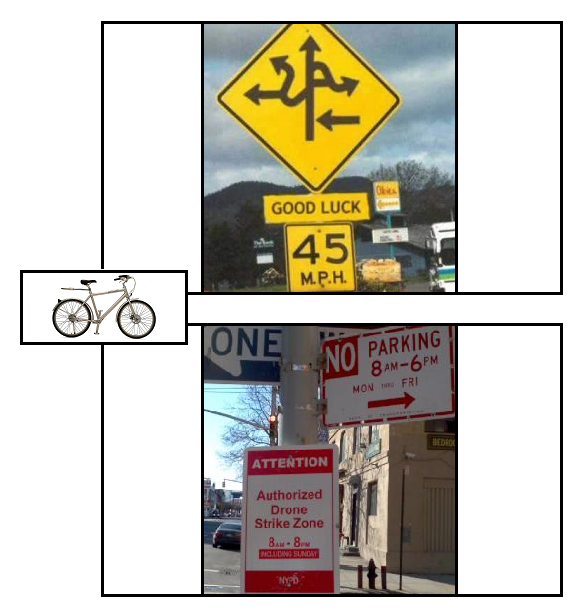
A couple of interesting, arresting and relevant signs here…

The top one is a perennial favorite, and is far too simple to represent genuine complexity with any accuracy — but still gets something of the point across.

The lower of the two comes from a post by blog-friend Shlok Vaida today — I’ve cropped the original because the lettering would be illegible in my “specs” format if I hadn’t, but I encourage you to click through and see it — and also to visit John Robb‘s very recent post Drone Swarms are Here: 1 Minute to Midnight?

Shloky is an enterprising fellow — is he already printing up large quantities of those “Authorized Drone Strike Zone” notices, or (more likely because more efficient) waiting a year or four before printing them on a just-in-time basis?

*

Are we wearing our time-crash helmets yet?

A “Big Dream” attributed to Osama bin Laden

Tuesday, December 13th, 2011

[ by Charles Cameron — hadith, Aden-Abyan, Abu M. al-Maqdisi, major dream of young bin Laden, role of narration 1 month after his death, any comments? ]

.

.

I was trying to follow up on a hadith which declares:

An army of twelve-thousand will come out of Aden-Abyan. They will give victory to Allah and His messenger. They are the best between myself and them.

There’s an extensive discussion of it on Somalinet offered by Sheikh Abu Muhammad al-Maqdisi [teh Sheikh Abu M al-Maqdisi?] and posted on June 4 of this year, but it doesn’t answer my question as to how this narration fits in with the various narrations about the army from Khorasan.

1.

While reading in and around this topic, however, I ran across this account of a dream on the young bin Laden, which appears on a number of sites favorable to jihad around June 4, 2011, i.e. after bin Laden’s death, and which I have not seen discussed on those analysts’ sites that I manage to follow.

It’s extremely interesting to me not only because dreams are potentially important vehicles for divine guidance in Islam, but also because it ties bin Laden specifically to the Khorasan / black banners hadith, and to the Mahdi.  In this dream, I( don’t think it’s going too far to say that bin Laden himself plays a preparatory role with regard to the Mahdi that we can perhaps understand in the west as equivalent to that of John the Baptist in preparation for Christ.

2. 

If this dream narrative has been explored in the open source analytic literature, I would be very interested to see what has been said.  In  the meantime, I will simply post the narration as I found it:

3.

This incident was narrated to me by a student of knowledge who spent more than 20 years in the company of scholars acquiring knowledge. He told me about a dream that Shaykh Osama bin Laden had when he was 9 years old, which indicated that Allah swt was preparing Shaykh Osama bin Laden, may Allah have mercy on him, since childhood, for battles against the Crusaders.

He told me that once he was sitting with a companion and discussing the deplorable condition of the Ummah but that all the incidents taking place in the Muslim Ummah are going according to Allah’s plan and that it is certain that the victory of Allah the Almighty will come. He will surely send a Leader and a Guide from amongst our Ummah who will deliver the humiliated and pitiful Ummah to the enlightened path of ascent and loftiness. We started thinking that who could be such a person!

Immediately, the thought of Shaykh Osama bin Laden came to our minds, since he has made innumerable sacrifices for the sake of the Ummah. On this, my companion smiled and said, “I will narrate to you a dream of Shaykh Osama bin Laden; you will be pleased to hear it, and your love for the mujahideen will only increase.”

He said, I was in al-Madinah al-Munawwarah at the house of a Scholar who used to lecture at the Prophet’s masjid. We had just arrived at his house when someone knocked on the door. The Shaykh returned with a person of luminous and honorable appearance who was about 80 years old.

The host welcomed him and requested the Tafsir of a few verses from the Qur’an. We quietly listened to him while the guest Shaykh recited a few verses, and then he gave the Tafsir of those verses. By Allah, I had studied a number of Tafsirs, but that Shaykh was a sea of knowledge. When he completed his lesson, the host invited him for a meal, but he declined politely, and we came to understand that he was fasting.

Eventually, the guest asked for permission to leave, but the host insisted, ‘Until you narrate to us the dream of Shaykh Osama bin Laden once more, you will not get the permission to leave.’

The Shaykh smiled and asked, ‘The dream that Shaykh Osama bin Laden had when he was 9 years old?’ The host replied in the affirmative.

This is how that Shaykh narrated the incident:

I was a close friend of Muhammed bin Laden, the father of Osama bin Laden. Many times I would be in his company. And many times, I used to visit his house regarding work related to construction. During the discussions, our talk would be disturbed by the playing of his children, and then he would ask them to go out and play.

But I was surprised to see that he would always ask one particular son to sit beside him. I asked him, “Why don’t you let this son of yours to play with his other brothers? Is he sick?”

Mohammed bin Laden smiled and said, “No, there something special about this son of mine.”’

When I asked his name, he said, “His name is Osama, and he is 9 years old. Let me share with you something strange which happened a few days ago. My son woke me up few minutes before the morning prayer and told me, ‘Dear father, I want to tell you about a dream that I had.’ I thought he must have had a nightmare. I made ablution and took him along with me to Masjid.

On the way, he told me, ‘In the dream, I saw myself in a huge, flat area. I saw an army mounted on white horses moving towards me. All of them were wearing black turbans. One of the horsemen, who had shiny eyes, came up to me and asked me, “Are you Osama bin Muhammed bin Laden?” I replied, “Yes.” He then asked me again, “Are you Osama bin Muhammed bin Laden?” I again replied, “Yes, that is me.” He again asked, “Are you Osama bin Muhammed bin Laden?” Then I said, “By Allah, I am Osama bin Laden.” He moved a flag towards me and said, “Hand this flag over to Imam Mahdi Muhammad bin Abdullah at the gates of Al-Quds.” I took the flag from him, and I saw that the army started marching behind me.’

Muhammed bin Laden said, “I was surprised at that but, due to business at work, I forgot about the dream. The next morning, he woke me up just before the morning prayer and narrated the same dream. The same thing happened on the third morning also. Now, I began to worry for my son. I decided to take him with me to a knowledgeable person who can interpret dreams.

Accordingly, I took Osama to a person of knowledge and informed him about the whole incident. He looked at us with surprise and asked, ‘Is this your same son who had the dream?’ I said, ‘Yes.’ He kept staring at Osama for some time. My concern multiplied. He comforted me and said, ‘I will ask you a few questions. I am sure that you will answer them truthfully.’

He asked Osama, ‘Son, do you remember anything about that flag which that horseman gave you?’ Osama replied, ‘Yes, I remember it.’

He asked him, ‘Can you describe it, how it was?’

Osama said, ‘It was similar to the flag of Saudi Arabia, but its color was not green but black, and there was something written on it in white color.’

He then put the next question to Osama, ‘Did you ever see yourself also fighting?’

Osama replied, ‘I commonly see such dreams.’ He then asked Osama to go out of the room and do recitation of the Qur’an.

Then that person of knowledge turned towards me and asked, ‘Where is your ancestry from?’

I replied from Hadramawt in Yemen. Then, he asked me to tell him something about my tribe. I replied that we are related to the tribe of Shanwah which is a Qahtani tribe from Yemen. He then cried out the Takbir loudly and called in Osama and kissed him while crying. He also said that the signs of the hour are near.

‘O Muhammed bin Laden, this son of yours will prepare an army for Imam Mahdi and for the sake of protecting his religion, he will migrate to the region of Khurasan. O Osama ! Blessed is he who will do Jihad by your side and undone and disappointed be he who leaves you alone and fights against you.’

4.

It is notable that this account appears to have surfaced in the English-language literature about a month after the Abbottabad raid of May 2.  At least in this English-language form, it seems to be a posthumous account, hagiographic in tone, and directly linking  bin Laden and those who fought with him to the fulfillment of Mahdist prediction.

My questions would be whether anyone knows of an earlier appearance of this narrative, perhaps in Arabic — and if it indeed is first found after bin Laden’s death, how the readers of signs, both Islamist and  Western-analytic, read this particular text.

I have seen this narrative featured on sites relating to the Netherlands, Egypt, Somalia, South Africa, Kashmir, and Pakistan — and as a text video with nasheed accompaniment on YouTube – so it seems to have spread pretty rapidly, which suggests it “fits” powerfully with the needs of the jihadizing internet shortly after bin Laden’s death.

5.

Sources include:


We spend far too much time on content, and not enough time on form

Tuesday, December 13th, 2011

[ by Charles Cameron — recursion as form — this one’s for analysts: poets should know it already ]

.

We spend far too much time on content, and not enough time on form.

We spend far too much time on the data, and not enough time on relationships. It is pattern that connects the dots with accuracy, not more dots – quality of insight, not quantity of information.

And pattern is underlying form.

Haiku is a form. The sonnet is a form, the sonata is a form. And just to juxtapose sonnet and sonata is to recognize the formal relationship between them.

1.

Recursion is the form that Doug Hofstadter explores in his book, Godel Escher Bach, and you’ll find it every time one mirror reflects another mirror (what color does a chameleon turn when placed on a mirror?), every time there’s a doll inside a doll inside a Matrioshka doll, often in the form of a paradox (“this sentence is meaningless”) – and when people take photos of themselves holding photos of themselves…

as in the pic of Noam Chomsky and Morris Halle and (in case your politics doesn’t agree so much with Chomsky) the one below them of Jacob Appelbaum and Donald Knuth in my “specs” image at the top of this post.

2.

Content can be powerful, but form really doubles up on the power. Here’s one way of thinking about it: form is what tightens information into meaning.

A couple of news reports in the last couple of days have caught my attention because of their form:

Charter of Open Source Org is Classified, CIA Says

Open Source Works, which is the CIA’s in-house open source analysis component, is devoted to intelligence analysis of unclassified, open source information. Oddly, however, the directive that established Open Source Works is classified, as is the charter of the organization. In fact, CIA says the very existence of any such records is a classified fact.

“The CIA can neither confirm nor deny the existence or nonexistence of records responsive to your request,” wrote Susan Viscuso, CIA Information and Privacy Coordinator, in a November 29 response to a Freedom of Information Act request from Jeffrey Richelson of the National Security Archive for the Open Source Works directive and charter.

“The fact of the existence or nonexistence of requested records is currently and properly classified and is intelligence sources and methods information that is protected from disclosure,” Dr. Viscuso wrote.

This is a surprising development since Open Source Works — by definition — does not engage in clandestine collection of intelligence. Rather, it performs analysis based on unclassified, open source materials.

That’s hilarious, it’s so misguided: I don’t know whether to laugh or barf (not a word I ever expected to use in my writings, but there you go).

3.

That’s sad, this one’s just plain tragic:

Protesters calling for religious tolerance attacked with stones, threatened with death

Police are investigating a violent attack on a ‘silent protest’ calling for religious tolerance, held at the Artificial Beach to mark Human Rights Day.

Witnesses said a group of men threw rocks at the 15-30 demonstrators, calling out threats and vowing to kill them.

One witness who took photos of the attacked said he was “threatened with death if these pictures were leaked. He said we should never been seen in the streets or we will be sorry.”

Killing your enemies for reasons of religion is one thing: killing those who work for peace between you and your religious enemies is no worse of the face of it – it’s religious killing, no more and no less, in both cases — but it drives the point home with considerable, poignant force.

Keep your eye out for recursion, it’s an interesting business. And respect form – it empowers content.

4.

You’ll find recursion right at the heart of Shakespeare: his plays were performed in a round theater (the “wooden O” of Henry V) called the Globe, whose motto was “totus mundus agit histrionem” – roughly, “the whole world enacts a play” – a notion which Shakespeare put into the mouth of the melancholy Jaques in As You Like It:

All the world’s a stage,
And all the men and women merely players.
They have their exits and their entrances,
And one man in his time plays many parts…

A martial version of this idea, indeed, can be found in the philosopher Plotinus, who wrote in his Enneads (3.ii.15):

Men directing their weapons against each other — under doom of death yet neatly lined up to fight as in the pyrrhic sword-dances of their sport — this is enough to tell us that all human intentions are but play, that death is nothing terrible, that to die in a war or in a fight is but to taste a little beforehand what old age has in store, to go away earlier and come back the sooner. So for misfortunes that may accompany life, the loss of property, for instance; the loser will see that there was a time when it was not his, that its possession is but a mock boon to the robbers, who will in their turn lose it to others, and even that to retain property is a greater loss than to forfeit it.

Murders, death in all its guises, the reduction and sacking of cities, all must be to us just such a spectacle as the changing scenes of a play; all is but the varied incident of a plot, costume on and off, acted grief and lament. For on earth, in all the succession of life, it is not the Soul within but the Shadow outside of the authentic man, that grieves and complains and acts out the plot on this world stage which men have dotted with stages of their own constructing.

5.

I thought it would be interesting to see if recursion had power, too, in the field of religion, and this passage from Ephesians (4.8) sprang to mind…

When he ascended up on high, he led captivity captive, and gave gifts unto men…

That’s a lovely recursion, “leading captivity captive”. But I think we can go deeper. John Donne‘s sonnet Death be not proud reaches to the very heart of the Christian message, it seems to me –it parallels the passage from Ephesians closely, while focusing in on the hope of resurrection with its stunning conclusion:

Death, thou shalt die.

Here’s the whole thing: profound content in impeccable form:

Death be not proud

Death be not proud, though some have called thee
Mighty and dreadfull, for, thou art not so,
For, those, whom thou think’st, thou dost overthrow,
Die not, poore death, nor yet canst thou kill me.
From rest and sleepe, which but thy pictures bee,
Much pleasure, then from thee, much more must flow,
And soonest our best men with thee doe goe,
Rest of their bones, and soules deliverie.
Thou art slave to Fate, Chance, kings, and desperate men,
And dost with poyson, warre, and sicknesse dwell,
And poppie, or charmes can make us sleepe as well,
And better then thy stroake; why swell’st thou then;
One short sleepe past, wee wake eternally,
And death shall be no more; death, thou shalt die.

6.

What do you think?

On bananas, cucumbers, tomatos and piano legs: an aside

Saturday, December 10th, 2011

[ by Charles Cameron, h/t Mike Few — bananas, cucumbers, tomatos and piano legs as sexual objects, reading the world as a book, Iraq recently, Shakespeare a while back, Robert Hooke ]
.

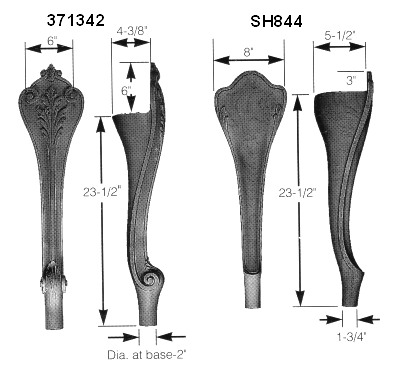
Louis XV grand piano legs, hard maple. Image credit: http://www.balaams-ass.com/grandlegs.htm

MikeF in a comment on my post, Let me put my banana in your fruitbasket, pointed us to his Small Wars Journal article The Break Point: AQIZ Establishes the ISI in Zaganiayh, in which he reports that the Mujahedeen Shura Council in Iraq passed out propaganda pamphlets providing “instruction on the proper actions of good Muslims” in preparation for the establishment of an Islamic State of Iraq. One example of “proper actions” given was as follows:

One cannot eat tomatoes and cucumbers together because one is male and the other is female. This action is immoral. Failure to comply will result in death.

Think long and hard on that one!

*

By way of light relief:

Frederick Marryat‘s 1839 book A Diary in America, in which he describes (as his title stipulates) American, not British, customs, seems to be the source of the idea that the (British, the urban legend having undergone a transatlantic metamorphosis here) Victorians covered the Legs (think: ankles, see diagram above) of their pianos for modesty’s sake.

Marryat, a credulous fellow as Matthew Sweet describes him in his Inventing the Victorians (p. xiii.), may well have been being teased when told this tale by his American friends. In any case, he reported that in an American girl’s school he visited, the head mistress “to preserve in their utmost purity the ideas of the young ladies under her charge” had “dressed all four limbs” of the school piano “in modest little trousers, with frills at the bottom of them!”

“Was this practice ever pursued, even in America?” Sweet asks sweetly, and answers himself: “Probably not.” And further, “whatever the case, the synecdochic relationship that now exists between Victorian sensibilities and the clothed piano leg is wholly fraudulent.”

Sweet is marvelous on this whole business, going on about it for pages. Most useful for my own purposes is his quotation from Richard Sennett‘s (1986) The Fall of Public Man, which argues:

that cultural change, leading to the covering of the piano legs, has its roots in the very notion that all phenomena speak, that human meanings are immanent in all phenomena.

*

And a tad more seriously…

Interestingly enough, that very notion is indeed to be found in Islam, where the Qur’an asserts that nature is to be read like a scripture. In the words of Seyyed Hossein Nasr:

The Quran refers constantly to the world of nature as well as to the human order. The sky and the mountains, the trees and animals in a sense participate in the Islamic revelation, through which the sacred quality of the cosmos and the natural order is reaffirmed. The sacred scripture of Islam refers to the phenomena of nature as ayat (“signs” or “portents”), the same term used for its verses and the signs that appear within the soul of human beings according to the famous verse: “We shall show our portents (ayat) upon the horizons and within themselves, until it be manifest unto them that it is the Truth” (41:53). Natural phenomena are not only phenomena in the current understanding of the term. They are signs that reveal a meaning beyond themselves. Nature is a book whose ayat are to be read like the ayat of the Quran; in fact, they can only be read thanks to the latter, for only revelation can unveil for fallen man the inner meaning of the cosmic text. Certain Muslim thinkers have referred to the cosmos as the “Quran of creation” or the “cosmic Quran” (al-Qur’an al-takwini), whereas the Quran that is read every day by Muslims is called the “recorded Quran” (al-Qur’an al-tadwini). The cosmos is the primordial revelation whose message is still written on the face of every mountain and tree leaf and is reflected through the light that shines from the sun, the moon, and the stars. But as far as Muslims are concerned, this message can only be read by virtue of the message revealed by “the recorded Quran.”

*

This view is not solely an Islamic one: Duke Senior, exiled to the Forest of Arden in Shakespeare‘s As You Like It (Act II Scene 1) declares:

And this our life: exempt from public haunt,
Finds tongues in trees, books in running brooks,
Sermons in stones, and good in everything.

And if Shakespeare be considered too worldly a source, here is Hugh of St. Victor (twelfth century):

For this whole visible world is a book written by the finger of God, that is, created by divine power … But just as some illiterate man who sees an open book looks at the figures but does not recognize the letters: just so the foolish natural man who does not perceive the things of God outwardly in these visible creatures the appearances but does not inwardly understand the reason. But he who is spiritual and can judge all things, while he considers outwardly the beauty of the work inwardly conceives how marvellous is the wisdom of the Creator.

More recently and less theologically, the scientist Robert Hooke (1635 – 1703), friend of Robert Boyle and discoverer of Hooke’s Law, wrote that in the interests of science it was:

much to be wisht for and indeavored that there might be made and kept in some Repository as full and compleat a Collection of all varieties of Natural Bodies as could be obtain’d, where an Inquirer might be able to have recourse, where he might peruse, and turn over, and spell, and read the Book of Nature, and observe the Orthography, Etymologia, Syntaxis, and Prosodia of Natures Grammar, and by which, as with a Dictionary, he might readily turn to and find the true Figures, Composition, Derivation, and Use of the Characters, Words, Phrases and Sentences of nature written with indelible, and most exact, and most expressive Letters, without which Books it will be very difficult to be thoroughly a Literatus in the Language and Sense of Nature.

*

All of which is to say that it may be unwise to read spiritual texts in too literal a manner.


Switch to our mobile site