zenpundit.com » symbolism

Archive for the ‘symbolism’ Category

Flags, shrouds, martyrs and the Fallen

Saturday, August 17th, 2013

[ by Charles Cameron — burial flags, shrouds on the unknown, and the black banner seen from a new angle ]
.

I feel grief.

**

We are, by now, all too well aware of the cost of war in lives. Sometimes those lives are of unknown souls, perhaps belligerents, perhaps partisans, perhaps peace-makers, perhaps simple souls caught in the cross-fire…

Caitlin Fit Gerald has a suitable memorial for those recently dead in Egypt, which I won’t reproduce here because I would make her already scaled-down images even smaller and less impressive if I did — click through to The Dead, When The Dying Is Done, then click again to see the images at better scale.

**

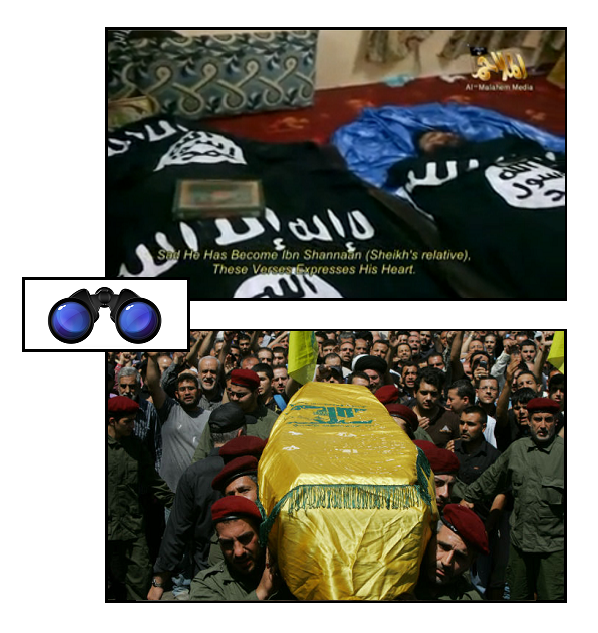
Sometimes the dead are our foes.

What interests me particularly on this occasion is seeing the Sunni Islamist black banner in what is for me a new context — draped like the Shi’ite flag of Islamist Hezballah on the martyrs of their faith.

**

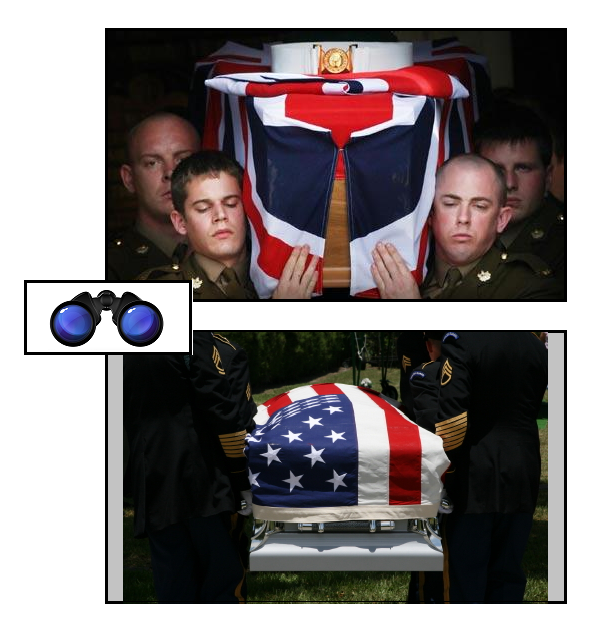
It raises for me another question: Hezbollah and the Salafi jihadists alike term their dead “martyrs”. We honor ours no less, wrapping them in symbols of that greater cause for which they gave their lives — “country” — and call them “patriots” to distinguish their cause, and “heroes” to salute their courage.

Yet they gave their lives. To indicate and honor this, we call them “the Fallen” — and perhaps in its quiet way it is enough.

Of the arm, fist and rifle

Thursday, July 25th, 2013

[ by Charles Cameron — product from a neat, brief convo with Ibn Siqilli aka Chris Anzalone ]
.

I found the upper image in the same Visual References post from Chris Anzalone that I recommended recently in two comments here [figs 2, 3, 3B] and here. If you look closely — or is just my poor eyesight? — you’ll see the arm, fist and rifle to the left of the black banner in the upper half of the upper image.

Black banner? Did I just say black banner?

That upper image is the “logo of the Brigade of the Awaited Savior (Katibat al-Mahdi al-Muntazar)” according to Chris, and the text below reads, “O’ One Who Arises (al-Qa’im) [from] the family of Muhammad.”

So there you have Mahdism (the titles al-Muntazar and al-Qa’im are both indicators of the same returning great one as the term al-Mahdi itself) along with the well-known banner…

**

What follows I have taken from a post on the Lebanese Expatriate blog, with some minor format changes to give the contents better graphical integration with the rest of the post:

For those with the slightest knowledge about Hezbollah and the Middle East, I am not sharing with you something new, but for those who receive this information as a revelation, check out the resemblance between the emblem of Hezbollah and that of the Pasdaran, a.k.a Army of the Guardians of the Islamic Revolution.

.
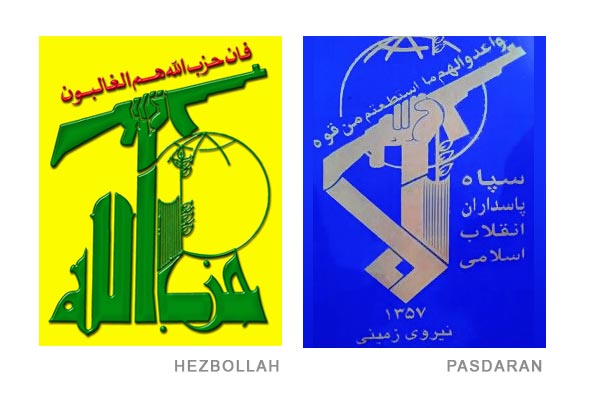
— Hezbollah emblem to the left in yellow. Pasdaran emblem to the right in blue.
.

So what’s new? Why am I shedding light on what is already obvious? Why target Hezbollah today, out of all the parties that have been selling Lebanon?

Today, more than ever, Hezbollah and Iran owe Lebanon an explanation. Take a look at the 10 Riyal postage stamp that is circulated in Iran.


Iranian 10 Riyal postage stamp showing the emblem of Hezbollah covering the whole map of Lebanon. A clear symbol of the hidden intentions and a direct breach for the sovereignty of Lebanon’s independence as a nation.

The stamp commemorates the martyrs of Hezbollah in Lebanon. Isn’t this an obvious breach of Lebanon’s sovereignty as a nation? I understand the bff relationship between Iran and Hezbollah, but why does Iran need to have Hezbollah’s emblem covering the Lebanese territories instead of the Lebanese flag? Why does Iran need to commemorate the Lebanese martyrs in the first place?

What does Hezbollah have to say about this in the first place? How can Hezbollah justify such a demeaning document? What can its big-bellied, tie-less MPs and representatives say to logically justify this? Will they even attempt to justify it, or consider it normal and not even worth concealing with the whole world’s knowledge of its non-matrimonial marriage to Iran.

As a Lebanese, I ask my government (which is controlled by Hezbollah) to question the Iranian ambassador about the motives of this stamp and ban its circulation.

As a Lebanese, I ask Hezbollah to denounce the usage and circulation of this stamp in Iran and ask the Iranian state for an apology to the Lebanese people and its government.

That’s taken from a post made in January, but I think it is no less relevant today, and adds to the general picture I’m painting.

**

I put this post together as the result of an exchange with Chris in which I asked him whether a raised arm with slanted rifle was now a characteristic motif across many or all Shi’a jihadist movements, to which he responded:

Those groups influenced by Hizbullah &, by extension, Iranian Gov’t, seem to favor it, likely b/c it’s used by the Pasdaran.

I then asked whether he’d say Hizbollah got the motif from the Pasdaran or vice versa, to which he replied:

The former.

I stumbled across the DoubleQuote image and accompanying Lebanese Expatriate post myself, searching for the best image of a Pasdaran flag or logo while following up on Chris’ pointer to the Pasdaran — and that gave me yet another use of DoubleQuotes in the wild!

Hat-tip, #FF and thanks, Chris!

**

Quiet note to self: compare the arm, fist and rifle motif here with the name of the Covenant, Sword, and Arm of the Lord group in 1970s Arkansas. Most interesting, the way we display value systems in titles and images…
The VA bows Before Mjolnir

Wednesday, July 24th, 2013

The Department of Veteran’s Affairs has approved Mjolnir, the hammer of Thor the Norse God of Thunder, for use on gravestones of US military personnel.

“The Department of Veterans Affairs got out of the deciding game,” Pitzl-Waters says. The new rules stated that as long as a soldier filled out the proper paperwork and the symbol they wanted was linked with an existing religious community, a soldier could have any emblem they wanted on their tombstone. “You can’t just put, say, a Metallica logo on your headstone, but otherwise, the VA shifted the onus off of themselves in deciding what is or isn’t an ‘appropriate’ religion.”

In theory at least, Thor’s hammer was an acceptable symbol of faith in the eyes of the VA for the first time ever. But there was a dark side to the rules change. Like blót, the ancient Norse ritual sacrifice used to worship the gods, the Department of Veterans Affairs required blood to be spilled before Thor’s hammer could be officially added to the list. A soldier needed to die.

….Details are thin: His name was Shane, and he was a sergeant in the Marine Corps. He came from an extremely private family of Odinists, and he died in August 2012. After his death, his mother campaigned for the VA to not only allow Shane to have the symbol of Mjölnir placed on his headstone but for the same right to be extended retroactively to her husband, Mark, who had been buried by the Department of Veterans Affairs under a blank headstone under stricter rules. After ten months of red tape, the VA finally relented, and where once the space had been left empty, Mjölnir was carved into both of their headstones.

It’s a weird thing, when you think about it. That somewhere within a sea of headstones at Calverton or some other national cemetery, two soldiers–father and son–lay buried beneath the emblem of their faith: a magic, flying hammer that just also happens to be a pretty cool comic book weapon millions of people around the world know pretty well. 

Read the rest here.

Hat tip Feral Jundi

Videos, the counter-nasheed and some dancing girls

Sunday, June 30th, 2013

[ by Charles Cameron — further notes from the frayed edges of what’s significant ]
.

Okay, you all know I’m interested in the graphics of terrorism and their symbolism, and only a day or two ago I posted Of dualities, contradictions and the nonduality on the two into one phenomenon — well, here’s an addendum:

**

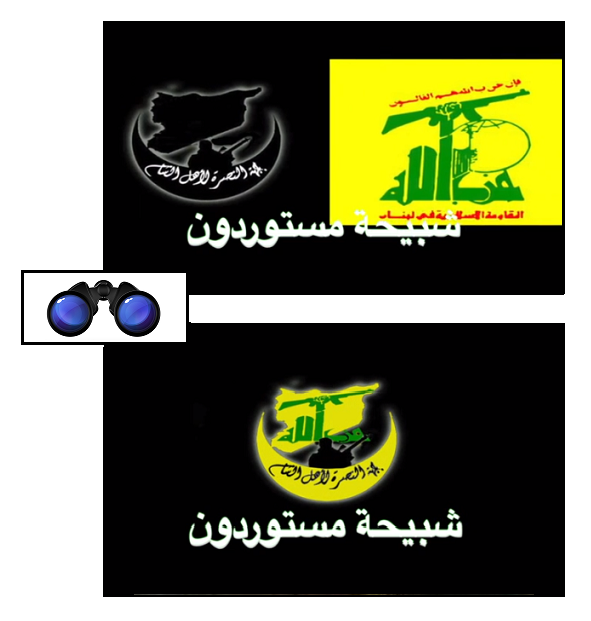
The upper image, showing the Jabha al-Nusra logo — Sunni, left — alongside the Hezbollah insignia — Shi’a, right — morphs into the single image in the lower panel, thereby resolving the sectarian conflict in Syria by filmic means.

The video from which these two shots were taken, alas, was the work product of the US Government, as part of an effort of outreach by the little-known Digital Outreach Team at the State Department, who at the time of writing appear to have 193 videos uploaded.

The BBC notes:

According to the Associated Press news agency, the 50-member Digital Outreach Team tweets, posts Facebook updates and uploads video to YouTube in Arabic, Punjabi, Somali and Urdu, in a bid to counter the radical jihadist message. It seems it’s even had exchanges with terror suspects such as US-born militant Omar Hammami, a former member of Somalia’s al-Shabab.

The two images above were taken from a video titled Secret meeting between Hassan Nasrallah and al-Zawahiri, but the Beeb’s article focused on what it termed a “spoof Al-Qaeda video”, which I’ll call Pharaoh Ayman speaks to the dancing girls for want of a better name:

The team’s al-Zawahiri spoof opens with a notice that “fizzy drinks should be consumed while watching this production” – a twist on the usual message at the beginning of al-Qaeda videos saying “it is not permitted to add music to this production … Taking the classic preaching-to-camera format, the three-minute clip features a voiceover in which the Egyptian-born militant repeatedly bungles his speech by saying things like: “The butchers, ahem, sorry, I mean the mujahideen”. In the video – issued by the US State Department’s Digital Outreach Team – al-Zawahiri is backed by punkah-wallahs. The clip then cuts to a shot, as though from behind the speaker, to reveal a troupe of dancers performing in front of him.”

But see for yourselves, punkah-wallas and all:

For your further Sundance consideration, and from the same studios, you might also like the lowest and slowest nasheed ever recorded.

**

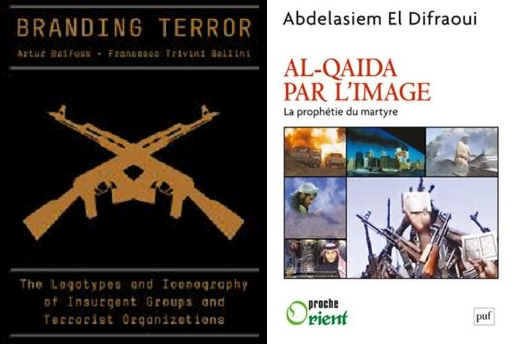
Speaking of graphics — coming up on ZP when I have had a chance to read a little more of El Difraoui, reviews of:

  • Beifuss and Bellini, Branding Terror
  • Abdelasiem El Difraoui, Al-Qaida par l’image. La prophétie du martyre
  • Form is insight: the vesica piscis

    Sunday, June 2nd, 2013

    [ by Charles Cameron — here’s another post in my importance of form in intelligence series ]
    .

    Form is pattern, and pattern recognition is insight.

    A while back, I started a series of posts [1, 2, 3, 4 and 5] in which I suggested that form is, from an intelligence point of view (and however you may parse “intelligence”) as important to humans as content. I’ll be saying more about this today, but wanted to complete this old and never quite completed post in that series right away, in response to a comment Grurray made today regarding Venn diagrams and the vesica piscis.
    .


    .

    **

    If you’ve seen a Venn diagram, you’ve seen overlap. And the simplest form of overlap — between two classes, ideas, or whatever — is the one that’s Venn diagrammed (below, left) as the overlapping of two equal circles — known to artists as the vesica piscis or eye of the fish.

    MasterCard uses it for its logo (right) —

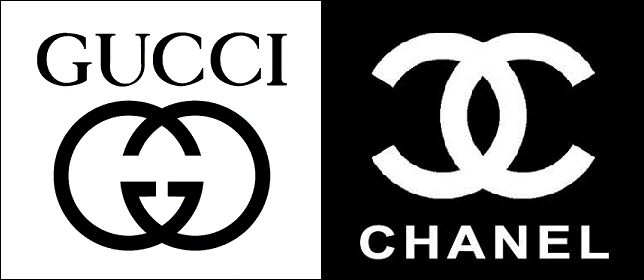
    — as do Gucci and Chanel:


    .

    **

    But let’s go back to that first pair of images:


    .

    Long before commerce took note of it, the vesica was a sacred image — back in the days when geometry, like nature herself, was sacred.

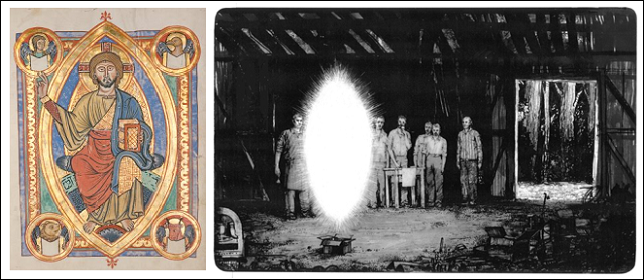
    Like the illuminist of the Codex Bruchsal (ca 1220) with his Christ Pantocrator (above, left), Jan Valentine Saether makes sacred use of the vesica in his book The Viloshin Letters, which I hope to see published shortly — the exquisite suite of prints that accompany the text have already been exhibited to acclaim.

    In his text accompanying this particular plate, he writes:

    I was not sure. But a new wonder has been moving towards us. That which is… has a new presence. Entering here from elsewhere, the holy spirit manifested again in the vernacular last Wednesday, September 16th.

    We were standing around, being together in our own fashion, when suddenly through our common imagination, right there on the floor in the old barn, the donna and the madonna, the loose one and the holy one, merged and became visible.

    **

    It seems to me there is more to the glory of God than there is to the glory of handbags and perfumes — but your mileage may vary, credit cards are handy little items, and then again, it’s all part of the glory in my opinion.

    A neat koan, that.


    Switch to our mobile site