zenpundit.com » judaism

Archive for the ‘judaism’ Category

Various body parts for various body parts

Friday, May 31st, 2013

[ by Charles Cameron — mostly about a fascinating quote from Martin Luther King ]
.

.

Let’s start with the Code of Hammurabi, 196-97:

If a man put out the eye of another man, his eye shall be put out. If he break another man’s bone, his bone shall be broken.

A few days ago, I found I was feeling mildly exercised by one Dan Hodges writing in the Telegraph:

Indeed, “An eye for an eye, a tooth for a tooth,” quoted by one of Lee Rigby’s suspected killers, comes from the Bible, not the Koran.

Hodges was quoting Michael Adebolajo, who had said on camera:

The only reason we have killed this man today is because Muslims are dying daily by British soldiers. And this British soldier is one. It is an eye for an eye and a tooth for a tooth. By Allah, we swear by the almighty Allah we will never stop fighting you until you leave us alone.

**

It is true that Deuteronomy 19.21 reads:

And thine eye shall not pity; but life shall go for life, eye for eye, tooth for tooth, hand for hand, foot for foot.

and Exodus 21.23-25:

And if any mischief follow, then thou shalt give life for life, Eye for eye, tooth for tooth, hand for hand, foot for foot, Burning for burning, wound for wound, stripe for stripe.

— but its is clear that Adebolajo — who was brought up devoutly Christian in Nigeria, converted (“reverted”) to Islam, and now references suras of the Qur’an using their Arabic names — would also be aware of Sura Al-Ma’ida (5) 45:

And therein We prescribed for them: ‘A life for a life, an eye for an eye, a nose for a nose, an ear for an ear, a tooth for a tooth, and for wounds retaliation’; but whosoever forgoes it as a freewill offering, that shall be for him an expiation.

**

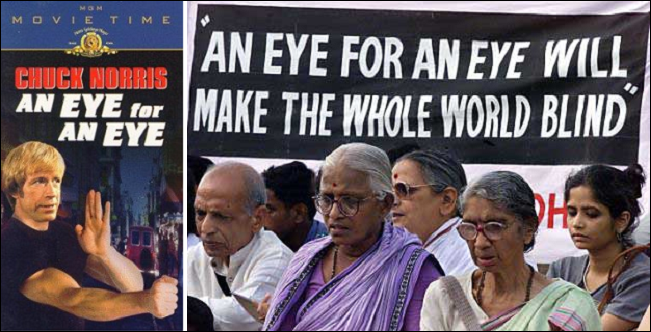
The quote “An eye for an eye makes the whole world blind” is often attributed to Mohandas Gandhi, but I checked with Quote Investigator and found it was originally used by one Louis Fischer to paraphrase Gandhi’s teaching, although the Gandhi family apparently think it sounds authentic. But what interested me most was that a form of the same phrase can safely be attributed to Martin Luther King, who is quote in Stride Toward Freedom: The Montgomery Story, p 208, as saying:

Violence as a way of achieving racial justice is both impractical and immoral. It is impractical because it is a descending spiral ending in destruction of all. The law of an eye for an eye leaves everyone blind. It is immoral because it seeks to annihilate the opponent rather than win his understanding; it seeks to annihilate rather than to convert. Violence is immoral because it thrives on hatred rather than love. It destroys community and makes brotherhood impossible. It leaves society in monologue rather than dialogue. Violence ends by defeating itself. It creates bitterness in the survivors and brutality in the destroyers.

That’s quite a paragraph.

**

Of note, besides the parallel structure with which King addresses violence as both impractical and immoral, are two matters I have often pointed to here on Zenpundit:

Self-reference:

Violence ends by defeating itself.

and polyphony:

It leaves society in monologue rather than dialogue.

**

Gandhi’s position seems to come close to that presented in Matthew 5. 38-48 — in which Christ clearly countermands the lex talionis as promulgated in Exodus and Deuteronomy:

Ye have heard that it hath been said, An eye for an eye, and a tooth for a tooth: But I say unto you, That ye resist not evil: but whosoever shall smite thee on thy right cheek, turn to him the other also. And if any man will sue thee at the law, and take away thy coat, let him have thy cloke also. And whosoever shall compel thee to go a mile, go with him twain. Give to him that asketh thee, and from him that would borrow of thee turn not thou away.

Ye have heard that it hath been said, Thou shalt love thy neighbour, and hate thine enemy. But I say unto you, Love your enemies, bless them that curse you, do good to them that hate you, and pray for them which despitefully use you, and persecute you; That ye may be the children of your Father which is in heaven: for he maketh his sun to rise on the evil and on the good, and sendeth rain on the just and on the unjust. For if ye love them which love you, what reward have ye? do not even the publicans the same? And if ye salute your brethren only, what do ye more than others? do not even the publicans so? Be ye therefore perfect, even as your Father which is in heaven is perfect.

And. for that matter, to The Richmond Declaration of Faith of 1887, as quoted today by my friend, Friend Marshall Massey:

We feel bound explicitly to avow our unshaken persuasion that all war is utterly incompatible with the plain precepts of our divine Lord and Law-giver, and the whole spirit of His Gospel, and that no plea of necessity or policy, however urgent or peculiar, can avail to release either individuals or nations from the paramount allegiance which they owe to Him who hath said, ‘Love your enemies.’ (Matt 5:44, Luke 6:27)

**

How — without denigrating those who are of either the Deuteronomic or the Gandhian persuasion — does one nudge the world-system gently away from justice and towards mercy, away from revenge and towards reconciliation, away from war and towards peace? Towards a new and more viable homeostasis?

Some good news aka gospel

Saturday, May 25th, 2013

[ by Charles Cameron — the Greek word for gospel, euangelion, literally means good news — these news items from the last month or so are good ]
.

Sources:

  • Times of Israel, Hard to deny a Holocaust your father saved Jews from
  • Ha’Aretz, In one hard-knock British city, a secret Muslim donor helps save a synagogue
  • Of Alice, Angels and Apsaras

    Wednesday, May 15th, 2013

    [ by Charles Cameron — squeezed between the space of astronomers and the paradise of the believers, is there yet room for the dancing play of poetry, music and imagination? ]
    .

    My first question for you today would be — do you believe in Alice?

    And further to that, do you believe in the Red Queen?

    **

    Two things collided to cause me to write this post today. First, Emptywheel opened her blog post on Putin’s outing of an American spy today with a quote from Lewis Carroll:

    ‘I declare it’s marked out just like a large chessboard!’ Alice said at last. ‘There ought to be some men moving about somewhere–and so there are!’ she added in a tone of delight, and her heart began to beat quick with excitement as she went on. ‘It’s a great huge game of chess that’s being played–all over the world -– if this is the world at all, you know. Oh, what fun it is!’

    I can’t really ignore Lewis Carroll when he crops up in my morning feed like that: he’s a Christ Church man and a poet, as I am, and it would be rude of me to ignore him. And besides, what he’s on about here is the world-as-game concept, which is never far from my mind — hence my inclusion of that question about the Red Queen.

    **

    And second, mermaids.


    .

    It gets more interesting, you see. Because what collided with that first question was a conversation @khanserai aka Humera Khan was having with @mujaahid4life aka Abdallah via Twitter, in which the Harry Potter books were discussed and the topic of unimaginative clerical fatwas on games and works of fiction came up. At which point, Abdallah pointed us all to this now-archived fatwa regarding the permissibility of eating mermaid flesh:

    Ruling on eating mermaids

    A mermaid is a creature that lives in water and looks like a human. As to whether it really exists or it is a mythical being, that is subject to further discussion.

    It says in a footnote in al-Mawsoo’ah al-Fiqhiyyah (5/129): From the modern academic resources that are available to us, it may be understood that the mermaid, which is called Sirène in French, is a mythical creature that is described in fairy tales as having an upper body like a woman and a lower half like a fish.

    See the French Larousse encyclopédique on the word Sirène.

    The encyclopaedia goes on to say: The widespread notion in ancient times was that the wonders and animals of the sea were more and greater than the wonders of dry land, and that there was no kind of animal in the sea that did not have a counterpart on land. This was confirmed by Prof. Muhammad Fareed Wajdi in his encyclopaedia, quoting from modern academic sources. See: Daa’irah Ma’aarif al-Qarn al-‘Ishreen: Bahr – Hayawiyan. End quote.

    Al-Dumayri said in Hayaat al-Haywaan al-Kubra: Mermaid: it resembles a human but it has a tail. Al-Qazweeni said: Someone brought one of them in our time. End quote.

    Many of the fuqaha’ mentioned mermaids and differed on the ruling concerning them. Some of them said that they are permissible (to eat) because of the general meaning of the evidence which says that whatever is in the sea is permissible. This is the view of the Shaafa’is and Hanbalis, and is the view of most of the Maalikis and of Ibn Hazm and others. And some of them regarded it as haraam because it is not a kind of fish. This is the view of the Hanafis and of al-Layth ibn Sa’d.

    Ibn Hazm (may Allaah have mercy on him) said in al-Muhalla (6/50): As for that which lives in the water and cannot live anywhere else, it is all halaal no matter what state it is in, whether it is caught alive and then dies, or it dies in the water and then floats or does not float, whether it was killed by a sea creature or a land animal. It is all halaal to eat, whether it is the pig of the sea (i.e., a dolphin), a mermaid, or a dog of the sea (i.e., shark) and so on. It is halaal to eat, whether it was killed by an idol-worshipper, a Muslim, a kitaabi (Jew or Christian) or it was not killed by anyone.
    What’s outside the box?

    And it goes on… ending, mercifully:

    And Allaah knows best.

    Sometimes I think those might be my favorite words evvah!

    **

    Are mermaids real enough for religious scholarship to address them?

    Is Alice?

    John Daido Loori Roshi, late zen master and abbot of the Mountains and Rivers Order’s Mt Tremper abbey, once gave a teisho using a passage from Alice as his koan:

    Many Zen koans contain references to myths and folktales of ancient India, China, and Japan. Since Westerners generally are not familiar with these stories, koan study without extensive background information is often a frustrating and exasperating process.

    In this dharma discourse, Abbot John Daido Loori fashions a koan, complete with pointer and capping verse, from a classic of children’s literature, Lewis Carroll’s Alice in Wonderland. The koan revolves around Alice’s encounter with a caterpillar who explains the magical properties of a special two-sided mushroom that to Alice’s eyes appears perfectly round. Alice’s struggles with this dilemma make for a stimulating story that mirrors the conflicts and dualities we face in our everyday life.

    You can read it here.

    **

    All of which brings me to the question of the place of deep imagination in a sometimes shallow world.

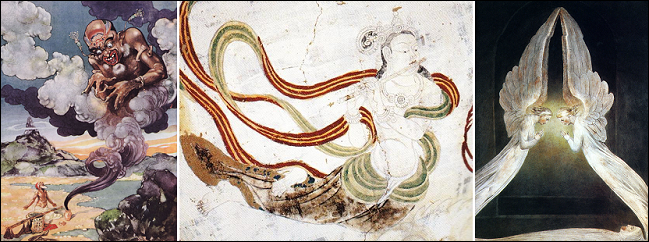
    Alice, do you believe in her? Mermaids and Macbeth mean something to sailors and theater-folk, respetively. Angels? If angels, then the djinn, too? Christian scripture speaks for the existence of one, the Qur’an of both — is one more probable, more real, perhaps, than the other?

    And what of the gandharvas and apsaras — middle panel — the celestial musicians and airy dancers who move to their music? Is there any poet who can claim never to have sensed them?

    **

    And thus we come to Robert Graves and the muse as he depicts her, in his book The White Goddess, and in many poems such as this:

    In Dedication
    .

    Your broad, high brow is whiter than a leper’s,
    Your eyes are flax-flower blue, blood-red your lips,
    Your hair curls honey-colored to white hips.

    All saints revile you, and all sober men
    Ruled by the God Apollo’s golden mean;
    Yet for me rises even in November
    (Rawest of months) so cruelly new a vision,
    Cerridwen, of your beatific love
    I forget violence and long betrayal,
    Careless of where the next bright bolt might fall.

    **

    But here the waters are getting deeper…

    Of the Jerusalem and Mahdist syndromes

    Friday, April 26th, 2013

    [ by Charles Cameron — messianisms as madness ]
    .

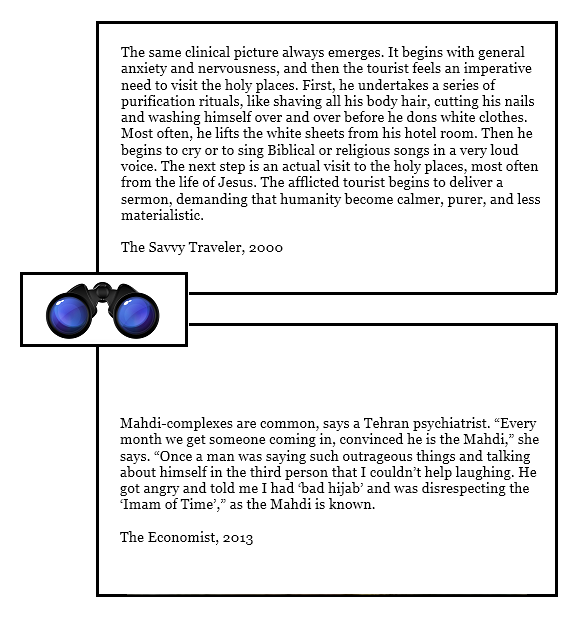
    The Economist has a fascinating piece out about Iran’s multiplicity of messiahs (lower panel, below) which reminded me strongly of the Jerusalem syndrome (upper panel).

    I suspect that was “bad adab” – bad manners, not bad clothing – but never mind.

    **

    The Economist piece is worth reading in full, if you also take the time to read Tim Furnish — who tones down the rhetoric a couple of notches:

    I seriously doubt that Iranian jails are full of thousands of self-styled mahdis; I suspect many of them are guilty of nothing more eschatological than complaining too publicly about the price of gas or having too large a satellite TV antenna on their homes. But even if reduced by a factor of ten, the Islamic Republic does nonetheless appear to have a serious problem with apocalyptic antipathy toward the government. And a regime predicated, in no small part, on Mahdist ideology finds itself being hoist by its own philosophical petard.

    **

    Meanwhile, back in Jerusalem:

    In Israel, Jerusalem Syndrome is taken very seriously. Everyone involved in security, tourism, or health is on the lookout for afflicted visitors. In an average year, three or four tourists develop real, palpable Jerusalem Syndrome. In l999, more than 50 visitors were diagnosed, the increase possibly attributed to millennial activities.

    Why the security concern? Well, because occasionally those afflicted try some pretty dangerous stuff. Dr Yair Bar-El wrote in The British Journal of Psychiatry (2000) 176: 86-90:

    A Protestant from South America conceived a plan to destroy Islamic holy places in order to replace them with Jewish holy places. The second stage of his plan was then to destroy them in order to start the war of Gog and Magog so that the Anti-Christ would reveal himself, after which Christ would reappear. The patient succeeded in gutting one of the most holy mosques in Jerusalem. Psychiatric examination was ordered by the court, and he was diagnosed as being unable to differentiate between right and wrong, not responsible for his deeds and therefore not fit to stand trial. He was admitted to a local psychiatric institution and later transferred to a mental health institution in his own country

    I think “gutting” is overstating what happened — but you can sense the risk…

    **

    DoubleQuote Sources:

  • The Savvy Traveler, 2000
  • The Economist, 2013
  • Tamerlan Tsarnaev … the Mahdist video, addendum to pt 2

    Monday, April 22nd, 2013

    [ by Charles Cameron — an addendum to my Mahdist video, pt 2 ]
    .


    .

    My thanks to Aaron Zelin, who suggested that the “Jewish (Bible) scholar” I’d mentioned in the post to which this is an addendum (and who featured beginning around 05.32 on the video) looked like looks Simcha Jacobovici and commented, “he is not a ‘scholar’. He’s a journalist.”

    **

    Jacobovici is indeed the fellow in question, and after a quick search I was able to find his film, Quest for the Lost Tribes. The section excerpted in the Mahdist video can be viewed via YouTube here:

    If you’d like to see the whole thing, you can begin here:

    And Jacobovici’s opening claims are both striking and decidedly apocalyptic:

    In the Bible there’s a prophecy. And that prophecy says that in the end of time, all these people that were exiled, that we call “the Lost Tribes of Israel”, will get up and come back to Israel. And it will start happening all over in the four corners of the world. And they’ll just get up and start moving back.

    And what if it was actually happening? Here you have this prophecy, and people are actually getting up, they may be in your own neighborhood. And they’re packing their bags, and to you they’re just somebody else packing their bags and moving. But in actual fact they’re responding to some kind of Biblical “post-hypnotic suggestion”, I’m not talking about a thousand year, I’m talking about twenty seven hundred year old “suggestion”, that they’re responding to now.

    And we can actually film these people, and match the prophecy with the events.

    And the reason it should matter is that — because once they do what they have to do, they trigger the apocalypse.

    **

    Jacobovici’s Internet Movie Database [IMDb] page is quite a long one: he’s a journalist, yes, and specifically a documentary filmmaker — and an Emmy winner for “Outstanding Investigative Journalism”.

    You may also be able to view the entire film online at his own site


    Switch to our mobile site