zenpundit.com » judaism

Archive for the ‘judaism’ Category

Musical chairs – and disharmony

Sunday, March 31st, 2013

[ by Charles Cameron — once again noting the value of seeking out parallels before rushing to judgment ]
.

**

I’m not in a position to say whether the event at University College, London was “segregated” or not — a Muslim woman who favors separated seating and was present wrote:

As a woman, I should have the choice who I choose to mix with. The organisers were accommodating to all – for those who wanted to sit separately, and for those who wanted to sit together. During the event, 2 men demanded to sit in the women’s section in between the women, after much discussion, the organisers cleared space for them to sit – (there were so many rows), while still trying to respect the position of the women who had requested to be seated separately. A man in particular demanded to sit in between the women in order to ‘challenge their beliefs’

Meanwhile, a man who describes himself as an ex-Muslim atheist wrote:

The evening turned sour right at the outset, as attendees were herded through segregated entrances into ‘Ladies’ and ‘Gentlemen’ sections.

Five minutes of remonstration yielded a slender two-row mixed section for the debauched, with the remaining twenty devoted to good old-fashioned chastity, whilst the five rows at the back with the worst views of the stage comprised the ‘Ladies Area’.

Matters came to a head when two male attendees were forcibly evicted from a section of the auditorium which turned out to be part of the ‘Ladies’ Area’.

Incensed, they raised the matter with the organisers, but were staggered to see the organisers set the guards on them instead, this time with the express intention of evicting them from the auditorium itself for “unruly behaviour”.

This behaviour cited consisted of little more than the temerity to occupy a vacant seat in a public auditorium, and to protest one’s unjust eviction, without recourse to raised voices or physical contact.

Again, I wasn’t there. But perhaps we should think about the Perlman concert and its seating arrangements, and decide that offering seating in three sections, two “separated” for those who prefer that arrangement, and one “mixed” for those with that preference, is a civilized way to accommodate the wishes of a variety of people.

Overkill — or useful heuristic?

**

Sources:

In between Big Bang and Heat Death

Thursday, March 21st, 2013

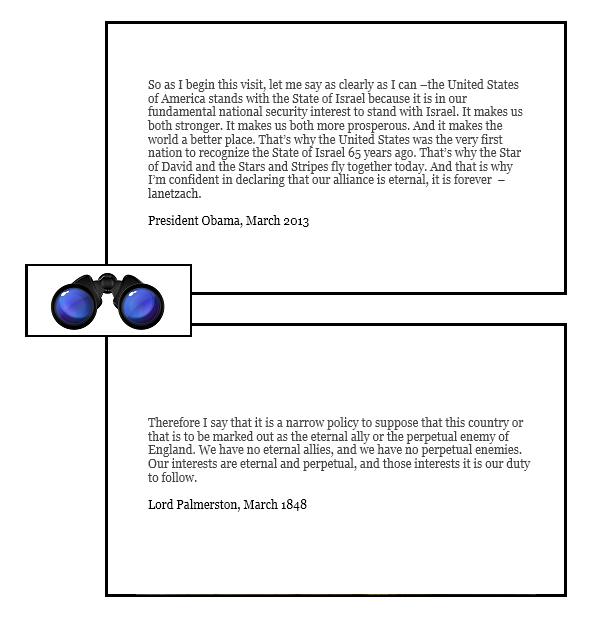
[ by Charles Cameron — a terrific example of the DoubleQuote form, drawing on Obama at Ben Gurion Airport and Palmerston in the House of Commons, and why the form is useful ]
.

Some time in between t-zero and t-aleph-null, some time between the First Day of Creation and Judgment Day, some time in between the Big Bang and the Heat Death of the Universe, there’s a stretch of time known as always.

**

What does juxtaposing the two statements allow us to understand?

  • That times have changed?
  • That what you tell a foreign government is not what you tell your own?
  • That Brits are more understated and Americans more plainspoken?
  • That President Obama is showing specific support for Israel, while Palmerston was expressing the general rule which covers all such utterances?
  • That the word “always” doesn’t necessarily mean “for ever”, “unto the ages of ages” as the Eastern Church has it?
  • Perhaps “for the foreseeable future” would be a better phrase to use, if it didn’t sound so iffy. I’d say it means something closer to “in continuity” than to “in perpetuity”.

    **

    The great thing about DoubleQuotes as a form is that they jump-start you into thinking about samenesses and differences, without demanding which particular implications you will select, thus giving rise to multiple possibilities and enlarging the scope of narrative or discussion.

    And while I’ve sharpened the pairing of quotes — or graphics — into a tool for repeated use, it’s already a habitual form of thinking, as we can see from the fact that these two particular quotes were juxtaposed by Sam Roggeveen in his post, America’s BFF: Obama calls it, in the Lowy Institute’s Interpreter today.

    **

    We naturally pair similars to contrast and compare them: it may be the most basic device that human memory affords us — this reminds me of that.

    Here are a few of my own old favorites…

    **

    You can read Obama’s speech, from which the excerpt above was taken, on this Israel Times page.

    Discovering a New Circle of Hell

    Monday, March 4th, 2013

    There is an understandable buzz when a historical event as well known and deeply investigated as  the Holocaust has suddenly been found to have been underestimated by an order of magnitude.

    From The New York Times:

    The Holocaust Just Got More Shocking 

    ….As early as 1933, at the start of Hitler’s reign, the Third Reich established about 110 camps specifically designed to imprison some 10,000 political opponents and others, the researchers found. As Germany invaded and began occupying European neighbors, the use of camps and ghettos was expanded to confine and sometimes kill not only Jews but also homosexuals, Gypsies, Poles, Russians and many other ethnic groups in Eastern Europe. The camps and ghettos varied enormously in their mission, organization and size, depending on the Nazis’ needs, the researchers have found.

    The biggest site identified is the infamous Warsaw Ghetto, which held about 500,000 people at its height. But as few as a dozen prisoners worked at one of the smallest camps, the München-Schwabing site in Germany. Small groups of prisoners were sent there from the Dachau concentration camp under armed guard. They were reportedly whipped and ordered to do manual labor at the home of a fervent Nazi patron known as “Sister Pia,” cleaning her house, tending her garden and even building children’s toys for her.

    When the research began in 2000, Dr. Megargee said he expected to find perhaps 7,000 Nazi camps and ghettos, based on postwar estimates. But the numbers kept climbing — first to 11,500, then 20,000, then 30,000, and now 42,500.

    The numbers astound: 30,000 slave labor camps; 1,150 Jewish ghettos; 980 concentration camps; 1,000 prisoner-of-war camps; 500 brothels filled with sex slaves; and thousands of other camps used for euthanizing the elderly and infirm, performing forced abortions, “Germanizing” prisoners or transporting victims to killing centers.

    In Berlin alone, researchers have documented some 3,000 camps and so-called Jew houses, while Hamburg held 1,300 sites.

    ….The lead editors on the project, Geoffrey Megargee and Martin Dean, estimate that 15 million to 20 million people died or were imprisoned in the sites that they have identified as part of a multivolume encyclopedia

    Read the rest here.

    Perhaps some of you will recall the controversy in the late 1990’s surrounding the release of Hitler’s Willing Executioners by Daniel Goldhagen where Goldhagen argued that Nazi genocide was only possible with the widespread complicity and often enthusiastic participation of “ordinary Germans” who were not themselves Gestapo agents or Nazi fanatics.  One of the primary charges against Goldhagen by academic historians was his generalizing indictment of a generation of Germans for Nazi policy that was, for all intents and purposes, officially a state secret.  After all, the closest thing to a “public” discussion in the Third Reich of the Final Solution was a terrifying speech by SS-Reichsfuhrer Heinrich Himmler at the Posen Conference to an assembly of Gauleiters  and Reichsleiters who constituted the aristocracy of the Nazi Party.

    The sheer geographic density and social ubiquity of the Nazi machinery of repression and genocide documented by researchers severely undermines the critics of Goldhagen. While it is well documented that most Germans, unless they were political opponent or social misfits, did not personally feel the heavy hand of the Gestapo in the way Soviet citizens experienced the NKVD, Germans during the war years irrefutably lived cheek by jowl with the miserably wretched slaves of the Reich.

    Some of the shock produced by this investigation is due to an artificial “parsing of genocide” by historians into distinct categories of death-dealing instead of looking at Nazi democide as a whole cloth or continuum.

    In the immediate aftermath of the war, there was little interest beyond the Nuremberg  Tribunal in delving into the depths of Nazi crimes. Reconstruction of Europe and “getting on with life” or the exigencies of the Cold War and the ominous threat of the Soviets took far greater precedence. Even among Holocaust survivors themselves, there was initially an effort to “move on” from the unimaginable, or to make a anguished pretense of so doing, as expressed in the critically acclaimed Rod Steiger film, The Pawnbroker. When historians began more serious examinations of Nazi crimes in the 1960’s and 1970’s, there was a tendency to separate the Holocaust from related or similar atrocities due in part to the overriding ideological emphasis the most extreme Nazis placed upon the total and absolute elimination of all Jews – every last one – at all costs,. Even over and above winning the war.

    However, that genocidal crusade by the SS against the Jews also facilitated the deaths of millions of others – including the Gypsies (marked for nearly complete extermination), the “useless eaters“, some 700,000 Serbs to please the Ustase puppet regime, political opponents who disappeared into the Night and Fog, and a vast democide of Slavic peoples to feed the Third Reich’s inexhaustible need for slave labor. Albert Speer wrote that Himmler coldly planned a further massive reduction of the Russian and Ukranian populations west of the Urals to build a post-war Nazi racial empire in vanquished Russia.

    The scale of murder by totalitarian governments in the 20th century approaches the mythic, a phenomena for which the Holocaust has become a totem.

    Of plagues of locusts, then & now?

    Tuesday, February 26th, 2013

    [ by Charles Cameron — the juxtaposition of sacred and secular worldviews, and what happens where they overlap ]
    .

    **

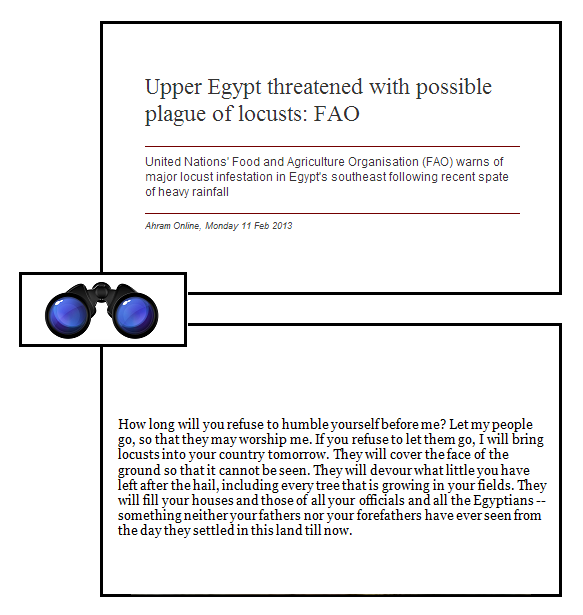
    I’m returning here to an old theme of mine, the juxtaposition of worldviews — in this case, accounting for plagues of locusts in Egypt.

    Such juxtapositions are like Rorschach blots in some ways — they allow each reader to see the items juxtaposed from within their own worldviews, perhaps applauding one and dismissing another, perhaps seeing some virtue in each or none in either — and perhaps arriving at some meta-level understanding which neither one alone would afford.

    Is a plague of locusts in Upper Egypt of which the FAO warns in the upper panel above entirely explained in terms of rainfall? Is it pure mental happenstance that Egypt was the site of a Biblical locust plague at the time of the Israelite Exodus [Ex. 10. 3-6]? Is there, perhaps, a message for Egypt vis-a-vis Israel for our own day?

    The answers people give to questions such as these, in which secular and sacred sources address what are putatively similar situations, can influence the way on which they voice themselves and vote — perhaps a good thing, perhaps not.

    **

    For what it’s worth, the plague of locusts is mentioned in the Qur’an in Sura 7.133:

    So We let loose upon them [the Egyptians} the flood and the locusts, the lice and the frogs, the blood, distinct signs; but they waxed proud and were a sinful people.

    **

    In contemplating matters of this sort, it may be valuable to consider the remarks of the Pontifical Biblical Commission in The Interpretation Of The Bible In The Church, 1993/4:

    The basic problem with fundamentalist interpretation of this kind is that, refusing to take into account the historical character of biblical revelation, it makes itself incapable of accepting the full truth of the incarnation itself. As regards relationships with God, fundamentalism seeks to escape any closeness of the divine and the human. It refuses to admit that the inspired word of God has been expressed in human language and that this word has been expressed, under divine inspiration, by human authors possessed of limited capacities and resources. For this reason, it tends to treat the biblical text as if it had been dictated word for word by the Spirit. It fails to recognize that the word of God has been formulated in language and expression conditioned by various periods. It pays no attention to the literary forms and to the human ways of thinking to be found in the biblical texts, many of which are the result of a process extending over long periods of time and bearing the mark of very diverse historical situations.

    Concerning the enforcement of morals

    Wednesday, January 30th, 2013

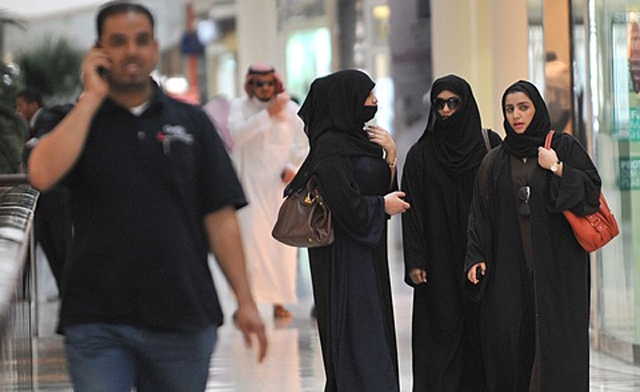
    [ by Charles Cameron — enforcement of moral codes in the UK, US, Israel and KSA, unofficial and official, worsening, continuing and improving, quite the smörgåsbord ]
    .

    .

    Moral vigilantism appears to be on the rise in parts of London, according to this first-person piece by Jane Kelly, consulting editor of the Salisbury Review, which identifies itself as “seriously right” — ‘I feel like a stranger where I live’ [Telegraph, 29 January 2013]:

    “When you go swimming, it’s much healthier to keep your whole body completely covered, you know.” The Muslim lady behind the counter in my local pharmacy has recently started giving me advice like this. It’s kindly meant and I’m always glad to hear her views because she is one of the few people in west London where I live who talks to me.

    [ … ]

    More worryingly, I feel that public spaces are becoming contested. One food store has recently installed a sign banning alcohol on the premises. Fair enough. But it also says: “No alcohol allowed on the streets near this shop.” I am no fan of street drinking, and rowdy behaviour and loutish individuals are an aspect of modern British ”culture’’ I hate. But I feel uneasy that this shopkeeper wants to control the streets outside his shop. I asked him what he meant by his notice but he just smiled at me wistfully.

    Perhaps he and his fellow Muslims want to turn the area into another Tower Hamlets, the east London borough where ”suggestive’’ advertising is banned and last year a woman was refused a job in a pharmacy because she wasn’t veiled.

    On the other hand, maybe I should be grateful. At least in Acton there is just a sign in a shop. Since the start of the year there have been several reports from around London of a more aggressive approach. Television news footage last week showed incidents filmed on a mobile phone on a Saturday night, in the borough of Waltham Forest, of men shouting “This is a Muslim area” at white Britons.

    The video commentary stated: “From women walking the street dressed like complete naked animals with no self-respect, to drunk people carrying alcohol, we try our best to capture and forbid it all.”

    **

    It also appears to be present in parts of Brooklyn, according to Modesty in Ultra-Orthodox Brooklyn Is Enforced by Secret Squads, [New York Times, January 29, 2013]:

    In the close-knit world of ultra-Orthodox Judaism, community members know the modesty rules as well as Wall Street bankers who show up for work in a Brooks Brothers suit. Women wear long skirts and long-sleeved, high-necked blouses on the street; men do not wear Bermuda shorts in summer. Schools prescribe the color and thickness of girls’ stockings.

    The rules are spoken and unspoken, enforced by social pressure but also, in ways that some find increasingly disturbing, by the modesty committees. Their power is evident in the fact that of the half dozen women’s clothing stores along Lee Avenue, only one features mannequins, and those are relatively shapeless, fully clothed torsos.

    The groups have long been a part of daily life in the ultra-Orthodox communities that dot Brooklyn and other corners of the Jewish world. But they sprang into public view with the trial of Nechemya Weberman, a prominent member of the Satmar Hasidim in Brooklyn, who last week was sentenced to 103 years in prison after being convicted of sexually abusing a young girl sent to him for counseling.

    [… ]

    The details were startling: a witness for Mr. Weberman’s defense, Baila Gluck, testified that masked men representing a modesty committee in the Hasidic village of Kiryas Joel, N.Y ., 50 miles northwest of New Y ork City, broke into her bedroom about seven years ago and confiscated her cellphone.

    The Brooklyn district attorney, Charles J. Hynes, who prosecuted the Weberman case, has now received allegations that members of a modesty committee forced their way into a home in the borough, confiscating an iPad and computer equipment deemed inappropriate for Orthodox children, officials say.

    [ … ]

    “They operate like the Mafia,” said Rabbi Allan Nadler, director of the Jewish studies program at Drew University in Madison, N.J.

    **

    And in Israel — from the same report, although perhaps more widely known? I’ve certainly seen mentions…

    In Israel, there have been similar concerns. Though no modesty committee was overtly involved, there has been anger over ultra-Orthodox zealots who spit on and insulted an 8-year-old girl for walking to school through their neighborhood in a dress they considered immodest.

    **

    Meanwhile, the Saudis seem to be decreasing the scope of their official equivalent, according to Saudi limits powers of the notorious religious police [Al Arabiya, 30 January 2013]:

    Saudi Arabia has set new limitations on the powers of its notorious religious police, charged with ensuring compliance with Islamic morality but often accused of abuses, its chief said on Tuesday.

    The Commission for the Promotion of Virtue and Prevention of Vice “once had much expanded powers, but with the new system… some of these powers, such as interrogating suspects and pressing charges,” will be restricted to the police and public prosecution, Shaikh Abdul Latif Abdel Aziz Al Shaikh told AFP.

    The religious police may still arrest those carrying out “flagrant offences such as harassing women, consuming alcohol and drugs, blackmail and the practice of witchcraft,” Shaikh said of the new law approved by the cabinet.

    and:

    Relatively moderate Al Shaikh, appointed last year, has raised hopes that a more lenient force will ease draconian social constraints in deeply conservative Islamic country.

    Two weeks into his post, Al Shaikh banned volunteers from serving in the commission, which enforces the kingdom’s strict Islamic rules.

    H/t John Burgess at Crossroads Arabia.

    **

    All these articles are worth reading in full, and you’ll be enriched by reading them together, comparatively — food for thought!

    Switch to our mobile site