zenpundit.com » Islam

Archive for the ‘Islam’ Category

Orlando Tweets Two

Tuesday, June 14th, 2016

[ by Charles Cameron — on a variety of other perspectives ]
.

Once again, my point is that there’s a whole lot of going on going on, and it’s worth getting a wide-angle view.. which means multiple perspectives, including those not your own:

**

Politicking:

Joshua Green, Trump seems to regard Omar Mateen as “Afghan” in the same way Judge Curiel was “Mexican”: foreign/un-American, even though both born in US
Charlene Deveraturda, The Atlantic’s ISIS Expert Graeme Wood Slams Trump For “Hurt[ing] The Fight Against ISIS” With Anti-Muslim Rhetoric

Both Al-Jazeera‘s and Joshua Green‘s tweets offer us examples of DoubleQuotes thinking.

**

Guns:

Program on extremism, ‘Orlando Shooter Legally Bought Guns Despite Previous Flags by FBI’
Rob Crilly, Orlando shows arc again. Hate-filled young man with access to guns picks his victims and then selects poisonous ideology to add “meaning”
Bill Maher, #Orlando Conservatives:”Don’t say it has anything to do with guns!” Liberals:”Don’t say it has anything to do with Islam!”
Maajid Nawaz, Saying this has nothing to do with Islam (libs) is as ignorant as saying this has nothing to do with guns (cons).Both need reform
Piers Morgan, Obama’s about to make the same speech he’s made about guns 20 times in his presidency. Just more pointless rhetoric, sadly.
Steven Crowder, Orlando timeline: Anti-Gay Muslim commits mass terrorism. American gun-owners condemn it. Liberals try to take their guns

**

Islamic responses:

Shadi Hamid, Muslim organizations in the United States unequivocally condemned the Orlando assault
Usama Hasan, Does #Islam condemn #gays to death?

and in ISIS perspective:

Cole Bunzel, ISIS’s A’maq news agency claims Florida attack was “carried out by a soldier of the Islamic State”
Will McCants, ISIS uses term “fighter” for Orlando attacker rather than “soldier” (Paris/Brussels) or “supporter” (San Bernardino) for whatever it’s worth

**

And finally, barely mentioned in the welter of opinions about Orlando — the other shoe:

JM Berger, We may have narrowly escaped having two very similar massacres on the same day, apparently unconnected
JM Berger, The fact that one was prevented and one was not is largely a trick of fate. We need robust reporting on LA incident as well
Orlando Tweets One

Tuesday, June 14th, 2016

[ by Charles Cameron — on the variety of possible motives ]
.

On twitter alone, there’s far too much going on as we scramble to understand the Orlando massacre for anyone to make a useful summary, although I must say that Rukmini Callimachi‘s twitter feed since yesterday has been superb. My own first assortment of relevant tweets focuses on the question of motive, but even with that narrowed focus it’s too extensive to present visually tweet by tweet, so I’m mostly going to post relevant texts with links. First, though, I’ll let Jeffrey Goldberg set the overview:

**

Mental Illness:

Yaroslav Trofimov, Orlando killer’s ex-wife says he was a wife-beater with a short fuse who liked to work out and wasn’t religious.
CBSN, It is definitely mental illness…no one ever expected that he would do this.

Mental illness or mental instability may arguably be present in many or all cases of rampage shooting, suicide bombing, etc — it’s a judgment call, and one most properly made by psychiatric or psychological professionals who have observed and interacted with the subjects personally. Sadly, however, continued use of this explanation as the explanation for acts of this kind avoids recognition of other factors in what is inevitably a multifactorial situation — and also contributes to the popular misperception that “mental illness” is a shameful failure of character rather than a complex of medical conditions.

**

Susceptibility to violence:

Lilith, Was Orlando shooter’s domestic violence history a missed warning sign?

**

Islamism:

JM Berger, Orlando gunman tied to radical imam released from prison last year, say law enforcement sources
Program On Extremism, Omar Mateen pledged allegiance to ISIS, official says

**

Homophobia:

Mona Holland, His father says he wasn’t religious, but was furious abt 2 gay men kissing a week or so ago in public
Murtaza Hussain, “Ty Smith & Chris Callen recalled the eventual killer being escorted drunk from the Pulse bar on multiple occasions”
Matt Pearce, “Do you think he was gay?” The shooter’s ex-wife was silent for three seconds. “I don’t know.”
Frances Traynor, speaking from experience, the most virulently homophobic are the most deeply closeted

It seems to me we may have two different forms of enantiodromia to consider here — enantiodromia being the Jungian term for sudden psychological reversal, a pattern I’ve explored elsewhere. The two versions here, which in practice might well be one, but which we can distinguish for analytic purposes, would be (a) psychological, ie the sudden revulsion at forms of sexuality one previously found acceptable and (b) religious, as in a sudden, emotional conversion experience or repentance by which someone non-religious is precipitated into a religious enthusiast.

**

Anti-semitism:

Molly Crabapple, According to the Trump fans in my Twitter replies, somehow the homophobic Orlando murderer is the fault of Jews

**

And finally, Rebellion against Empire:

Excerpt:

An al Qaeda fighter made a point once in a debriefing. He said, all these movies that America makes, like Independence Day and Hunger Games and Star Wars, they’re all about a small scrappy band of rebels who will do anything in their power with the limited resources available to them to expel an outside, technologically advanced invader. And what you don’t realize, he said, is that to us, the rest of the world, you are The Empire, and we are Luke and Han. You are the aliens and we are Will Smith.

Rumi One: the poet and his poems

Sunday, June 12th, 2016

[ by Charles Cameron — first of four posts on the poet Jalal al-Din Rumi, hugely popular, perhaps soon to be the pivot of a blockbuster movie ]
.

Rumi has been in the news recently and in Rumi Three I’ll say a bit about why. But first, in this post, Rumi One, I’ll say something about the poet and his poems — leaving his ineffable spiritual attainments ineffable, since if they’re anything, they’re ineffable — and in Rumi Two I’ll consider a current attack on Rumi and “Rumism” in Turkey, little observed in the western press, which may be of interest to the poet’s many followers here. Rumi Four will contain some recommended readings.

**

Let’s start with some praise of Rumi from Will McCants:

It’s a powerful poet who turns a scholar to the study of his language, the better to read him.

**

I’ve been reading Rumi at least since the first Arberry translations of his Mystical Poems came out in 1968, and in the mid-eighties between then and now had the delight and privilege of doing a joint poetry reading with his more recent translator / popularizer, Coleman Barks, at Lake Tahoe.

I’m in no way surprised — but yes, delighted — that a scholar of McCants’ stature should appreciate Rumi so warmly, and envious of his ability to read the Divan, the Masnavi, the Discourses in the original. Did not the great poet Jami write of Rumi’s Masnavi that it is “the Qur’an in the Persian tongue”?

**

Here’s the poem with which Chicago University Press introduces Arberry’s Mystical Poems of Rumi:

My verse resembles the bread of Egypt—night passes over it, and you cannot eat it any more.
Devour it the moment it is fresh, before the dust settles upon it.
Its place is the warm climate of the heart; in this world it dies of cold.
Like a fish it quivered for an instant on dry land, another moment and you see it is cold.
Even if you eat it imagining it is fresh, it is necessary to conjure up many images.
What you drink is really your own imagination; it is no old tale, my good man.

Set beside this, another comment of Rumi’s, considering his poetry:

I am affectionate to such a degree that when these friends come to me, for fear that they may be wearied I speak poetry so that they may be occupied with that. Otherwise, what have I to do with poetry? By Allah, I care nothing for poetry, and there is nothing worse in my eyes than that. It has become incumbent upon me, as when a man plunges his hands into tripe and washes it out for the sake of a guest’s appetite, because the guest’s appetite is for tripe.

The secular mind may think of that second quote as something of a pose, imagining the poetry of a great poet to be the poet’s own primary concern — but the poems of Rumi themselves, like the poems of St John of the Cross, speak of a love of the divine of which the poetry itself can be but an offshoot, a byproduct.

**

There are none so happy, I would suggest, as those who keep company with the lovers of the divine beloved, and it is that companionship that I see depicted in the poem of Rumi’s I most treasure:

Little by little the drunkards congregate, little by little the wine-worshippers arrive.
The heart-cherishers coquettishly come along the way, the rosy-cheeked ones are arriving from the garden.
Little by little from the world of being and not-being the not-beings have departed and the beings are arriving.
All with skirts full of gold as a mine are arriving for the sake of the destitute.
The lean and sick from the pasturage of love are arriving fat and hale.
The souls of the pure ones like the rays of the sun are arriving from such a height to the lowly ones.
Blessed is that garden, where, for the sake of the Mary’s, new fruits are arriving even in winter.
Their origin is grace, and their return is grace; even from the garden to the garden they are coming.

Indeed, that grace, that garden is woven throughout Rumi’s poetry:

The springtide of lovers has come, that this dust bowl may become a garden; the proclamation of heaven has come, that the bird of the soul may rise in flight.

And where is that garden, when is that springtide of lovers?

Alfred North Whitehead was thinking of education as a stepped-down version of that same garden when he wrote:

The present contains all that there is. It is holy ground; for it is the past, and it is the future. … The communion of saints is a great and inspiring assemblage, but it has only one possible hall of meeting, and that is, the present, and the mere lapse of time through which any particular group of saints must travel to reach that meeting-place, makes very little difference.

Of sundry musicians and their moon walks

Sunday, June 12th, 2016

[ by Charles Cameron — a jeu d’esprit, really, because i already have my sunday surprise for this week lined up, and this was too much fun to miss ]
.

I ran across this tweet this morning from Husain Haqqani, former ambassador of Pakistan to the United States and author of Pakistan: Between Mosque and Military and Magnificent Delusions: Pakistan, the United States, and an Epic History of Misunderstanding, currently with the Hudson Institute:

Neil Armstrong? Heard the Islamic Call to Prayer? On the moon?

**

Poets love the moon, almost by definition — the Chinese poet Li Po supposedly drowned while attempting (under the influence) to kiss her face in the Yellow River — so this alleged, though dubious, story was definitely too rich in possibilities for me to ignored. And the Islamic Call to Prayer? According to Nicholas Kristof in the NYT:

Mr. Obama described the call to prayer as “one of the prettiest sounds on Earth at sunset.”

You may or may not agree, but if you want to hear the Call and judge for yourself, you could try listening to one of these videos:

  • https://www.youtube.com/watch?v=mUHDYlJHaOQ
  • https://www.youtube.com/watch?v=otdgbR3yso0
  • https://www.youtube.com/watch?v=T8o6WKTQpMc
  • **

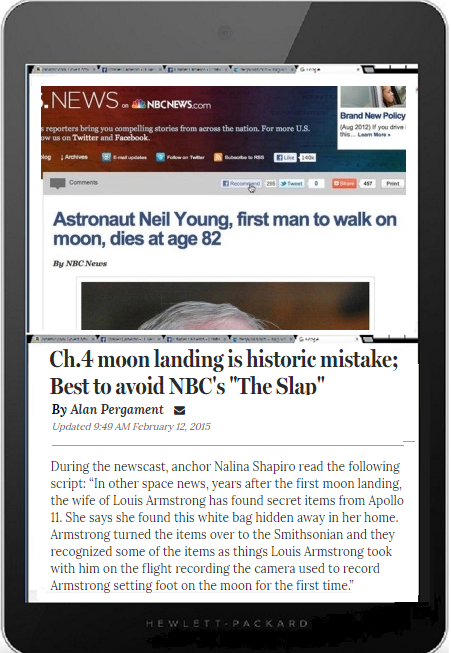
    That’s what led me to my second discovery –one which might be excused by blaming autocorrect, twice, for suggesting that Neil Young — he of the voice, upper panel below — and Louis Arnmstrong — he of the trumpet, lower panel — were each the first man to land on the moon, per (in both cases) NBC.

    Tablet DQ 600 at 75 blank Musicians on Moon

    In all fairness, it’s worth noting that other candidates for moon walks include Buzz Lightyear, Lance Armstrong, and Michael Jackson.

    **

    Sources:

  • Mix 104.1, Twitter Confuses Neil Armstrong With Lance and Louis
  • Buffalo News, Ch.4 moon landing is historic mistake; Best to avoid NBC’s “The Slap”
  • **

    None of these mistakes are critical, however, if you believe the late Srila Prabhupada, who introduced Krishna Consciousness to the United States. As someone fascinated by different cosmologies and theologies, I remember reading of Prabhupada’s claim that the moon landing was faked in a California film studio in his magazine some time in the 1970s. No longer having access to the magazine, and looking for confirmation of that memory, I found this page, Srila Prabhupadas statements about the moon landing, of considerable interest:

    Srila Prabhuapda himself said different things at different times. Sometimes he directly said they didn’t go and it was some kind of hoax. And at other times he said they didn’t go to the moon because they didn’t experience the higher dimensional nature of the moon planet, which is a rational way to harmonize the Vedic perspective with the idea of three dimensional space travel. At other times he just said the whole idea was foolish and a waste of money. He saw material space travel as a foolish attempt to reach higher dimensions which can only be reached by yogic practice.

    Bear in mind too that both Joseph Smith and L Ron Hubbard also taught their followers about significant planets that do not form part of the standard astronomical account of deep space — or the heavens, in other words.

    And Charles Williams — the brilliant Dante scholar, Arthurian poet, novelist, theologian of Romantic Love, and friend of JRR Tolkien and CS Lewis — offers a striking near-contemporary Christian example of the genre in the opening paragraph of his book, The Descent of the Dove: A Short History of the Holy Spirit in the Church.

    The beginning of Christendom, is, strictly, at a point out of time. A metphysical trigonometry finds it among the spiritual Secrets, at the meeting of two heavenward lines, one drawn from Bethany along the Ascent of the Messias, the other from Jerusalem against the Descent of the Paraclete. That measurement, the measurement of eternity in operation, of the bright cloud and the rushing wind, is, in effect, theology.

    See also my post, A metaphysical trigonometry.

    The Champ: knockouts, protests, sufism and the man

    Saturday, June 4th, 2016

    [ by Charles Cameron — Muhammad Ali ]
    .

    The knockout:

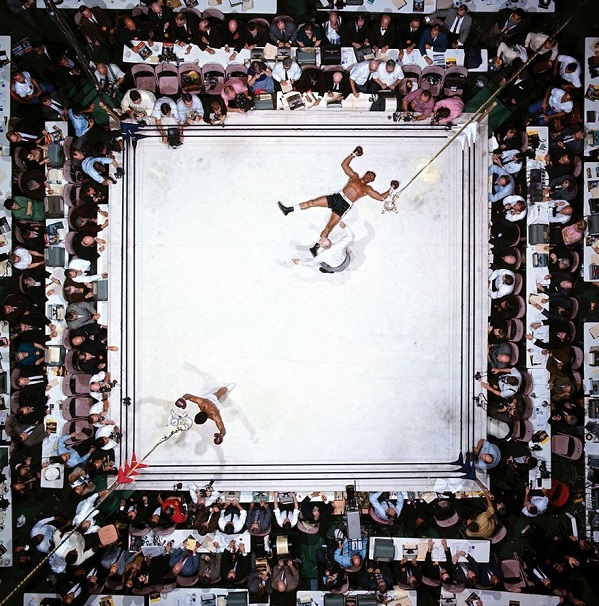
    Obviously, the champ was a knockout — and this photo is almost certainly the loveliest photo of a sporting event I have ever seen — victory and defeat in perfect symmetry:

    Ali mandala of victory
    Neil Leifer/Sports Illustrated/Getty Images via The Guardian

    **

    The protestor

    quote-there-is-one-hell-of-a-difference-between-fighting-in-the-ring-and-going-to-war-in-vietnam-muhammad-ali

    **

    The sufi:

    How did your dad come to embrace Sufi Islam, and what attracts him to it?

    My father has a collection of books by a man named Hazrat Inayat Khan. They’re Sufi teachings. He read them front to cover. They’re old and yellow and the pages are torn. They’re amazing. He always says they’re the best books in the world.

    My father is very spiritual — more spiritual now than he is religious. It was important for him to be very religious and take the stands he did in earlier years. It was a different time. He still tries to convert people to Islam, but it’s not the same. His health and his spirituality have changed, and it’s not so much about being religious, but about going out and making people happy, doing charity, and supporting people and causes.

    **

    The man:

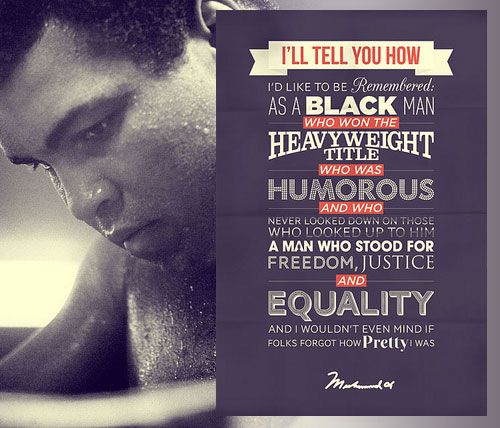
    How Ali wld like to be remembered

    **

    May he cross the bridge and attain the lake.


    Switch to our mobile site