zenpundit.com » Islam

Archive for the ‘Islam’ Category

Jottings 2: Dr Fadl book announcement

Friday, May 3rd, 2013

[ by Charles Cameron — I got the announcement via Cole Bunzel, and Kévin Jackson kindly informed me that Dr Fadl is currently free ]

.

Dr Fadl‘s announcement, in Arabic, is here — I had to use Google Translate, which wouldn’t pass a Turing test. However…

**

A while back, I made a post here titled Will Dr Fadl retract his Retractions? in which I wrote:

Sayyid Imam al-Sharif, popularly known as Dr Fadl, wrote two of the key works of jihadist ideology, The Essential Guide for Preparation and the thousand-page Compendium of the Pursuit of Divine Knowledge, in the late 1980s — thereby providing his friend from student days, Ayman al-Zawahiri, with powerful scholarly backing for the doctrines of militant jihad and takfirism. Lawrence Wright refers to Fadl as an “Al-Qaeda mastermind” in a detailed 2008 New Yorker analysis.

Dr Fadl was imprisoned without trial in the Yemen shortly after 9/11, but it was after he had been transferred to an Egyptian prison in 2004 that he wrote Rationalizing Jihad, the first volume of his “retractions” — a work so powerful in its attack on his own earlier jihadist doctrine that al-Zawahiri felt obliged to respond with a two-hundred page letter of rebuttal. A second volume from Dr. Fadl followed more recently.

If Dr Fadl regains his liberty, the question arises whether he will claim his critiques of jihadist dictrine were obtained by force, and effectively retract his retractions – or whether he will stand by them, as I somehow expect he might — still declaring, this time as a free man, that “There is nothing that invokes the anger of God and His wrath like the unwarranted spilling of blood and wrecking of property,” and “There is nothing in the Sharia about killing Jews and the Nazarenes, referred to by some as the Crusaders. They are the neighbors of the Muslims … and being kind to one’s neighbors is a religious duty.”

**

As late as October 2012, I was noting an Atlantic piece by Daveed Gartenstein-Ross and Aaron Zelin on How the Arab Spring’s Prisoner Releases Have Helped the Jihadi Cause, and asking whether Dr Fadl had been released in my post Quick update / pointer: GR & AZ on prisoner release — but now we know.

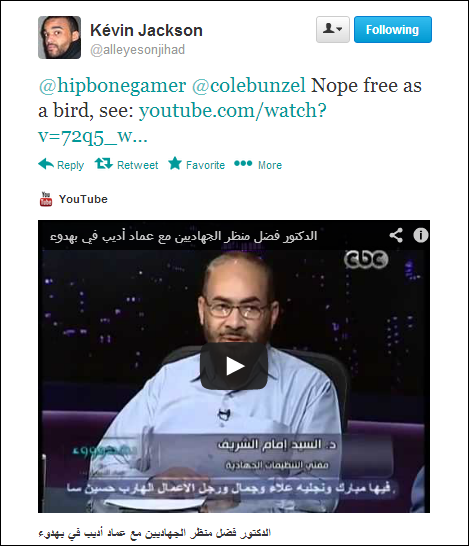
In response to an inquiry I tweeted after seeing Bunzel‘s tweet above — asking whether Dr Fadl was still imprisoned, albeit more comfortably than most — Kévin Jackson replied:

I’m no Arabist, but I’d guess we can take it that Sayyed Imam Al-Sharif aka Dr Fadl is talking freely in this book, which he says will cover both his experience of the history of AQ “from the womb (the Afghan jihad against communism) … to the end” in detail, with dates and names, and “all this with the background of the study of Islamic jurisprudence that distinguish between right and wrong, and this is a jurisprudential historical book.”

**

Tricky that, the need to rely on Google Translate. Once again I regret my lack of umpteen languages.

Of the Umayyad mosques of Aleppo and Damascus

Thursday, May 2nd, 2013

[ by Charles Cameron — convinced that the architecture of sacred geography is of extraordinary importance, now and always ]
.

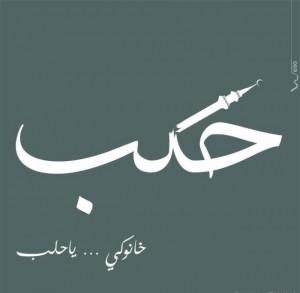
On April 24, the Umayyad Mosque in Aleppo’s UNESCO world heritage site was destroyed… with both the rebels and government forces blaming the event on the other. There’s a beautiful post at Syria Deeply about the mosque and its destruction, which is worth reading in full – here I’ll simply excerpt the paragraph which explains the graphic at the head of this post:

It’s very symbolic. People are really devastated. A lot of people changed their picture on social media to show the minaret. Or rather, a broken minaret. It’s part of our identity [in Aleppo.] The BBC got backlash for heavily covering it, because people said, ‘Why are you covering the destruction of a minaret when so many people are dying?’ But there is that sense that it’s part of our identity, and people are mourning it.

and two more, which convey in the poetic words of Amal Hanano, a rich sense of the accompanying tragedy:

The lesson of the minaret: every tyrant will fall and the city remains. History has taught us that the people find a way to pick up the pieces of their city and rebuild. One thousand years from now, these years will be a chapter in history books. The future people of Aleppo will visit this sacred site and will feel the calm and peace once more. The stone will be old again. They will point to the square tower and whisper to their children the tale of this minaret that falls every few centuries when the lesson of tyranny must be taught to a people who had forgotten. Those people of the future are lucky. They will be unaware of the pain of living those years, unaware of the shame of writing this chapter. History is abstract and seamless to them, like it once was for us. It is merely a story they can recite while they trace their fingers over the stone and remember without consequence. I envy them.

We were once like those people, telling tales of barbaric Mongols or tragic fires that had destroyed the Umayyad Mosque, the Great Mosque of Aleppo. Instead we will have to be the ones to pick the pieces this time and find a way to rebuild, to heal and to restore what was erased. Even when the rebuilding is done and the blood has stopped flowing, we will never be able to enter these sites without remembering what was lost. It will never smell timeless again for us. History will never be seamless with our memory again.We know that what we will rebuild is a replacement for something that was once perfect. Something that can never come back and will never be the same. We will be destined to whisper to our children and grandchildren: “Once upon a time, there was a minaret that was 1,000 years old. We loved it and we loved our city. But we had forgotten our history. We had forgotten that the hatred of men destroys all that we love, all that is sacred. And one day we woke up and the minaret was gone.

**

My thoughts turn now to another Umayyad mosque…

The Umayyad mosque in Damascus is one of the holiest shrines in Islam, including within its precincts the tomb of the great warrior Saladin / Salah al-Din, but also featuring a minaret described in Muslim eschatology as the place where Jesus will return to earth. The hadith, presented by Aaron Zelin in a post on Jabhat al-Nusrah at al-Wasat, says in part:

it would at this very time that Allah would send Jesus, son of Mary, and he will descend at al-Manarah al-Bayda’ (the white lighthouse or minaret) in the eastern side of Damascus wearing two garments lightly dyed with saffron and placing his hands on the wings of two Angels

If my readings are correct, the two most recent imams of the mosque have been (i) Moaz al-Khatib, who was deposed and imprisoned under Assad, and during the Syrian revolution led the National Opposition Coalition until his April 21st resignation, and (ii) Mohamed al-Bouti, the famed scholar who replaced him, who was killed in a suicide attack on another Damascus mosque, the Iman Mosque, on March 21st.

The burial of al-Bouti — who had supported Assad and called the Syrian opposition “scum” — in the Umayyad, close to the tomb of Saladin, is therefore a potentially incendiary move, giving extraordinary high honor to the imam in the aftermath of a revolutionary strike against another mosque in which that same Assad-supporting imam was killed while preaching.

**

May the Umayyad mosque of Damascus, now a locus of possible contention, avoid the fate of its sister in Aleppo. May the “white lighthouse” minaret be preserved…

Furnish on Pew findings re: Islam

Thursday, May 2nd, 2013

[ Charles Cameron presenting guest-blogger Timothy Furnish ]
.

.

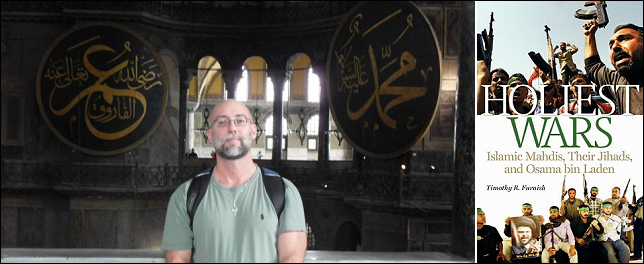
I’m delighted to welcome Dr Timothy Furnish as a guest-blogger here on Zenpundit. Dr Furnish has served as an Arabic linguist with the 101st Airborne and as an Army chaplain, holds a PhD in Islamic history from Ohio State, is the author of Holiest Wars: Islamic Mahdis, Their Jihads, and Osama bin Laden (2005), and blogs at MahdiWatch. His extended piece for the History News Network, The Ideology Behind the Boston Marathon Bombing, recently received “top billing” in Zen’s Recommended Reading of April 24th.

**

Does This Paint It Black, or Am I A Fool to Cry? Breaking Down the New Pew Study of Muslims
by Timothy R. Furnish, PhD
.

Pew has released another massive installment of data from its research, 2008-2012, into Muslim attitudes, entitled “The World’s Muslims: Religion, Politics and Society.” Over 38,000 Muslims in almost 40 countries were surveyed, thus constituting a survey both statistically sound and geographically expansive. Herewith is an analysis of that information and what seem to be its major ramifications.

The first section deals with shari`a, usually rendered simply as “Islamic law” but more accurately defined as “the rules of correct practice” which “cover every possible human contingency, social and individual, from birth to death” and based upon the Qur’an and hadiths (sayings and practices attributed to Muhammad) as interpreted by Islamic religious scholars (Marshal G.S. Hodgson, The Venture of Islam, Vol 1: The Classical Age of Islam, p. 74). Asked “should sharia [as Pew anglicizes it] be the law of the land,” 57% of Muslims across 38 countries answered “yes” — including, most problematically for the US: 99% of Afghans, 91% of Iraqis, 89% of Palestinians, 84% of Pakistanis and even 74% of Egyptians. Should sharia apply to non-Muslims as well as Muslims? Across 21 countries surveyed on this question, 40% answered affirmatively — with the highest positive response coming from Egypt (its 74% exceeding even Afghanistan’s 61%). And on the question whether sharia punishments — such as whippings and cutting off of thieves’ hands — should be enacted, the 20-country average was 52%, led by Pakistan (88%), Afghanistan (81%), the Palestinian Territories [PT] (76%) and Egypt (70-%). On the specific penalty of stoning for adultery, the 20-country average was 51% — with, again, Pakistan (89%), Afghanistan (85%), the PT (84%) and Egypt (71%) highest in approval. Finally, 38% of Muslims, across those same 20 nations, support the death penalty for those leaving Islam for another religion.

Huge majorities of Muslims across most of these surveyed nations say that “it’s good others can practice their faith” — but Pew’s imprecise terminology on this topic makes possible that this simply mean many Muslims are willing to grant non-Muslims the tolerated, but second-class, ancient status of the dhimmi. Majorities, too, in most countries say that “democracy is better than a powerful leader;” however, the latter was actually preferred by most surveyed in Russia, Bosnia-Hercegovina, Kyrgyzstan, Afghanistan and Pakistan, as well as by 42% of Iraqis, 40% of Palestinians and 36% of Egyptians. Most Afghans, Egyptians and Tunisians (and even 1/3 of Turks) believe that “Islamic political parties” are better than other ones, although 53% of Indonesians and 45% of Iraqis are also worried about “Muslim extremists.” (Curiously, 31% of Malaysians are, on the other hand, worried about “Christian extremists” — although evidence of such existing in that country is practically non-existent.) There is good news on the question of suicide bombing, however: across 20 countries, only 13.5% think it is ever justified — although the support is much higher in the PT (40%), Afghanistan (39%) and Egypt (29%).

In terms of morality, large majorities in most Muslim countries (especially outside Sub-Saharan Africa) think drinking alcohol is morally repugnant, notably in Malaysia (93%), Pakistan and Indonesia (both 91%). Most Muslims in most countries surveyed consider abortion wrong, as well as pre- and extra-marital sex and, almost needless to say, homosexuality. (Although one wishes Pew had asked about mu`tah, or “temporary marriage” — a practice originally Twelver Shi`i which has increasingly become used by Sunnis.) Yet, simultaneously — following Qur’anic rubrics — some 30% of Muslims in 21 countries support polygamy, including almost half of Palestinians, 46% of Iraqis and 41% of Egyptians. There is also significant support for honor killings in not just Afghanistan and Iraq but also Egypt and the PT. Over ¾ of Muslims across 23 countries says that “wives must always obey their husbands:” an average of 77%. And Pew notes that there is a statistically very significant correlation between sharia-support and believing women have few(er) rights.

Asked whether they believed they were “following Muhammad’s example,” 75% of Afghans and 55% of Iraqis answered affirmatively — although most Muslims were not nearly so confident. On the question “are Sunni-Shi`i tensions a problem,” 38% of Lebanese, 34% of Pakistanis, 23% of Iraqis and 20% of Afghans said “yes.”

It is no surprise that huge majorities of Muslims in most surveyed countries believe that Islam is the only path to salvation, nor that most also say “it’s a duty to convert others” to Islam. It is somewhat counterintuitive, however, that many Muslims say they “know little about Christianity” — even in places with large Christian minorities, such as Egypt. Muslims in Sub-Saharan Africa are the most likely to agree that “Islam and Christianity have a lot in common,” and so are 42% of Palestianians, as well as some 1/3 of Lebanese and Egyptians. But only 10% of Pakistanis agree. Asked whether they ever engaged in “interfaith meetings,” many Muslims in Sub-Saharan Africa said that they did (with Christians), and a majority of Thais said likewise (albeit with Buddhists). But only 8% of Palestinians, 5% of Iraqis, and 4% of Egyptians said they ever do so—despite substantial Christian populations in each of those areas.

Regarding the question “are religion and science in conflict,” most Muslims said “no” — with the exceptions of Lebanon, Bangladesh, Tunisia and Turkey where over 40% in each country (and, actually, a majority in Lebanon) said that they were at loggerheads. Most Muslims also say they have no problems with believing in Allah and evolution — the exceptions being the majority of Afghans and Indonesians. Regarding popular culture, clear majorities of Muslims in many countries say they like Western music, TV and movies—but, at the same time, similar majorities say that such things undermine morality (although Bollywood less so than Hollywood).

Observations:

1) The high degree of support for sharia is the red flag here. Contra media and adminstration (both Obama and Bush) assurances that most Muslims are “moderate,” empirical data now exists that clearly shows most Muslims, in point of fact, support not just sharia in general but its brutal punishments. Perhaps just as disturbing, almost four in ten Muslims are in favor of killing those who choose to follow another religion. And countries in which the US is heavily involved either diplomatically or militarily (or both) are the very ones where such sentiments run most high: Pakistan, Afghanistan, Egypt, the Palestinian Territories. So are the “extremists” these very Muslims who want to follow, literally, the Qur’an and hadiths? Messers Brennan, Holder and Obama have some explaining to do.

2) Afghanistan would appear to be a lost cause. Afghans are at the top of almost every list in support for not just sharia, suicide bombing, honor killing and — ironically (or perhaps not) — confidence that they are emulating Islam’s founder, as well as dislike for democracy. In light of this clear data, two points about Afghanistan become clear: tactically, ostensible American befuddlement as to the causes of “green on blue” attacks and the continuing popularity of the Taliban in Afghanistan appears as willful ignorance; strategically, the US decision to stay there after taking out the al-Qa`ida [AQ] staging, post-9/11, and attempt to modernize Afghanistan was a huge, neo-Wilsonian mistake. 2014 cannot come soon enough.

3) In some ways Islam in Southeastern Europe, and to a lesser extent in Central Asia, seems to be a more tolerant brand of the faith than the Middle Eastern variety. For example, the SE European and Central Asian Muslims are the least likely to support the death penalty for “apostasy,” and the most supportive of letting women decide for themselves whether to veil. And Muslims in Sub-Saharan Africa are the most likely to know about Christianity, and to interact with Christians. On the other hand, African Muslims are among the most enamored of sharia, and Central Asian ones fond of letting qadis (Islamic judges) decide family and property disputes. So there does not seem to be a direct link between Westernization and moderation; in fact, the influence of Sufism — Islamic mysticism — in the regard needs to be correlated and studied (beyond what Pew did on the topic in last year’s analysis).

4) One bit of prognostication based on this data: Malaysia may be the next breeding ground of Islamic terrorism. It’s home to some 17 million Muslims (61% of its 28 million people), who hold a congeries of unsettling views: 86% want sharia the law of the land; 67% favor the death penalty for apostasy; 66% like sharia-compliant corporal punishments; 60% support stoning for adultery; and 18% think suicide bombing is justified. PACOM, SOCOM and the intelligence agencies need to ramp up hiring of Malay linguists and analysts.

5) Finally, some words for those — like FNC’s Megyn Kelly and Julie Roginsky (on the former’s show “American Live,” 4/30/13) — who pose a sociopolitical and moral equivalence between Muslim support for sharia and Evangelical Protestant Christian support for wives’ obedience to husbands: that’s a bit too much sympathy for the devil. Yes, Evangelical Christian pastors hold some pretty conservative views of the family, as per a 2011 Pew study of them; for example, 55% of them do agree that “a wife must always obey her husband” (compared to 77% of Muslims). And, ironically, many such Evangelicals agree in large measure with Muslims on issues such as the immorality of alcohol, abortion and homosexuality. However, one searches in vain for any Evangelical (or other) Christian support for whippings, stonings, amputation of thieves’ limbs, polygamy or suicide bombing.

Islam is the world’s second-largest religion, numbering some 1.6 billion humans (behind only Christianity’s 2.2 billion). There is, thus, enormous diversity of opinion on many issues of doctrine and practice, and essentializing Islam as either “peaceful” or “violent” is fraught with peril. Nonetheless, this latest Pew study provides empirical evidence that many — far too many — Muslims cling to a literalist, supremacist and indeed brutal view of their religion. Insha’allah, this will change eventually — but time is not necessarily on our side.

A religious footnote to the pro-life / pro-choice issue

Monday, April 29th, 2013

[ by Charles Cameron — with cites from the Qur’an and Bukhari, together with a concerto by Saint-Saëns ]
.


.

Stephen Hough is a classical pianist of note recording on the Hyperion label, the recipient of a MacArthur Fellowship, and one of twenty living polymaths listed as “Pianist, poet, composer, writer on religion” in a 2009 survey by The Economist’s 2009 Intelligent Life blog.

Hough — a Catholic — blogs at The Telegraph, and today he wrote something that caught my eye in his post Why haven’t you written anything about Gosnell?:

I think that without religious faith it is hard to accept a zygote as equivalent in value to a fully formed child. I can understand that a non-religious person is going to see a scale of development in the nine months of pregnancy.

**

To broaden Hough’s discussion a little, I’d like to gently point out that not all religious faiths perceive these matters in the same way. Islam, for instance, has a Qur’anic passage that’s apposite in Sura 20, The Believers, 12-16:

Man We did create from a quintessence (of clay); Then We placed him as (a drop of) sperm in a place of rest, firmly fixed; Then We made the sperm into a clot of congealed blood; then of that clot We made a (foetus) lump; then we made out of that lump bones and clothed the bones with flesh; then we developed out of it another creature. So blessed be Allah, the best to create! After that, at length ye will die Again, on the Day of Judgment, will ye be raised up.

Getting into more detail, we find these ahadith — the first in Bukhari, Chapter 6, The Book of Menstruation, 312:

It is related from Anas ibn Malik that the Prophet, may Allah bless him and grant him peace, said, “Allah the Mighty and Majestic appoints an angel to every womb who says, ‘O Lord! A sperm drop! O Lord A clot! O Lord! A lump of flesh! ‘ Then if He desires to complete His creation, He does so and the angel asks, ‘Is it to be male or female? Wretched or happy? What is its provision? What is its life-span?’ This is all decreed in the mother’s womb.”

and the second in Bukhari Chapter 63, The Book of the Beginning of Creation, 3036:

It is related that ‘Abdullah said, “The Messenger of Allah, may Allah bless him and grant him peace, who is the truthful confirmed one, said, ‘The way that each of you is created is that you are gathered in your mother’s womb for forty days as a sperm-drop and then for a similar length of time as a blood-clot and then for a similar length of time as a lump of flesh. Then an angel is sent and he breathes the spirit into you and is encharged with four commandments: to write down your provision, your life-span, your actions, and whether you will be wretched or happy.

*

My Sources:

  • Qur’an 20, in the Yusuf Ali rendition
  • Bukhari, Book of Menstruation 312 the Aisha Bewley translation
  • Bukhari, Book of the Beginning of Creation, 3036 also in the Bewley translation
  • **

    Here Stephen Hough plays Camille Saint-Saëns‘ Piano Concerto 2 in G minor Op. 22 with the City of Birmingham Symphony Orchestra, Sakari Oramo conducting:

    blockquote>

    Of the Jerusalem and Mahdist syndromes

    Friday, April 26th, 2013

    [ by Charles Cameron — messianisms as madness ]
    .

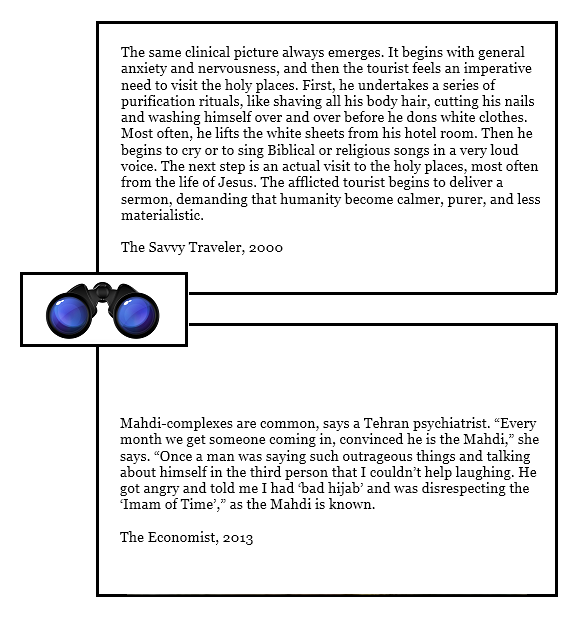
    The Economist has a fascinating piece out about Iran’s multiplicity of messiahs (lower panel, below) which reminded me strongly of the Jerusalem syndrome (upper panel).

    I suspect that was “bad adab” – bad manners, not bad clothing – but never mind.

    **

    The Economist piece is worth reading in full, if you also take the time to read Tim Furnish — who tones down the rhetoric a couple of notches:

    I seriously doubt that Iranian jails are full of thousands of self-styled mahdis; I suspect many of them are guilty of nothing more eschatological than complaining too publicly about the price of gas or having too large a satellite TV antenna on their homes. But even if reduced by a factor of ten, the Islamic Republic does nonetheless appear to have a serious problem with apocalyptic antipathy toward the government. And a regime predicated, in no small part, on Mahdist ideology finds itself being hoist by its own philosophical petard.

    **

    Meanwhile, back in Jerusalem:

    In Israel, Jerusalem Syndrome is taken very seriously. Everyone involved in security, tourism, or health is on the lookout for afflicted visitors. In an average year, three or four tourists develop real, palpable Jerusalem Syndrome. In l999, more than 50 visitors were diagnosed, the increase possibly attributed to millennial activities.

    Why the security concern? Well, because occasionally those afflicted try some pretty dangerous stuff. Dr Yair Bar-El wrote in The British Journal of Psychiatry (2000) 176: 86-90:

    A Protestant from South America conceived a plan to destroy Islamic holy places in order to replace them with Jewish holy places. The second stage of his plan was then to destroy them in order to start the war of Gog and Magog so that the Anti-Christ would reveal himself, after which Christ would reappear. The patient succeeded in gutting one of the most holy mosques in Jerusalem. Psychiatric examination was ordered by the court, and he was diagnosed as being unable to differentiate between right and wrong, not responsible for his deeds and therefore not fit to stand trial. He was admitted to a local psychiatric institution and later transferred to a mental health institution in his own country

    I think “gutting” is overstating what happened — but you can sense the risk…

    **

    DoubleQuote Sources:

  • The Savvy Traveler, 2000
  • The Economist, 2013

  • Switch to our mobile site