zenpundit.com » will mccants

Archive for the ‘will mccants’ Category

Dawson & Amarasingam, Furnish & McCants

Thursday, February 2nd, 2017

[ by Charles Cameron — multi-causal and single focus motivations not incompatible ]
.

Tim Furnish offered a terse “File this under ‘duh.'” in response to a CNSNews report titled Study: Religion is ‘Primary Motivator’ of Foreign Jihadists Who Go to Iraq & Syria on Facebook today. In response to a comment, he elaborated: “I’ve done the same study about 37 times over the last 15 years.”

Tim’s right. But I also believe we need a more nuanced approach to the issue of motivation.

**

Here’s the passage from the study in question, Lorne Dawson and Amarnath Amarasingam‘s Talking to Foreign Fighters: Insights into the Motivations for Hijrah to Syria and Iraq:

The findings reported here converge with those of these other studies in terms of how people radicalize and become foreign fighters. However, they tend to diverge with regard to why they go. In the twenty interviews analyzed no one indicated, directly or indirectly, that forms of socioeconomic marginalization played a significant role in their motivation to become a foreign fighter. Moreover, the interactions with these individuals were so heavily mediated by religious discourse it seems implausible to suggest that religiosity (i.e., a sincere religious commitment, no matter how ill-informed or unorthodox) is not a primary motivator for their actions. Religion provides the dominant frame these foreign fighters use to interpret almost every aspect of their lives, and this reality should be given due interpretive weight.

There we are:

Religion provides the dominant frame these foreign fighters use to interpret almost every aspect of their lives

I couldn’t agree more. But then again, as Will McCants reminds us in Trump’s misdiagnosis of the jihadist threat (late 2016, but now twitter-pinned “because the causality question comes up constantly”):

The disappoint stems from the desire to attribute the jihadist phenomenon to a single cause rather than to several causes that work in tandem to produce it. To my mind, the most salient are these: a religious heritage that lauds fighting abroad to establish states and to protect one’s fellow Muslims; ultraconservative religious ideas and networks exploited by militant recruiters; peer pressure (if you know someone involved, you’re more likely to get involved); fear of religious persecution; poor governance (not type of government); youth unemployment or underemployment in large cities; and civil war. All of these factors are more at play in the Arab world now than at any other time in recent memory, which is fueling a jihadist resurgence around the world.

**

I’ve never been clear-headed enough to follow Aristotle‘s distinctions between material, formal, efficient, and final causes, let alone discussion of hypothetical causes that follow their effects, but it seems to me that the two statements above are easily reconciled if we understand that there are many causes for disgruntlement, to which a religious solution is in all cases present as disgruntlement turns to ISIS-sympathetic recruitment.

Religion (as Dawson & Amarasingam have it, “i.e., a sincere religious commitment, no matter how ill-informed or unorthodox”) is the sine qua non of jihadism.

**

So yeah, doh! — with multi-factorial causality earlier in the process..
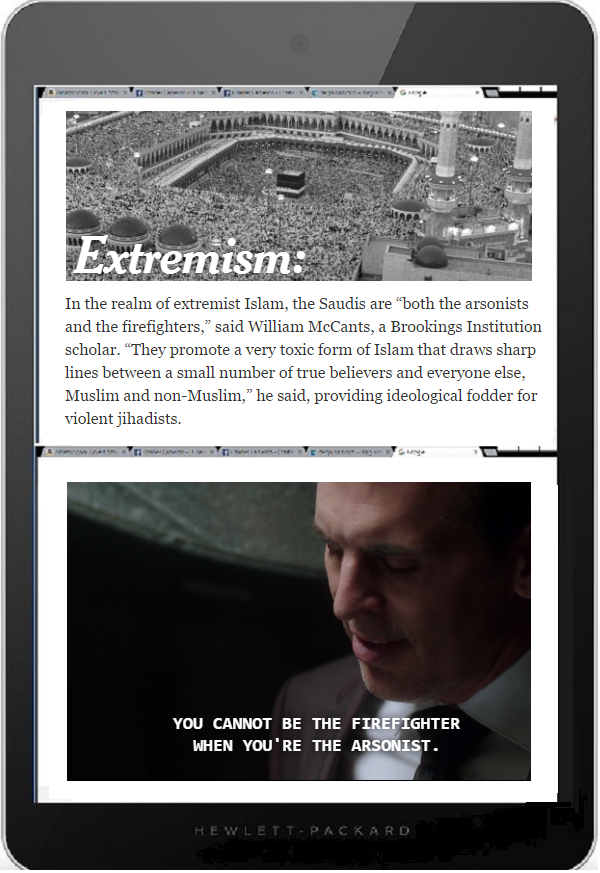
McCants explains the Saudis, Quantico rebukes them

Friday, August 26th, 2016

[ by Charles Cameron — Saudi-sourced jihadism, the FBI, Baader-Meinhof — hey, it’s all about terrosism ]
.

Will McCants explains [upper panel, below] how the Saudis are and are not promoting terrorism —

Tablet DQ 600 arsonist

— while a screen-cap from episode 9 in the first season of Quantico explains just why such an approach is logically bound to be defective.

**

Oh well, not to worry. It’s just another example of the illusion colloquially known as the Baader-Meinhof phenomenon. I wouldn’t want to go all irrational on you, so I’ll let RationalWiki explain:

The frequency illusion (also known as the Baader-Meinhof phenomenon) is the phenomenon in which people who just learn or notice something start seeing it everywhere.

Except that — well, there it is again — Baader-Meinhof — it’s all terrorism!

Rumi One: the poet and his poems

Sunday, June 12th, 2016

[ by Charles Cameron — first of four posts on the poet Jalal al-Din Rumi, hugely popular, perhaps soon to be the pivot of a blockbuster movie ]
.

Rumi has been in the news recently and in Rumi Three I’ll say a bit about why. But first, in this post, Rumi One, I’ll say something about the poet and his poems — leaving his ineffable spiritual attainments ineffable, since if they’re anything, they’re ineffable — and in Rumi Two I’ll consider a current attack on Rumi and “Rumism” in Turkey, little observed in the western press, which may be of interest to the poet’s many followers here. Rumi Four will contain some recommended readings.

**

Let’s start with some praise of Rumi from Will McCants:

It’s a powerful poet who turns a scholar to the study of his language, the better to read him.

**

I’ve been reading Rumi at least since the first Arberry translations of his Mystical Poems came out in 1968, and in the mid-eighties between then and now had the delight and privilege of doing a joint poetry reading with his more recent translator / popularizer, Coleman Barks, at Lake Tahoe.

I’m in no way surprised — but yes, delighted — that a scholar of McCants’ stature should appreciate Rumi so warmly, and envious of his ability to read the Divan, the Masnavi, the Discourses in the original. Did not the great poet Jami write of Rumi’s Masnavi that it is “the Qur’an in the Persian tongue”?

**

Here’s the poem with which Chicago University Press introduces Arberry’s Mystical Poems of Rumi:

My verse resembles the bread of Egypt—night passes over it, and you cannot eat it any more.
Devour it the moment it is fresh, before the dust settles upon it.
Its place is the warm climate of the heart; in this world it dies of cold.
Like a fish it quivered for an instant on dry land, another moment and you see it is cold.
Even if you eat it imagining it is fresh, it is necessary to conjure up many images.
What you drink is really your own imagination; it is no old tale, my good man.

Set beside this, another comment of Rumi’s, considering his poetry:

I am affectionate to such a degree that when these friends come to me, for fear that they may be wearied I speak poetry so that they may be occupied with that. Otherwise, what have I to do with poetry? By Allah, I care nothing for poetry, and there is nothing worse in my eyes than that. It has become incumbent upon me, as when a man plunges his hands into tripe and washes it out for the sake of a guest’s appetite, because the guest’s appetite is for tripe.

The secular mind may think of that second quote as something of a pose, imagining the poetry of a great poet to be the poet’s own primary concern — but the poems of Rumi themselves, like the poems of St John of the Cross, speak of a love of the divine of which the poetry itself can be but an offshoot, a byproduct.

**

There are none so happy, I would suggest, as those who keep company with the lovers of the divine beloved, and it is that companionship that I see depicted in the poem of Rumi’s I most treasure:

Little by little the drunkards congregate, little by little the wine-worshippers arrive.
The heart-cherishers coquettishly come along the way, the rosy-cheeked ones are arriving from the garden.
Little by little from the world of being and not-being the not-beings have departed and the beings are arriving.
All with skirts full of gold as a mine are arriving for the sake of the destitute.
The lean and sick from the pasturage of love are arriving fat and hale.
The souls of the pure ones like the rays of the sun are arriving from such a height to the lowly ones.
Blessed is that garden, where, for the sake of the Mary’s, new fruits are arriving even in winter.
Their origin is grace, and their return is grace; even from the garden to the garden they are coming.

Indeed, that grace, that garden is woven throughout Rumi’s poetry:

The springtide of lovers has come, that this dust bowl may become a garden; the proclamation of heaven has come, that the bird of the soul may rise in flight.

And where is that garden, when is that springtide of lovers?

Alfred North Whitehead was thinking of education as a stepped-down version of that same garden when he wrote:

The present contains all that there is. It is holy ground; for it is the past, and it is the future. … The communion of saints is a great and inspiring assemblage, but it has only one possible hall of meeting, and that is, the present, and the mere lapse of time through which any particular group of saints must travel to reach that meeting-place, makes very little difference.

After IS, what next? — the missing (apocalyptic) strand

Monday, May 23rd, 2016

[ by Charles Cameron — four recent tweets, some lines of inquiry, & no certain conclusion, no date certain ]
.

The four recent tweets that set me off..

**

There are a multitude of voices now raising the question After ISIS< What Next? They can be heard from as far back as October 2014, onwards:

  • Al Arabiya English, What comes after ISIS’ defeat?
  • Foreign Policy, What Comes After the Islamic State Is Defeated?
  • Lexington Institute, What Do We Do The Day After ISIS Is Defeated?
  • The National Interest, We Defeat ISIS. Then What?
  • The Telegraph, What happens once Isil is defeated?
  • Wilson Center, Iraq: Now and After ISIS
  • The [Huffington] World Post, The Middle East after ISIS
  • and most recently:

  • The Atlantic, The Hell After ISIS
  • If IS continues losing territory, as suggested in the tweets above, this question can only gain in force.

    **

    I have been following Islamic eschatology since 1998 or thereabouts, when I met David Cook, and I thought that what was at that time an eerily unappreciated question had at last made its way into informed consciousness after..

  • 2002, David Cook, Studies in Muslim Apocalyptic
  • 2005, David Cook, Contemporary Muslim Apocalyptic Literature
  • 2011, J-P Filiu, Apocalypse in Islam
  • 2014, Martin Dempsey, speech: IS has “an apocalyptic, end-of-days strategic vision”
  • 2015, Jessica Stern & JM Berger, ISIS: The State of Terror
  • 2015, Graeme Wood, What ISIS Really Wants
  • 2015, Will McCants, The ISIS Apocalypse
  • But no, the question I’m interested in has not been raised:

    Is there a more potent form of apocalyptic movement than the two we have most recently seen?

  • a Mahdist movement, one focused on the army with black flags from Khorasan — AQ
  • a Caliphal movement, one focused on the establishment of the rightly-guided kingdom — IS
  • **

    Four hints:

    It seems to me that you can have a Caliphal (kingdom based), or a Mahdist (leader based) movement, and that the Caliphal approach, should IS be a clear failure as a global quasi-state, will be exhausted for quite some time — and that since AQ, to the extent that it is or was an apocalyptic movement, was one that looked to a future Mahdi, the only route “up” from either one would be the declaration of an actual Mahdi-claimant with armed insurrection to follow.

  • The worst messianic movement, in terms of fatalities, would still be China’s 19th Century Taiping Rebellion, 20-30 million dead. Strangely enough, Gordon of Khartoum was involved.
  • The most recent and widely notable Mahdist rebellion was the Sudanese one that killed Gordon, led initially by Muhammad Ahmad al-Mahdi.

  • The next highly plausible date for the appearance of a Mahdi would be at the start of the next Islamic century, 1500 AH / 2076 BCE, since ahadith suggest a Mujaddid or Reformer will be sent every 100 years, and there have been assertions that the Ummah will not endure longer than 1,500 years (see here eg)
  • My guess is that we’ll have a cooling-off period in terms of Islamic apocalyptic if IS is seen to fail — but as they say, mortal mind cannot know the time of the end, and Allah knows best.

    Aymen al-Zawahiri, al-Sham and ISIS as Khawarij

    Friday, May 20th, 2016

    [ by Charles Cameron — a highest-intensity insult in the jihad among jihadists ]
    .

    A significant article is announced:

    Both Will McCants and Cole Bunzel have recommended this article, so you may already have seen it.

    **

    Okay, I understand that there are various viewpoints, and hence various different people will make different choices as to which is the key paragraph here. For many, it will be Zawahiri‘s focus on al-Sham.

    Indeed, Zawahiri’s new geographic focus happens to align itself with what Abu Musab al-Suri proposed in his Global Islamic Resistance Call — published, perhaps a tad presciently, more than a decade ago in 2004/5 — that (in J-P Filiu‘s phrase, Apocalypse in Islam, p. 189):

    It is self-evident to him that the “country of Sham” — Greater Syria, including Lebanon, Palestine, and Jordan — looms as the apocalyptic theater par excellence, and that al-Qaida’s strategic conception of global jihad must be reoriented to take into account this final clash.

    **

    From my own POV, as someone whose interest is in movements in religious thought, this is the key paragraph:

    Zawahri did deliver at least one message aimed at the jihadist base, affirming that the IS’s members are “Khawarij,” a historical Muslim sect of hyper-extremist deviants. Labeling the Islamic State group as such has been controversial within Salafi-jihadism — theorist Abu Muhammad al-Maqdisi has resisted it — in part because it requires jihadists to act on the Prophet Muhammad’s prescription for dealing with the Khawarij: “qatl Ad,” or total extermination. Zawahri has now come down firmly on one side of this intra-jihadist debate.

    On which topic, see also my November 2015 post here on Zenpundit: Is the Islamic State Islamic? The Yes and No of the matter, and this, from JM Berger in 2014:


    Switch to our mobile site

