zenpundit.com » prophecy

Archive for the ‘prophecy’ Category

Apocalyptic Trivia

Sunday, September 2nd, 2012

[ by Charles Cameron — the true Beast revealed, in fiction and non-fiction ].
.

I thought this, which I came across on the web, was my apocalyptic find for the day:

Halfway through SEAL training, Cadet Jack Walker, still green but showing incredible promise, is whisked away to join four SEALs—and their dog—for a special ops mission. Walker soon finds himself in a whirlwind of otherworldly creatures and events as he finds out the true nature of this “special ops” team: SEAL Team 666. Battling demons, possessed humans, mass-murdering cults, and evil in its most dark and ancient form, SEAL Team 666 has their work cut out for them. And it’s not long before they realize that the threat isn’t just directed against the U.S.—an ancient and deadly cult has bigger plans, and Walker is at the center of a supernatural conflict with the entire world at stake.

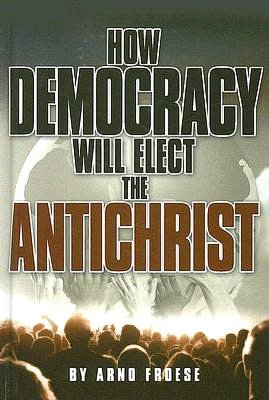
Until, that is, I went to the thrift store, and found this:

It is ironic that democracy, the system we so love, cherish, and defend, is the only system that seems to match the endtime political scenario whereby the entire world will be united. Strangely enough, it is not through the force of communism, or some dictatorship, but the peaceful means of election “by the people, for the people,” that the prophesied one world system is being established in our day!

**

SEAL Team 666 will be available in December.

Pew on the prevalence of Mahdism — take heed!

Sunday, August 12th, 2012

[ by Charles “told you so” Cameron — Pew figures for Mahdist expectation, also the Second Coming, Israel, and the potential influence of apocalyptic ideation on foreign policy ]
.
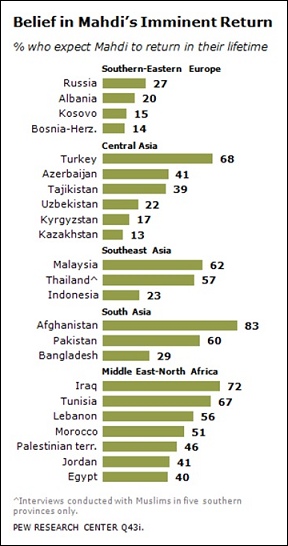
The World’s Muslims: Unity and Diversity, p. 65

.

I am Qualit, not Quant by nature, really much more interested in the workings of the imagination that in the aggregates of poll responses, so it’s a bit like pulling teeth for me to report on a Pew report — but in this case I can legitimately say “I told you so”, which massively outweighs the reluctance I might otherwise feel…

**

Recently, Pew has been including questions about the expectation of the Mahdi in some of its reports, and even Tim Furnish — who wrote the book on Mahdist movements and has long been saying we neglect them at our peril — even Tim was surprised at how widespread Mahdist expectation is, as reported in their just released The World’s Muslims: Unity and Diversity. In a post aptly titled Don’t Leave a Live (or Occulted) Mahdi Out of Your Calculations, Tim says the report contains “The most notable — indeed, strikingly important — news” in the form of “fascinating — and disturbing — data on belief in the Mahdi’s imminent (in one’s lifetime) return.”

See graphic above.

I recommend you read Tim’s analysis for the full range of his points — I won’t, for instance, be touching on what he says about Turkey — here I am going to select a couple of his key issues, and make just a point or two of my own.

**

Furnish:

Of the 23 countries whose Muslim citizens were polled, nine have majorities which expect the Mahdi in their lifetimes, with the overall average percentage at 41.8% … it is safe to extrapolate this percentage to Islam as a whole; ergo, 42% of 1.6 billion = 672 million Muslims who believe in the Mahdi’s imminent return! This is FAR greater than I had supposed.

Furnish also notes that Iran, the world’s most intensely Shi’ite nation and the one whose President has been speaking openly of Mahdist expectation, is not even included among the 23 countries Pew sampled.

Simply put, we have been blind to a very real phenomenon, and now we have a statistical alarm call to wake us up.

More subtly: there’s a difference between answering yes to the question “do you expect the Coming of X in your lifetime” and being on the edge of your seat, viewing every week as threshhold. Damian Thompson is very good on this in his book, Waiting for the Antichrist, and Stephen O’Leary in Arguing the Apocalypse suggests there’s an optimal “arousal” period — if you believe the Coming is too far away, you won’t be motivated to prepare for it quite yet, and if it’s too close it may be too late for you to do much to spread the word…

So, Pew — next time, ask a question with the opinions “in the next five to ten years” and “in my lifetime” — okay? The distinction is important, and a shift towards the shorter time-span would be highly significant.

**

Furnish again:

Despite the conventional wisdom (repeated even by Pew, in the face of their own data) that Mahdism is primarily the province of Shi`is, note that three of the four countries with the highest percentage expecting the Mahdi are majority-Sunni ones: Afghanistan (83%), Turkey (68%) and Tunisia (67%). This has ramifications, respectively, for: US policy in a country we are currently occupying; the only NATO Muslim-majority nation; and the vanguard state of the “Arab Spring.”

In his Conclusions, Furnish says:

The usual State/Defense departments’ “rational actor” approach to international relations might be quite simply irrelevant, if almost half the world’s Muslims expect the imminent return of their eschatological deliverer.

So there you have it. I discussed the “rational actor” versus Scott Atran‘s “devoted actor” in a recent post. And yes indeed, there are “ramifications for U.S. policy”…

Notably with regard to Afghanistan …

**

Here’s Furnish again:

Afghanistan is so rife with Islamic messianism because the 80% of the population that is Sunni and the 20% that is Shi`i (albeit Sevener/Isma’ili, as well as Twelver) both are in the middle of a war and occupation by a “Christian” power — which tends to ratchet up such expectations …

And again, in his Conclusions:

Afghanistan is a lost cause: over eight in ten of its people expect the Mahdi in their lifetime, and no amount of roads and clinics and girls’ schools built by the infidels will change that.

I don’t want to argue that second point in detail, although I think there’s a great deal more to life that Mahdist expectation for many who would answer “yes” to Pew’s question about expecting the Mahdi in one’s lifetime — see my comment on Damian’s book above. But how can I put it? A background Mahdist expectation can become a passionate involvement in a Mahdist movement if the right trigger comes along.

But what I find most striking here is that Afghanistan should be the country with the strongest Mahdist current out of all those Pew selected. And I’m struck not because Afghanistan has been a battlefield for so much of recent history — indeed, for so much of its history, period. I am struck because, in Al-Qaida’s recruitment narrative, supported by a number of ahadith, Afghanistan as Khorasan is the very locus from which the Mahdi’s victorious army will sweep out to conquer (finally) Jerusalem. And this too I have been posting about, eg in my discussions of Ali Soufan‘s The Black Banners and Syed Saleem Shahzad‘s Inside Al-Qaeda and the Taliban.

So the highest level of Mahdist expectation also happens to be found in an area with a potentially major role to play in an end times scenario…

**

There’s at least one earlier report in which Pew raised the question of Mahdist expectation — this time tied in with both the expectation of the Caliphate, and Christian hope of the Second Coming — their 2010 report Tolerance and Tension: Islam and Christianity in Sub-Saharan Africa.

Here, for instance, we learn:

Both Christians and Muslims believe they are living in a time that will undergo momentous religious events. For example, at least half of Christians in every country with large enough samples of Christians to analyze believe that Jesus will return to earth during their lifetime, including nearly seven-in-ten Christians in the Democratic Republic of the Congo (69%).

And at least half of Muslims in 10 of the 15 countries with large enough Muslim populations to analyze say they believe that the caliphate, the golden era of Islamic rule, will be re-established in their lifetime; this belief is most common among respondents in Mozambique (69%). And in 12 of these 15 countries, roughly six-in-ten or more Muslims believe in the return of the Mahdi, the guided one who will initiate the final period before the day of resurrection and judgment, though the survey did not ask respondents whether they expect this to occur during their lifetime.

And here is the relevant data on sub-Saharan Mahdist belief. In Q51 of this poll, Muslims were asked whether they believe “in the return of the Mahdi, the guided one who will initiate the final period before the Day of Resurrection and Judgment? Here’s the table of responses:

Given the “religious fault line” of mixed conflict and amicable coexistence between Christians and Muslims running across Africa from (so to speak) Nigeria to Somalia, with Boko Haram and Al-Shabaab among the less delightful participants, keeping an eye out for signs of Mahdist “semiotic arousal” would be important here, too.

**

And “semiotic arousal” — that reminds me. Richard Landes, who coined the term, has the definitive, encyclopedic book out about all the many forms of apocalyptic, and why they’re important: Heaven on Earth: The Varieties of the Millennial Experience Essential reading, if you ask me, on a hugely neglected and no less critically important subject.

**

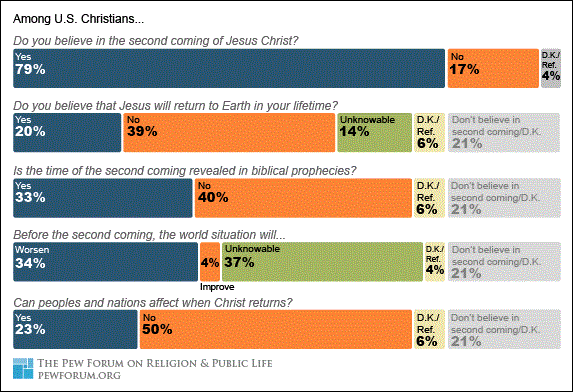
Finally, here’s yet another Pew graphic

— to be viewed in conjunction with this one, illustrating the ways in which belief in the Second Coming of Christ correlate with opinions about scriptures and the State of Israel:
**

Prophecy has impact, both on public opinion and on believing leaders. Jews with an expectation of the Messianic era, Christians expecting the soon Coming of Christ, and Muslims with Mahdist expectations each have their own apocalyptic scenarios, and in each case those scenarios exert some influence on policies relating to the Middle East and the Israeli-Palestinian situation in particular.

The bottom line?

Scriptural interpretation — and prophetic eschatology in particular — can no longer be assumed to be a quiet backwater topic for rabbinic students, seminarians and future mullahs to study, each in terms of their own tradition. It is now a series of conflicting drivers of current affairs — of war and peace.

Prophecy, Poetry and Prediction

Tuesday, July 17th, 2012

[ by Charles Cameron — personal preference, gangs, Chicago, insurgency, Afghanistan, and admitting the uncomfortable ]
.

Albrecht Durer, The Blessed Virgin enthroned on the crescent moon

**

Poetry, on the whole, has a liking for prophets. Thus Sylvia Plath writes:

By the roots of my hair some god got hold of me.
I sizzled in his blue volts like a desert prophet.

There’s an undeniable affinity there, the sense of giving voice to a lightning strike. Or as Randall Jarrell puts it:

A good poet is someone who manages, in a lifetime of standing out in thunderstorms, to be struck by lightning five or six times; a dozen or two dozen times and he is great.

**

Okay. I’m a poet, I think, partly because I have such a damnably literal mind that I need to break out in metaphor the way athletes break out in a sweat.

And the trouble with prophecy, from my point of view, is that it’s all too often read in damnably literal-minded ways, as though:

And there appeared a great wonder in heaven; a woman clothed with the sun, and the moon under her feet, and upon her head a crown of twelve stars

wasn’t clearly poetry. Let me clarify: it is.

And it is because prophecy (not “false prophecy”) is all too often read literally that the end of the world is so regularly promised, without once having come to pass thus far.

Even though the scriptures proclaim, But of that day and hour knoweth no man, no, not the angels of heaven

**

I suppose it goes along with being a poet rather than a statistician that I’m far more interested in qualitative than in quantitative approaches to modeling — or understanding, as we used to call it.

There are times, though, when it’s advisable to acknowledge the approaches most different from one’s own — for they too have their moments.

**

A Reporter’s Notebook entry yesterday on Fox News titled Chicago gang database intends to predict and prevent further violence tells us “One shooting sets the next shooting in motion.” That’s poignant even if a tad banal. But what comes next is interesting:

In an attempt to predict the next violent act, Chicago police are turning to technology. They have established a database that includes information on more than 100,000 known gang members. Even the lowest members of the gangs are entered as soon as police become aware of them. Their arrest records and affiliations are all entered and cross-referenced and available to the cop on the street. This is the kind of information a good beat cop would keep in his head; now it’s available to every cop on every beat. Sgt. Tom Ryan is in the gang unit on the South Side. “This is just a great way that we can look at all the information gathered because it is hard for the detectives to talk to all the different units. This is a good way of filtering down data through the departments to each other.

Probably of greatest use to the officers, when a guy gets shot, police see who his buddies are. “We can make predictions about where retaliations might be likely to happen,” says Commander Jonathan Lewin.

**

And I bring this to your attention because today I ran across an article in Wired’s Danger Room with the headline Study: WikiLeaked Data Can Predict Insurgent Attacks which resonated with yesterday’s Chicago gang report:

Insurgencies are amongst the hardest conflicts to predict. Insurgents can be loosely organized, split into factions, and strike from out of nowhere. But now researchers have demonstrated that with enough data, you might actually predict where insurgent violence will strike next. The results, though, don’t look good for the U.S.-led war.

And they’re also laden with irony. The data the researchers used was purloined by WikiLeaks, which the Pentagon has tried to suppress. And the Pentagon has struggled for years to develop its own prediction tools.

That data would be the “Afghan War Diary,” a record of 77,000 military logs dated between 2004 and 2009 that were spilled onto the internet two years ago by WikiLeaks. In a paper published Monday by the Proceedings of the National Academy of Sciences, a team of researchers used the leaked logs to (mostly) accurately predict violence levels in Afghanistan for the year 2010. (Behind a paywall, alas, but a summary is available for free in .pdf.)

**

I’m focused on minds and hearts, as the saying goes — but I’ll admit that mines and HK417s are also significant.

If the quant side of the house can reduce casualties, I’m all for that.

When you have a worldview, it all fits together

Saturday, June 30th, 2012

[by Charles Cameron — the difficulty of difference, plus a poem for M ]
.


.

When you have a worldview, it all fits together pretty seamlessly. You see a map of record high temperatures such as the one above, swiped from emptywheel today, and it’s either global warming, and maybe:

this is getting to a point where the terror industry and the homeland security industry, generally, needs to come to grips with the fact that the biggest immediate threat to the “homeland” is not terrorism or drugs or even hackers, but climate change…

or it’s the hot face of an angry God:

And the fourth angel poured out his vial upon the sun; and power was given unto him to scorch men with fire.

— Revelation 16.8

**

I read the Book of Revelation in much the same spirit in which I read William Blake or WB Yeats — as figurative, imaginative thinking rather than future history. Record high temperatures, rising sea levels, dazzling storms, wildfires and the like I tend to view as natural phenomena belonging to the realm of science as far as causation is concerned, and to first responders and FEMA in terms of crisis response.

But they’re still awesome, the poet in me still stirs…

**

What concerns me here, though, is not to explain my own position nor to refute or approve either the prophetic or scientific explanations, but to emphasize that when you have a worldview, you have explanations ready-made in place for (almost) whatever happens.

And that goes for the Taliban, for Al Qaida, for the Brotherhood, for Christians of the Dominionist or Soon Coming or Episcopalian varieties, for Buddhists, for Scientists, and for many who are braiding their own, picking up different strands in different places as they go along.

If someone else’s worldview is not your worldview, it may very well be as different as the world in which God is blasting His displeasure at Washington DC is different from the world in which Washington DC needs to do something about global warming before nature re-balances our ecosystem in a manner we find decidedly inhospitable.

**

In a shared worldview, you can talk face to face. Across worldviews, you can only talk worldview to worldview — and the “other” worldview may well be unable to make sense of what you say or do, or take a meaning from it that has serious negative consequences for you in your world.

Just yesterday, Gulliver tweeted:

Ha!

But it’s true, as Paul Van Riper said and I know, I’ve quoted him before, but this is good:

What we tend to do is look toward the enemy. We’re only looking one way: from us to them. But the good commanders take two other views. They mentally move forward and look back to themselves. They look from the enemy back to the friendly, and they try to imagine how the enemy might attack them. The third is to get a bird’s-eye view, a top-down view, where you take the whole scene in. The amateur looks one way; the professional looks at least three different ways.

The thing is: how do you get inside a magical head with a rational mind?

It’s not impossible, mind you — but it takes great strength of imagination.

That’s the point I’m trying to make here. Done. Finished.

**

And this is for Madhu, who encourages me to post my poems:

Storm words
.

There are no words for the stride of thunder –

pounding stride of clouds across a drumhead of plains,
the traveling downpour, drenching
the dry gullies and passing, words cannot
see nor show what the eye sees, the great lights
thrown, the target trees scorched and left —

but for man who lives in the path of thunder,
wrestling a little grass for soup from the parched land,
feeling thrum of a god’s advance under bare feet,
seeing the lowering god with his bright arms striding,

sensing the god’s strong coming, longing
for the fresh grasses after the storm’s passing,
the calm that follows the god: fearing
the god’s blasting, scorching, man’s words are prayer.

Religious & other weather forecasting

Thursday, June 28th, 2012

[ by Charles Cameron — forecasting, relihttp://zenpundit.com/?p=10194&preview=truegious and otherwise ]
.

As I write, there are fires still raging in the area of Colorado Springs, Colorado.

**

Years ago (in October, 1982?) I lived in a little place called El Nido, the Nest, about half way up Corral Canyon in Malibu, California. My papers were there, a decade’s worth of my thinking and writing, all highly flammable. I was in Santa Monica as it happened, watching a wildfire that had jumped the many lanes of the Ventura Freeway — eucalyptus bark carries flame nicely in a high wind — and was pouring down the dry scrub hills towards the coast, and I heard a police spokesman say the fire had been diverted into two mostly uninhabited canyons — Corral and Latigo — to avoid any risk of the fire reaching the prestigious Malibu Colony a little ways down the road.

That fire burned to within fifteen feet of our house.

The Colorado Springs fires are in the immediate vicinity of the US Air Force Academy, in and around the city the Guardian calls “the ‘evangelical Vatican'” and NPR “a Mecca for Evangelical Christians”.

**

When Hurricane Katrina flooded 80% of New Orleans in August 2005, Pastor John Hagee said:

All hurricanes are acts of God, because God controls the heavens. I believe that New Orleans had a level of sin that was offensive to God, and they are — were recipients of the judgment of God for that. … I believe that the Hurricane Katrina was, in fact, the judgment of God against the city of New Orleans.

When Haiti was hit by a 7.0 magnitude earthquake in 2010, killing 300,000 and rendering more than a million people homeless, one-time pastor Pat Robertson said:

Something happened a long time ago in Haiti and people might not want to talk about. … They were under the heel of the French, you know Napoleon the third and whatever. And they got together and swore a pact to the devil. They said ‘We will serve you if you will get us free from the prince.’ True story. And so the devil said, ‘Ok it’s a deal.’ And they kicked the French out. The Haitians revolted and got something themselves free. But ever since they have been cursed by one thing after another…

Now it’s the turn of Colorado Springs, the Evangelical Vatican or Mecca.

**

Here’s Joel Rosenberg blogging on the topic of the Colorado Springs fires:

Thousands of years ago, God told the Hebrew prophet Haggai to write down these words: “For thus says the Lord of hosts, ‘Once more in a little while, I am going to shake the heavens and the earth, the sea also and the dry land. I will shake all the nations. . . . I am going to shake the heavens and the earth. I will overthrow the thrones of kingdoms and destroy the power of the kingdoms of the nations’” (Haggai 2:6-7, 21-22). This is Bible prophecy. This is an intercept from the mind of the all-knowing, all-seeing God of the universe. It is a weather report from the future, if you will, a storm warning.

His headline?

**

Juan Cole has a different set of resources, a different worldview:

Over the coming decades, the American Southwest will become drier and warmer as a result of all the carbon dioxide and soot that the US, China and other industrial societies are dumping into the atmosphere.

[ … ]

Professor Max A. Moritz at the Department of Environmental Science, Policy, and Management, University of California, Berkeley and his colleagues find the long-term probability of increase of forest fires in the American southwest is high.

Texas and Arizona are among those states at risk — further evidence that the Red States that engage in active climate change denial are committing suicide. I suspect most Coloradans know exactly what is happening to them and why, and my heart goes out to them.

**

It appears that Boulder, too, may be under some degree of threat, and is preparing for possible evacuation.

Boulder, as very distinct from Colorado Springs, is where the Buddhists thrive — home of Naropa University and much more besides.

Best watch out, Boulder. Some Buddhists — as true to the Buddha’s teaching, perhaps, as Rev. Hagee is to those of Christ — hold views about Karma that seem remarkably similar to Rev. Hagee’s views about the wrath of God.

I’m thinking of Sharon Stone:

Stone, 50, who was speaking to reporters at the Cannes film festival, criticised the Chinese government’s actions in Tibet and directly linked them to the disaster: “I’ve been concerned about how should we deal with the Olympics, because they are not being nice to the Dalai Lama, who is a good friend of mine,” she said. “And then all this earthquake and all this stuff happened, and I thought, is that karma – when you’re not nice that the bad things happen to you?”

**

God, nature or karma — whatever it is, it appears to be an equal-opportunity creator and destroyer.

We’re human.

With our heads, we’d like to explain and blame. With our hearts we are terrified, concerned, meditate, pray, fear, love. And help.


Switch to our mobile site

