[ by Charles Cameron — the juxtaposition of sacred and secular worldviews, and what happens where they overlap ]
.
**
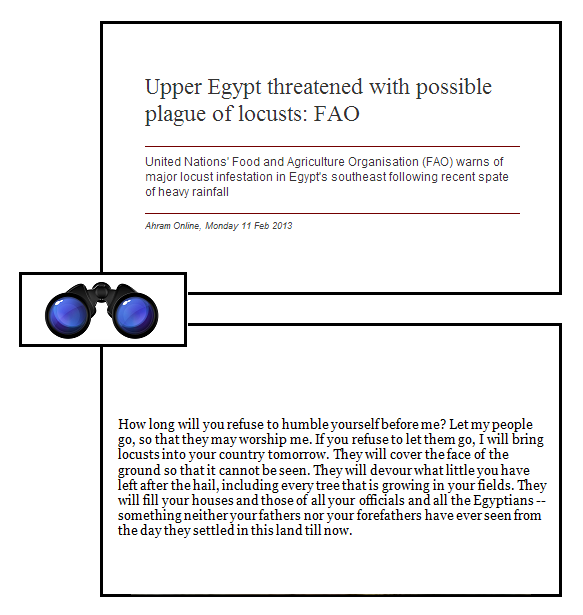
I’m returning here to an old theme of mine, the juxtaposition of worldviews — in this case, accounting for plagues of locusts in Egypt.
Such juxtapositions are like Rorschach blots in some ways — they allow each reader to see the items juxtaposed from within their own worldviews, perhaps applauding one and dismissing another, perhaps seeing some virtue in each or none in either — and perhaps arriving at some meta-level understanding which neither one alone would afford.
Is a plague of locusts in Upper Egypt of which the FAO warns in the upper panel above entirely explained in terms of rainfall? Is it pure mental happenstance that Egypt was the site of a Biblical locust plague at the time of the Israelite Exodus [Ex. 10. 3-6]? Is there, perhaps, a message for Egypt vis-a-vis Israel for our own day?
The answers people give to questions such as these, in which secular and sacred sources address what are putatively similar situations, can influence the way on which they voice themselves and vote — perhaps a good thing, perhaps not.
**
For what it’s worth, the plague of locusts is mentioned in the Qur’an in Sura 7.133:
So We let loose upon them [the Egyptians} the flood and the locusts, the lice and the frogs, the blood, distinct signs; but they waxed proud and were a sinful people.
The basic problem with fundamentalist interpretation of this kind is that, refusing to take into account the historical character of biblical revelation, it makes itself incapable of accepting the full truth of the incarnation itself. As regards relationships with God, fundamentalism seeks to escape any closeness of the divine and the human. It refuses to admit that the inspired word of God has been expressed in human language and that this word has been expressed, under divine inspiration, by human authors possessed of limited capacities and resources. For this reason, it tends to treat the biblical text as if it had been dictated word for word by the Spirit. It fails to recognize that the word of God has been formulated in language and expression conditioned by various periods. It pays no attention to the literary forms and to the human ways of thinking to be found in the biblical texts, many of which are the result of a process extending over long periods of time and bearing the mark of very diverse historical situations.
[ by Charles Cameron — on human impact, with a quick glance at Pundita’s wide-angle thinking ]
.
The “butterfly effect” identified by meteorologist Edward Lorenz suggests that when you are dealing with highly complex systems such as weather patterns, what eventually happens may be “sensitively dependent on initial conditions”. Very small differences at one moment in such systems may result in very large differences later on. As Lorenz explains in the upper quote above, however, we’re dealing with a myriad of influences simultaneously, and it’s entirely possible that our own meteorological impact exceeds and outweighs that of the butterfly species…
I’ve chosen to post this particular pair of quotes, in fact, because both examples point to severely deleterious effects of human impact on our home environment in the larger sense — “the world we live in” — at a level where human individuals may not feel they have much of an individual impact, but where the cumulative effect is much greater: global warming? devastating storms? loss of rain forest? — narcarchy?
Narcarchy: hereby defined as rule by cartel — see this fascinating news piece, and note in particular the presence of a significant religious thread in the midst of the drug / crime / warfare picture.
**
On the question of sensitive dependence on initial conditions, this graphic paints the picture nicely and with nuance, for those who “think in pictures”:
I also wanted to juxtapose the two quotes above because they give me a chance to talk about “wide angle views” and their virtues, and to point you to a recent Pundita post that set me thinking along those lines. The post is Then and Now: Instructive parallels between 9/11/01-Benghazi and Katrina-Sandy storms, and part of my comment read as follows:
…you have an amazing breadth of thought going on here – especially in your paragraph:
It’s as if a new era arrived, with its vast changes in weather patterns and attack patterns, and nobody is yet fully processing the nature of the threats. I guess such an observation is actually old news. But Sandy coming on the heels of Benghazi struck me as a kind of exclamation mark to the fact that civilizations start to fall at the point where they’re no longer able to process the cumulative effects of their past.
Seeing parallels between Benghazi and 9/11, or between Sandy and Katrina, would be one thing – but managing to see parallel changes in both “weather patterns and attack patterns” is quite another — and even though people may want to question and qualify some of the details, the overall scope and view is breathtaking.
We need this kind of wide-angle thinking, it seems to me, and I offer my two quotes here in much the same spirit.
So if “sensitive dependence on initial conditions” is one analytic thought pattern I’m promoting here, “wide-angle thinking” and the capacity to zoom from significant detail to global context is surely another.
[ by Charles Cameron — a quick look at some confusing clashes between messianisms, with specific reference to the MUJAO — also the late Ayatollah Baqir al-Sadr sounding an ecumenical note ]
.
image: Dajjal, from Okasha Abdelmannan al-Tibi's The Whole Truth about the Antichrist
What he doesn’t state outright, which is also true, is that all too often that heretic is the anti-Messiah.
**
I use that term “anti-Messiah” deliberately, because in discussing Islamic end times beliefs, the term “Antichrist” is frequently used by both Christians and Muslims to refer to the Muslim “equivalent” of the Christian Antichrist — ie the “deceiving messiah” or Masih al-Dajjal, whose coming at the end of days is predicted in Islamic apocalyptic narratives in negative counterpoint to the coming of the Mahdi, in much the same way that some Christian apocalyptic narratives predict the coming of the Antichrist in negative counterpoint to the return of the Christ.
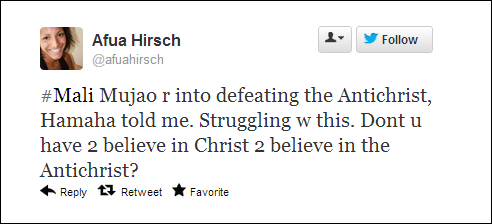
This issue was brought home to me once again today when Aaron Zelin pointed me to this tweet from Afua Hirsch [ @afuahirsch ], West Africa Correspondent for the Guardian:
Frankly, I think that’s a very natural question to raise, and one that has an even more intriguing answer.
**
One other note, which I’ve separated out between asterisks here because I think it’s a crucial one at that:
by Afua Hirsch’s account, Mali’s Movement for Unity and Jihad in West Africa (MUJAO) has the apocalyptic fever…
**
Strange things happen when different views of the end times, as prophesied one way or another in various branches of all three Abrahamic religions, clash.
Here’s where I see the moebius strip effect, whereby apocalyptic figures are turned into their opposites by rival sets of beliefs:
Some Muslims call the Dajjal (literally, “the deceiver”) the Antichrist — here, for instance, is a video clip of Sheikh Imran Hosein, whom I have discussed on Zenpundit before, quoting a hadith or tradition of the Prophet from the Sahih Muslim collection, and using the term “Antichrist” without further comment in his translation of the term Dajjal —
Joel Richardson in his book Antichrist: Islam’s Awaited Messiah argues that the Mahdi will be the Antichrist of the Bible and that the Muslim Jesus will be be the False Prophet of the Bible who serves the Antichrist and his purposes. Both will be destroyed when the true Jesus returns at the end of the Tribulation.
While the great Dajjal focuses on atheism and fights Christianity, the Islam Dajjal, Sufyan, fights Islam, which is the only true religion before Allah, openly. Therefore he is regarded as more frightening.
There’s also a question of one and / or many Antichrists in Christianity, of course — see 1 John 2:18:
Little children, it is the last time: and as ye have heard that antichrist shall come, even now are there many antichrists; whereby we know that it is the last time.
Ibn Majah, however, also has a hadith in which it is stated that at the time of the Mahdi’s advent he will invite the returning Jesus to lead the evening dawn prayer [as quoted here]:
…while their Imaam will have advanced to pray the Fajr prayer with them, Eesa, the son of Mary will descend [at the time of the Fajr prayer]. The Imaam will draw backward so that ‘Eesa would go forward and lead the people in prayer. However, ‘Eesa would put his hand between his shoulders and say to him: “Go forward and pray, as it is for you that the call for the prayer was called, so their Imaam would lead them in prayer.”
**
Confusing?
I think so, unless you are paying close attention.
My own recommendation would be that the phrase “the Islamic Antichrist” should be replaced by “the Islamic equivalent of an Antichrist” when referring to the Dajjal, and “the Mahdi viewed as Antichrist” when referring to the Mahdi.
I know, I know — the chances of changing people’s verbal habits across the board are pretty slender.
But have I made things seem complicated enough?
**
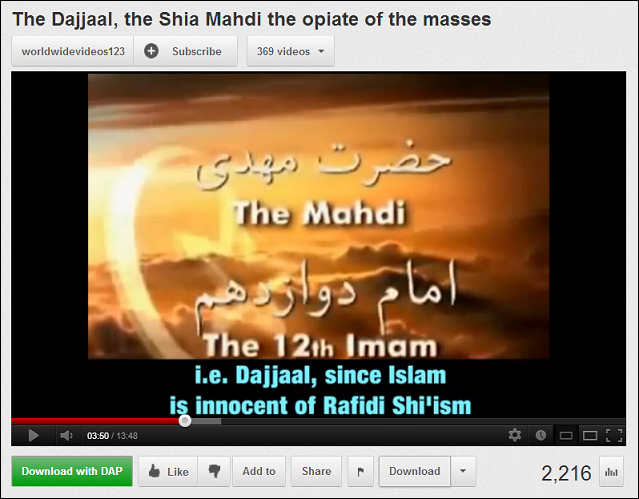
This whose business naturally gets just a tad more complicated once one adds in the Sunni concept — I am not sure how widespread it is, but it would make a fascinating topic for research for someone with the requisite language skills — that the Mahdi of the Shiites will be the Dajjal of the Sunni… as shown in this screen cap of a YouTube video.
[Rafidi means one who has deserted the truth, and is a derogatory term, in this case used by Sunnis to disparage the Shiites.]
Or this one — with its equation of the Shiites with the Jews:
Everything I have described above is dualistic in nature and sectarian in its specifics. It comes as something of a surprise, then, to find the late Ayatollah Muhammad Baqir al-Sadrquoted as writing:
The Mahdi is not an embodiment of the Islamic belief but he is also the symbol of an aspiration cherished by mankind irrespective of its divergent religious doctrines. He is also the crystallization of an instructive inspiration through which all people, regardless of their religious affiliations, have learnt to await a day when heavenly missions, with all their implications, will achieve their final goal and the tiring march of humanity across history will culminate satisfactory in peace and tranquility. This consciousness of the expected future has not been confined to those who believe in the supernatural phenomenon but has also been reflected in the ideologies and cult which totally deny the existence of what is imperceptible. For example, the dialectical materialism which interprets history on the basis of contradiction believes that a day will come when all contradictions will disappear and complete peace and tranquility will prevail.
So, our own camp comprises of people who have this understanding: First of all, they are the people who believe in the Ahl al-Bayt. Yet, in our camp it is possible for there to be people who work for the Ahl al-Bayt without knowing the Ahl al-Bayt. This is also something very important. You may have a non-Shia who works for the Ahl al-Bayt better than many Shias. Indeed, you have some Shias that work against the Ahl al-Bayt. You may even have non-Muslims who are working for Imam Mahdi—for the cause of Imam Mahdi, for justice, for many things—and they may not even know who Imam Mahdi is. So it is not that whoever is not a Shia is not in our camp.
and:
I believe that the majority of the people of the world are not against us; it is just our failure to present our ideas and to convince them that what we have is for all mankind. I think in particular, in the case of Imam Mahdi, we must do the same thing: we must not present Imam Mahdi as a saviour for the Shias. Imam Mahdi is not a saviour for [just] the Shias. Imam Mahdi is a saviour for all mankind…
**
And then you see what you yourself see, and believe what you yourself believe.
[ by Charles Cameron — some thoughts on news reports and prophecy, since it is not unheard of for people to bolster their versions of prophecy by quoting current events ]
.
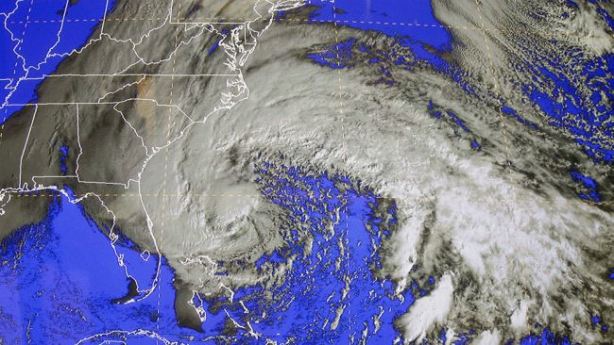
AP satellite image - which might as well be titled, in Shelley's words, "look on my works, ye mighty, and despair"
.
I want to explore the relation of prophecy and prediction to news, and my inbox in the last couple of days has provided me with a simple way to compare and contrast the two.
Here, then, are two versions of what might shortly come to pass:
The Joel Rosenberg piece providing an interpretation of what might be just a day away, under that alarming headline, begins:
“For thus says the Lord of hosts, ‘Once more in a little while, I am going to shake the heavens and the earth, the sea also and the dry land. I will shake all the nations.” (Haggai 2:6-7) Just days before one of the most significant and momentous presidential and Congressional elections in American history, God is reminding us that America’s fate lies not in the hands of the politicians, but in His hands. Weather experts are warning Americans on the East Coast to “get ready, be prepared” for Hurricane Sandy, which they say could prove to be one of the most devastating storms in American history. Is that hype, or is it true? Tens of millions Americans are not taking any chances. They are buying water, food, gasoline and other supplies as the storm moves towards land. I can tell you that my family and I in the Washington, D.C. area are doing the same.
**
The interesting question from my POV is whether it is legitimate to invoke supernatural causes when natural causes could sufficiently account for what is observed to be happening.
There is indeed a major storm system in the offing, and it is indeed as yet uncertain whether it will be devastating, a comparatively minor irritant, or somewhere in between. But the Washington Post appears content to attribute the possibilities to natural forces, whereas Rosenberg prefers an explanation in terms of his views on morality.
Basically, there are two positions here:
If we are shaken, it is because we are sinful.
If we are shaken, it is because natural forces are interacting in such a way as to cause devastation on the scale of human interest.
I would argue for a third view:
If we are shaken, it is because we have messed enough with the planet’s intricate homeostases as to drive weather patterns to inhospitable extremes.
**
Here are some rules that the looming Frankenstorm has prompted me to consixder:
One:
Don’t overstate the case: if you want a worst case scenario for warning and planning purposes, clearly mark it as such, and at least sketch the alternative scenarios and an informed guess as to their respective likelihoods.
Two:
If you associate a presumed cause to an expected effect, and when the time comes the effect does not happen, admit that the cause as presumed was flawed within your own system of explanation. In the case of Rosenberg’s storm, should it prove to be less of a shaker than Rosenberg’s headline suggests, this would mean he would admit that God obviously didn’t intend to shake America all that much — either because America is less sinful and more pleasing to God than Rosenberg gives it credit for, or because the threat of the storm caused a sufficient moral awakening to make its actuality unnecessary, or because God is more long-suffering than Rosenberg initially imagined.
Three:
Keep your explanation internally consistent. The storm is, even in Rosenberg’s sense, a meteorological phenomenon — which is why his post carries the AP satellite image of Hurricane Sandy that I put at the top of this post. It is a stretch — biblically permitted, but a stretch nevertheless — to assert a moral cause (such as tolerance of homosexuality) for a meteorological event, particularly if the known meteorological causes would in themselves be sufficient to account for it.
**
And then there’s the most interesting part of all.
Suppose that prophecy isn’t a matter of specific and accurate prediction, but a sketch of possible outcomes, along the lines of “if you carry on like that, you’ll drink yourself into an early grave.” When someone says something like that, they don’t mean the person concerned will find an empty grave and get so drunk as to fall into it — they mean that excessive imbibing, over the long term, puts the imbiber at risk of a variety of distressing ends, fatal car crashes and kidney failure among them.
We have the saying, “pride comes before a fall.” Is that prophecy? It is found in scripture, in Proverbs 16.18:
Pride goeth before destruction, and an haughty spirit before a fall.
Arguably the proud and power-hungry have a tendency to overextend themselves — the Greeks would call it hubris, and see nemesis close on its heels. Is it prophecy, then, or a simple observation of human nature? It certainly seems to fit quite a number of circumstances — to be “fulfilled” on a regular basis.
**
My friend and mentor the shaman Wallace Black Elk emphasized to me that in his Lakota tradition, prophecies were understood as visionary warnings of likely outcomes to be avoided — not as inevitabilities.
**
What I’m getting at here is that as predictions become specific — Edgar Whisenart‘s prediction that the Rapture would occur between September 11 and 13, 1988, or Jose Arguelles proclamation that the harmonic convergence of August 17, 1987 would be the great moment of shift — or are interpreted in specific ways — I linked to a minister preaching that Oprah Winfrey was the Antichrist only yesterday — we may be mistaking a poetic reading of trends for an act of previsioning in detail a predetermined, preordained and predestined future.
From my POV, this would mean that prophetic texts should be read as poetic foreshadowings — “put too much strain on the environment and it will bite back at you” — rather than as matrices into which the events of the day should be shoehorned — back in the days of Nero and Domitian, back in the days of Hitler and Stalin, or today, tomorrow and tomorrow…
In this way, both prophetic and scientific traditions can be appropriately honored.
neatly encapsulates the “counterintuitive” paradox by which bow and arrows — and catapults too, for that matter — work. You pull back to send forwards.
Gurdon spoke of his own unlikely career as a young man who loved science but was steered away from it at school, only to take it up again at university.
He still keeps an old school report in a frame on his desk: “I believe he has ideas about becoming a scientist… This is quite ridiculous,” his teacher wrote. “It would be a sheer waste of time, both on his part and of those who have to teach him.”
What’s funny here is that our new-minted Nobelist liked this comment well enough to frame it. He has shown the teacher in question to be wrong, no doubt about it, and perhaps given others who have received similarly negative advice some encouragement along the way.
But here’s my question: did that unflattering report somehow propel him to greater effort?
**
For your thinking pleasure in the matter of the bow to arrow paradox:
reverse psychology
blowback
reculer pour mieux sauter
counterintuitive
unintended consequences
It’s really quite a party for the party-going mind. Does your mind party?
**
There will be more posts in this “form is insight” series, as time and tide permit.
Zenpundit is a blog dedicated to exploring the intersections of foreign policy, history, military theory, national security,strategic thinking, futurism, cognition and a number of other esoteric pursuits.