zenpundit.com » fisking

Archive for the ‘fisking’ Category

Fisking McCaffrey’s Futurism

Monday, March 24th, 2008

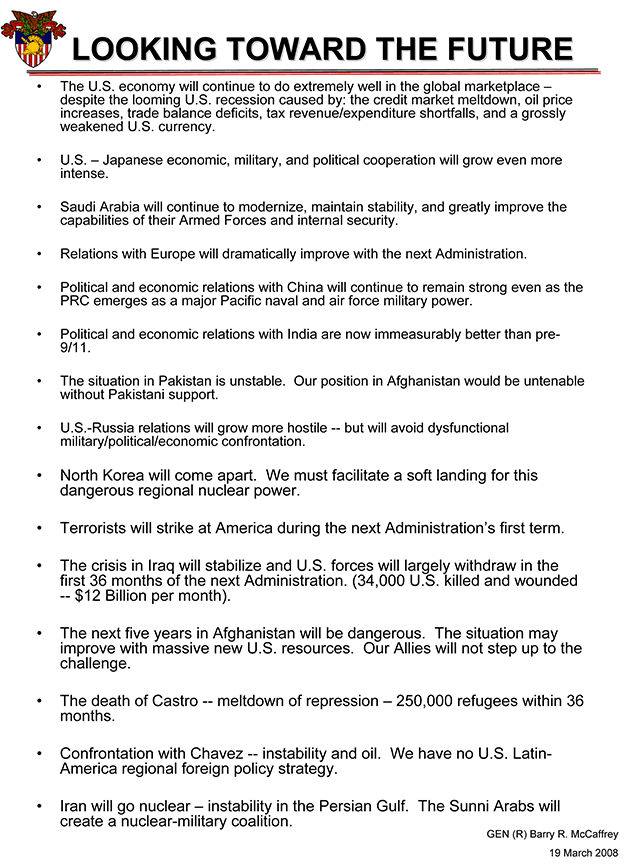
Yesterday, The SWJ Blog ( and blogfriends on Twitter, one of whom characterized it as “weak”) aleted me to a futurist slide by General Barry McCaffrey with his predictions of potential national security events faced by the United States in the near term. I’m certain this was in the context of a much larger presentation, given to a specific group with stated policy concerns; unfortunately, those particulars are unknown to me:

futurism.gif

My commentary:

First of all, one notes the number of “safe” predictions in the sense that none of these represent even the likeliest of outliers much less scenarios representing true, statistical rarity, “Gray Swans”. There’s a certain probalistic logic to doing so – the status quo more often than not in any given scenario will continue uninterrupted except by minor adjustments. On at least half of this list, given the breadth and/or vagueness, I’m certain that McCaffrey will be able in five years to say that he was more right then wrong. Unfortunately, the narrow number of domains from which he is extrapolating – nothing on cutting edge tech, applied science, the environment, macrodemographics, religious fundamentalism or interesting “intersectional” possibilities – leaves  policy makers with a vision that may be more susceptible to a Black Swan event than before by reinforcing previously held expectations.

Sidebar: I’d love to see Art Hutchinson, Tom Barnett, John Robb , Michael Tanji and the gents at Kent’s Imperative also critique the slide.

Now, in fairness, to the good General, a few of his bullet points are more interesting than others. I think McCaffrey’s called a hard landing for Cuba correctly unless Raul Castro has a secret admiration for Deng Xiaoping and the comprehension of economics to execute a Deng-like transition. It will be difficult for Cuba to really open up without the economic logic of the American market and favorable asylum policies for Cubans immediately kicking in as it did for the East Germans when the other Soviet bloc states ceased cooperating with Honecker’s repressive policies. With Chavez too, I think General McCaffrey is correct given that there is a little remarked friction between Venezuela the oil producer and America the refiner of Venezuelan oil ( refining capacity is itself a choke point along with oil production nor is all crude created equal; some is more expensive to refine than others). Finally, the temptation for al Qaida to “send a message” to the new administration and create downstream political effects may prove well-nigh overwhelming; it may even override their present policy of waiting until to pull off a catastropic level act of terror.

How do you see it ? Comments, questions, rants are all welcome.

A Remarkable Disconnect From Context and Causation

Sunday, November 25th, 2007

I was surfing over at the always engaging, Left of center blog, The Newshoggers, when I saw a post by Cernig discussing a NYT op-ed by Martin Walker giving the lion’s share of the credit for the end of the Cold War to Mikhail Gorbachev, a position Cernig strongly endorsed, expounding upon the” Reagan won Mythtique”.  A key section from the Walker op-ed:

“According to both Schell and Rhodes, the cold war ended not because Reagan stood firm at Reykjavik but because Gorbachev and his supporters had already decided to stop waging it, or as Gorbachev’s adviser Giorgy Arbatov once put it to this reviewer in Moscow, “to take your enemy away.” Gorbachev understood that the arms race was ruining his country. And then he learned that the radiation fallout from Chernobyl was the equivalent of a single 12-megaton bomb.It was a wondrous accident of history that saw Gorbachev, the determined reformer of a sclerotic Soviet system, coincide with Reagan, the anti-Communist conservative who nonetheless dreamed of a world without nuclear weapons. After Reagan came the first president Bush, whose initial caution about Gorbachev gave way to such enthusiasm that he unilaterally scrapped America’s vast arsenal of land- and sea-based tactical nuclear weapons. Between them, the three men put an end to the first nuclear age.”

The first paragraph begs the question of “Why?” – particularly when Gorbachev’s recent predecessor as General-Secretary and longtime political godfather, Yuri Andropov, had such a drastically different reaction to nearly identical circumstances, despite being perhaps the best informed Soviet leader to ever rule the Kremlin. Walker ( leaning heavily on the writings of Jonathan Schell and Richard Rhodes) credits the Chernobyl disaster causing a Paul on the road to Damascus political conversion in the highest reaches of the Soviet nomenklatura. I find that such a thesis strains credulity, to put it mildly.

Walker would have us believe that a totalitarian system that weathered: approximately 20 to 25 million war dead in WWII, plus; another 20 to 30 million Soviet citizens who vanished into the Gulag under Stalin; that went to the brink of nuclear war with the U.S. under Khrushchev and with China under Brezhnev; that was, at the time, accepting tens of thousands of casualties annually in Afghanistan under Gorbachev; was suddenly undone morally and spiritually by a comparative handful of dead in an industrial accident at a nuclear plant and subsequent bad Western P.R. This is not history but wishful fantasy of an adolescent kind.

Let us be clear, Mikhail Gorbachev deserves significant credit for his share in bringing the Cold War to a sane and relatively soft landing.  He exercised intelligent restraint at a number of critical junctures where an ideologue would have provoked a civil war – something the coup plotters who toppled Gorbachev almost did. Gorbachev also understood that the Soviet system was fundamentally incompatible with the emergence of a globalized and highly technological information economy and that if his country did not adapt quickly, it would be left behind. At no time in power, however, did Gorbachev intend to destroy the Soviet Union or abandon “socialism” ( though what socialism was to be in the future, became increasingly vague in Gorbachev’s pronouncements) – these were the unintended consequences of trying to square a circle and make the USSR into a “normal” state via perestroika. A herculean task that exceeded even Gorbachev’s considerable political talents.

The facts are that Gorbachev and the USSR lost the Cold War and then sued for peace out of necessity, not from moral superiority or anti-nuclear altruism. It is a further truth that Ronald Reagan was substantially more correct than most of his contemporaries, Left and Right, on the proper American stance toward the Soviets; and that without his tough but flexible policies, the USSR might have limped along on life support for some time longer, as has North Korea.  Possibly, without the challenge of Reagan in the first place, the Soviet politburo might have opted for yet another ailing octogenarian to warm Lenin’s seat after Chernenko died and the “youthful” Gorbachev might have idled as a second tier leader for another decade.

No, Ronald Reagan did not win the Cold War by himself but he contributed to that victory and all attempts to spin Mikhail Gorbachev, a tough-minded and daring apparatchik who wanted to save the Soviet Union, into the grand savior of humanity are just that – empty spin.

Sunday, February 11th, 2007

FISKING VLADIMIR PUTIN

Russian President Vladimir Putin rattled the diplomatic set with a pugnacious and critical speech about American foreign policy that was a clever mixture of blunt realpolitik, obvious gestures for domestic consumption, a play for the sympathy of the anti-American Left in Europe and the anti-Bush Left in America. It was also a not so subtle form of pressure on the Bush administration to treat Russia as a great power partner in world affairs, especially the Middle East.

Russia of course, while not an enemy of the United States, would like all of the goodies that come with being an American strategic partner without having to ante up anything of substantive import in return. While not much praise can be given to the unimaginative, backburner, American policy toward Russia since the Soviet collapse in 1991, the Bush administration has at least been smart enough to not reward empty talk from the Kremlin until Putin puts something concrete on the table. Something the Russian leader has steadfastly refused to do on Iraq, Iran or much of anything else.

Addressing Putin’s specific remarks:

“The United States has overstepped its national borders in every way,” he said in an address at an annual international security conference here. “Nobody feels secure anymore, because nobody can take safety behind the stone wall of international law.”

I have also read this statement more literally translated as ” hide behind international law”, which to my reading of Putin, is more in tune with his ex-KGB cynical realism and “Great Russia” nationalism. The statement above reads more like the Foreign Ministry approved text.

On one level, Putin speaks for many foreign leaders who are unhappy with American intervention in Iraq and other places overseas even as American power hems in their own regional ambitions. The Bush administration has failed to use diplomacy, particularly public diplomacy, well or offer realistic carrots to win over the mercurial fence-sitters who do not give a fig for Iraq of Islamist terrorism but care deeply about other subjects. Using hard power successfully requires making the connections beforehand that minimize counterbalancing “blowback” and this chore the Bush administration has been unwilling or unable to do.

On another, deeper, level this is a very illuminating and an honest realpolitik assessment, while being cleverly worded to appeal to Bush critics and International Law professor types who believe that the world actually turns on the moral implications of their abstruse interpretations of treaty conventions. What Putin is really acknowledging is that the previous, Cold War era, ability to carry out policies that were serious threats to the vital interests of other states, especially America, because of ” plausible deniability” created by fig leaf nods to international law, is now much riskier.

The plausible deniability for which Putin longs, served a critical purpose -to avoid escalating a minor regional conflict into a superpower confrontation, so the U.S. and U.S.S.R. were forced to look the other way on many instances of terrorism, subversion, espionage and nuclear proliferation involving each other’s clients. We had to grin and bear it or strike back at the Soviet bloc with equal indirection, sometimes in a wholly unrelated sphere. This dynamic suited the Soviets well which is why they also fiercely resisted Nixon-Kissinger “linkage” at the bargaining table. Lacking the nuclear tripwire, the need for Washington to pretend hostile actions are anything but hostile was going to fade regardless of who was president, but 9/11 and Bush administration ideological convictions vastly accelerated the process.

“we don’t want Iran to feel cornered.”

Translation: “We need Iranian cash. We can’t afford to be seen backing down to Washington and continue to be regarded as a viable alternative arms supllier to the United States. We are against you attacking Iran, even though, frankly, we Russians don’t like Iranians or Ahmadinejad very much but find Iran useful as a counterweight to American power in the region, and this overrides longer term concerns.”

“It is a world of one master, one sovereign … it has nothing to do with democracy,” he said. “This is nourishing the wish of countries to get nuclear weapons.”

This is laughable to anyone with rudimentary knowledge of the history of nuclear weapons but it is good propaganda for justifying Russia’s assistance to Iran’s nuclear weapons program. Nor does possession of a small nuclear arsenal help much against the United States, if Pervez Musharraf is to be believed. It will help you against your neighbors in your own nation-state weight class though.

How serious is Putin ? Recall that politically, Putin takes the wind out of extremist parties, Right or Left, by preventing them from waving the flags of Nationalism and Neo-Sovietism by doing so himself ” responsibly”. His governing class, the Siloviki, were entirely insincire Communists in Soviet times, KGB pragmatists who saw the world from the prism of power, carrots, sticks and dirty tricks. The Siloviki hold all the power in Russia and political opposition is effectively neutered and could, if they had chosen to do so, enact far more aggressive anti-Western policies. They and Putin have not because it isn’t in their personal interest or Russia’s to get into serious conflicts with the U.S. or the E.U.

ADDENDUM:

First, thank you to Real Clear Politics for linking to this post. Much appreciated!

A few Putin links:

Thomas P.M. Barnett

RedState

Switch to our mobile site

