zenpundit.com » foreign policy

Archive for the ‘foreign policy’ Category

Porter at Infinity Journal

Friday, April 8th, 2011

Infinity Journal has added a more “blog-like” or “column-like” section to cover events within a contemporaneous frame in addition to their peer-review articles which come out quarterly (or perhaps bimonthly) more contemporaneous peer reviewed articles, oriented toward current events, in addition to their quarterly publication of the journal . Dr. Patrick Porter of Offshore Balancer ( and King’s College) has the maiden post with a provocative piece:

Exclusive: Lost in Libya: The UK does not understand strategy

The limited war of 2011 would refuse to be quarantined. After all other options were exhausted, it could culminate in a land war against Tripoli. Distressingly, we would shoulder the burden of invading, pacifying and administering this country. Occupation would probably lead to resistance – and Libya propelled more foreign-born jihadi volunteers into Iraq than any other nation. A new front in the War on Terror would open up. Idealists now calling for humanitarian rescue would discover that all along they opposed Western imperial hubris….

Free registration required. 

Admittedly, I stole the excerpt above from SWJ Blog – the online format of IJ makes it difficult for bloggers to quote sections of articles by copying and pasting into blog posts. This probably cuts down on the velocity and extent of IJ articles circulating in the .mil/strategy/foreign policy online world (blogosphere, twitter, listservs). OTOH the editors may not care as it probably reduces the amount of inane vs. informed criticism as well 🙂

In any event. Dr. Porter’s article is worth reading.

The Year of Living Memory

Wednesday, April 6th, 2011

[ by Charles Cameron ]

*

Some people’s — and more to the point, some peoples’ — living memory appears to be longer than others. China, for instance, has what you might call long term living memory.

*

But first, the Crusades. When Bush 43 first used the word “crusade” in reference to the US response to 9/11, I went to Google and checked, and the first listing for “crusade against” that came up was to The Crusade Against Dental Amalgam. I’m the suspicious type, and as I suspected, the word “crusade” simply doesn’t have the same valence for most twenty-first century Americans that it has for many in the twenty-first century Arab world. In the US, a crusade is a concerted effort to change just about anything, the use of mercury in dental fillings being just one example.

Across the Arab world, however, the word has very different connotations: thus Amin Maalouf writes in The Crusades through Arab Eyes:

The Turk Mehmet Ali Agca, who tried to shoot the pope on 13 May 1981, had expressed himself in a letter in these terms: I have decided to kill John Paul II, supreme commander of the Crusades. Beyond this individual act, it seems clear that the Arab East still sees the West as a natural enemy. Against that enemy, any hostile action — be it political, military, or based on oil — is considered no more than legitimate vengeance. And there can be no doubt that the schism between the two worlds dates from the Crusades, deeply felt by the Arabs, even today, as an act of rape.

That’s long term living memory for you.

*

I’m writing this because I just read a fascinating article by Robert Barnett on the New York Review of Books blog titled The Dalai Lama’s ‘Deception’: Why a Seventeenth-Century Decree Matters to Beijing — need I say more?

The title will suffice for those who don’t have much time today — I understand, we’re all under the fire-hose one way or another — while those with the ability to sneak in ten or fifteen minutes laterally while the clock’s not watching can and should definitely read the whole thing…

*

I have just one side-observation though — the article tells us, among many other things directly relating to Tibet and the history of the Dalai Lamas:

And again, when Jiang Zemin made a brutal decision to annihilate the basically harmless Falungong cult in 1999, it is believed that he saw it as analogous to the religious movement that had started the Taiping Rebellion and nearly toppled the Qing in the mid-19th century.

I think that’s right — but what Barnett doesn’t mention, since Taiping is only an aside for him, is that the rebellion was only eventually quelled at the cost of between twenty and thirty million lives…

I mentioned my own hunch that memories of Taiping were behind the Chinese government’s fierce response to Falun Gong in question time after Ali A Allawi‘s talk on Mahdist movements in Iraq at the Jamestown Foundation a few years back, and he responded that similarly, the reason the Iraqi government took such fierce action against a small Mahdist uprising near Najaf — even calling in US air support as I recall, for an incident perhaps best compared in US terms with Waco — was that they remembered the Babi movement in their own neck of the woods, and the tens of thousands who died back in the 1850s, around the same time as the Taiping in China.

*

Living memory — which could almost be a definition of history, or at least of what historical research aims to create — can itself be long term or short, perishable or perennial.

And then there’s Psalm 90, which declares “For a thousand years in thy sight are but as yesterday when it is past, and as a watch in the night.”

Now (and I’m being playful here, albeit with a touch of serious intent) does that suggest a Memory that reaches back in perfect detail through the eons to the Big Bang and perhaps before it? Or … “twentieth century? nineteenth? the Crusades?.. it’s all a bit of a blur, I’m afraid — it all rushes by so fast…”

*

There seems to be a choice set before us as individuals — and more to the point, as peoples:

Shall we choose Lethe, and the restfulness of oblivion, or Mnemosyne — the mother of all Muses? There are, you know, immediate educational implications, and serious geopolitical implications down the road, for the choice we make…

Pity America the Un-Philosophical

Tuesday, March 29th, 2011


I attempted to leave a short amusing response at Foreign Policy.com but was thwarted by their comment system, so I am writing a pedantic post here instead.

Joshua Keating, bursting with admiration for Bernard-Henri Levy, laments the lack of enlightenment of American politicians compared to their much cooler French counterparts:

Libyan intervention: Brought to you by Bernard-Henri Levy?

….I was going to write some kind of quip along the lines of, “Can you imagine President Obama taking phone calls from [American philosopher] in the oval office while he debates whether to send U.S. troops to war,” but I can’t even think of a name for whom that joke would make sense. 

France and Germany have a tradition of publicly engaged philosophers that’s pretty much alien to the United States. The idea of an American BHL or even Jurgen Habermas seems pretty laughable. Economists like Paul Krugman are the go-to public intellectuals here while philosophy has become an increasingly specialized and technical discipline, even within academia. What effect the prominence of philosophers in public life has on a country’s political culture and policies is a pretty promising subject for further research.

Heh. 

Philosophers have never had much of an impact on American public life and the politics of their times except…. maybe…. for William James, Reinhold Neibhur, John Dewey, Leo Strauss, Walter Lippmann, Ayn Rand, Herbert Croly, Sydney Hook, Allan Bloom, James Burnham, John Rawls and Thomas Kuhn. That’s just off of the top of my head. If you want to include economists as philosophers who influenced contemporary American political life – and, frankly, we often should – add Adam Smith, Karl Marx, John Maynard Keynes, Friedrich von Hayek, Ludwig von Mises, John Galbraith and Milton Friedman to the list. It should not need to be said, but America was founded on the ideals of philosophers like John Locke, Baron de Montesquieu and Cicero by men deeply steeped in moral and political philosophy. Some of the founders would have qualified as philosophers themselves.

I don’t know much about Mr. Keating. Pretty sure he is a sharp guy, but I bet he is 35 or younger and was a journalism or polisci grad. Academic philosophy as a profession has been increasingly irrelevant to policy makers or the general public as described, Keating is spot on there, since the early mid-60’s, which is probably the entirety of his life. It was not always this way. Formerly, philosophers wrestled with problems of general interest and were active public intellectuals, the determined self-marginalization of today’s professional philosophers notwithstanding.

It is a symptom of intellectual decline but the problem Keating identifies is not in American society or even in American politicians but in the philosophers.

Soon soon coming of the Mahdi?

Monday, March 28th, 2011

[ by Charles Cameron ]

*

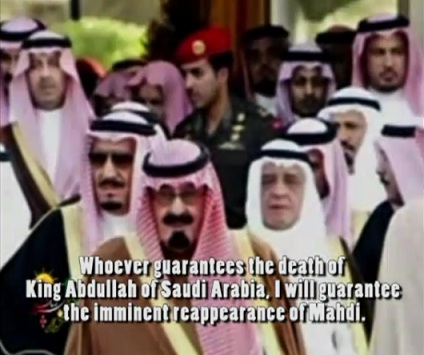
Okay, I’d say things are heating up. Here’s a screen grab from what we are led to believe is a recent video from Iran, made with government backing as described below the fold.

death-of-abdullah-sign-of-mahdi.jpg

This does not bode well…

*

The Christian thriller novelist Joel Rosenberg (author of The Twelfth Imam) has a new blog post up, in which he cites a Christian Broadcasting Network story — which in turn refers to a video posted with some introductory materials on his blog by Reza Kahlili (author of A Time to Betray: The Astonishing Double Life of a CIA Agent Inside the Revolutionary Guards of Iran).

According to Kahlili, who has also posted the full video to YouTube, it is a half-hour long program sponsored by the Basij militia and the Office of the President of Iran, affirming the soon-return of the Mahdi.

And containing “inflammatory language” about King Abdullah of Saudi Arabia (see subtitle above)?  Can I say that?

For what it’s worth, the supposed “hadith” about the death of King Abdullah is discussed in some detail at The Wake-Up Project, so it’s definitely “in the air” — but I don’t recall seeing any references to it in Abbas Amanat, Abdulazziz Sachedina, or any of the lists of Signs of the Coming I’ve read, so my suspicion is that this is an opportunistic addition to the corpus rather than a reliable hadith.

Which brings me to my last point:

I am not posting these materials to encourage panic — that’s what terrorism strives for, and it is the very opposite of what I would wish to see.  If anything, these stirrings of Mahdist sentiment should make us more careful and attentive to the serious scholarly work that has been done in this area.  Jean-Pierre Filiu‘s book Apocalypse in Islam, which I reviewed for Jihadology, would be an excellent place to start.

*

There are plenty of other things going on that I would love to track, blog about or comment on these days, but for the next while I shall try to restrain myself and focus in on this particular issue and its ramifications:

  • Contemporary Shi’ite Mahdist expectation
  • The Iranian nuclear program in the light of Mahdist expectation
  • Iranian attempts to use Mahdism to unite Sunni and Shi’a
  • Mahdism and jihad
  • The role of Khorasan in Mahdist rhetoric
  • Christian apocalyptic responses to Mahdist stirrings
  • Joel Rosenberg‘s book, The Twelfth Imam
  • Joel Richardson‘s book, The Islamic Antichrist
  • Glenn Beck‘s increasing focus on Iranian Mahdism
  • The increasing influence of Islamic and Christian apocalyptic on geopolitics

This is a pretty complex and potent mix of topics, and while I’ll post some individual pieces of the puzzle as I see it, I shall also try to put together a “bigger picture” piece with the whole mosaic laid out.

*

Apart from that, I remain deeply committed to questions of chivalry and peace-making, and will continue to monitor developments and write what I can on those topics as time allows…

US Defense Budget, Fear and Interest

Wednesday, March 23rd, 2011


Major Chris, a ZP reader, wrote in today to draw my attention to an item at NRO and I promised a comment:

From Reihan Salam at The Agenda:

Matt Frost and Jim Manzi on US Military Expenditures

Matt Frost (you can find him on Twitter: @mattfrost) copied me on an email earlier today, and he’s kindly given me permission to share his thoughts with all of you:

Comparing the US’s military expenditures against the next three or five potential competitors doesn’t have much analytical value as such, because there are thresholds of capability that you can only cross at some absolute level of cost. Let $x be how much the US spends on the military.

Let $y be how much China spends. The difference between $xand $y, whether in terms of ratio or absolute dollars, doesn’t tell you much, because what matters is value $z, which is how much it costs to field a carrier battle group and maintain bases for air tankers and launch a constellation of GPS satellites and have all your planes be all-weather capable etc etc. Once you get to point $z+1, your capabilities are categorically different from those of a country at $z-1.

Sure, the US spends over $600 billion while the Chinese only spend $98 billion. That difference looks absurd in comparative terms. But between $98 billion and $600 billion there’s a threshold below which you just can’t project power globally. If we think that #winning means global power projection, then cutting to $200 billion won’t work, since it’s not a matter of keeping a 100% lead over the Chinese, or 150% or whatever. Superpower status does not depend on a proportional lead over our competitors; our place at the head of the pack requires staying above that magic increment while everyone else stays below it.

I don’t know what the magic number really is. If it’s $599 billion, then we’re spending the exact amount that our global strategy insists we spend. If it’s $300 billion, then we’re wasting half of every dollar. My hunch is that the real value is closer to the top than the bottom of this range. [Emphasis added]

Hmmm. My two cents:

Comparing the ostensible dollar figures of the Chinese and US defense budgets is a relatively meaningless exercise.

First, like the old Soviet Union, you are not dealing with honest budget figures in regard to Chinese military power. Many military expenditures in China are subsumed by other state agencies, such as for internal security paramilitary troops which even China admits to being slightly over 100% of the PLA budget. This alone would make China’s defense budget twice as large as admitted and we can reckon these figures as being a) underestimates and b) not comprehensive, failing to count military expenditures billed to scientific, industrial, intelligence, nuclear and space related entities. The official published statistics for these items could also be outright lies. Their system is as opaque as it chooses to be. If China’s real national security and defense budget is a cent under $ 300 billion I’d be very surprised.

Then there are the technical economic questions of converting their currency into dollars and whether that accurately reflects the purchasing power of the Chinese government on national security items. Hint: It doesn’t.

It turned out during the Cold War our best analytical efforts grossly overestimated the true size of the GDP of the USSR while vastly underestimating the astronomical percentage of GDP the Soviets devoted to national security and defense. What makes anyone think we are any more accurate today with China when so few of our analysts are expert Sinologists compared to the large number of Soviet specialists during the Cold War?

If you want to understand Chinese power projection capabilities, you have to count the verifiable assets and boots that give them the ability to project power and estimate the degree to which their known logistical capability can support “x” forces at “y” distance for “z” period of time. That will be about as accurate a guess as can be made, along with qualitative assessments of Chinese personnel and equipment and the most probable areas of operation for them. I don’t expect a Chinese Armada off the coast of Uruguay any time soon.

Chinese military power is growing, just ask India or Vietnam, but we need to be realistic about where the PLA is in terms of military power vis-a-vis the United States. We can put an enormously powerful military force on their front porch at will. If it was a contest today of the entire nation of China vs. just PACOM, my money is on PACOM.

That will change in time but how fast and to what degree of adversariality between our two countries depends on far more than just military spending.


Switch to our mobile site

