[ by Charles Cameron — dying more than once in hadith, in press reports, in Rumi and John of the Cross ]
.
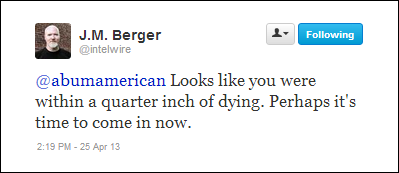
The American mujahid in Somalia, Omar Hammami [see his Wikipedia bio], who has been tweeting back and forth with various “U.S. national security professionals” [see this Wired piece], reported yesterday that he had been shot in the neck “by Shabab assassin” [see this piece by Clint Watts at Selected Wisdom]. JM Berger, who has been in close correspondence with him, tweeted:
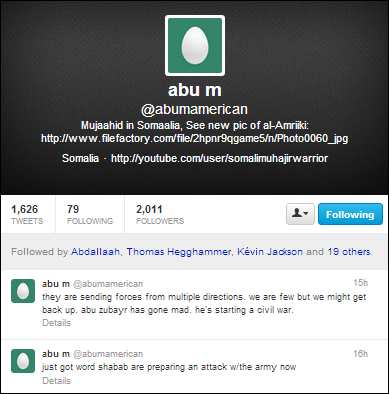
Omar has indeed been in dispute with Shabab, the group he originally joined [see this LWJ post], and his own most recent tweets, sent eighteen hours ago as I write this, were these:
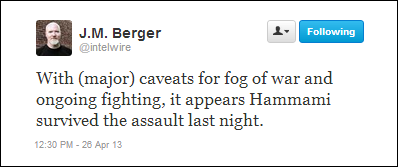
Omar Hammami may or may not still be among us, although recent reports suggest with caveats that he survived the attack…
That’s the background.
**
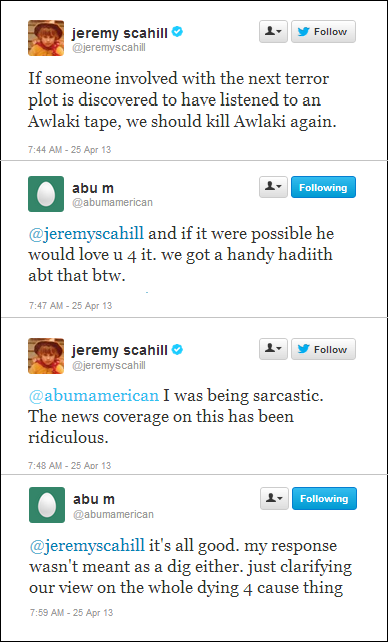
From my point of view, the most interesting discussion anyone had with Hammami in the last day or two was this exchange between Hammami and Jeremy Scahill, whose book Dirty Wars has just hit the stands:
Characteristically, Omar has a light tone — yet speaks to the issue in the context of his theology…
**
There are, it seems to me, basically three ways that one might imagine dying more than once. The first — and it’s the one Hammami himself was referring to — is found in the hadith in Bukhari[Volume 4, Book 52, Number 54]:
Narrated Abu Huraira:
The Prophet said, “… By Him in Whose Hands my life is! I would love to be martyred in Allah’s Cause and then get resurrected and then get martyred, and then get resurrected again and then get martyred and then get resurrected again and then get martyred.
Let the intensity of that hadith — and Hammami’s reference to it, a little earlier [?] on the same day he was shot — sink in.
**
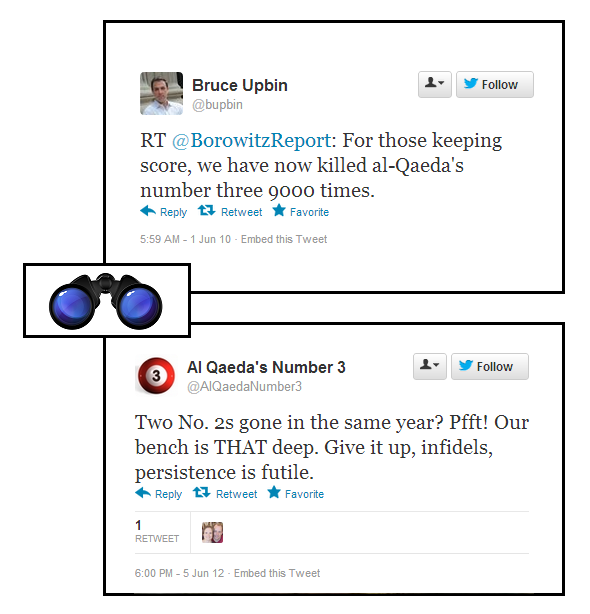
The second, “secular” way to have “died” more than once is through faulty intelligence and / or journalism — and that’s what JM Berger is on about when he tweets:
Now Hammami has apparently resurfaced, with two new a cappella songs that appeared on the web earlier this week. In “Send Me A Cruise,” Hammami begs to be plastered by a tank shell, a drone attack or a cruise missile, so that he can martyred like some of the heroes he names, including Al Qaeda leaders Abu Musab al-Zarqawi and Abu Laith al-Libi. In his trademark tuneless drone, he claims “an amazing martyrdom” is what he “strive(s) for and adore(s).” “Send me a cruise like Maa’lam Adam al Ansari/ And send me a couple of tons like Zarqawi,” chants Hammami. “Send me four and send me more, that’s what I implore.”
More generally, false reports of AQ leaders dying hither and yon have become so common that I posted a DoubleQuote about it last year:
**
Here’s where it get’s most interesting…
For a third view of dying more than once, we can turn to the mystical tradition. Thus the Prophet Muhammad is credited with the hadith “Die before death” by Jalaluddin Rumi, who in his Mathnawi, VI, 3837-38 writes:
The mystery of “Die before death” is this, that the prizes come after dying (and not before).
Except dying, no other skill avails with God, O artful schemer.
Man’s authentic existence is in the Divine; he has a higher Self, which is true; he can attain felicity, even before death (“Die before you die,” said the Prophet). The call comes: to flight, migration, a journey beyond the limitations of world and self.
Of course, St John of the Cross wrote in much the same vein:
This life I live in vital strength
Is loss of life unless I win You:
And thus to die I shall continue
Until in You I live at length.
Listen (my God!) my life is in You.
This life I do not want, for I
Am dying that I do not die.
[ by Charles Cameron — powered by a 2009 post from Ibn Siqilli ]
**
As you know by now, I am fascinated by the oblique-angled windows on current affairs offered us by mythology, folklore, iconography… and for the record, I’ll specifically include flags under iconography.
Thus Amjad Jaimoukha‘s The Chechens: A Handbook (available here for Kindle at $135, a price every scholar can surely afford) caught my eye with the following quote:
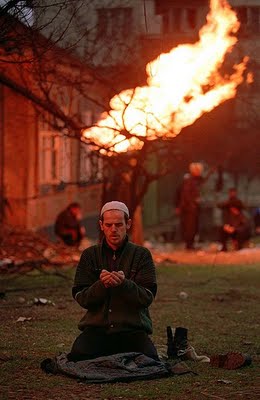
The wolf (borz) is a potent national symbol, and its character traits are considered paragons to be emulated. Chechen men would be proud to be compared to wolves. ‘He was nursed by the She-Wolf,’ is a compliment implying adroitness and courage. Legend has it that it was the wolf that redeemed the world by standing heroically in face of the fury unleashed on doomsday. According to the Chechen ethos, the wolf is the only animal that would enter into an unequal match, making up for any disadvantage by its agility, wit, courage and tenacity. If it loses the battle, it lies down facing the foe in full acceptance of its fate — Chechen poise equivalent to the famed British ‘stiff upper lip’. This wolfish analogy is a depiction of how the Chechens have dealt with outside invaders for millennia.
According to mythology, god had created sheep for the wolf to enjoy, but man tricked it out of its ‘patrimony’, so it had to resort to ruse and robbery to reclaim its right.
That’s Chechen wolf-imagery in the upper flag, above.
**
Three things to note in those two paragraphs from Jaimoukha:
What calling a Chechen a “lone wolf” does to self-esteem:
Chechen men would be proud to be compared to wolves.
the deft touch of apocalypse:
Legend has it that it was the wolf that redeemed the world by standing heroically in face of the fury unleashed on doomsday.
and asymmetric warfare:
According to the Chechen ethos, the wolf is the only animal that would enter into an unequal match, making up for any disadvantage by its agility, wit, courage and tenacity.
**
As to prayers, the use of the takbir, “Allahu Akbar” above the swords in the lower flag is part of the muezzin’s call to prayer, and recited during the prayers themselves.
Analysts have tended to call such individuals “lone wolves,” in my view, a romanticizing term that suggests a cunning and deadly predator. A few of those recorded here display this kind of lethal determination, but others, while still dangerous, skulk about, sniffing at violence, vocally aggressive but skittish without backup. “Stray dogs,” not lone wolves, more accurately describes their behavior.
If there were any doubts that lone wolves can be deadly, they were dispelled by Anders Breivik, the Norwegian anti-Muslim crusader who in July killed 69 young people in a coordinated attack using guns and a car bomb.
Does it matter that some (but not all) of the terrorist network members described above were actually undercover law enforcement agents or informants? It doesn’t change the fact that none of these individuals was working alone. They were receiving advice, concrete assistance, and passive reinforcement from people they believed — rightly or wrongly — to be part of larger terrorist organizations.
None of this means that these guys aren’t dangerous, and none of this is to argue that they shouldn’t have been arrested. But they are not lone wolves. They are essentially al Qaeda volunteers …
But I’ll let Tim Furnish have the last word on nomenclature. In a comment here on Zenpundit he told us he’d originally entitled his HNN blog post “The Brothers Tsarnaev: Hyenas in the Service of the Mahdi” — and in the post itself he writes:
But viewing them from outside, analytically, as lone wolves may give them too much credit; while classifying them as stray dogs neutered of religious ideology gives the Islamic element too little. Perhaps a new paradigm, one of roaming hyenas, best describes the Tsarnaevs — characterized by anomie (fitting into neither domestic nor foreign contexts), the ability to feign surrender when necessary, and a propensity for attacking only the defenseless.
**
And oh, by way of cosmic irrelevance, my googling brought me here:
[ by Charles Cameron — closing out my account of the Mahdist video — with much from Tim Furnish, and pointers to Wajahat Ali and JM Berger ]
.
Blog-friend Dr Timothy Furnish covers most of what I’d wanted to say about the final section of the Mahdist video I’ve been on about lately [1, 2, 3] — its last section is largely devoted to footage of jihadists-in-training — so I’ll save myself time and effort and simply drop in five (of Tim’s thirteen) paragraphs that deal with the video below… But first..
Here’s the woman taken in adultery clip from Mel Gibson‘s Passion, which the Mahdist video adapts to its own dramatic purposes:
**
As I indicated above, Tim Furnish has a long and detailed post up at History News Network — here are those five paragraphs:
The video that Tamerlan Tsarnaev had linked on his social media sites has been described (by “Mother Jones,” among others) as an “Al Qaeda prophecy” — but that observation, while perhaps necessary, is woefully insufficient. The idea of forces bearing “black banners” coming from the eastern part of the Islamic world into the Middle East proper (and further West) to conquer fi sabil Allah, “in the path of Allah,” is almost as old as Islam itself — enshrined in a number of hadiths, “sayings” attributed to Islam’s founder Muhammad. There are literally thousands of hadiths, in both Sunni and Shi`i collections, second in Islamic doctrinal authority only to the Qur’an itself, dealing with topics ranging from the mundane (how to bathe like Muhammad) to the bizarre (drinking camel urine is recommended). Much of Islamic eschatology — theorizing about the end of the world — derives from these alleged sayings of Muhammad; in particular those dealing with al-Mahdi, “the rightly-guided one” sent by Allah to make the entire world Muslim (with help from the returned prophet `Isa, or Jesus) before the end of time by militarily establishing a global caliphate. (I examine these subjects in my book Holiest Wars, pp. 11ff, as well as, with even more detail, in my doctoral dissertation “Eschatology as Politics, Eschatology as Theory: Modern Sunni Arabi Mahdism in Historical Perspective,” Ohio State University, 2001, pp. 68ff.)
The video which Tamerlan Tsarnaev favored specifically draws upon this tradition — which, again, is not particular to al-Qaeda [AQ] but, rather, is part of the entire Sunni world’s patrimony. (The Twelver Shi`is, while believing even more fervently in the Mahdi, have different hadiths and beliefs about him — most notably, that he has already been here as the 12th Imam descended from Muhammad, disappeared but never died in the 9th c. AD, and will return, perhaps soon).
This video — almost the entirety of which is backgrounded with a soundtrack of Arabic Muslim chanting — is entitled “The Emergence of Prophecy: Black Flags from Khorasan” and opens, unsurprisingly, with the flag (or banner) in question: a jet-black one emblazoned in white with the shahada, the Islamic “profession of faith” which says “there is no god but Allah and Muhammad is his messenger.” This is followed by slow-motion clips of marching jihadists with AK-47s as the voice over by Imran Hosein Nasr — a prominent cleric who opines often on Islamic eschatology and Mahdism — warns that “they demonize as a terrorist anyone who supports Allah.” A disclaimer then appears, cautioning that “the Muslims pictured herein may not be the people of prophecy” but rather images (or, presumably, types) thereof as well as that some of the sourced hadiths are authentic, but some are weak. (Hadiths are classified, by Muslim scholars, as: sahih, “verified;” hasan, “sound” but not certain; and da`if, “weak,” and quite possibly fabricated.) A hadith from Abu Huraira that “great wars will occur” is illustrated with shots of what appear to be U.S. airstrikes on Iraq. Ibn Majah’s hadith that “Allah will raise a non-Arab army with better weapons who are better riders” is then adduced, followed by a gloss that these will conquer “Constantinople.” Since a great non-Arab Muslim army already conquered that city in 1453 — the Ottoman Turks — one is hard pressed to see how this “prophecy” is still to be fulfilled. Then a hadith from Muslim b. al-Hajjaj is cited: “some will come from the east who will make the caliphate … easy for Imam Mahdi,” as well as one from Ibn Hanbal advising that “if you see black banners from Khurasan, go to them because the Mahdi will be among them.” This is followed by several minutes explicating, with maps, Khurasan as an area encompassing eastern Iran, western and northern Afghanistan, as well as portions of Turkmenistan, Uzbekistan, Tajikistan and, most notably for the Tsarnaevs, Kyrgyzstan (but not, at least, Secretary of State Kerry’s “Kyrzakhstan”).
There is also a fascinating exegesis of another hadith from al-Hajjaj that “the last hour will not come until 70,000 from Bani Ishaq will attack and conquer Constantinople,” after which al-Dajjal — the Islamic “Deceiver,” or leader of evil, who will be killed by Jesus — will emerge: these “sons of Isaac” are said to be Jews who had relocated to Khurasan at some point, and proof for this is provided via the “Jewish scholar” Simcha Jacobovici, former host of the TV show “The Naked Archaeologist.” (Why an Islamic eschatological film would attempt to include Jews — usually depicted in such venues as, at best, nefarious — in the Mahdi’s army is curious. Perhaps the intent is more to stress Islam’s link to the Hebrew Scriptures, and thus attract Christians? Or could it be a way of ameliorating Islamic anti-Jewish tendencies?)
In perhaps the same vein, al-Hajjaj is cited to the effect that Jesus will join the Mahdi’s ranks. This is illustrated with a (pirated?) clip from the movie “The Passion of the Christ” — namely, the scene where Jesus saves the woman caught in adultery, a rather counterintuitive choice. Following Jesus (or at least his sandal, which is all we see), clips resume of marching jihadists brandishing weapons and carrying the black flag. Then a hadith from al-Tirmidhi is proffered, to the effect that these black banners will, eventually, reach Jerusalem; curiously, however, the Dome of the Rock rather than al-Aqsa mosque is shown. This is immediately followed by the hoary video, from shortly after 9/11, of AQ jihadists running an obstacle course in their Converse, embellished with more Imran Hosein Nasr voice-over, asserting that “no one can stop that jihad. When you see that army coming from Khurasan, [like] the Prophet said, go and join that army — even if you have to crawl over ice.” Then a smorgasboard of jihadist eschatological imagery follows: Taliban or Uzbek tribesmen on horses; black banners; jihadists praying with weapons shouldered. As the video winds down, an unidentified, black-clad, bearded Muslim — likely intended as a Mahdist figure — intones “the flags from Khurasan are on their way. Allah will honor his religion and demean the disbelievers. History is repeating itself, as with Muhammad conquering [pagan] Mecca. The polytheists hate it.” (Polytheists, in this Islamic worldview, include Christians — for the Trinity is mischaracterized as three deities.) The very final screen shot informs the viewer that the “real undercover enemies” are the Illuminati, the Freemasons and the New World Order.
**
Furnish titles his HNN post — which I recommend you read in full — The Ideology Behind the Boston Marathon Bombing. It’s not entirely clear to my eye whether that ideology (for Dr. Furnish) is Islam as a historical phenomenon, contemporary political Islamism of the jihadist kind, or its specifically Mahdist expression — I believe he sees all three as intricately inter-related.
That’s an extremely nuanced issue, and not one that can be fully addressed by either one of us in a single blog-post, as I think Dr Furnish would agree. By way of showing that Islam by no means begins and ends with the Tsarnaev brothers, I’d suggest you also read playwright Wajahat Ali‘s I am not the Tsarnaevs. The reality is that Islam is as varied as the people, places and times in which it is practiced.
Christians too, in times past, had their Crusaders — and their St Francis.
**
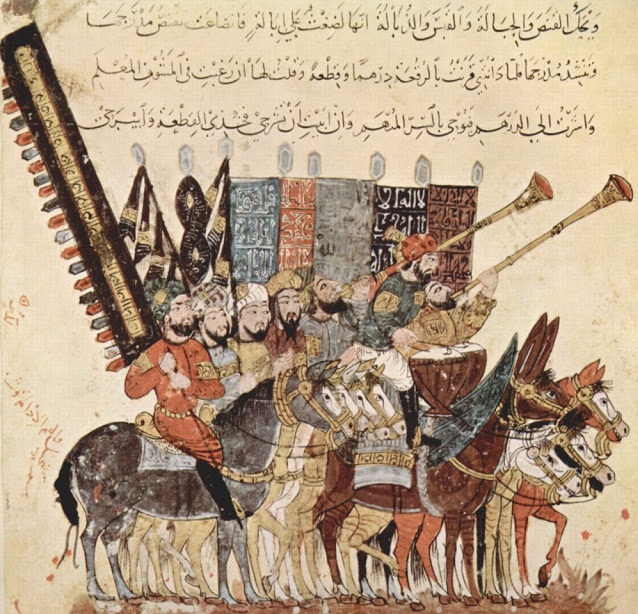
Tim Furnish also has a brief post on his MahdiWatch blog, pointing to his HNN piece — and I could only wish HNN permitted him to post illustrations, since the image of Abbasid “black banners” he posts at MahdiWatch is definitely of interest…
A stunning find!!
**
One other article appeared recently that I’d like to draw your attention to.
JM Berger, another friend of this blog, has an important extended piece on Chechnya-related radicalism in Boston over several decades, now up at Foreign Policy: Boston’s Jihadist Past.
Zenpundit is a blog dedicated to exploring the intersections of foreign policy, history, military theory, national security,strategic thinking, futurism, cognition and a number of other esoteric pursuits.