zenpundit.com » JM Berger

Archive for the ‘JM Berger’ Category

Net gains in Turkey and Iran?

Wednesday, July 20th, 2016

[ by Charles Cameron — when two data points contradict a trend, what’s up? ]
.

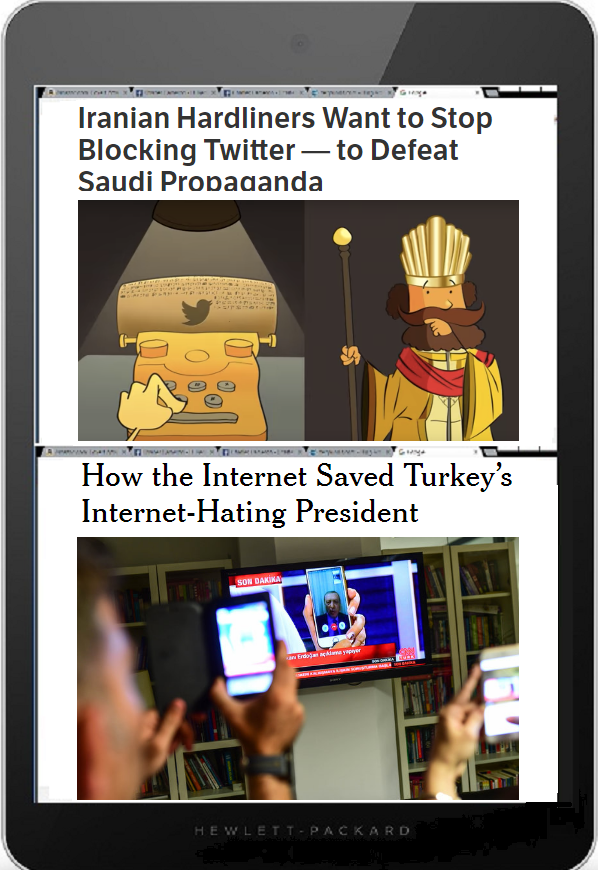
Gotta love the graphic of “Twitter being written into the ancient Persian Cyrus Cylinder in an animation film for Farsi Twitter, highlighting the platforms importance for communications in Iran” (upper panel, below):

Tablet DQ internet saved

— and there’s something faintly Escherian about the screengrab of Turkish President Erdogen in, what, a hall of screens? (lower panel, above).

I’ve said before that single data-points mean little, but two of them — outliers from a general trend — may consitute an eddy in the stream, a knot in the wood, a disturbance in the force worth noting, worth looking into.

Thus far, our interest in social media in the Middle East has largely focused on terrorist uses [eg Berger 1, 2] and counter-terrorism & CVE measures [eg Aistrope], with a sidelong glance at authorities blocking the net {eg Kerr]..

**

Here’s the video:

Sources:

  • Zeynep Tufekci / NYT, How the Internet Saved Turkey’s Internet-Hating President
  • Global Voices, Iranian Hardliners Want to Stop Blocking Twitter — to Defeat Saudi Propaganda
  • Food for thought:

    Note that knots in wood are generally indicative of a third-dimensional force, oblique to the wood’s surface plane. In considering any situation analogous to a knt in wood or eddy in a river, it’s worth asking: is there an oblique force at work disturbing the current, and if so, what is it, why here, and what does it portend?

    Should trees, parks, rivers, whales, corporations have standing?

    Thursday, July 14th, 2016

    [ by Charles Cameron — and what about straw men & sovereign citizens? ]
    .
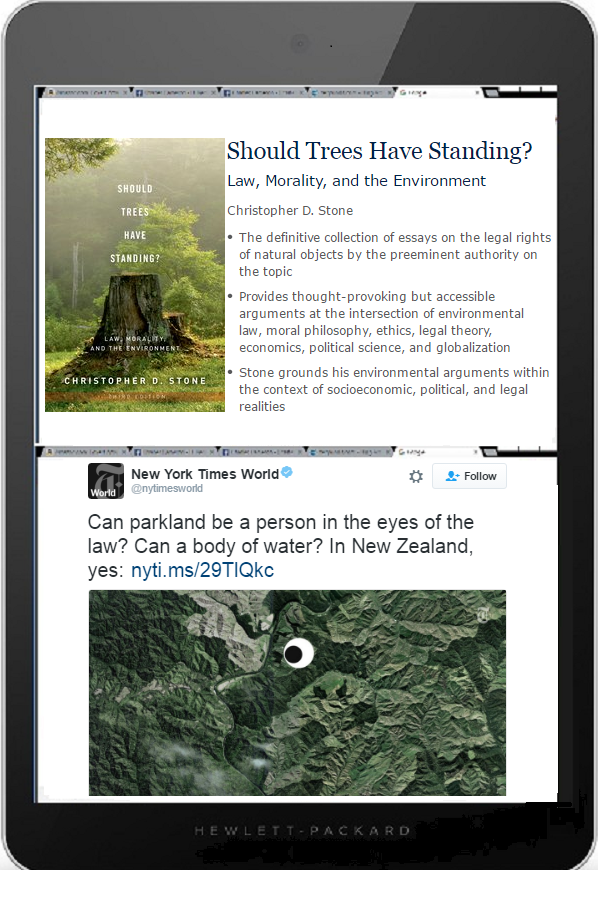
    Tablet DQ Trees standing

    **

    I have long appreciated Mr Justice Douglas‘ dissent in Sierra Club v. Morton, 405 U.S. 727 (1972), and Christopher Stone‘s comment on the same, Should Trees Have Standing? — presented along with other essays in Stone’s book of the same name [upper panel, above].

    That takes care of the trees in my title. Parks and rivers are covered by the New York Times piece today, In New Zealand, Lands and Rivers Can Be People (Legally Speaking).

    Whales and apes get added to our list, as you can see, in Brighter Green‘s Nature’s Rights: Rivers, Trees, Whales, and Apes — which mentions that under Ecuador’s constitution enshrining the legal rights of nature as a whole::

    Ecuador stepped to the forefront of the nature’s rights movement when it became the first country to include the rights of Mother Earth (Pachamama) in its constitution, which was ratified in 2008. The document states, “Nature or Pachamama, where life is reproduced and exists, has the right to exist, persist, maintain, and regenerate its vital cycles, structure, functions, and its processes in evolution.” Nature is a “rights-bearing entity that should be treated with parity under the law.” Citizens are given the power to sue on behalf of nature, now a legal entity

    **

    And corporations?

    The irony here, of course, is that those who would like to see Nature get a word in edgewise in the courts as a legal Person, tend to be unhappy with corporations having the same rights as chimpanzees. Eric Posner in Slate, Stop Fussing Over Personhood, catches the irony nicely:

    From a legal standpoint, there is nothing remarkable about a chimpanzee claiming to be a person. Indeed, there are a number of cases that have been brought by animals—including a palila, a marbled murrelet, and a spotted owl. All of these animals sought to enforce their rights under the Endangered Species Act, under a provision that gives “persons” the right to bring suit.

    In none of these cases was a judge fooled into thinking that an animal possesses all the rights of human beings. The lawyers bringing them were simply ensuring that a judicial remedy was available to address the harm that Congress sought to fix. If the spotted owl had also asked for the right to vote, the request would have been denied. A judge wouldn’t give a hoot that an earlier court had deemed the owl a “person” under the Endangered Species Act. A person for one legal purpose is not necessarily a person for another.

    The law also treats various nonhuman, nonsentient entities as “persons” for certain legal purposes. Corporations, estates, trusts, partnerships, and government entities are often defined this way. Walmart, Illinois, and the California Pension Fund can sue, for example, without anyone asking if they have a right to abortion.

    The classic case here is the famous and infamous Citizens United v. Federal Election Commission, No. 08-205, 558 U.S. 310 (2010).

    **

    I’d be remiss if I didn’t mention here also the curious notions of personhood invoked by members of the Sovereign Citizens movement. From JM Berger‘s recent report, Without Prejudice: What Sovereign Citizens Believe:

    Fictitious Person

    Because the UCC provides an interstate standard for things such as driver’s licenses, property ownership, and bank accounts, many sovereigns believe that these documents (and associated laws and financial obligations) do not apply to them, but instead to a fictitious person created by the illegitimate law, sometimes referred to as a “straw man.” Some believe a fictitious person is denoted in legal documents by listing his or her name in all capital letters. The fictitious person is a legal entity akin to a company with the same name as the citizen, sovereigns believe.

    Some sovereigns create their own driver’s licenses and license plates because they believe the state-issued documents are inauthentic, as they refer to the fictitious person, and that using or signing these documents exposes them to vulnerabilities under the illegitimate and tyrannical commercial laws, including debt collection, arrest, and prosecution.

    The correct use of certain phrases or legal citations can reduce or eliminate these vulnerabilities, however. For instance, some believe that documents used by the illegitimate system, such as contracts or court documents, can be signed safely if the citizen appends the phrase “Without Prejudice UCC 1-308” to the signature, which they believe preserves the sovereign citizen’s common law rights and privileges.

    **

    Let’s return to sanity.

    The final word in Sierra Club vs Morton is given to Mr Justice Douglas: in a footnote, he cites John Donne, poet — and thus according to Shelley, one of the “unacknowledged legislators of the world”:

    “No man is an Iland, intire of itselfe; every man is a peece of the Continent, a part of the maine; if a Clod bee washed away by the Sea, Europe is the lesse, as well as if a Promontorie were, as well as if a Mannor of thy friends or of thine owne were; any man’s death diminishes me, because I am involved in Mankinde; And therefore never send to know for whom the bell tolls; it tolls for thee.”

    Devotions XVII.

    And by way of comparison, here’s a Maori expression of the same sense of extended personhood, in context from the NYT article I cited above:

    A former national park has been granted personhood, and a river system is expected to receive the same soon.

    The unusual designations, something like the legal status that corporations possess, came out of agreements between New Zealand’s government and Maori groups. The two sides have argued for years over guardianship of the country’s natural features.

    Chris Finlayson, New Zealand’s attorney general, said the issue was resolved by taking the Maori mind-set into account. “In their worldview, ‘I am the river and the river is me,’” he said. “Their geographic region is part and parcel of who they are.”

    After IS, what next? — the missing (apocalyptic) strand

    Monday, May 23rd, 2016

    [ by Charles Cameron — four recent tweets, some lines of inquiry, & no certain conclusion, no date certain ]
    .

    The four recent tweets that set me off..

    **

    There are a multitude of voices now raising the question After ISIS< What Next? They can be heard from as far back as October 2014, onwards:

  • Al Arabiya English, What comes after ISIS’ defeat?
  • Foreign Policy, What Comes After the Islamic State Is Defeated?
  • Lexington Institute, What Do We Do The Day After ISIS Is Defeated?
  • The National Interest, We Defeat ISIS. Then What?
  • The Telegraph, What happens once Isil is defeated?
  • Wilson Center, Iraq: Now and After ISIS
  • The [Huffington] World Post, The Middle East after ISIS
  • and most recently:

  • The Atlantic, The Hell After ISIS
  • If IS continues losing territory, as suggested in the tweets above, this question can only gain in force.

    **

    I have been following Islamic eschatology since 1998 or thereabouts, when I met David Cook, and I thought that what was at that time an eerily unappreciated question had at last made its way into informed consciousness after..

  • 2002, David Cook, Studies in Muslim Apocalyptic
  • 2005, David Cook, Contemporary Muslim Apocalyptic Literature
  • 2011, J-P Filiu, Apocalypse in Islam
  • 2014, Martin Dempsey, speech: IS has “an apocalyptic, end-of-days strategic vision”
  • 2015, Jessica Stern & JM Berger, ISIS: The State of Terror
  • 2015, Graeme Wood, What ISIS Really Wants
  • 2015, Will McCants, The ISIS Apocalypse
  • But no, the question I’m interested in has not been raised:

    Is there a more potent form of apocalyptic movement than the two we have most recently seen?

  • a Mahdist movement, one focused on the army with black flags from Khorasan — AQ
  • a Caliphal movement, one focused on the establishment of the rightly-guided kingdom — IS
  • **

    Four hints:

    It seems to me that you can have a Caliphal (kingdom based), or a Mahdist (leader based) movement, and that the Caliphal approach, should IS be a clear failure as a global quasi-state, will be exhausted for quite some time — and that since AQ, to the extent that it is or was an apocalyptic movement, was one that looked to a future Mahdi, the only route “up” from either one would be the declaration of an actual Mahdi-claimant with armed insurrection to follow.

  • The worst messianic movement, in terms of fatalities, would still be China’s 19th Century Taiping Rebellion, 20-30 million dead. Strangely enough, Gordon of Khartoum was involved.
  • The most recent and widely notable Mahdist rebellion was the Sudanese one that killed Gordon, led initially by Muhammad Ahmad al-Mahdi.

  • The next highly plausible date for the appearance of a Mahdi would be at the start of the next Islamic century, 1500 AH / 2076 BCE, since ahadith suggest a Mujaddid or Reformer will be sent every 100 years, and there have been assertions that the Ummah will not endure longer than 1,500 years (see here eg)
  • My guess is that we’ll have a cooling-off period in terms of Islamic apocalyptic if IS is seen to fail — but as they say, mortal mind cannot know the time of the end, and Allah knows best.

    Aymen al-Zawahiri, al-Sham and ISIS as Khawarij

    Friday, May 20th, 2016

    [ by Charles Cameron — a highest-intensity insult in the jihad among jihadists ]
    .

    A significant article is announced:

    Both Will McCants and Cole Bunzel have recommended this article, so you may already have seen it.

    **

    Okay, I understand that there are various viewpoints, and hence various different people will make different choices as to which is the key paragraph here. For many, it will be Zawahiri‘s focus on al-Sham.

    Indeed, Zawahiri’s new geographic focus happens to align itself with what Abu Musab al-Suri proposed in his Global Islamic Resistance Call — published, perhaps a tad presciently, more than a decade ago in 2004/5 — that (in J-P Filiu‘s phrase, Apocalypse in Islam, p. 189):

    It is self-evident to him that the “country of Sham” — Greater Syria, including Lebanon, Palestine, and Jordan — looms as the apocalyptic theater par excellence, and that al-Qaida’s strategic conception of global jihad must be reoriented to take into account this final clash.

    **

    From my own POV, as someone whose interest is in movements in religious thought, this is the key paragraph:

    Zawahri did deliver at least one message aimed at the jihadist base, affirming that the IS’s members are “Khawarij,” a historical Muslim sect of hyper-extremist deviants. Labeling the Islamic State group as such has been controversial within Salafi-jihadism — theorist Abu Muhammad al-Maqdisi has resisted it — in part because it requires jihadists to act on the Prophet Muhammad’s prescription for dealing with the Khawarij: “qatl Ad,” or total extermination. Zawahri has now come down firmly on one side of this intra-jihadist debate.

    On which topic, see also my November 2015 post here on Zenpundit: Is the Islamic State Islamic? The Yes and No of the matter, and this, from JM Berger in 2014:

    On militarizing the concept of Thought Police

    Wednesday, April 20th, 2016

    [ by Charles Cameron — a renewed emphasis on the war of ideas? ]
    .

    A cluster of items from JM Berger‘s twitter feed this morning gave me pause for thought — but I was careful not to think anyway.

    Here’s the basic concept:

    The most overt example:

    Independent corroboration:

    Connecting the dots:

    And for the Illustrated Executive Brief:


    Switch to our mobile site
