Archive for the ‘russia’ Category
Armageddon: if you can’t hasten it, maybe you can dodge it?
Wednesday, September 30th, 2015[ by Charles Cameron — plus a date-setting video, awaiting The End in 2031! ]
.
Armageddon. Even if you can’t hotwire it..
you may still be able to dodge it..
**
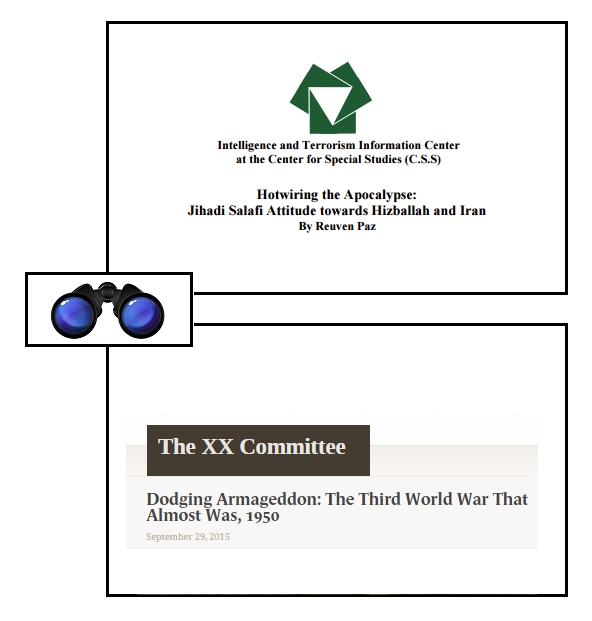
From the late Israeli analyst, Reuven Paz:
Jihadi apocalyptic discourse, either by Jihadi-Salafi scholars, clerics, or supporters of global Jihad is one of the main innovations of the Jihadi-Salafi discourse that followed the September 11 attacks. Waves of what may be termed apocalyptic discourse are not new in the modern Arab Islamic world. They accompanied almost every major war or disaster that occurred in the Arab World in modern times. Such major events were the collapse of the Ottoman Empire and the last Muslim Caliphate in 1922-24; The 1948 war with Israel — the “catastrophe” (Nakbah) in Arab and Palestinian eyes — which resulted in the establishment of the State of Israel; The 1967 war — the calamity (Naksah) in Arab and Muslim eyes — which resulted in Israeli occupation all over Palestine, Jerusalem, and Al-Aqsa mosque, and marked a humiliating Arab defeat; and the first Gulf war in 1991, following the Iraqi occupation of Kuwait, which marked the first round of America’s massive military involvement in the Middle East. These wars, and some additional minor events such as the “Triple aggression” in the Suez canal in October 1956; “Black September” and the sudden death of the most admired Egyptian President Gamal Abd al-Nasser in September 1970, The Islamic revolution in Iran in February 1979; The Israeli-Egyptian peace// agreement the same time; The Iran-Iraq war between 1980-88, or the Soviet collapse in 1990-91, created waves of apocalyptic discourse.
From John Schindler:
Fifteen years ago I authored a piece for Cryptologic Quarterly, the National Security Agency’s in-house classified journal, about how close the world actually came to World War III in the early 1950s. Although this was little understood at the time, the North Korean invasion of South Korea in June 1950 was a dry-run for the Kremlin, which was obsessed with silencing Tito’s renegade Communist regime in Yugoslavia. Had the United States not strongly resisted Pyongyang’s aggression, a Soviet bloc invasion of Yugoslavia would have followed soon after.
Of course, President Harry Truman did send U.S. forces to defend South Korea in the summer 1950, resulting in a conflict that has never formally ended. More importantly, he saved the world from nuclear Armageddon, as my CQ piece laid out in detail. Lacking much Western conventional defenses in Europe, any Soviet move on Yugoslavia would have resulted in rapid nuclear release by a hard-pressed NATO. I cited numerous still-secret files and as a result my article was classified TOPSECRET//SCI.
However, NSA has seen fit to declassify and release my article, minus some redactions, and even post it on the Agency’s open website. They have omitted my name, perhaps out of fear UDBA assassins will track me down decades after Tito’s death, but I’ll take my chances.
You can read the article here — enjoy!
Sources:
Reuven Paz, Hotwiring the Apocalypse: Jihadi Salafi Attitude towards Hizballah and Iran John Schindler, Dodging Armageddon: The Third World War That Almost Was, 1950
**
None of which precludes date-setting — something that both Christian and Islamic scriptures suggest is futile.
I can’t embed MI7 Agency‘s Passage Through the Veil of Time, but it’s an intriguing entry into the prediction stakes, and the first I’ve seen that confirms Richard Landes‘ contention that Christian millennial movements will be with us at least until the second millennial anniversary of the death and resurrection of Christ in the 2030s — and no doubt through the start of the next Islamic century in 2076 AD since, as Tim Furnish has also reminded us, “Mahdist expectations increase at the turn of every Islamic century.”
The Freikorps Revival
Monday, September 14th, 2015[by Mark Safranski, a.k.a. “zen”]

One of the signs that the Westphalian state system was approaching its zenith was the gradual extinction of legal private warfare in Europe (and in America , east of the frontier). While this trend predated the French Revolution with divine right absolutism monarchs taxing and regulating their nobles once formidable feudal armies into harmless personal bodyguards and ceremonial companies, it was enforced in earnest after the Napoleonic wars by now bureaucratic nation-states. To the sovereign power of the state jealously guarding its monopoly on the legal use of force, in the late 19th century were added the weight of international law.
While once it was commonplace for heavily armed “Free Companies” to roam Europe’s battlefields, hiring themselves out or pillaging on their own, neither the Lieber Code nor the Hague Convention took an indulgent view of the professional mercenary or the provincial partisan, proscribing their historic role in warfare and condemning them along with spies and saboteurs to death. By the time of the First World War with the exception of Tsarist Russia, which still had vestiges of pre-modern feudalism in their Cossack hosts that supplemented the Russian Army, all of the great and middle powers entered WWI with national armies based upon mass conscription, run by a professional officer corps. Even America saw its long established military tradition of locally raised volunteer units of the States abolished by President Wilson, who instituted a draft. Wilson it seems, feared the political effects of an aging Teddy Roosevelt leading a new band of Rough Riders on the Western Front.
This situation shifted dramatically in the aftermath of the Great War. Communist revolution and civil war in Russia, Hungary and Bavaria spawned a rebirth of private militarism; right-wing and nationalist “white” paramilitaries composed of ex-soldiers battled anarchist and Bolshevik “Red guards” made up of factory workers and party militants. In defeated Germany, a vigorous and heavily armed “Freikorps” movement of embittered veterans led by charismatic officers arose and fought engagements in the Baltic states, in Polish and Czech borderlands, in the Ruhr and in Bavaria, where they crushed a short-lived Soviet republic.
Partially suppressed by the weak Weimar state, partially covertly subsidized and organized by the leadership of the German Army which saw the Friekorps as a “Black Reichswehr” strategic reserve against French attack, the Freikorps degenerated, pillaged, mutated into terrorist organizations and gradually merged with and militarized Germany’s extreme nationalist and volkisch (racialist) political factions, including the nascent National Socialist German Workers Party. Ex-Freikorps fighters became the backbone of the Nazi SA and nationalist Stahlhelm armies of brawlers, thugs and hooligans. They even had their own newspapers, sports clubs, artists and writers, among whom Ernst Junger was a favorite of that generation.
The reason for this long historical prologue is that it is happening again. The fascinating article below from VICE gives evidence of what should be called a Freikorps Revival. Note the connection to the French Foreign Legion veterans with the Azov Regiment; the Legion once welcomed almost as many German Freikorps men as did the Nazi Party.
Meet the European Fighters Who Have Gone to War in Ukraine
….”I spent all day with a pistol in one hand and a grenade in the other, wondering how I was going to kill myself and how many [separatists] I could take with me,” said Chris “Swampy” Garrett, a British citizen and a member of the squad of Europeans fighting in Eastern Ukraine for Azov Regiment.
Garrett had just returned to Kiev after a failed mission behind enemy lines in the small village of Shyrokyne. His team had been surrounded and cut off from Ukrainian positions before the men fled. He spent over 14 hours trapped behind an enemy advance, fighting in close quarters and taking shelter from friendly artillery fire, before sneaking out of the village under the cover of darkness.
For Garrett, who has served in the British army and done humanitarian de-mining work in the Karen State on the Thai/Myanmar border, the decision to join the Azov Battalion was a simple one: “One day they posted up on the [Azov Battalion] Facebook site, asking, ‘We need people who have any kind of knowledge with first aid, volunteering, with basic military skills, de-mining, anything. If you have any skills at all, to any level, can you come and help?’ So I kind of saw that as my route in, even if I didn’t stay with the [Azov] Battalion. [It was] my surest way to get into the country—get into the east and then be able to see the bigger picture from there.”
….Garrett is not the only member of the group of European soldiers who came to defend Ukrainian sovereignty. But while some came to protect Ukraine, others here came to fight for conservative and nationalist politics in Ukraine’s relatively open political space. For Harley, a 42-year-old from France who served in the French navy and later in the private security industry, involvement was two-sided: he came “to help Ukraine against Russia” and wears a “Fuck U Putin” bracelet on his wrist, but joined Azov because its politics were similar to his own: “Azov,” he said, propagated a political agenda that “was closer to my idea.”
Azov’s politics have drawn fire for being far-right to the point of neo-Nazism; “If you want to find Nazis, [Azov] is the place to come,” one soldier told me on the way to the frontline. And yet, the political reality of Azov is much more complicated than that. One soldier in the European group told me he estimates that around 20 percent of the battalion could be considered neo-Nazis, while David Eriksson—a 48-year-old Swede who owns real estate and marketing businesses—said: “I think almost 100 percent of foreigners—it used to be maybe 90 percent of foreigners—are not Nazis. They are here to fight.”
Read the rest here.
This may be a meta-trend. Everywhere, rootless young (and some not so young) men are turning their backs on civilized existence and seeking out answers to life or a quick death in lawless conflict zones. Third generation European Muslims who leave families and communities to join ISIS in Syria while American and Dutch motorcycle gang members show up to fight with the Kurdish Peshmerga. Russian outlaw bikers by contrast are Putin’s Cossacks in the Crimea and Donbass while in Pakistan the ISI has made funneling angry young men into terrorist groups and militias something of a cottage industry
Some of these men will never return, but most will. If the lessons of history are to be reckoned, this bodes poorly for the future. They will bring a Darwinian outlook and a politics of the gun.
Book notification: Terror in the Name of God, Simma Holt version
Monday, September 7th, 2015[ by Charles Cameron — two books of the same name ]
.
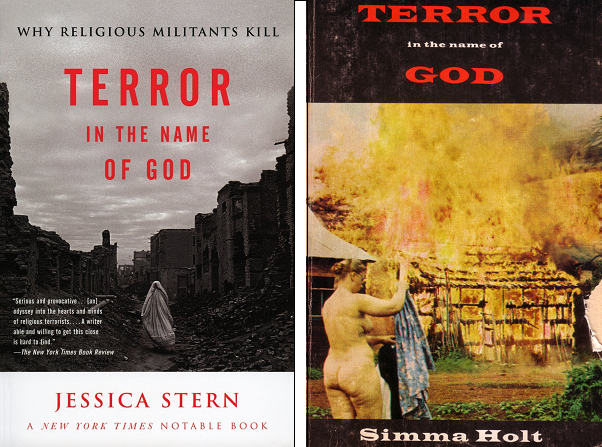
I have long been an admirer of Jessica Stern‘s Terror in the Name of God, which benefits greatly from the author’s intrepid insistence on visiting and debriefing those religious militants from around the world she wishes us to understand. Imagine my surprise, therefore, at discovering yesterday a book with the same title, written by one Simma Holt, published in 1964, and dealing with religious violence as practiced by the Svobodniki or Sons of Freedom sub-group of the Doukhobors or Old Believers:
**
I haven’t been on a thrift-store book run in a couple of years, and yesterday’s jaunt with son Emlyn rewarded me with three or four items, of which this was the standout — albeit my copy lacks the lurid dust-jacket.
The Old Believers have interested me for some time now, but I haven’t known much about them. Apparently their split (“Raskol”) from the larger body of Russian Orthodoxy was in opposition to reforms intended to align the Russian with other Orthodox patriarchies in terms of practice — the one change I’d run across having to do with the substitution of the sign of the cross made with two fingers by the sign made with three fingers.
I am accordingly very interested to see what more I can learn about the Old Believers in general and in particular the Svobodniki, their doctrine of “Opposite Speak” and their theological sanctions for arson and murder.
Now too, I get to explore Aylmer Maude‘s 1904 book on the Doukhabors, A Peculiar People. That phrase — more fully, “ye are a chosen generation, a royal priesthood, an holy nation, a peculiar people” (I Peter 2.9) — has always pleased me, and Maude’s Christian name, a relatively uncommon one I believe, is my own second name, and the name of one of my uncles.
O quiet joy.
Lapido: Putin, Russia’s second Prince Vladimir
Wednesday, August 26th, 2015[ by Charles Cameron — my piece contains some choice quotes from John Schindler to give perspective ]
.
Here’s a teaser from my latest post at LapidoMedia:
St Vlad
There’s a small Russian Orthodox sect that, as Time magazine reported in 2011, considers Russian President Vladimir Putin a Saint.
It’s an all-female sect, it’s called The Chapel of Russia’s Resurrection, and its members venerate Putin as a sort of second coming of the Apostle Paul.
The group’s founder, Mother Fotina, explains:
‘According to the Bible, Paul the Apostle was a military commander at first and an evil persecutor of Christians before he started spreading the Christian gospel. In his days in the KGB, Putin also did some rather unrighteous things. But once he became president, he was imbued with the Holy Spirit, and just like the apostle, he started wisely leading his flock. It is hard for him now but he is fulfilling his heroic deed as an apostle.’
The focus, then, is not so much on Vladimir Putin as on Russian nationalism. And while the sect itself is small and obscure, the concept of Putin symbolizing Russian nationalism of a specifically spiritual sort is a potent one in Putin’s own projected image
But perhaps you should read the whole thing…