Veteran’s Day
Tuesday, November 11th, 2008


Briefly, here is a juxtaposition of posts worth looking at that portray war through the lens of the social scientist:
Rethinking Security – The Study of War as A Social Science
…Rather, it would be better to re-concieve the study of strategic affairs as a multi-disciplinary social science major combining sociology, international relations, philosophy, political science, cognitive science, economics, history, and “pure” military theory. This would be intellectually rigorous enough to banish forever the stereotype of the armchair general and the wargamer.
I see learning about strategy in itself as the key aim of such a curriculum–the goal would be to produce a student able to either apply his or her learnings in a think-tank or government, join the armed forces, come up with reasonable anti-war critiques as an activist, resolve conflict as a humanitarian, or apply strategy in the corporate world.
War as a social science akin to sociology or economics would bring empirical and quantitative rigor into the study of military history and affairs on the undergraduate level as well as a focus on the mechanics of war (tactics, operational art, strategy, and grand strategy) rarely seen outside of a Professional Military Education (PME).
SWJ Blog – The Genetic Roots of the War on Terrorism
….In the article, titled “A Natural History of Peace,” Stanford Professor Robert M. Sapolsky compares and contrasts human aggressive tendencies with well-documented propensities for violence among several species of primates, and develops a case suggesting that human aggression of the kind that produces warfare mainly stems from the genetic impulses rooted in humans as primates (not a new suggestion of itself). But more significantly, he offers proof extracted from a now robust body of field work that even strong genetic tendencies for violence in certain species of primates can be mitigated by exposure to the equivalent of “cultural” forces. He singles out from the body of such observations the case history of one group of baboons (a particularly aggressive and violent species of primate) that he calls the Forest Troop, the intensely aggressive behavior of which was ameliorated after exposure to the more peaceful and tolerant “mores” of another baboon troop of an identical species with which the Forest Troop had come in contact. He concludes by asserting that “some primate species can make peace despite violent traits that seem built into their natures.” He goes on to muse, “The challenge now is to figure out under what conditions that can happen, and whether humans can manage the trick themselves.”
Sapolsky’s argument frames the issues associated with the current global conflict in which the United States is now engaged in a potentially very useful light: as a biological problem best understood and dealt with using means specifically tailored to deal with human genetic tendencies in order to promote cooperation and tolerance instead of competitive violence. This stands in contrast to the current approach which appears to assume that the conflict mainly results from a combination of cultural and economic factors that can be dealt with by a strategy that combines selected violence, targeted monetary investments mixed, and cross cultural messages through so called strategic communications.
The Social Sciences are a powerful but fractionating, reifying lens. Individually, they unearth certain aspects of large and highly complex phenomena albeit at the cost, at times, of distorting the proportional importance to the whole of the aspect that the social scientist chooses to study. The sociobiological perspective is a radical and controversial one but it is a position that is far more open to empirical investgation in a scientific sense than are many traditional components of strategic theorizing. At Rethinking Security, Adam wisely tries to balance the heavy load of quantitative methods in his proposed program with at least a few qualitative disciplines; input from military practitioners and security experts would also be helpful to the prospective student in this regard as well.
Here’s an array of interesting topics:
Top Billing! Haft of the Spear – In the Age of Obama
A project in which I am very pleased to have a small part.
SWJ Blog – Mexico’s Criminal Insurgency ( originally at DNI)
Global Guerillas – THE STAGE FOR THE 21ST CENTURY’S EPOCHAL CONFLICT
Abu Muqawama (Londonstani) – Extremism and theology – Saudi style and Extremism and theology
Michael Porter – Businessweek – Why America Needs an Economic Strategy ( Hat tip to Richard Florida)
Election Opinions from: Wizards of Oz , Duck of Minerva, DNI, Sic Semper Tyrannis, Soob, Mapping Strategy, Complexity and Social networks Blog
Open the Future – 80 Hours in the Air-Conditioned Nation
That’s it!
Working hard on a modest writing assignment for a national security anthology type book. I’m not sure about the rest of you but I find that the kind of shorthand thinking involved in blogging “conversations”, while very stimulating at it’s best, can interfere with the reflection needed to craft more polished and professional prose – a struggle for me in any event. A certain amount of gestation and revision, more focus on developing the concept, is required for that level of writing instead of trying to casually brainstorm ideas, observations, criticisms and questions ( not to mention better sentence structure than you will normally see here).
As a result, I stepped back from blogging the past few days until I have finished the rough. I’ll put up a recommended reading post on Sunday but blogging may be light until I finish. Not sure when.
As an aside, I will strongly recommend ( again) Garr Reynold’s Presentation Zen: Simple Ideas on Presentation Design and Delivery (Voices That Matter)
A case in point, for those who are not longtime readers, I teach history and periodically give presentations on teaching methodology and curriculum to adults. Normally, I’m a fair public speaker and receive favorable feedback but I’ve done two new presentations recently, both using Reynold’s methods and Sliderocket to deliver the content, once to students and once to an audience of professionals. No comparison. The effect was stunning in each instance. It was akin to having five year’s progress crammed into a month.
Zenpundit has a large number of .gov, .mil and .edu readers for whom slideware is de riguer. Sliderocket, a web application ( you can download a copy though to your laptop for a back-up) deserves generous kudos in it’s own right; my only criticism is that the Sliderocket folks need to have an embed code function for those of us who need to, from time to time, put the slideshows up in a blog or wiki.
If you are still on powerpoint instead of Sliderocket, then you are driving a Model T.
Design guru David Armano had a graphic up that was intriguing from a psychological point of view:
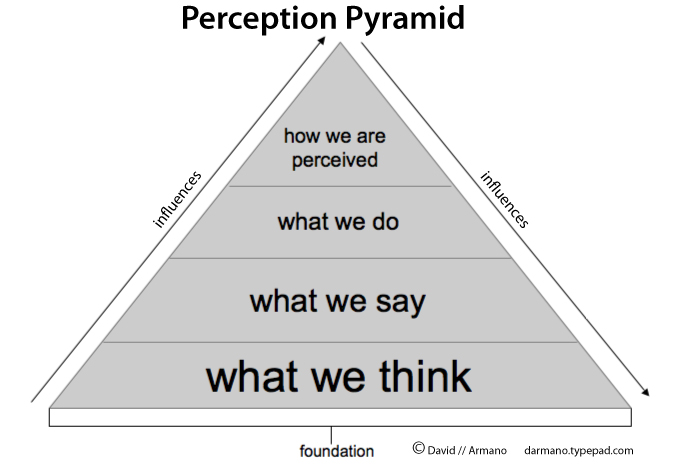
My instant impression on seeing Armano’s visual was a reminder from Western philosophy and Eastern religion:
“We are what we frequently do” – Aristotle
“What we think, we become” – Buddha
The second impression from the graphic was it’s simultaneous representation as both a feedback loop and a hierarchy. As a hierarchy, I’m not certain I would put “what we say” as a more fundamental tier than “what we do” as Armano did. Actions would appear to be less subjective as events occuring in time and space than words but words moreso than the perceptions of others which we can neither control nor reliably audit, yet they very much influence us, as Armano suggests.
Compare the flow of information/action in Armano’s pyramidical graphic with John Boyd’s OODA Loop:
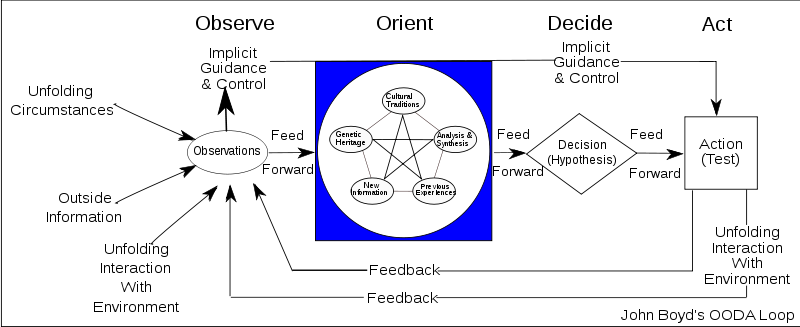
Boyd’s conception is not hierarchical or sequential, though many people view OODA as a deliberative step by step process, running through it in such a manner instead would slow the cycle considerably. Armano’s consideration of the perceptions of others would be important to Boyd as “outside information” and “unfolding interaction with environment”. It would address the mental and moral levels of conflict and competition:
It would also measure our ability to attract support from or positively influence third parties or allies.
Interested in any thoughts the readership might have on the comparison or from any of my numerous co-authors….

Zenpundit is a blog dedicated to exploring the intersections of foreign policy, history, military theory, national security,strategic thinking, futurism, cognition and a number of other esoteric pursuits.
Customized Web Site & Blog Design

